
If you play Texas Hold'em, you do not need a giant probability table for its own sake. You need the numbers that change decisions:
- how often you are dealt a pocket pair
- how often pocket aces appear
- how often you flop a set
- how often you flop two pair
- how often you flop a flush draw
- how often your draw gets there by the river
These are the poker odds players really search for. They matter because they keep you from guessing. A pocket pair is not just "a decent hand". It is a hand that sometimes turns into a set. A flush draw is not "almost made". It still misses more often than it hits.
Start with the deck
Texas Hold'em uses 52 cards. Your two hole cards are dealt from that deck, and the flop comes from the remaining cards.
That is why poker probabilities are useful. Once you count combinations correctly, the game becomes less emotional and more measurable.
How often are you dealt a pocket pair?
A pocket pair means both hole cards have the same rank, like 8-8 or K-K.
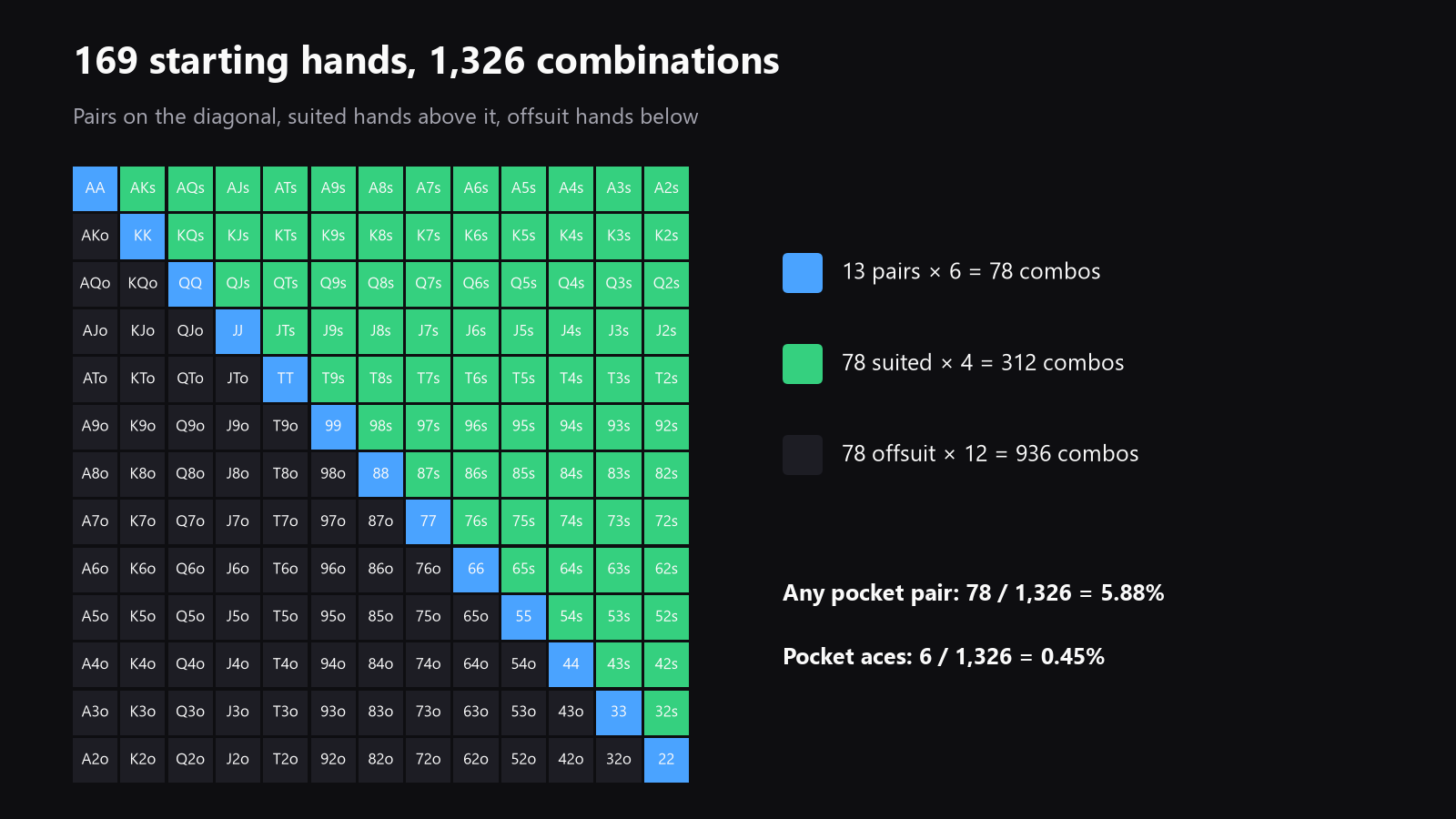
There are 13 ranks, and each rank has 6 possible two-card combinations. So there are:
- 78 pocket-pair combinations
- 1,326 possible starting hands overall
That means the chance of being dealt any pocket pair is:
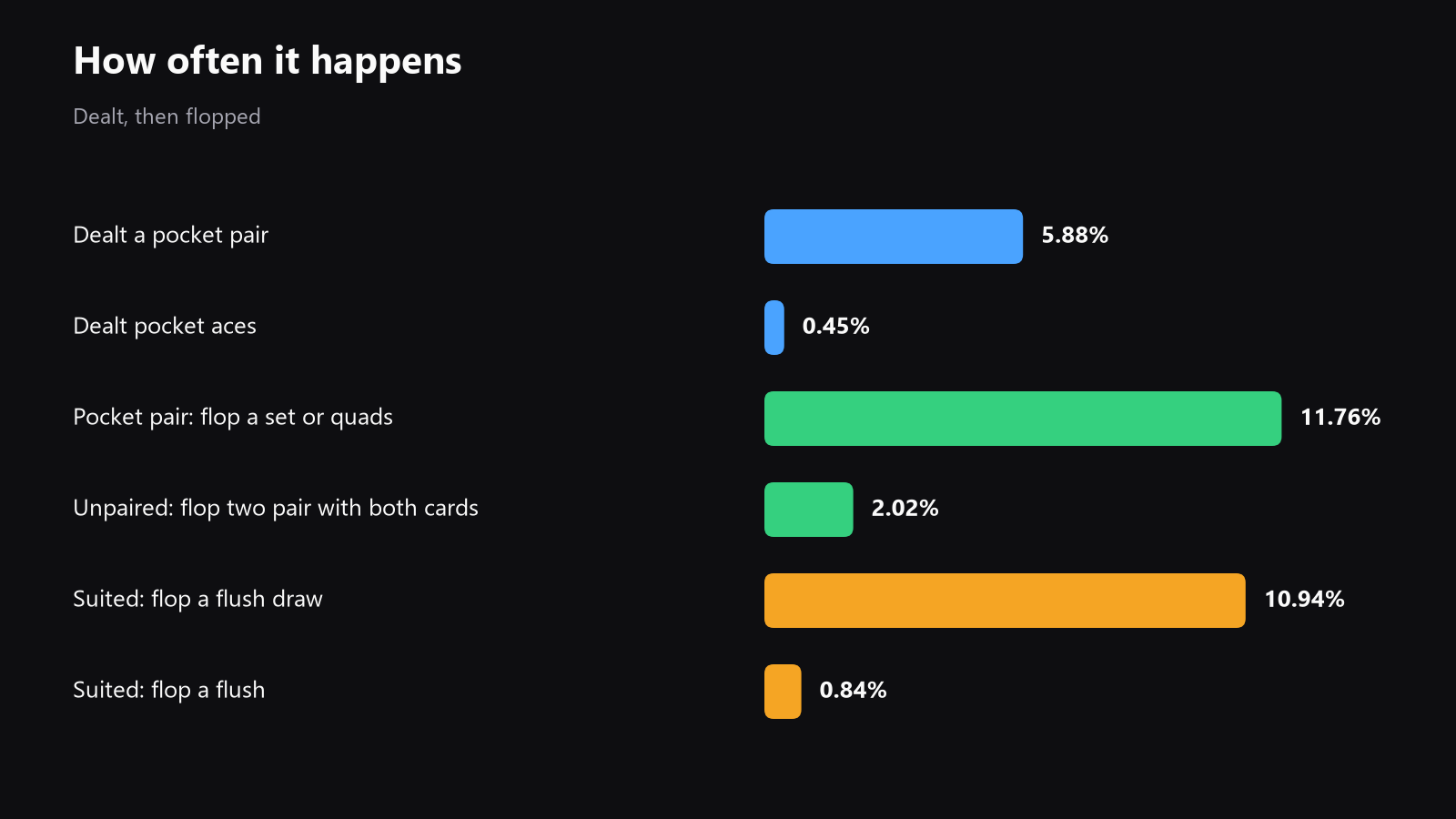
78 / 1,326 = 5.88%
So you get a pocket pair about 1 time in 17 hands.
How often are you dealt pocket aces?
Pocket aces are one specific pair, and there are only 6 combinations of A-A.
So the chance of being dealt pocket aces is:
6 / 1,326 = 0.45%
That is about 1 time in 221 hands.
If you play a long session and never see aces, that is still normal. The hand is rare.
How often do you flop a set with a pocket pair?
If you start with a pocket pair, flopping a set means one of the three flop cards matches your rank.
There are 2 remaining cards of that rank in the deck, and 3 flop cards are dealt from the 50 unseen cards.
The exact chance of flopping a set or quads is:
11.76%
That is about 1 time in 8.5 flops.
Set or quads?
This 11.76% includes quads, but quads are very rare compared with sets. In practice, when players say "I flopped a set", this is the number they mean.
The important lesson is strategic:
- you miss the flop most of the time
- when you hit a set, your hand often becomes very valuable
- that is why small pocket pairs can be profitable in the right spots
This is the logic behind set mining. You are not paying to hit often. You are paying to hit rarely and win enough when you do.
How often do you flop two pair?
This one depends on your starting hand.
With two unpaired hole cards
If your two hole cards are unpaired, like A-K or 9-7, the chance of flopping exactly two pair using both hole cards is about:
2.02%
That is about 1 time in 49.5 flops.
Example:
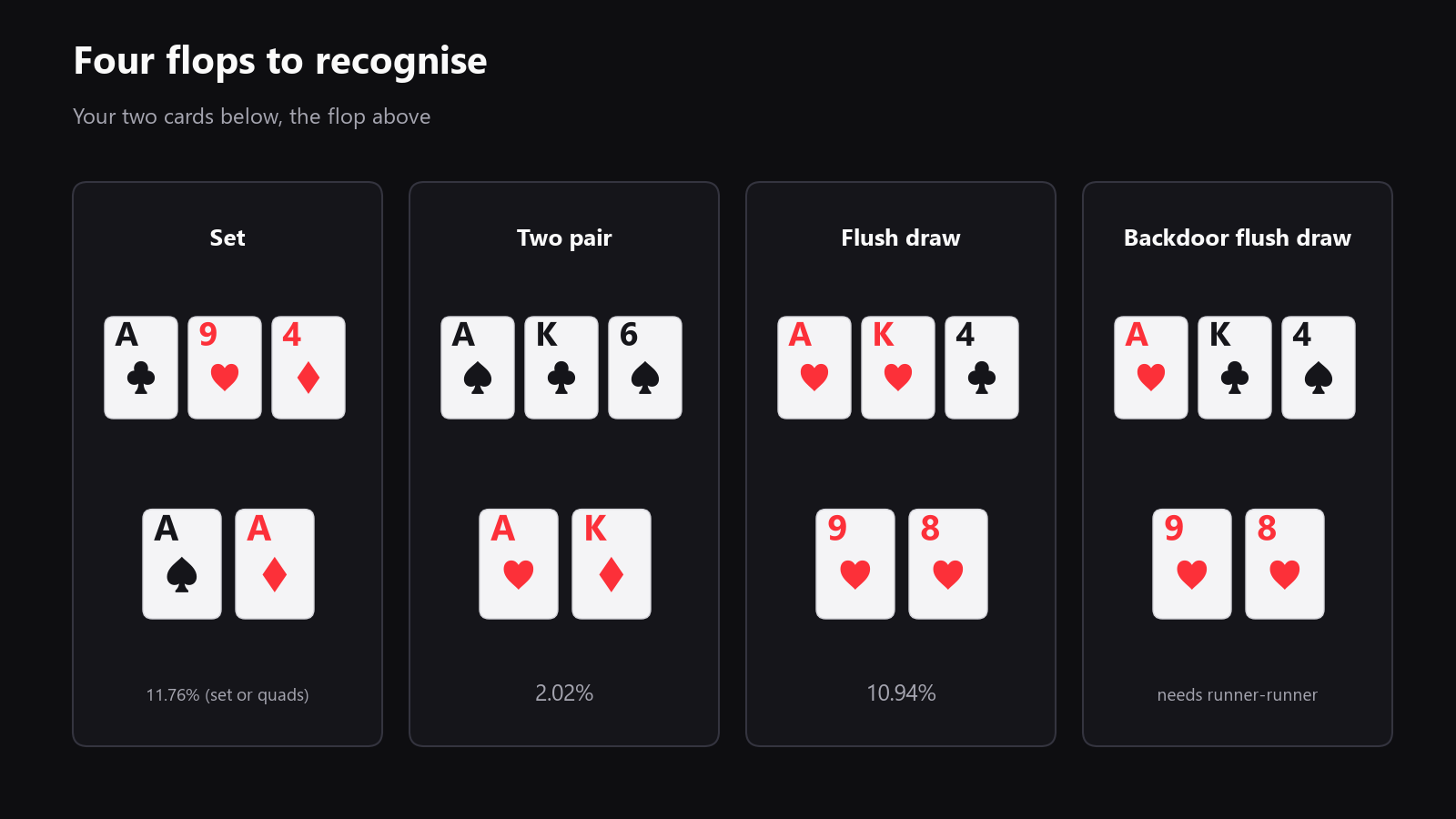
- you hold A-K
- the flop comes A-K-x
That is two pair.
It happens less often than people feel it does, because big results are easier to remember than misses.
Why this matters
Two pair is strong on the flop, but it is not invincible. Knowing that it appears only about 2.0% of the time with two unpaired hole cards helps you stop assuming that people are "always hitting".
They are not. Most flops miss most ranges.
How often do you flop a flush draw?
This is one place where wording matters.
If by flush draw you mean a front-door flush draw, meaning you have four cards to a flush on the flop, then with two suited hole cards the chance is:
10.94%
That is about 1 time in 9.1 flops.
A common confusion is the difference between a flush draw and a backdoor flush draw:
- front-door flush draw: four cards to a flush on the flop, one card away
- backdoor flush draw: only three cards to a flush on the flop, needing runner-runner to complete
With two suited hole cards, you will see a backdoor flush draw much more often than a true front-door flush draw.
The chance of flopping a made flush with two suited hole cards is:
0.84%
That is about 1 time in 119 flops.
How often does a draw complete by the river?
This is where many players think too loosely. They know they have outs, but they do not turn outs into probability.
The rule of 2 and 4
A quick estimate is:
- multiply your outs by 4 on the flop, to estimate your chance by the river
- multiply your outs by 2 on the turn, to estimate your chance on the river
It is an approximation, but it works well at the table.
Exact river completion numbers
Here are the common draws:
| Draw type | Outs | Chance by river from flop | Chance on river from turn |
|---|---|---|---|
| Gutshot | 4 | 16.5% | 8.7% |
| Open-ended straight draw | 8 | 31.5% | 17.4% |
| Flush draw | 9 | 35.0% | 19.6% |
A flush draw does not complete half the time. It completes about 35% of the time by the river from the flop.
That is a huge difference.
Why this matters in real hands
Suppose you face a bet with a draw.
You need more than "I have outs". You need to know:
- how often you actually improve
- what you are paying to continue
- what happens when you miss
- what happens when you hit
If you do not know the odds, you will call too much with weak draws and fold too much with good ones.
The most useful poker odds chart, in plain language
Here is the cheat sheet version.
Preflop
- Any pocket pair: 5.88%
- Pocket aces: 0.45%
Flop
- Set or quads with a pocket pair: 11.76%
- Two pair with two unpaired hole cards: 2.02%
- Front-door flush draw with two suited hole cards: 10.94%
- Made flush with two suited hole cards: 0.84%
By the river
- Gutshot completes: 16.5%
- Open-ended straight draw completes: 31.5%
- Flush draw completes: 35.0%
If you remember only one thing, remember this: draws miss more often than they hit.
That single idea saves money.
What these probabilities change in your strategy
Knowing the numbers is not about sounding smart. It changes your decisions.
1. You stop overvaluing weak made hands
If a pocket pair flops a set only about 1 time in 8.5, you stop pretending the pair itself is already strong just because it is a pair.
An overpair is strong. A middle pocket pair on a dangerous board is not automatically strong.
2. You set mine for the right reason
A small pocket pair is not a hand you keep barreling with every time. Its value comes from the rare flop where it becomes a hand that can win a big pot.
That means you need enough stack depth, and you need opponents who will pay you when you hit.
3. You do not chase every draw
A flush draw looks nice, but it still misses most of the time.
If you call because "you have a draw", you are only halfway done. You also need to know:
- the pot odds
- the implied odds
- the fold equity
- the opponent's tendencies
4. You understand why ranges matter
The same draw is worth more against one range than another.
A flush draw against one pair can be strong. The same draw against a higher flush draw, or against a made flush, is a different story.
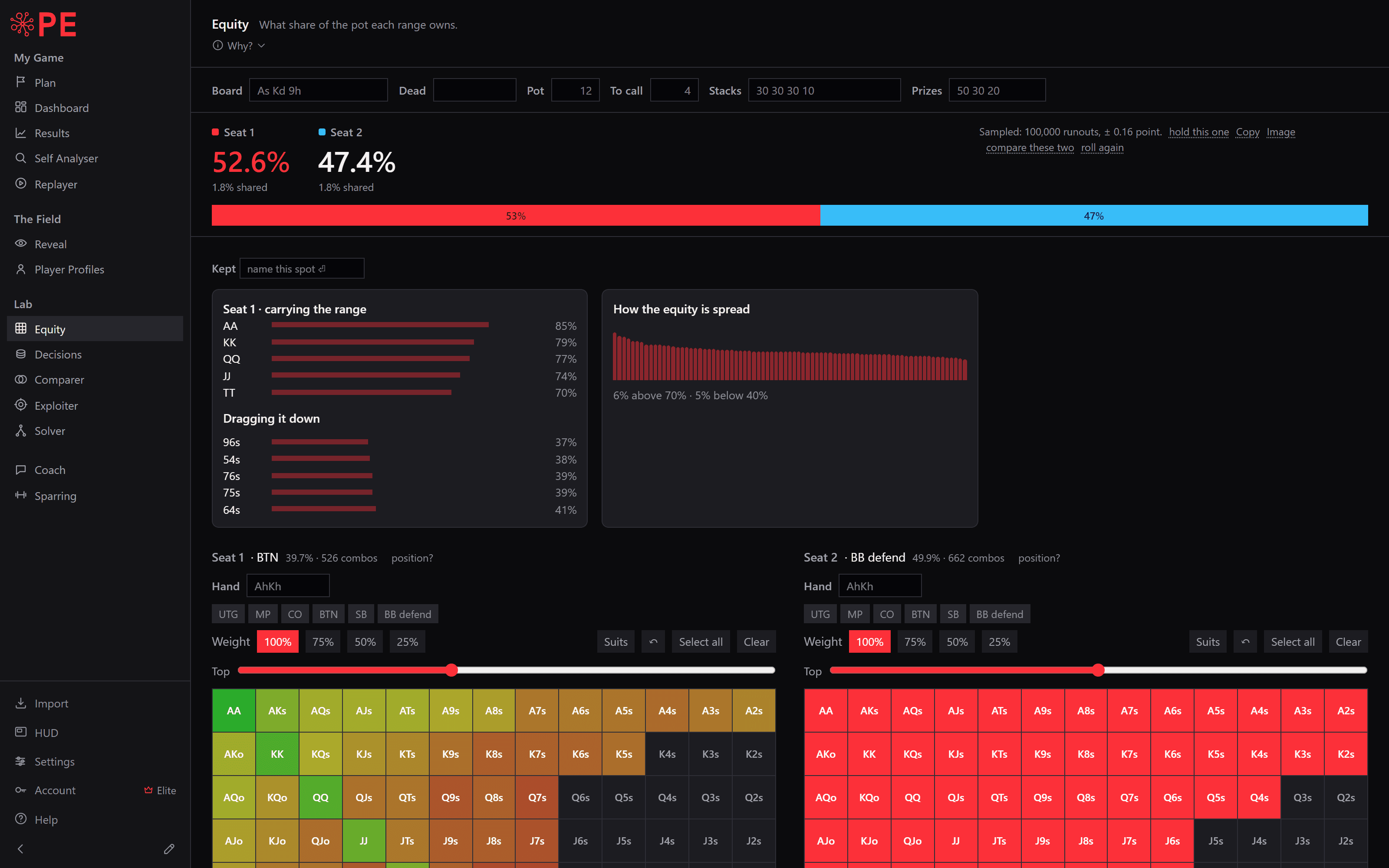
That is where exact equity matters. If you want to compare a hand or a range against another, the Equity module in Poker Exploit gives the equity computed over 100,000 runouts, so you do not have to rely on rough memory.
A small worked example
You hold A-K suited.
The flop gives you a flush draw.
What do you know?
- you have 9 outs
- you will complete by the river about 35% of the time
- you will miss about 65% of the time
So if you call only because "you have a flush draw", you are not done thinking. You still need:
- pot odds
- implied odds
- fold equity
- opponent profile
That is the difference between knowing a number and using it well.
One more thing players often miss
A probability is not a promise.
If something happens 35% of the time, that does not mean it will happen soon. You can miss ten draws in a row and still be within normal variance.
That is why it helps to track your results over enough hands, not over one evening. A graph, a sample size, and the rake next to your result tell you more than memory does.
The short version
If you want the poker probabilities you actually use, keep these in mind:
- pocket pairs are dealt 5.88% of the time
- pocket aces are dealt 0.45% of the time
- a pocket pair flops a set or quads 11.76% of the time
- two unpaired hole cards flop two pair about 2.02% of the time
- two suited hole cards flop a front-door flush draw about 10.94% of the time
- a flush draw gets there by the river about 35% of the time
- an open-ended straight draw gets there by the river about 31.5% of the time
If you keep one habit from this article, make it this one: when you see a draw or a made hand, turn it into a percentage before you act.
Poker gets much easier when you know what the cards are actually doing.
Do it on your own hands.