
Expected value, or EV, is one of the most important ideas in poker.
If you understand EV, you stop asking the wrong question, "Did I win the hand?" and start asking the right one, "Was this decision profitable in the long run?"
That shift changes how you study, how you review hands, and how you think at the table.
A good call can lose today and still be correct. A bad bluff can win today and still be a mistake. Poker is a game of repeated decisions, not a single showdown.
What EV means in poker
In poker, EV is the average amount a decision wins or loses if you could repeat the same spot many times.
That "many times" part is the key.
If you make a call that is worth +10 chips in EV, that does not mean you win 10 chips right now. It means that if you could play that exact spot again and again against the same ranges and the same bet size, that call would average 10 chips of profit.
That is why EV is better than results for judging decisions.
- Results tell you what happened once.
- EV tells you what should happen on average.
In cash games, EV is usually measured in money or big blinds. In tournaments, the same idea still applies, but ICM means chips and money are not always the same thing.
The basic EV idea
The simplest way to think about EV is this:
EV = average value of all outcomes
For a poker decision, that usually means:
- what you win when villain folds
- what you win or lose when villain calls
- what you win or lose when you improve, miss, or get shown down
You do not need one magic formula for every spot. You need to break the decision into branches.
That is the real skill.
How to calculate the EV of a call
A call is the easiest place to start.
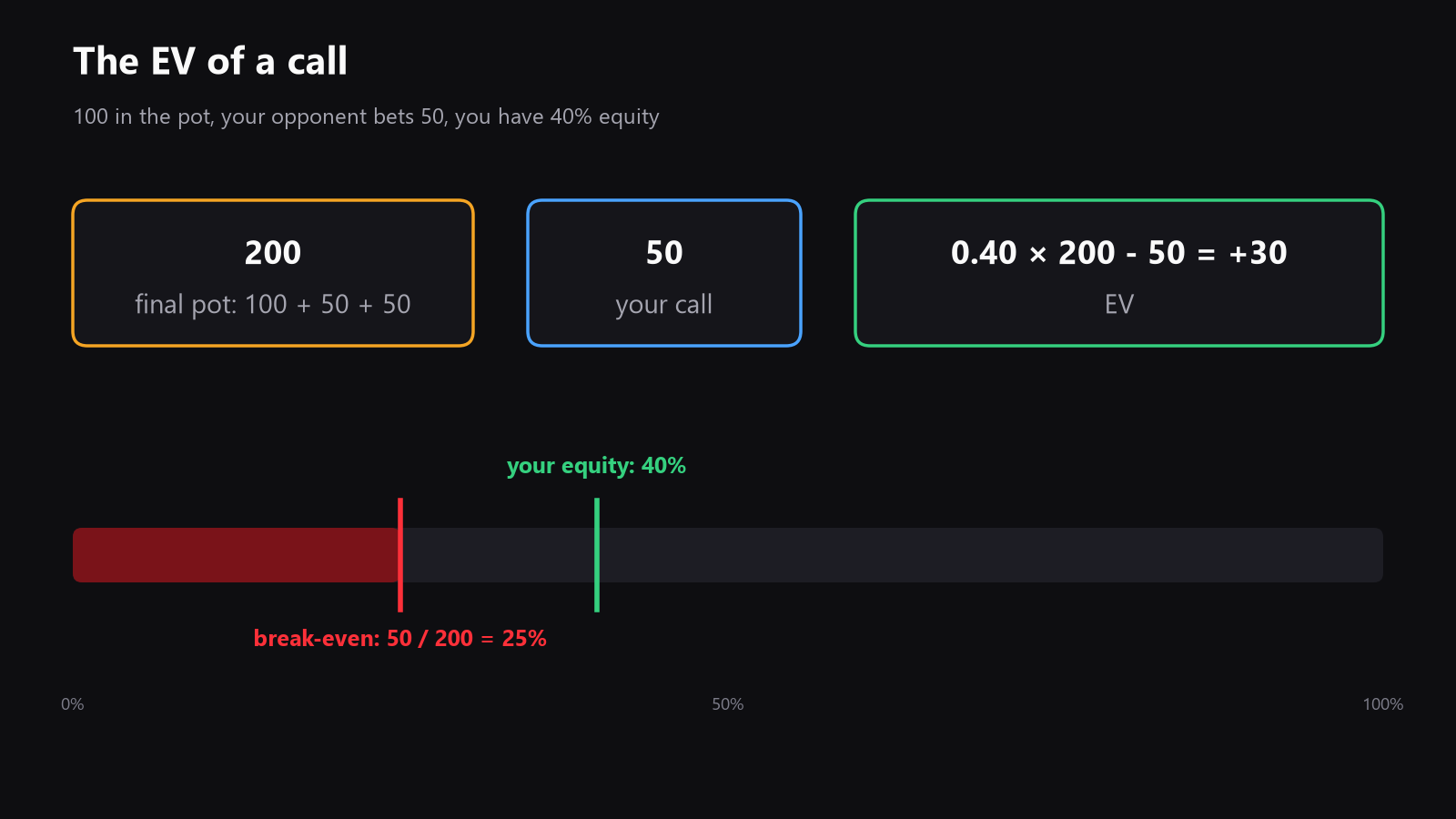
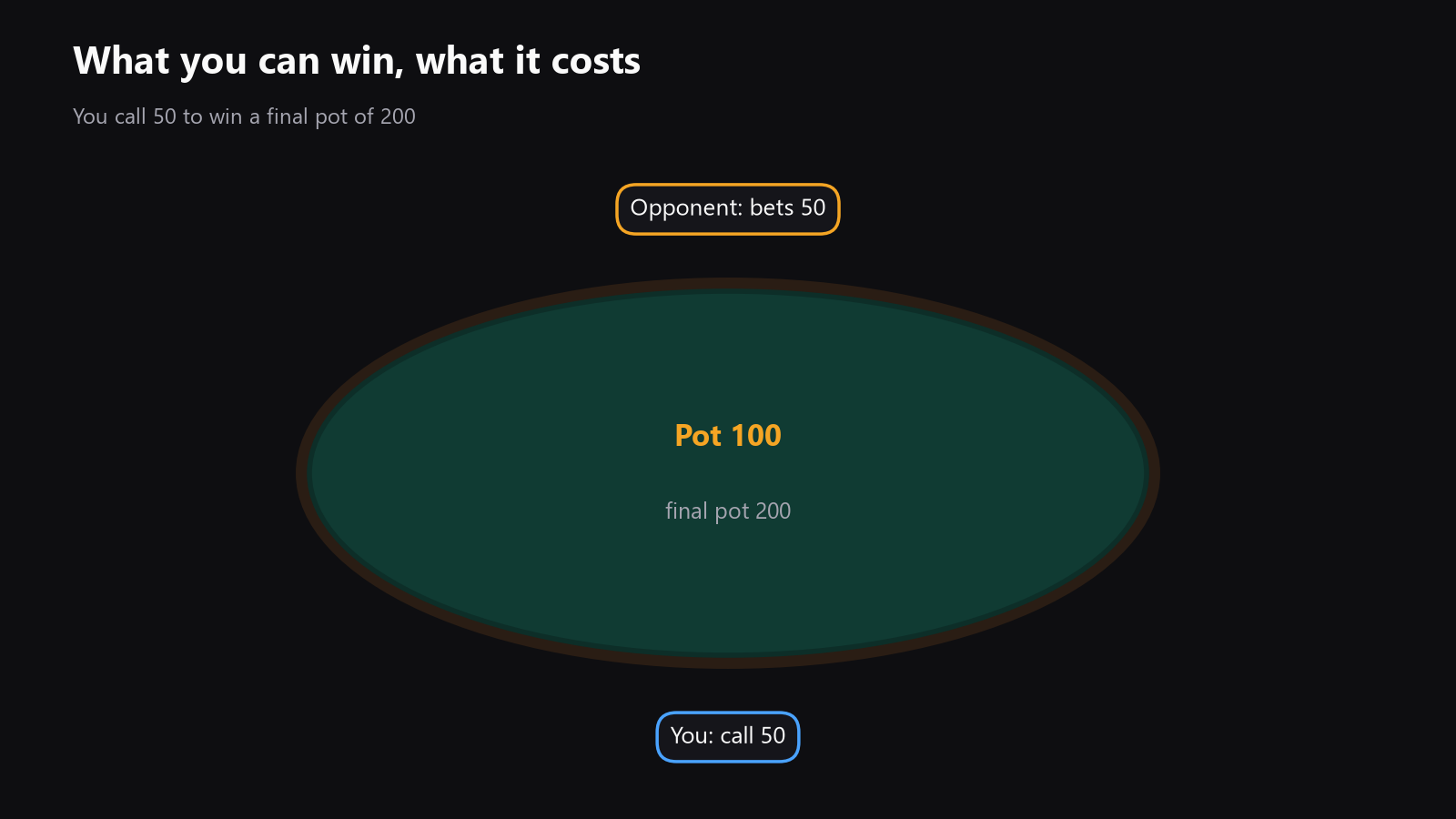
Imagine there is 100 in the pot, and your opponent bets 50. You must call 50 to continue.
If you call, the final pot becomes 200, because:
- 100 was already in the pot
- villain added 50
- you add 50
So the pot you can win is 200, and your cost is 50.
The EV of the call is:
EV(call) = equity x final pot − cost of call
If your equity is 40%, then:
EV = 0.40 x 200 − 50 = 30
That call is very profitable.
Break-even equity for a call
To find the point where a call is exactly break-even, set EV to zero:
0 = equity x final pot − cost
So:
equity = cost / final pot
In the example above:
equity = 50 / 200 = 25%
So you only need 25% equity for the call to break even.
This is why pot odds matter. Pot odds are just EV in another form.
Pot odds and why they matter
Players often hear "pot odds" and think it is a separate concept from EV. It is not.
Pot odds are just a quick way to estimate whether a call is +EV.
If you have to call 50 to win 200, you need to win at least 25% of the time to break even.
If your equity is higher than that, the call is +EV. If it is lower, the call is -EV.
This becomes very powerful when you combine it with range thinking.
You do not ask, "Do I have a pair?" You ask, "Against the range that continues here, how often am I ahead or improving?"
That is a much better EV question.
How to calculate the EV of a bluff
A bluff is just another EV problem.
When you bluff, you are buying folds.
The value of the bluff comes from two places:
- the pot you win immediately when villain folds
- your equity when villain calls, if you still have some chance to win
A simple bluff formula is:
EV = fold rate x pot now + call rate x EV when called
If you make a pure bluff and you have almost no equity when called, the formula becomes even simpler:
EV = fold rate x pot now − call rate x bet size
Example of a bluff
Suppose the pot is 100 and you bet 75.
If villain folds 45% of the time, your immediate profit is 100 whenever they fold.
If villain calls, and you treat your hand as a pure bluff with no equity, then you lose your 75 bet.
So:
EV = 0.45 x 100 − 0.55 x 75 EV = 45 − 41.25 = 3.75
That bluff is slightly +EV.
If the fold frequency drops a little, the bluff becomes bad. If the fold frequency rises, it becomes more profitable.
That is why bluffing is never about "looking strong". It is about whether the fold rate and the sizing make the bet profitable.
Why bet sizing changes EV
Bet size changes both sides of the equation.
A bigger bet:
- wins more when villain folds
- costs more when villain continues
- usually needs more fold equity
- often builds a bigger pot when you have a strong value hand
That means the best size is not the one that "feels right". It is the one that maximizes EV against the range you expect to face.
Sometimes a small bet is better because you get called too often if you size up. Sometimes a larger bet is better because the extra fold equity more than pays for it. Sometimes the right answer is not a bluff at all.
This is exactly why a solver can be useful when you study away from the table, because it shows how the EV of each action changes with size, ranges and board texture.
Why a good decision can lose
This is where many players go wrong.
A +EV decision does not win every time.
If your call is correct only 35% of the time and you lose the other 65%, then most of the time you will lose the pot. That does not make the call bad.
It makes the call normal.
For example:
- you call 50 to win 200
- you need 25% equity to break even
- you have 35% equity
That is a good call, even though you will still lose most of the time.
Poker is full of spots like this. You are supposed to lose plenty of good decisions.
Why a bad decision can win
The opposite is also true.
A -EV decision can win once, or even many times in a row.
You can call with 15% equity, hit your two-outer, and stack someone. You can make a bluff that should not work, and still get a fold. You can hero-call into the one hand you beat.
None of that changes the math.
Results can be noisy. EV is the long-run truth.
EV beats results, but results still matter
You should not ignore results. They tell you whether your game is working over time.
But when you want to judge a single decision, results are often misleading.
That is especially true in:
- all-in pots
- short samples
- tournament swings
- spots with high variance
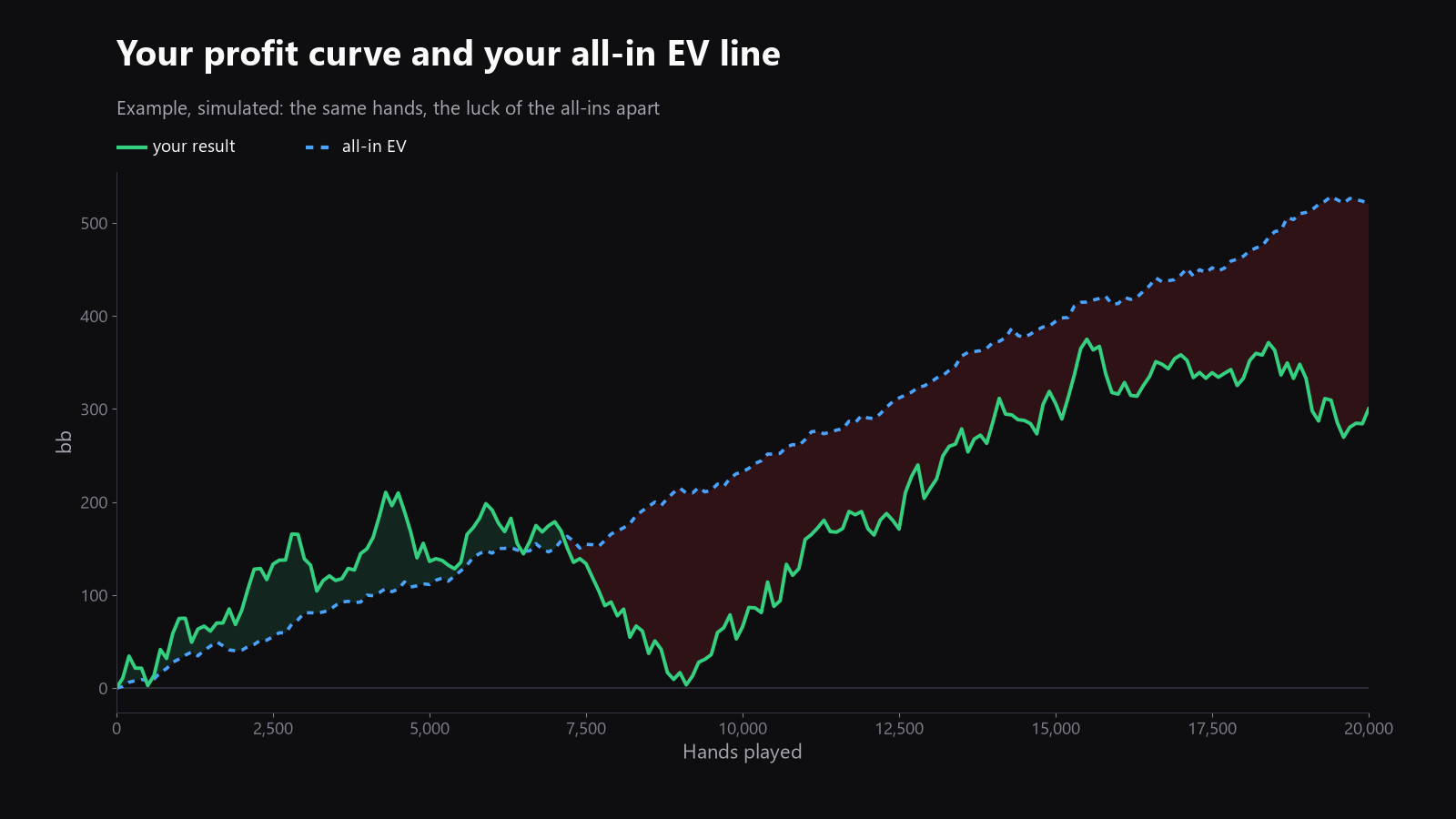
A graph of your winnings can look ugly even when you are playing well. It can also look good while you are making mistakes.
That is why it helps to look at the EV line next to the profit curve when you review your hands. If the line for all-in EV is much flatter than the results curve, a lot of what you are seeing is runout, not decision quality.
Rake changes EV
Rake is part of the math too.
A spot that is barely profitable before rake can become unprofitable after rake. That matters a lot in micro and small stakes, where small edges disappear quickly.
So when you study EV, do not stop at pot odds and equity. Ask one more question:
How much does rake take away from this decision?
That one habit will save you from many thin calls that look fine in theory but leak money in practice.
A practical EV checklist for real hands
When you face a decision, run this checklist:
- What is the pot right now?
- What do I have to invest?
- What range does villain have?
- What range continues against my bet or call?
- How much equity do I have against that continuing range?
- How often does villain fold?
- What does rake do to the spot?
- What future cards or future actions change the EV?
If you can answer those questions, you are no longer guessing.
You are thinking like a poker player who understands expected value.
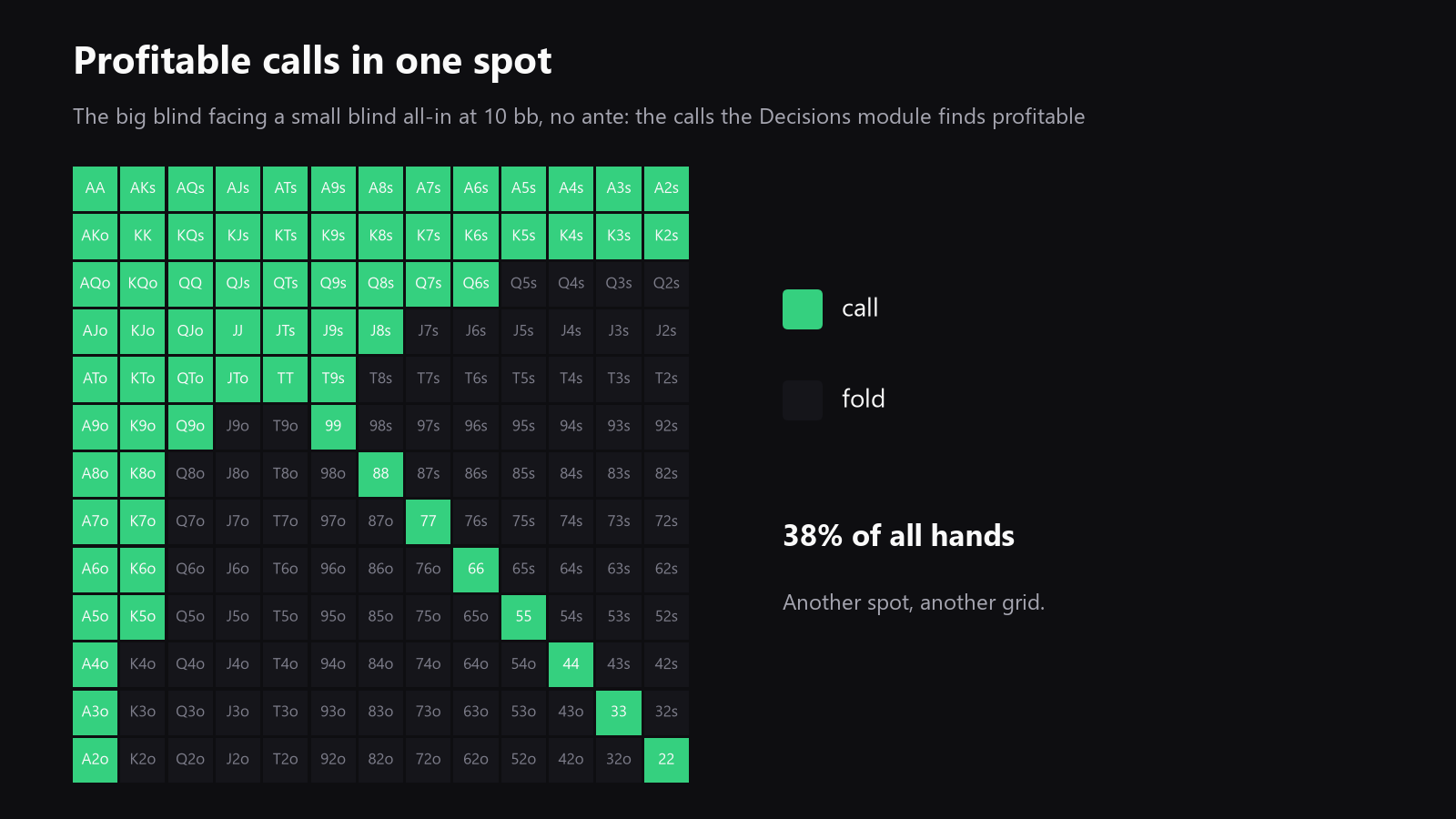
A starting-hand view of EV
A useful way to think about EV is to look at hands as actions, not as labels.
Two hands can both be "ace-high" and have completely different EV depending on position, stack depth, board texture, and opponent tendencies.
A hand can be:
- a profitable call in one spot
- a profitable bluff in another
- a fold in a third
That is why a grid view of starting hands is useful when you study. It helps you see which classes of hands can continue profitably and which should let go.
How to study EV without drowning in theory
You do not need to solve every hand from scratch.
A better way is to study the recurring spots that cost you the most:
- calling too wide versus bets
- bluffing when opponents underfold
- value betting too thin against stations
- missing fold equity on the turn
- paying rake in spots that are already marginal
If you want to review your own database, the Dashboard module shows your win rate, margin and rake, and the Results module lets you compare your profit curve with the all-in EV line. For off-table study, the Solver module helps you see how a spot behaves when ranges, board texture and bet sizes change.
That kind of review turns EV from an abstract idea into a practical tool.
The main idea to remember
If you remember only one thing, remember this:
Poker EV is about the quality of the decision, not the short-term outcome.
Good decisions can lose. Bad decisions can win. Your job is not to win every hand. Your job is to make the decision with the highest expected value as often as you can.
That is the standard worth using when you study, review, and improve.
Do it on your own hands.