
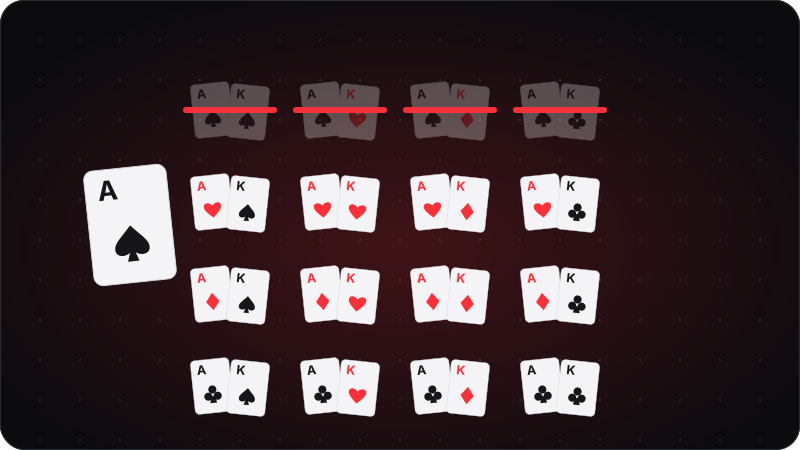
If you want to read ranges well, you need to think in combos, not just in hand names.
That small shift changes everything.
"Ace king" is not one thing. AKs and AKo are different hand classes, with different combo counts and different strategic weight. Pocket pairs are different again. Once you start counting the actual combinations behind a range, you stop making vague guesses and start seeing where the money really is.
This lesson will show you how to count combos, how visible cards remove combos, and how that count changes your decisions.
1. What a combo is
A combo is one exact way to make a hand.
For example:
- QQ is not just "queens"
- AKs is not just "ace king suited"
- AKo is not just "ace king offsuit"
Each of those names hides several exact card combinations.
Examples:
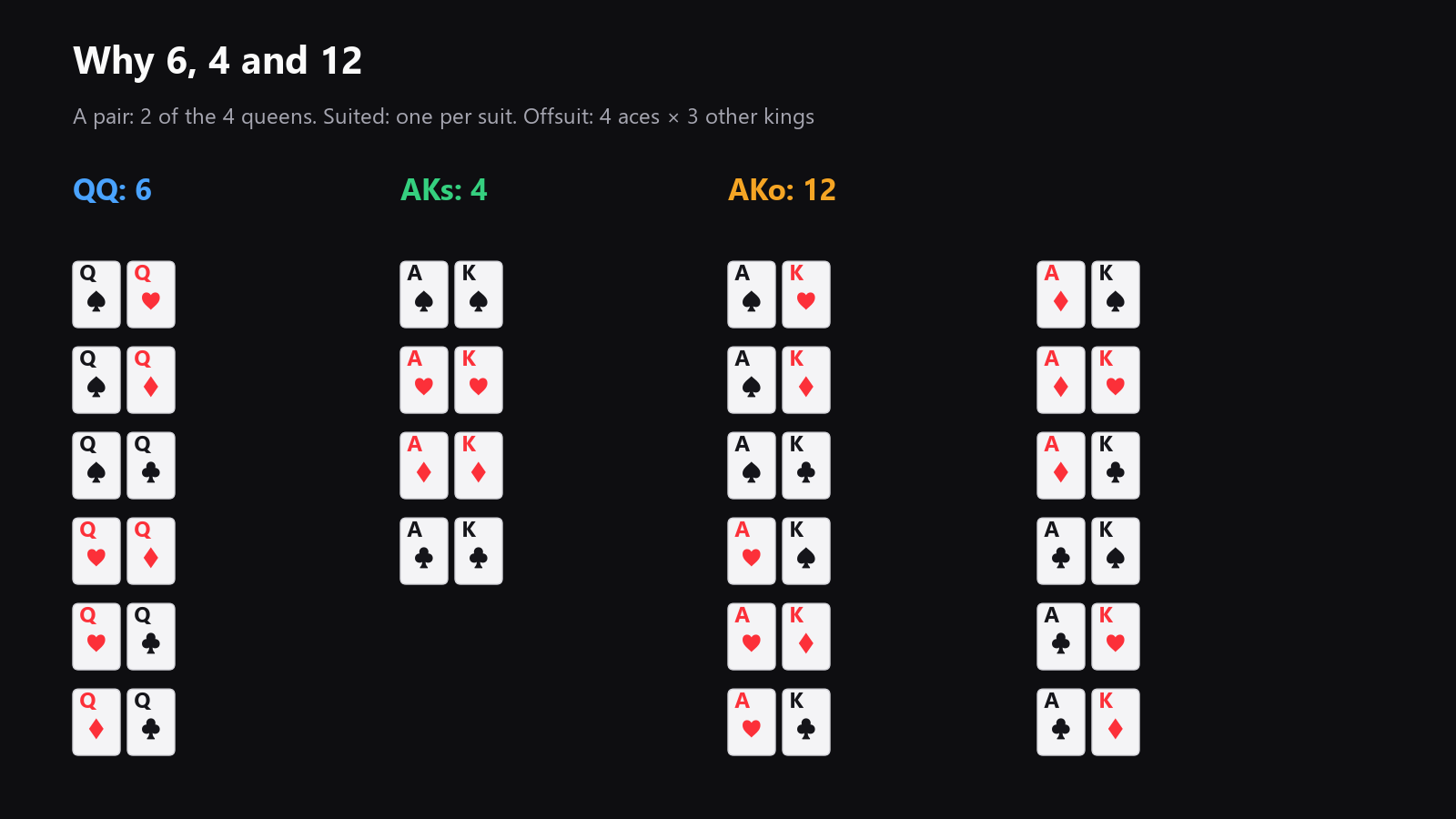
- QQ has 6 combos
- AKs has 4 combos
- AKo has 12 combos
Why? Because the suits matter.
If you say "villain can have ace king", that is still incomplete. You need to know whether you mean all 16 ace king combos, only the suited ones, only some offsuit ones, or something in between.
That is what poker combinatorics is about: counting the exact number of ways a hand can exist.
2. The three basic combo counts
There are only three basic cases for a two card starting hand.
Pocket pairs: 6 combos
Take pocket queens.
There are 4 queens in the deck. To make QQ, you choose 2 of those 4 cards.
The six combos are:
- Q♠ Q♥
- Q♠ Q♦
- Q♠ Q♣
- Q♥ Q♦
- Q♥ Q♣
- Q♦ Q♣
So every pocket pair has 6 combos.
Mathematically, that is "4 choose 2", which equals 6.
Suited hands: 4 combos
Take AKs.
There is one suited version in each suit:
- A♠ K♠
- A♥ K♥
- A♦ K♦
- A♣ K♣
So every suited non pair has 4 combos.
Offsuit hands: 12 combos
Take AKo.
The two cards must be different suits.
For each ace suit, there are 3 king suits that do not match it.
So the 12 combos are:
- A♠ K♥, A♠ K♦, A♠ K♣
- A♥ K♠, A♥ K♦, A♥ K♣
- A♦ K♠, A♦ K♥, A♦ K♣
- A♣ K♠, A♣ K♥, A♣ K♦
That is 4 times 3, so 12 combos.
3. Why the total number of starting hand combos is 1,326
There are 13 possible ranks for each card.
If you count every possible two card starting hand, the total is:
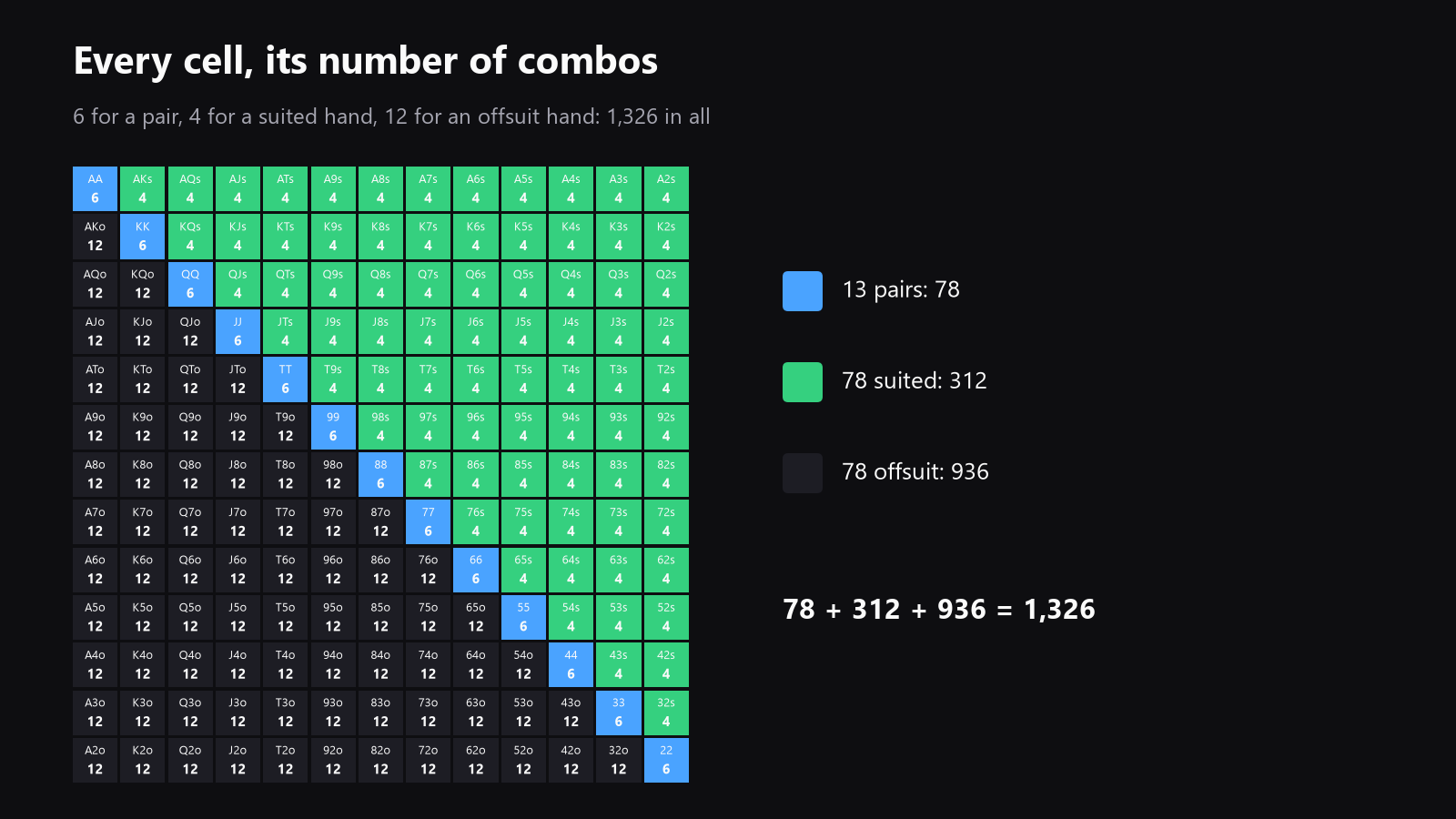
- 13 pocket pairs, each with 6 combos, so 78 combos
- 78 suited non pair hand classes, each with 4 combos, so 312 combos
- 78 offsuit non pair hand classes, each with 12 combos, so 936 combos
Add them up:
78 + 312 + 936 = 1,326
That is the full universe of starting hand combos before any cards are removed.
4. Hand classes are not combo counts
This is one of the easiest ways to make range work worse without noticing.
People say things like:
- "He opens ace queen"
- "She 3 bets kings"
- "They defend all broadways"
Those are hand classes, not combo counts.
A hand class can be small or large in combo terms.
Examples:
- AA is 6 combos
- AKs is 4 combos
- AKo is 12 combos
- any one pocket pair is 6 combos
- any suited broadway is 4 combos
So if you treat every hand class as if it mattered equally, your range work becomes distorted.
AKo is three times as common as AKs. That matters a lot.
5. Card removal: the cards you can see take combos away
Now we get to the part that changes decisions.
Every visible card removes possible combos from ranges.
There are two kinds of visible cards:
- the board cards, which are public
- your own hole cards, which are private but still remove combos from villain's range
This is called card removal. When your own cards do the removing, people often call them blockers.
Example 1: pocket pair removal
If you want to count QQ on a board that contains one queen, the count is no longer 6.
Suppose the board is Q♠ 7♦ 2♣.
One queen is already on the board, so only 3 queens remain in the deck.
Now QQ is:
- Q♥ Q♦
- Q♥ Q♣
- Q♦ Q♣
So there are only 3 combos left.
If the board is Q♠ Q♥ 2♣, then only 2 queens remain, so QQ has only 1 possible combo.
That is how board cards remove value hands from villain's range.
Example 2: suited hand removal
Take AKs on a board with A♠ and K♦ already out.
The four suited AK combos are:
- A♠ K♠
- A♥ K♥
- A♦ K♦
- A♣ K♣
But A♠ and K♦ are dead, so these two combos are impossible:
- A♠ K♠
- A♦ K♦
That leaves:
- A♥ K♥
- A♣ K♣
So AKs is reduced from 4 combos to 2 combos.
Example 3: offsuit hand removal
Take AKo on a board with A♠ and K♣.
You still may have many AKo combos left, but not all 12.
Every dead ace or dead king reduces the possible suit combinations.
This is why board texture matters. A board with many high cards, paired cards, or suit cards removes more combos from some ranges than from others.
6. Blockers: your hand changes villain's range
Your own cards are private, but they still matter.
If you hold a card that shares rank or suit with a likely villain holding, you block some of those combos.
Rank blockers
If you hold an ace, villain has fewer ace high value hands available.
For example, if you hold A♣ Q♣ on A♦ K♠ 7♥, you block some top pair and two pair type combinations.
Suit blockers
If you hold a spade on a board where spades still matter, you reduce the number of spade draws or flushes villain can have.
That is one reason strong bluffs often contain good blockers. A good bluff often blocks the hands that would call you, while not blocking the hands that would fold.
A practical example
Suppose the board is Q♠ 8♠ 2♦ on the turn, and you hold A♠ J♦.
Here the spade in your hand matters. You block some strong spade draws, which can make a bluff more attractive.
But on a board like 9♠ 8♠ 2♦ Q♥ K♣, a flush is impossible because there are only two spades on the board and each player has only two hole cards. So A♠ does not block a made flush there, because a flush cannot exist in the first place.
That distinction matters. Blockers only matter for hands that are actually possible.
7. Combo counting changes every decision
This is where combinatorics stops being theory.
Value betting
When you value bet, you are asking how many worse hands can call.
If villain has 18 value combos that beat you and 36 worse combos that can call, your value bet looks attractive.
If villain has only 6 worse combos and 30 better combos, your value bet may be thin or bad.
The exact answer depends on stack sizes, position, and board texture, but combo counting gives you the raw material.
Bluffing
Bluffing is about how many value combos you can credibly represent, and how many bluffs your line can contain.
For a half pot bet, the balanced bluff frequency is about 25 percent of your betting range.
Put differently, you want roughly 1 bluff combo for every 3 value combos.
So if your betting range contains 12 value combos, a balanced bluff count is about 4 combos.
If your betting range contains 30 value combos, a balanced bluff count is about 10 combos.
Now you are not guessing. You are counting.
Bluff catching
When you face a bet, you want to know whether villain has enough bluffs.
If their line contains 40 value combos and only 8 bluff combos, you should be very cautious with bluff catchers.
If their line contains 16 value combos and 14 bluff combos, you can call much more often.
The point is not to memorize one perfect number. The point is to count the range properly.
8. A simple method you can use at the table
When you want to count combos in a real hand, follow this order.
Step 1: name the exact hand class
Do not stop at "top pair" or "draw".
Write the exact hand class if possible, like:
- AKs
- AKo
- JTs
- 76s
Step 2: remove the dead cards
Look at the board and at your own hand.
Ask:
- how many of this rank are left?
- how many of this suit are left?
- does this hand class still exist at all?
Step 3: count the remaining combos
Use the basic rules:
- pair: choose 2 from the remaining same rank cards
- suited: count the matching suit pairings still possible
- offsuit: count the suit pairings that are not matched
Step 4: group the combos by function
Put them into buckets:
- value
- bluff
- draw
- weak bluff catcher
This is where the count becomes strategic.
Step 5: compare with the price of the decision
If you are facing a bet, compare the combo count behind villain's range with the price you are getting.
If you are betting, compare your value combos with your bluff combos.
That is how combinatorics becomes practical poker.
9. A full example
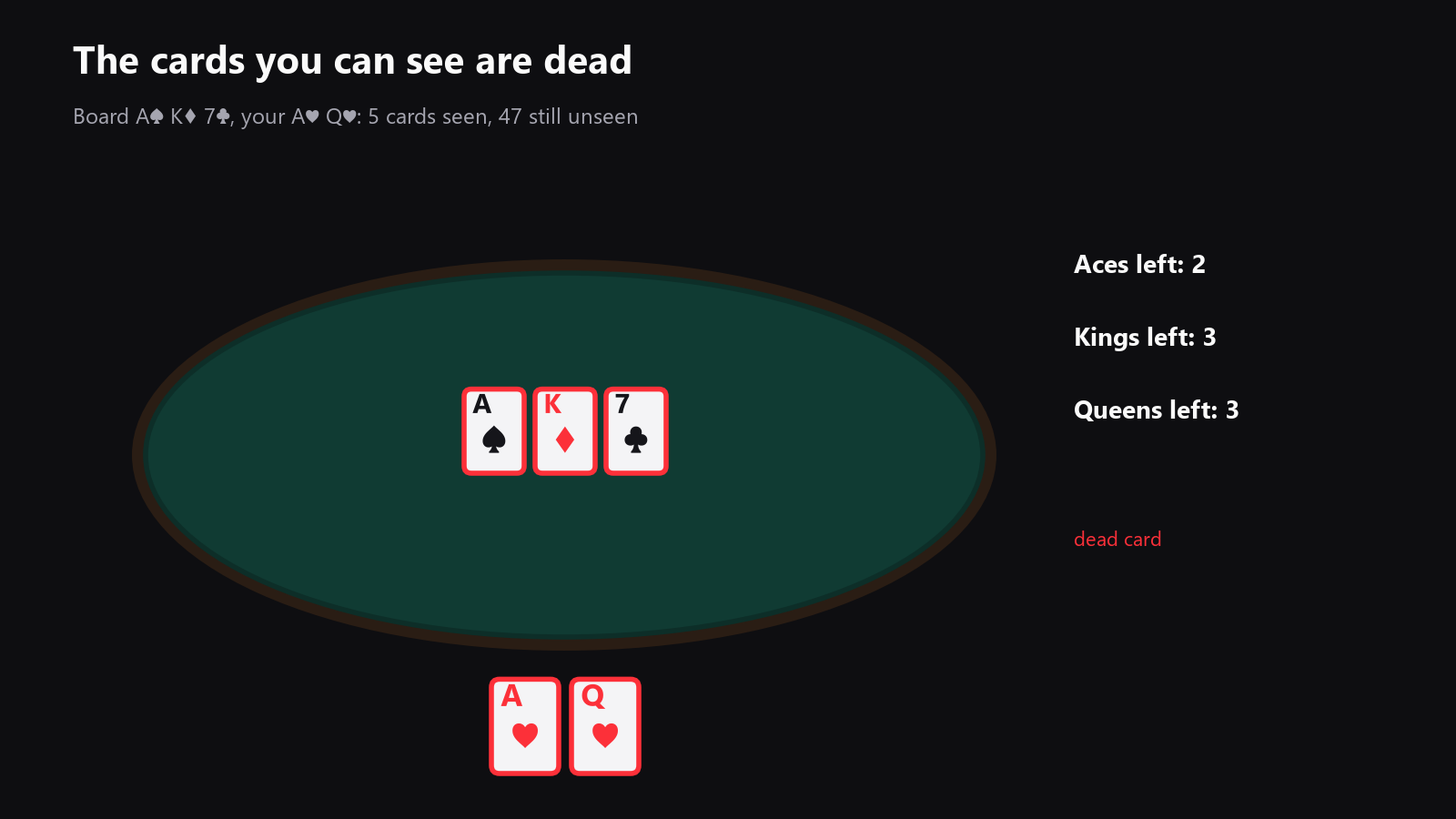
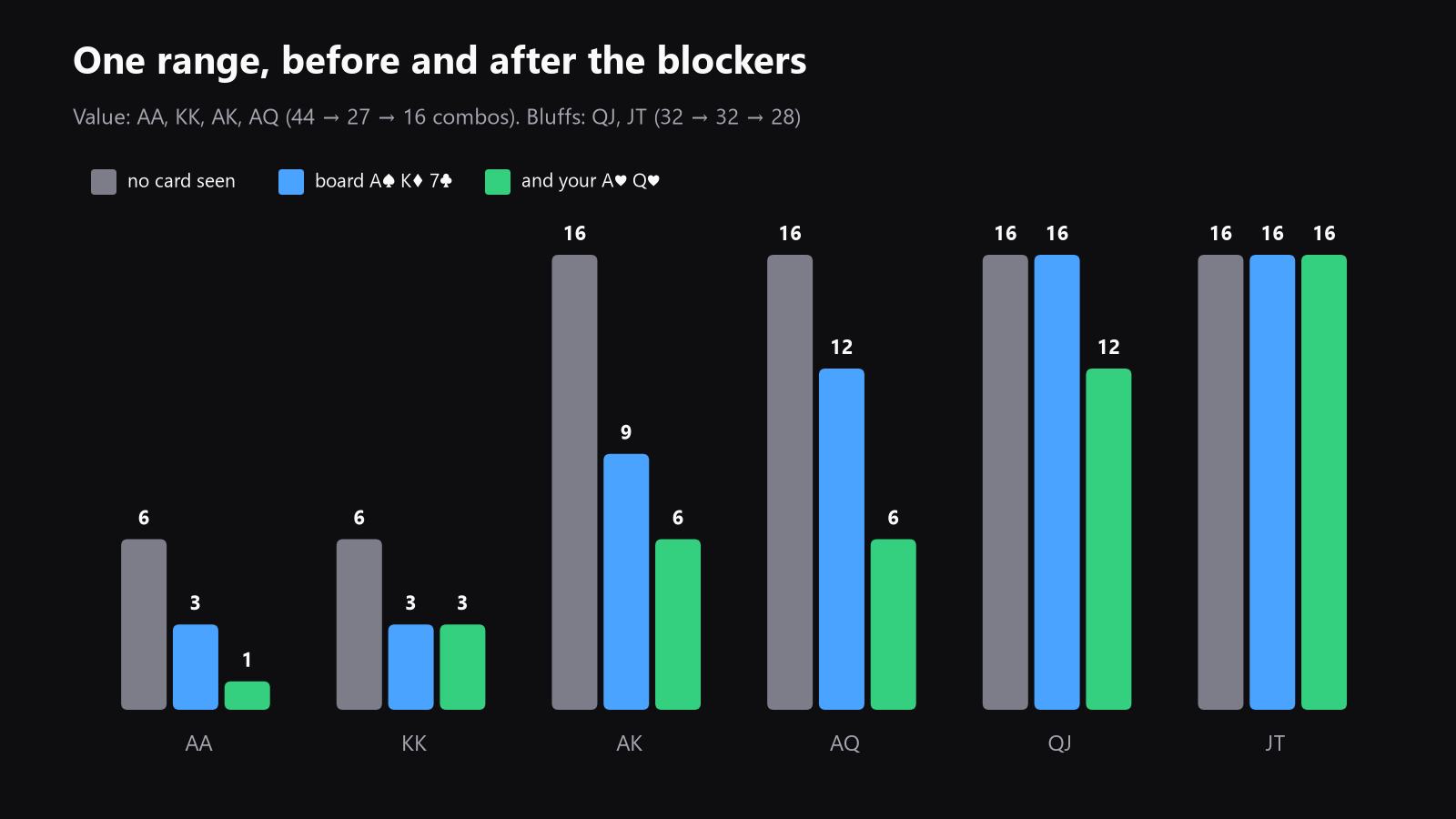
Let us say the board is A♠ K♦ 7♣ and you are estimating villain's continuing range after they bet flop and barrel turn.
You think they can value bet:
- AA
- KK
- AK
- AQ
- some bluffs with QJ, JT, or backdoor type hands
Now count.
AA
One ace is on the board, so only 3 aces remain.
AA becomes 3 combos, not 6.
KK
One king is on the board, so only 3 kings remain.
KK becomes 3 combos, not 6.
AK
Now both an ace and a king are on the board.
AK is heavily reduced.
Some suited versions are gone, some offsuit versions are gone, and the exact count depends on which suits are visible.
AQ
A board ace removes some AQ combos too, and if you hold an ace, it removes more.
Once you do this carefully, you often discover that a hand you thought was "everywhere" is actually much rarer than you thought.
That is one of the main reasons range work gets sharper when you count combos properly.
10. Why this matters for solver work too
When you look at a strategy grid, you may see colors, frequencies, and bet sizes.
Behind all of that is combo weighting.
A line that looks small in hand classes can be large in combos, and the reverse is also true.
That is why combinatorics matters when you study with a solver. The Solver module in Poker Exploit shows an equilibrium strategy grid and result figures, and you can use combo counting to understand how much weight sits behind each action.
If you are serious about improving, do not just ask, "What does the solver do?"
Ask, "How many combos are in each part of the range, and what cards remove them?"
That is the question that makes the output useful.

11. A short checklist you can remember
When you are counting combos, remember this:
- Pair = 6 combos
- Suited non pair = 4 combos
- Offsuit non pair = 12 combos
- The board removes combos
- Your hand removes combos
- Range size is combo weighted, not hand weighted
- Decision quality depends on the remaining combos, not just the hand name
If you can do those seven things well, your postflop range reading will improve fast.
12. Final thought
Most players say they understand ranges. Fewer players actually count them.
If you learn to count combos properly, you will see hands more clearly, understand blockers better, and make better decisions with value bets, bluffs, and bluff catchers.
That is the foundation of good poker math.
And once you start seeing the game in combos, the rest of the work becomes much easier.
Do it on your own hands.