

If you play poker long enough, you hear the same shortcut again and again: the rule of 2 and 4.
It is a mental shortcut for turning outs into an approximate chance of improving.
- On the flop, multiply your outs by 4 to estimate your chance to hit by the river.
- On the turn, multiply your outs by 2 to estimate your chance to hit on the river.
It is fast, useful, and close enough in many spots that it saves you from doing exact combinatorics at the table.
But it is still a shortcut. If you want to use it well, you need to know what it measures, how close it is, and where it starts to lie to you.
First, what is an out?
An out is a card that improves your hand to what you are hoping for.
Examples:
- You have a flush draw with 9 outs.
- You have an open-ended straight draw with 8 outs.
- You have a gutshot with 4 outs.
The rule of 2 and 4 only works if you count the outs correctly.
That sounds obvious, but it is the first place people go wrong. Some outs are not really clean. A card can make your hand, but still not win the pot. More on that later.
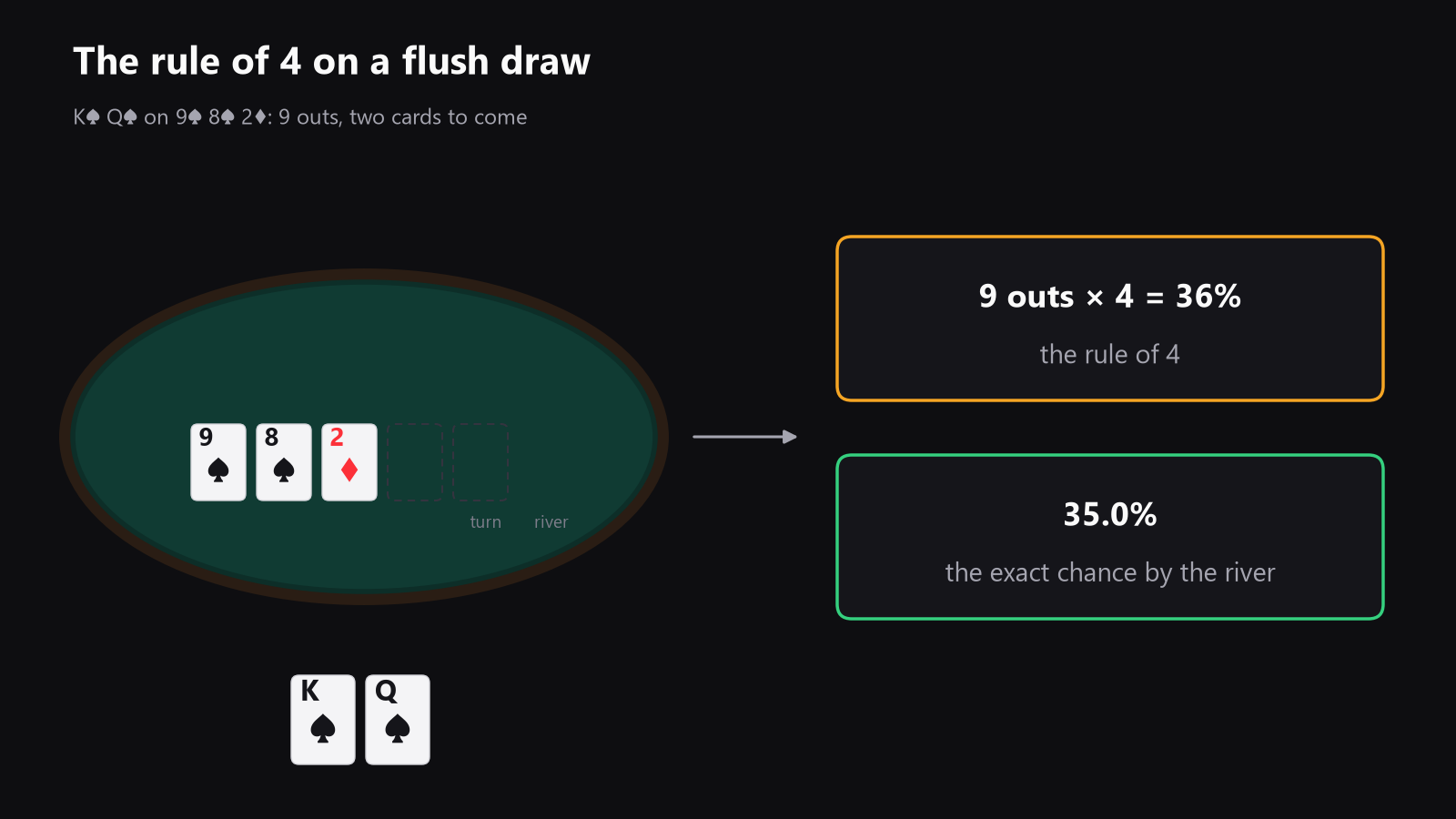
The rule of 4 on the flop
On the flop, there are two cards still to come: the turn and the river.
So if you have outs, your rough chance to improve by the river is:
outs x 4%
A few common examples:
- 4 outs, about 16%
- 8 outs, about 32%
- 9 outs, about 36%
- 12 outs, about 48%
- 15 outs, about 60%
This is easy to remember, and for small and medium draws it is often close enough to guide a decision.
The exact flop formula
If you want the exact chance of hitting by the river from the flop, the formula is:
1 − ((47 − outs) / 47) x ((46 − outs) / 46)
Why 47 and 46?
- On the flop, you already know 5 cards, your 2 hole cards and 3 board cards.
- That leaves 47 unseen cards.
- After one card comes, 46 unseen cards remain.
So the exact chance is not linear, because you have two chances to improve, not one.
That is why the rule of 4 is only an approximation.
How close is it?
Here is the practical picture:
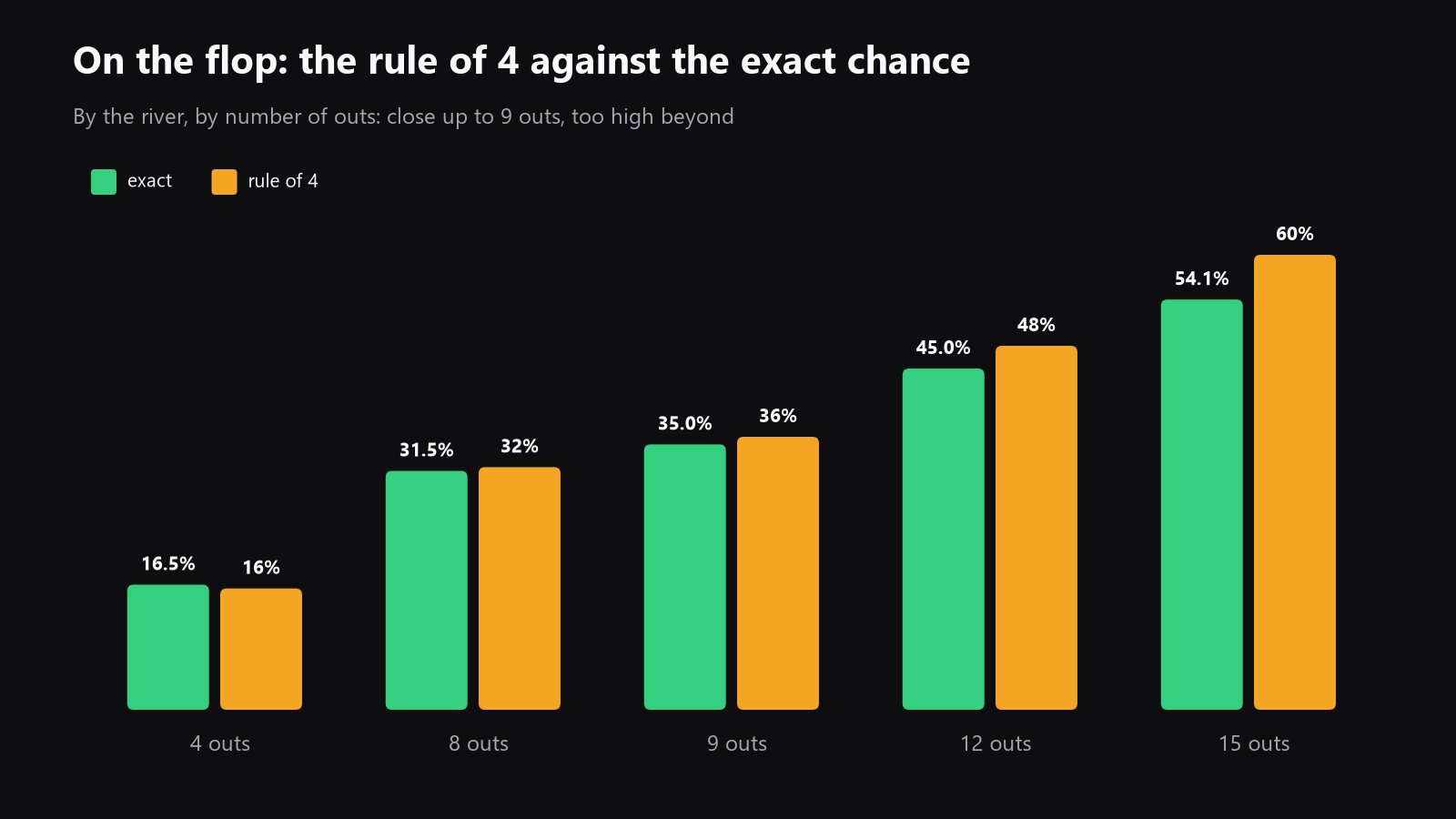
| Outs | Exact chance by river | Rule of 4 |
|---|---|---|
| 4 | 16.5% | 16% |
| 8 | 31.5% | 32% |
| 9 | 35.0% | 36% |
| 12 | 45.0% | 48% |
| 15 | 54.1% | 60% |
For 4 to 9 outs, it is usually very close.
Once you get to 12 or 15 outs, the shortcut starts to overstate your chance more clearly.
The rule of 2 on the turn
On the turn, only one card remains.
So the shortcut becomes much simpler:
outs x 2%
Examples:
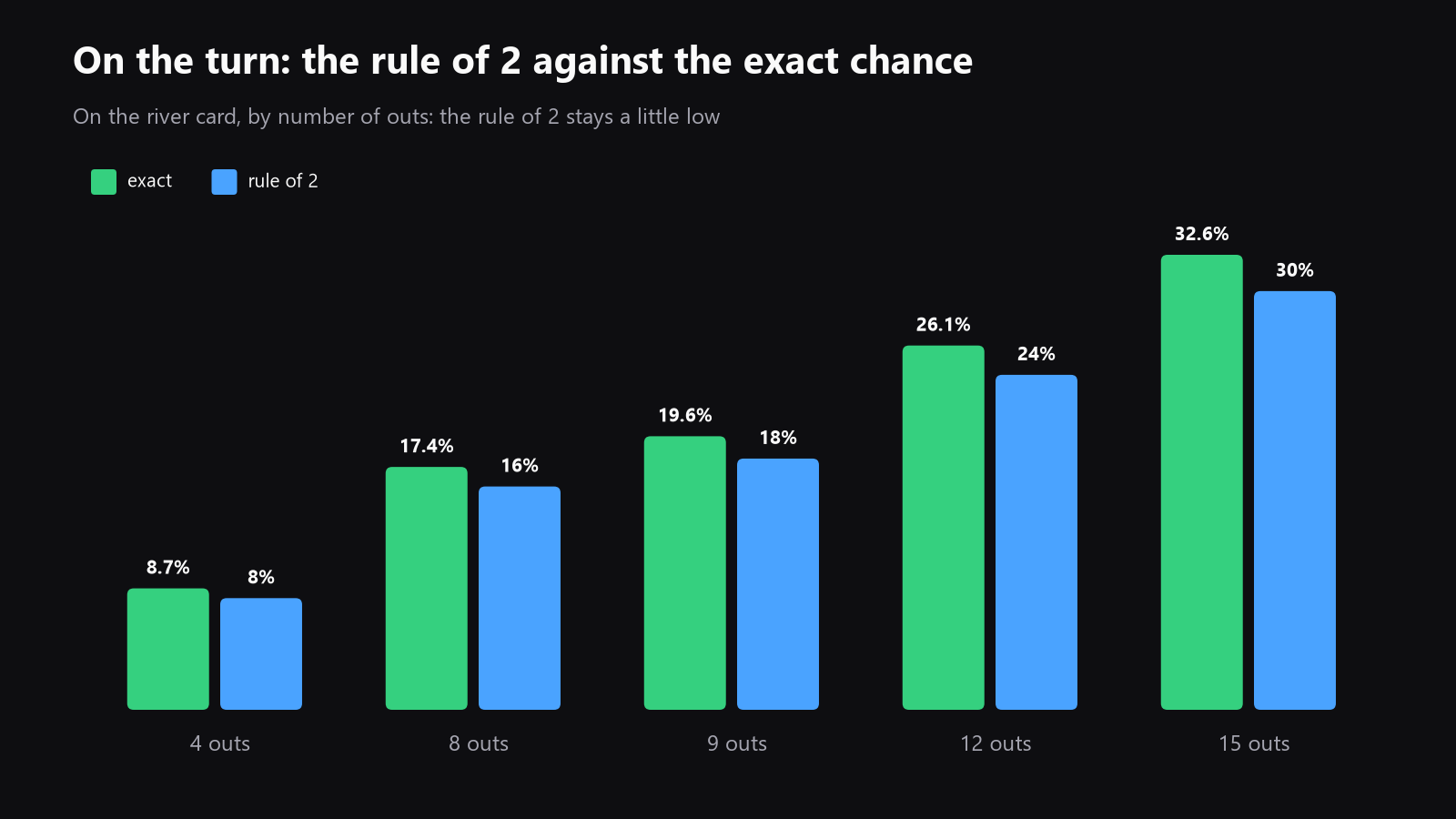
- 4 outs, about 8%
- 8 outs, about 16%
- 9 outs, about 18%
- 12 outs, about 24%
- 15 outs, about 30%
The exact turn formula
The exact chance to hit on the river is simply:
outs / 46
Because there are 46 unseen cards left and you usually care about one specific group of outs.
So with 9 outs:
- Exact chance = 9 / 46 = 19.6%
- Rule of 2 = 18%
The rule of 2 is usually a bit conservative, which is often fine at the table.
If you want to be more exact without doing full math, some players use 4.3 on the flop and 2.2 on the turn. On the flop, 4 is usually a little closer for most draws; on the turn, 2.2 is closer to the exact math.
Why the rule works
The rule works because the number of remaining unseen cards is large enough that a quick percentage per out gives you a usable estimate.
It is not magic. It is just compressed probability.
On the flop, each out has two chances to show up by the river. On the turn, each out has one chance. The rule of 4 and 2 turns that into something you can do in your head during a hand.
That is why good players use it as a decision aid, not as a final answer.
Where the rule goes wrong
This is the part that matters most.
1. Dirty outs
Not every out is a winning out.
Example: you have a straight draw, but the board can pair and give your opponent a full house. Or you make a top pair, but your opponent already has two pair or a set.
The rule of 2 and 4 counts improvement, not victory.
2. Multiway pots
In a multiway pot, even a made hand can still be behind.
If one card improves you but someone else improves too, your out is worth less than the shortcut suggests.
3. Reverse implied odds
Sometimes a card that helps you also helps the field more.
A flush card can complete your flush, but if the board is paired, your flush may still lose. A straight card can give you a straight, but an even bigger straight may already be possible.
4. Backdoor draws
The rule of 2 and 4 only counts the outs you already have.
It does not help much when your real value comes from runner-runner possibilities, because those are harder to count quickly and often too small to matter in a fast decision.
5. Big combo draws
The more outs you have, the more the shortcut drifts.
A combo draw with 15 outs is huge, but the rule of 4 says 60%, while the exact figure is closer to 54%.
That is a meaningful gap.
If you are making close decisions, that gap can change whether a call is profitable.
A simple way to use it correctly
Use the rule in three steps:
- Count your clean outs.
- Multiply by 4 on the flop, or by 2 on the turn.
- Ask whether that chance is enough for the price you are getting.
That is the real value of the shortcut.
It is not just about knowing whether you hit often enough. It is about comparing that chance to the pot odds you are being offered.
For example:
- If you have 9 outs on the flop, the shortcut says about 36%.
- If the pot is offering you a price that needs only 25% equity, the call looks good on raw chance.
- If your outs are dirty, or you are often paid off only when you miss, you need more caution.
A quick cheat sheet
Use this when you need a fast estimate.
On the flop
- 4 outs: about 16%
- 8 outs: about 32%
- 9 outs: about 36%
- 12 outs: about 48%
- 15 outs: about 60%
On the turn
- 4 outs: about 8%
- 8 outs: about 16%
- 9 outs: about 18%
- 12 outs: about 24%
- 15 outs: about 30%
If you want to be more exact without doing full math, remember this:
- flop, 4 per out is usually closer than 4.3
- turn, 2.2 per out is closer than 2
The main lesson
The rule of 2 and 4 is a shortcut, not a law.
It is very good for quick table decisions, especially with common draws like flush draws and open-ended straight draws.
It gets worse when:
- your outs are not clean,
- the pot is multiway,
- the draw is very strong,
- or the decision is close enough that a few percentage points matter.
So use it to estimate. Do not use it to stop thinking.
If you want the exact figure for your own spot instead of a shortcut, the Equity module in Poker Exploit computes your share of the pot against a hand or a range over 100,000 runouts, so you can check whether your quick estimate was really good enough.
Do it on your own hands.