
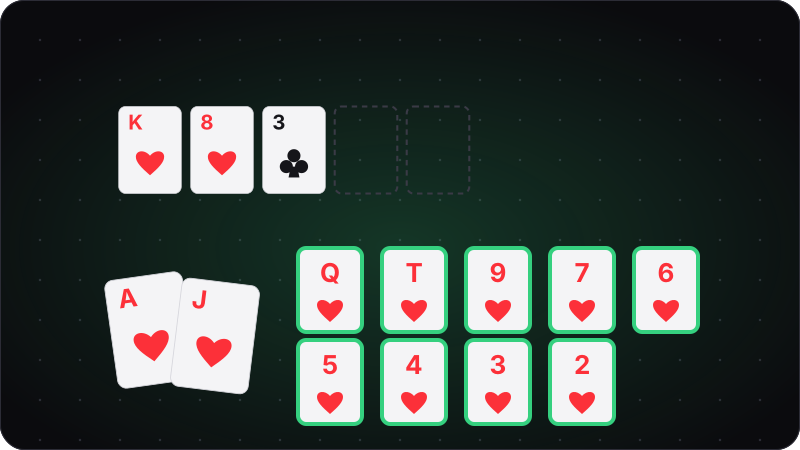
When you have a draw, the first question is not “do I feel lucky?”
It is: how many cards can still come and make my hand the likely best one?
Those cards are your outs.
Counting outs well is one of the most useful poker skills you can learn. It helps you estimate your chance to improve, compare that chance with the price you are being offered, and avoid two classic mistakes: overcalling with weak draws, or folding hands that already have enough equity to continue.
What an out is, and what it is not
An out is a card that, if it comes, gives you a hand that is likely good enough to win by showdown, or at least good enough to continue profitably.
That “likely” matters.
A card is not automatically an out just because it improves your hand. If a card gives you two pair but the board texture means your opponent can still have a better two pair, a straight, a set, or a full house, then that card may be a dirty out, or not an out at all.
So the right question is not only:
- “Does this card improve me?”
It is also:
- “Does it improve me enough against the range I face?”
How to count outs on the flop
On the flop, there are two cards still to come. That gives you two chances to hit.
The quick shortcut is:
- Rule of 4 on the flop: outs × 4 gives a rough percentage to improve by the river.
It is an approximation, not an exact answer, but it is fast and usually close enough for play.
Common flop draws
Here are the most common ones:
| Draw | Clean outs | Approx. chance by river |
|---|---|---|
| Flush draw | 9 | 36% |
| Open-ended straight draw | 8 | 32% |
| Gutshot straight draw | 4 | 16% |
| Two overcards | often 6, but not always clean | about 24% before discounting |
The exact chances are slightly different, but close:
| Outs | Exact chance by river |
|---|---|
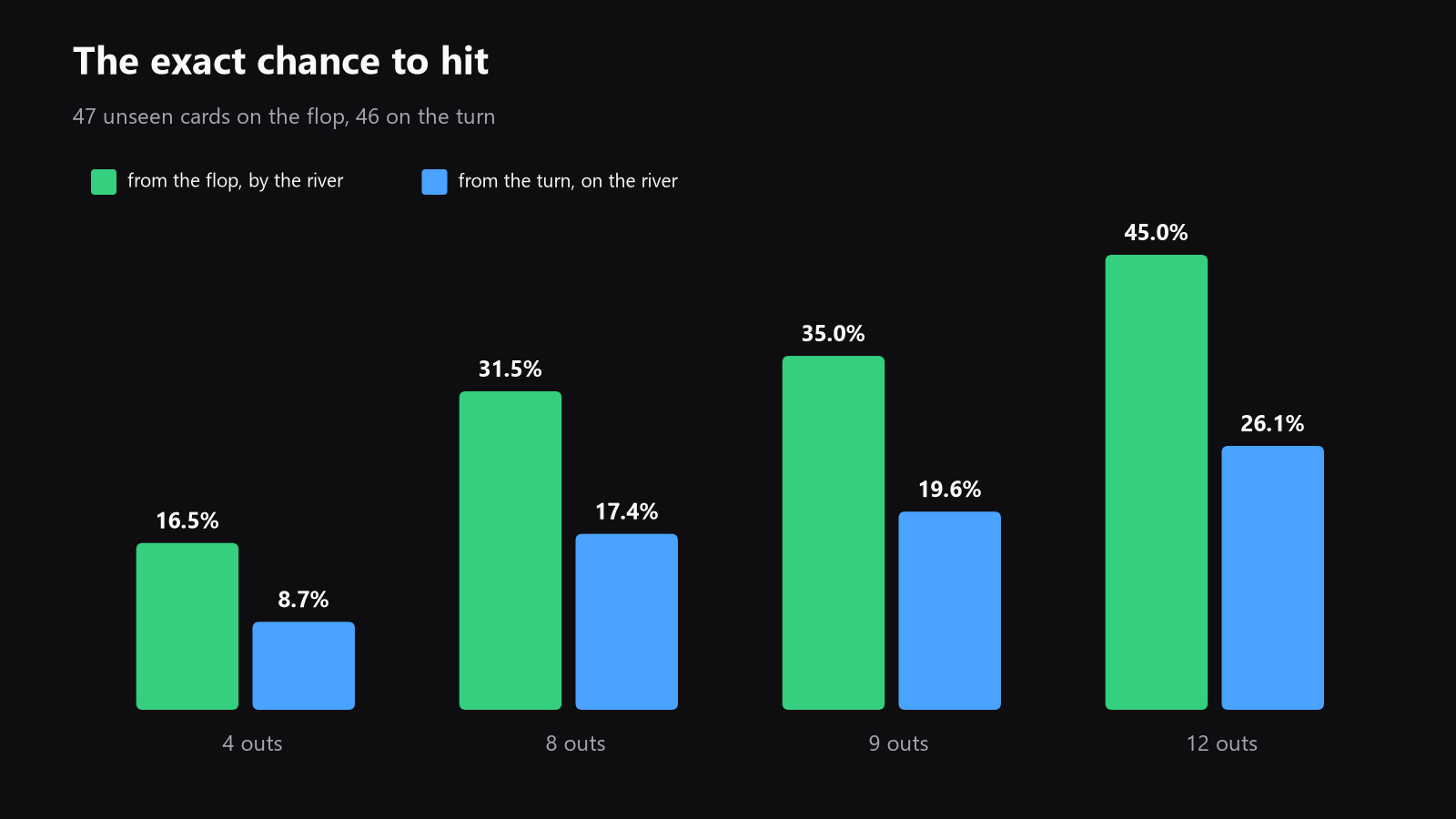
| 4 | 16.5% |
| 8 | 31.5% |
| 9 | 35.0% |
| 12 | 45.0% |
| 15 | 54.1% |
A very useful habit is to translate a draw into a number of outs before you do anything else.
For example:
- A flush draw usually has 9 outs
- An open-ended straight draw usually has 8 outs
- A gutshot usually has 4 outs
If you have both draws at once, count the unique cards, not the categories.
Do not double count a card that completes two parts of your draw.
Example: combo draw
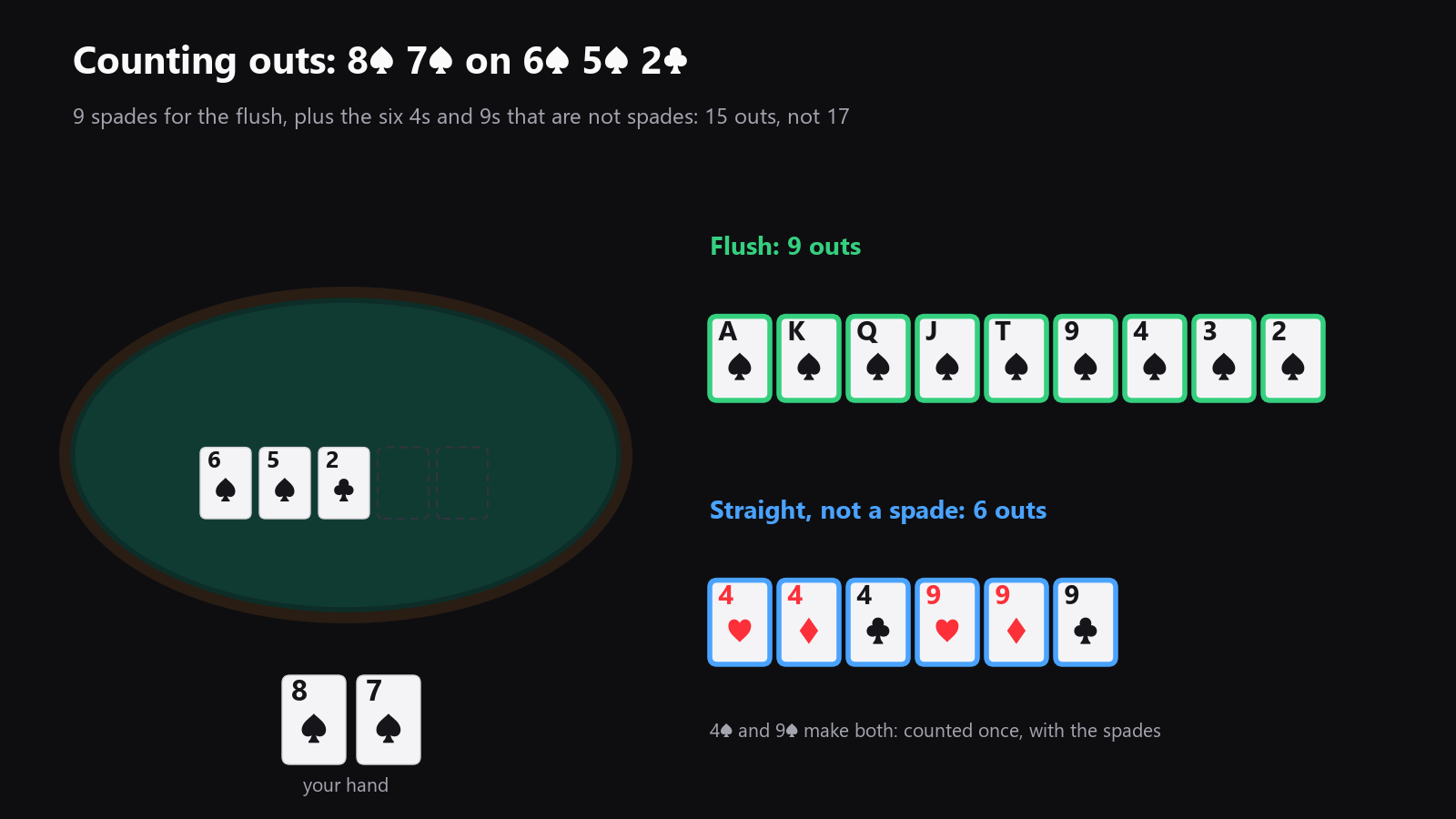
Say you hold 8♠ 7♠ on 6♠ 5♠ 2♣.
You may have:
- 8 straight outs, because any 4 or 9 completes the straight
- 9 flush outs, because any spade completes the flush
That does not mean 17 outs.
The 4♠ and 9♠ are already included in the flush count, so they cannot be counted twice.
The correct total is 15 unique outs, assuming all of them are clean:
- 9 spade outs for the flush
- 6 non-spade straight outs, which are 4♥, 4♦, 4♣, 9♥, 9♦, 9♣
That is a huge difference. Counting 17 instead of 15 can push you into calling too much.
If you want a very important warning: the board and the suits matter. The same hand on a different flop can have a very different out count.
How to count outs on the turn
On the turn, there is only one card left to come.
That changes the math a lot.
The quick shortcut is:
- Rule of 2 on the turn: outs × 2 gives a rough percentage to improve on the river.
Again, it is only a shortcut. The exact chance is a little above 2% per out, because there are 46 unseen cards on the turn, not 50.
Turn quick reference
| Outs | Exact chance on river card |
|---|---|
| 4 | 8.7% |
| 8 | 17.4% |
| 9 | 19.6% |
| 12 | 26.1% |
| 15 | 32.6% |
This is why many draws that look strong on the flop become much weaker on the turn. You only have one card left, so your equity drops fast unless you have a strong draw.
Clean outs vs dirty outs
This is where many players go wrong.
A clean out is a card that improves you and is likely to give you the best hand.
A dirty out is a card that improves you, but not enough to be safe, or not enough often enough.
Dirty out examples
- A card that completes your hand but also completes a better hand for villain If you make a flush on a paired board, the board can pair again and give villain a full house. Your flush may not be safe.
- A card that pairs you, but villain’s range is stronger Two overcards are not always six clean outs. If you hold AQ on K72, hitting an ace or a queen may still leave you behind a king, two pair, or a stronger ace.
- A card that gives you a made hand, but a higher version of that hand is common If you make a low flush, villain can often have a higher flush. Not every flush card is equally good.
The practical lesson is simple: do not count “cards that help” and “outs” as the same thing.
Ask yourself:
- Does this card actually make me likely best?
- Or does it only make me less dead?
If it only makes you less dead, it may still have value, but it is not a full clean out.
The easiest mistake: counting cards that are not unique
This happens all the time.
If one card completes two parts of your draw, count it once.
If a card improves your pair and your straight draw at the same time, it is still only one card in the deck.
If you have two overcards plus a backdoor flush draw, do not add every possible improvement and assume they all stack perfectly. They often overlap.
The right way is:
- List every card that truly helps
- Remove duplicates
- Discount the dirty ones
That gives you a real out count, not a fantasy count.
A simple way to count outs at the table
Use this checklist:
- What hand can I make?
- How many cards make that hand?
- Are any of those cards already counted somewhere else?
- Are some of them dirty?
- Is my draw strong enough to continue at this price?
If you do this often enough, it becomes automatic.
Outs and pot odds
Counting outs is only useful if you use them.
Once you know your chance to improve, compare it with the price you are being offered.
The basic idea
If the pot is laying you a better price than your chance of improving, a call can be correct.
If not, it usually is not, unless you have implied odds, future betting chances, or other reasons to continue.
That is why you should never use outs in isolation. You need to think about:
- Pot odds
- Implied odds
- Reverse implied odds
- Future action
Example on the turn
If you have 8 clean outs on the turn, you improve about 17.4% of the time.
That does not mean you can never call. It means you need enough price, or enough extra money you expect to win when you hit, for the call to be profitable.
So the real question is not:
- “Is 17.4% enough?”
It is:
- “Is the price good enough, and how much will I win when I hit?”
That is a much better poker question.
Quick examples to memorize
Here are the numbers worth knowing cold:
- Flush draw: 9 outs
- Open-ended straight draw: 8 outs
- Gutshot: 4 outs
- 4 outs on the turn: about 8.7%
- 8 outs on the flop: about 31.5% to the river
- 9 outs on the flop: about 35% to the river
If you remember those, you will already be ahead of many players who call by instinct.
When to be careful
Be especially careful when:
- the board is paired
- the straight or flush is not the nuts
- your pair could already be second best
- the turn card changes the texture in a way that helps villain more than you
- stacks are deep enough that reverse implied odds matter
That is the part many beginners miss. A draw is not valuable only because it exists. It is valuable because it wins enough money when it hits.
A quick exact check if you want to verify your count
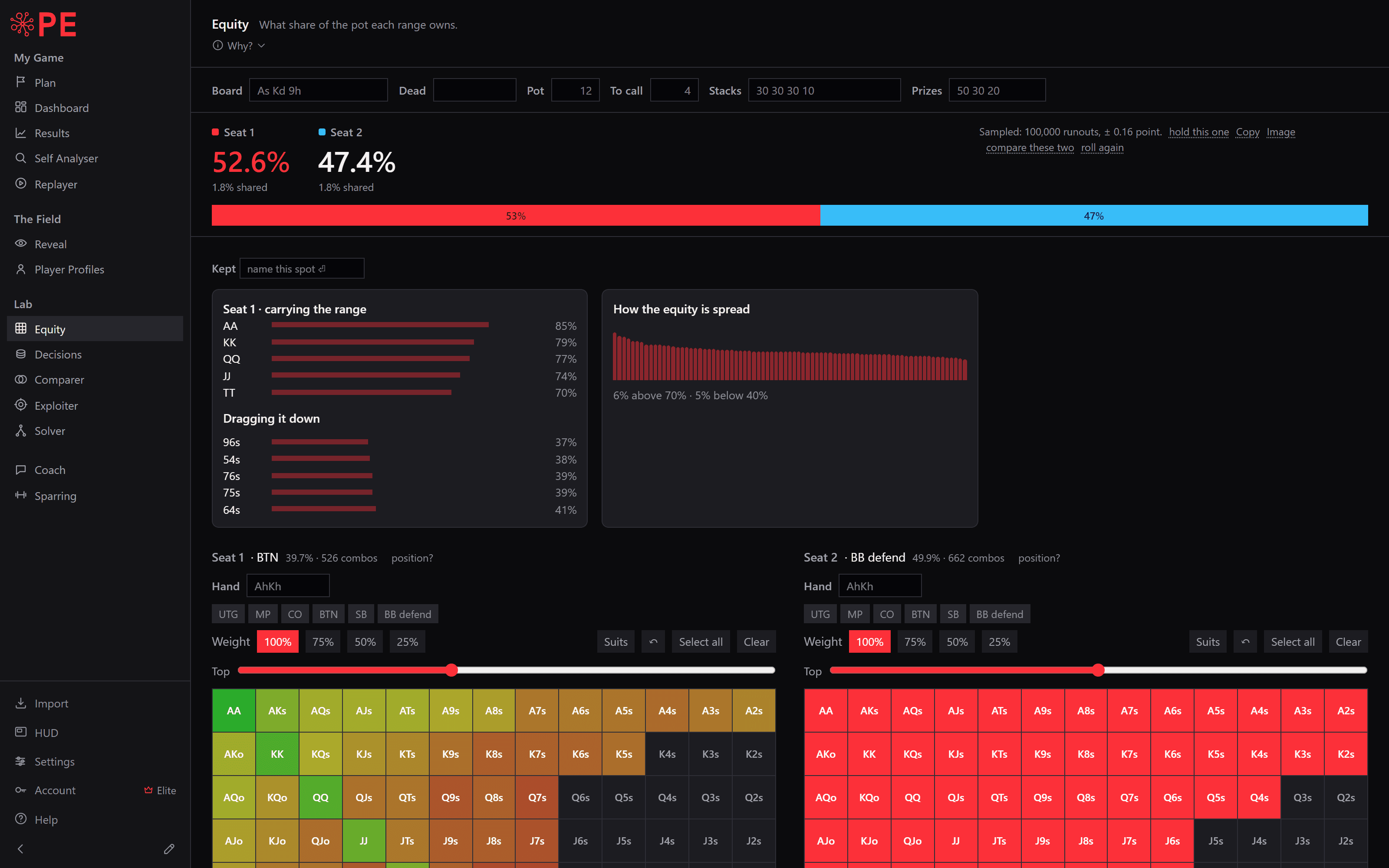
If you want to sanity check a draw, the Equity module lets you compare your hand or range against another hand or range and see a close estimate of your share of the pot over many runouts.
That is a good way to test whether the outs you counted really hold up against a realistic range, especially when some of them are dirty.
Final takeaway
Counting outs is not just a memorization exercise.
It is a decision tool.
If you can:
- identify the cards that help you,
- count them once,
- discount the dirty ones,
- and apply the right shortcut for flop or turn,
then you will make far better decisions with draws.
That is one of the fastest poker skills to learn, and one of the easiest to profit from once it becomes second nature.
Do it on your own hands.