
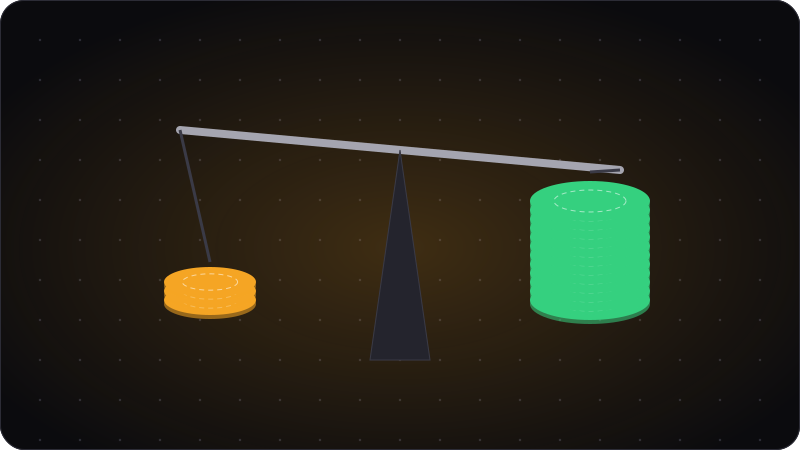
Pot odds are the price the pot offers you for a call.
That sounds simple, because the core idea is simple. But many players still miscount the money in the pot, forget to include the call itself, or compare the wrong number to their hand strength.
Once you understand pot odds, you can use them on the flop, turn, river, and preflop.
What pot odds mean
Pot odds tell you what price you are getting when you consider calling a bet.
If someone bets, you have choices. You can fold, call, or sometimes raise. Pot odds are the part of the decision that answers: if I call, how much do I need to win for that call to make sense?
The bigger the pot is compared with the call, the better the price you get.
That is why pot odds matter so much. A hand does not need to be a favorite to be a good call. It only needs enough equity for the price you are being offered.
The core idea
A call is profitable if your equity is higher than the break-even equity required by the pot.
That is the whole game.
The formula for pot odds
The cleanest way to think about pot odds is as a percentage.
Step 1: Find the amount you must call
This is your risk.
Step 2: Find the final pot if you call
Final pot = current pot + your call
Step 3: Divide the call by the final pot
Required equity = call / final pot
Example
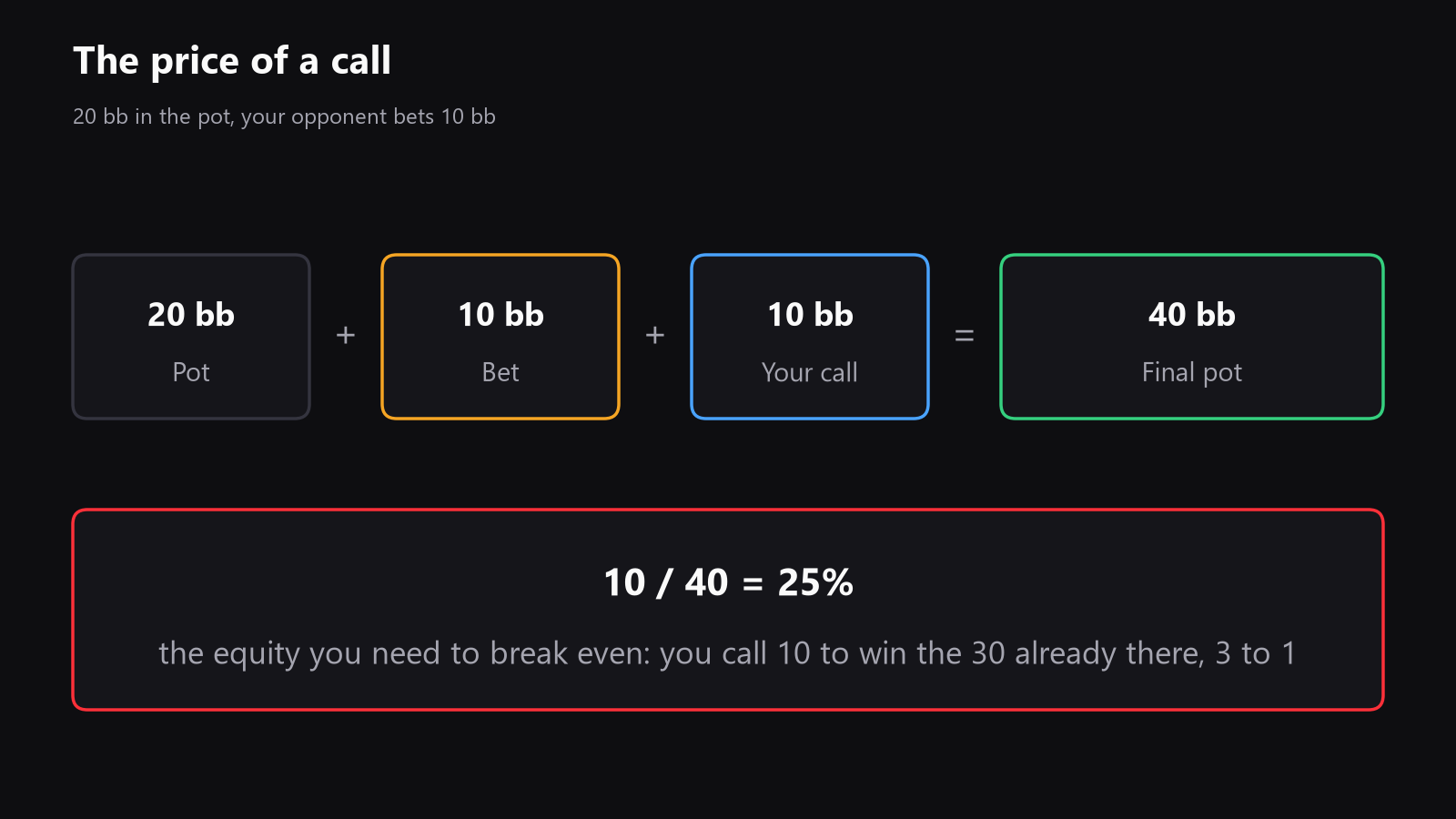
Suppose there is 20 bb in the pot, and your opponent bets 10 bb.
- You must call 10 bb
- If you call, the final pot will be 40 bb
- Your break-even equity is 10 / 40 = 25%
So if your hand or range has more than 25% equity, the call is profitable in chip EV. If it has less, the call is a fold.
Pot odds as a ratio
Players also talk about pot odds as a ratio.
In the same example, you are calling 10 bb to win the 30 bb already in the middle before you call. That is why you may hear the spot described as 3 to 1.
This is normal, but it is also a source of confusion.
To avoid mistakes, use the percentage when you can:
- Call 10, final pot 40, need 25%
- Call 50, final pot 200, need 25%
- Call 100, final pot 300, need 33.3%
The percentage is harder to misread than the ratio.
Common pot odds you should know by heart
Here are the most useful ones.
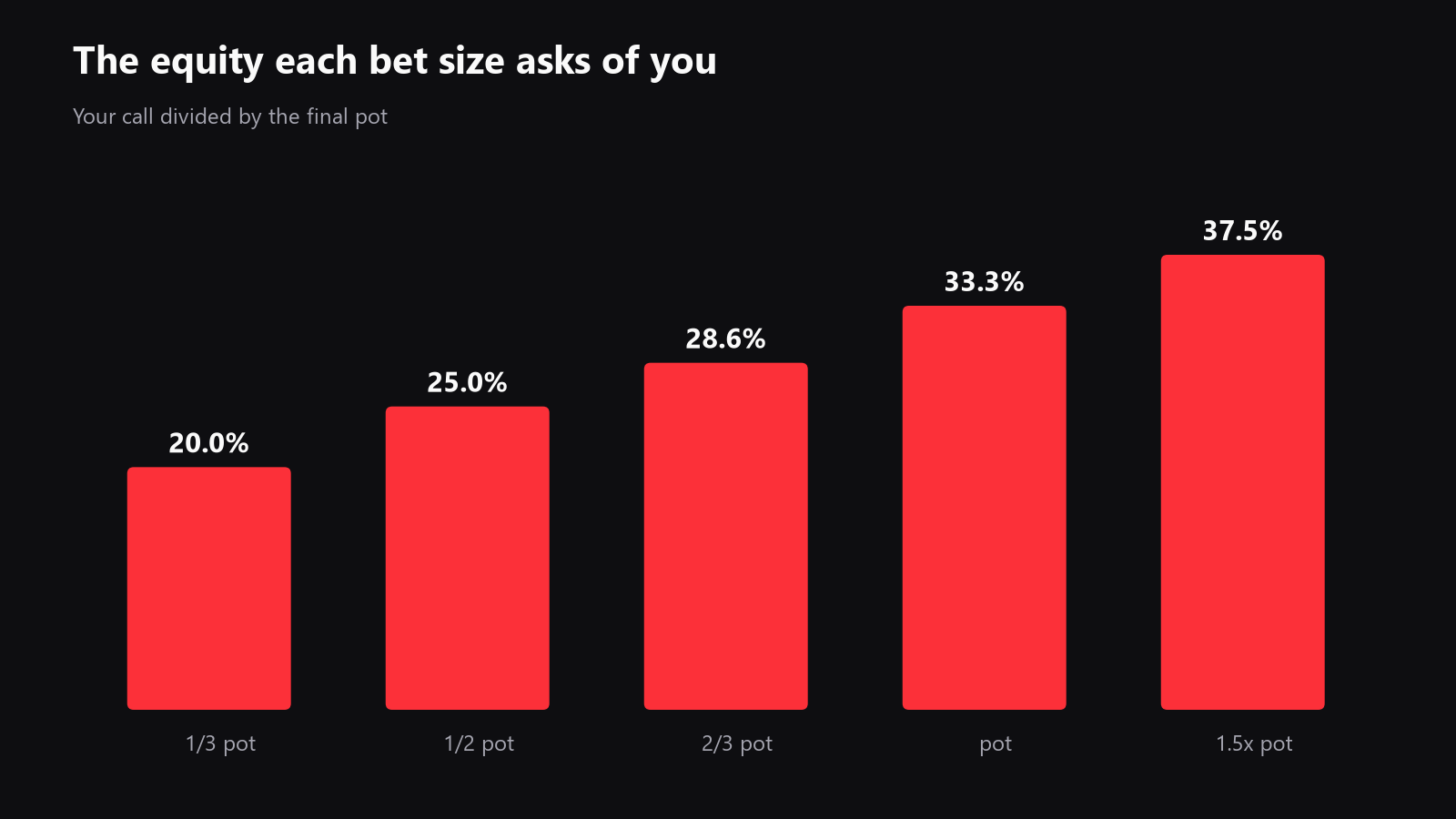
| Villain’s bet size | You must call | Final pot if you call | Equity needed |
|---|---|---|---|
| 1/3 pot | 0.33 pot | 1.66 pot | 20.0% |
| 1/2 pot | 0.50 pot | 2.00 pot | 25.0% |
| 2/3 pot | 0.67 pot | 2.34 pot | 28.6% |
| Pot | 1.00 pot | 3.00 pot | 33.3% |
| 1.5x pot | 1.50 pot | 4.00 pot | 37.5% |
A few quick conclusions:
- A half-pot bet gives you a 25% price
- A pot-sized bet gives you a 33.3% price
- A bigger bet asks for more equity, not less
How to compare pot odds with your equity
Pot odds alone do not tell you whether to call. You also need your equity.
What equity means
Equity is your share of the pot if all the cards are dealt and no more money goes in.
If you have 35% equity against your opponent’s range, that means you would win the pot about 35% of the time in the long run, given that exact situation.
The decision rule
- If your equity is higher than the required equity, call
- If your equity is lower than the required equity, fold
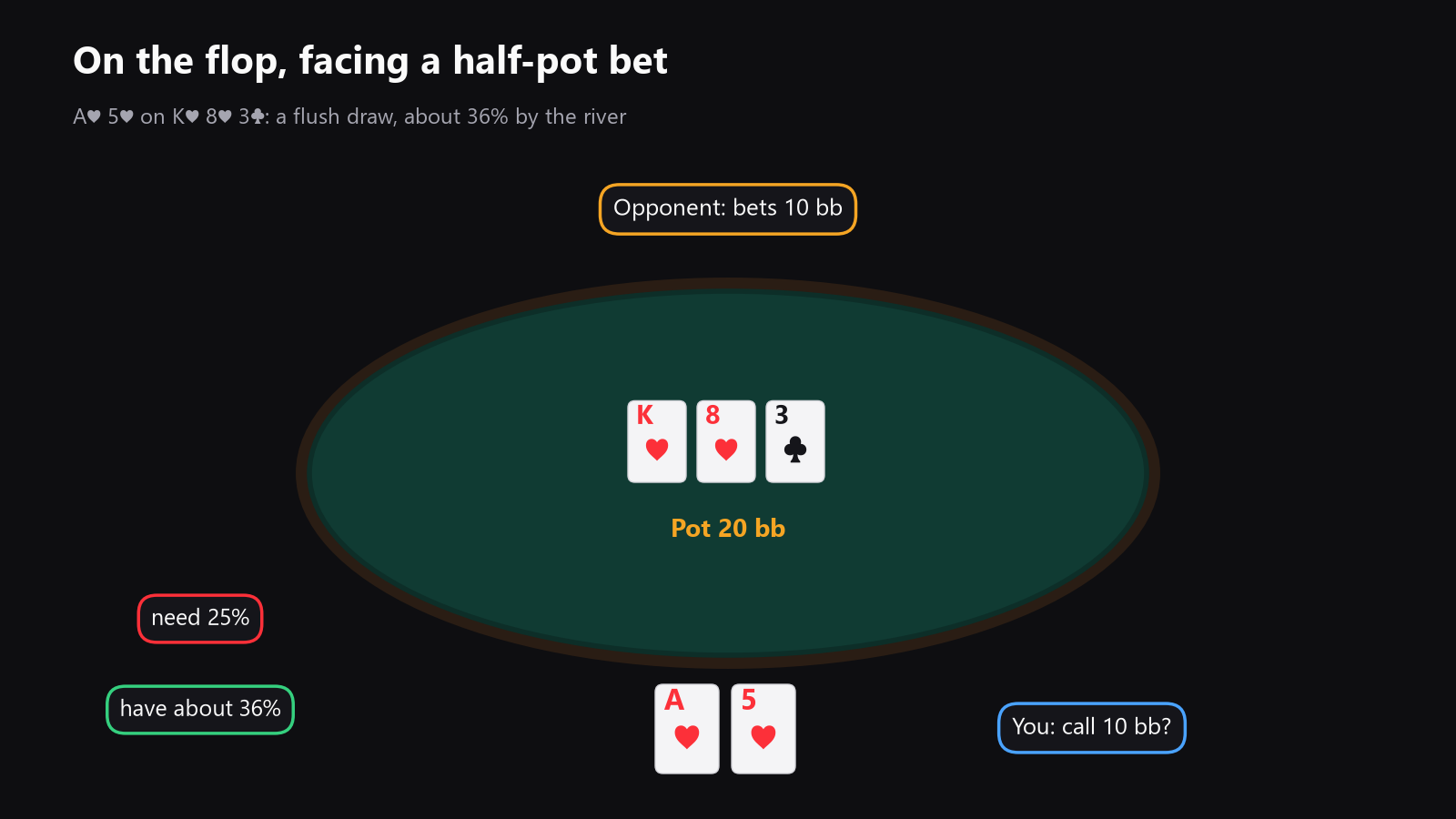
Example 1: Flush draw versus a half-pot bet
You have a flush draw on the flop. You estimate that your hand has around 36% equity by the river.
Villain bets half pot.
- Required equity: 25%
- Your equity: about 36%
That is a clear call in chip EV.
Example 2: Weak draw versus a pot-sized bet
You face a pot-sized bet.
- Required equity: 33.3%
If your draw only has around 25% equity, it is not enough. Fold.
Example 3: Turn spot
On the flop, you might have plenty of equity because you still have two cards to come.
On the turn, you only have one card to come. Your equity is much lower.
That is why the same draw can be a call on the flop and a fold on the turn.
Pot odds and outs
If you do not know your exact equity, you can use outs as a quick estimate.
A common shortcut is:
- On the flop, outs x 4 gives you a rough percentage by the river
- On the turn, outs x 2 gives you a rough percentage to the river
Example
You have 9 clean outs on the flop.
- Rough equity: 9 x 4 = 36%
Now compare that to the price:
- Against a half-pot bet, you need 25%
- Against a pot bet, you need 33.3%
In that kind of spot, you often have enough equity to continue.
But this shortcut is only a shortcut. Clean outs are not always clean, and raw equity is not always the same as realized equity.
Pot odds are not the whole story
This is where good players separate from automatic callers.
1. Implied odds
Sometimes you can win more money later when you hit your hand.
That matters a lot for hands like small pairs or draws in deep-stacked cash games. A call that looks thin now can become good if you win a big pot later.
2. Reverse implied odds
Sometimes you hit your hand, but you still lose money because your hand is second-best too often.
That happens when you make dominated top pair, a weak flush, or a straight on a board that can easily be beaten.
3. Rake
In small stakes cash games, rake matters a lot.
A call that is only barely profitable before rake can become bad after rake. Thin preflop calls and marginal flop calls are especially sensitive to this.
4. Future betting
Pot odds are exact only when the decision is effectively final, as on many all-in spots or river calls.
On earlier streets, you also have to think about what happens next. If you call now and face another big bet later, your hand may not realize its full equity.
A fast way to think at the table
When you face a bet, ask yourself these four questions:
- How much do I have to call?
- What will the final pot be if I call?
- How much equity does my hand have against this range?
- Does rake, implied odds, or reverse implied odds change the answer?
If you can answer those four questions, pot odds stop being abstract and become a practical decision tool.
Common mistakes with pot odds
Here are the mistakes that show up most often.
Forgetting to include your call in the final pot
If you call, your money goes into the pot too. Do not compare your call only to the money already there.
Comparing pot odds to hand strength instead of equity
A hand can look weak and still have enough equity to call. A hand can look strong and still be a fold if the price is too high.
Ignoring the number of cards to come
A flop draw and a turn draw are not the same spot.
Ignoring range strength
Your equity is not against one random hand. It is against your opponent’s range.
Ignoring rake
This is a big one in micro and small stakes games.
Pot odds in real poker
You do not need to solve every spot exactly at the table. You only need to get close enough often enough.
A strong player knows when a call needs 25%, when it needs 33%, and when it needs 40%. That already eliminates a huge number of mistakes.
If you want to go one step further, compare your estimated equity against your opponent’s range, not just a vague hand class. For example, a flush draw against one pair is not the same as a flush draw against a made flush or a set with redraws.
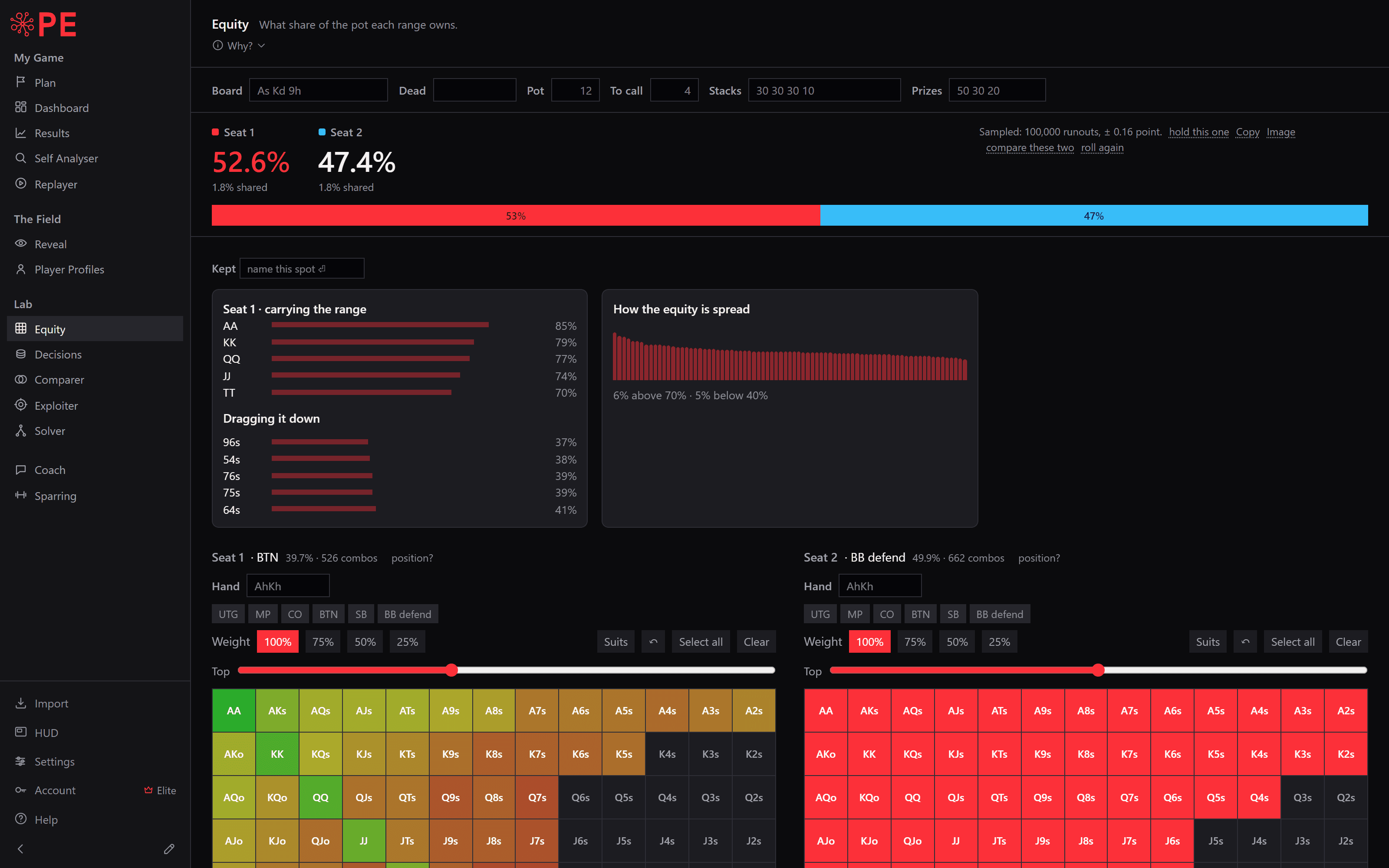
That is where study tools become useful. The Equity module computes equity over 100,000 runouts, so you can check how a hand or a range stands against another one. The Dashboard shows your win rate, your margin, your money won in big blinds, your rake per 100 hands, and the number of hands you have played, so you can keep your results and your cost structure in view while you work on the spots that matter.
The short version
Pot odds answer one question:
Is the price of this call good enough for the equity I have?
If the answer is yes, call. If the answer is no, fold.
That is the whole idea, and it is one of the most important habits in poker.
If you want, I can also turn this into a more visual version with a stronger opening example, or expand it with a separate section on implied odds and reverse implied odds.
Do it on your own hands.