
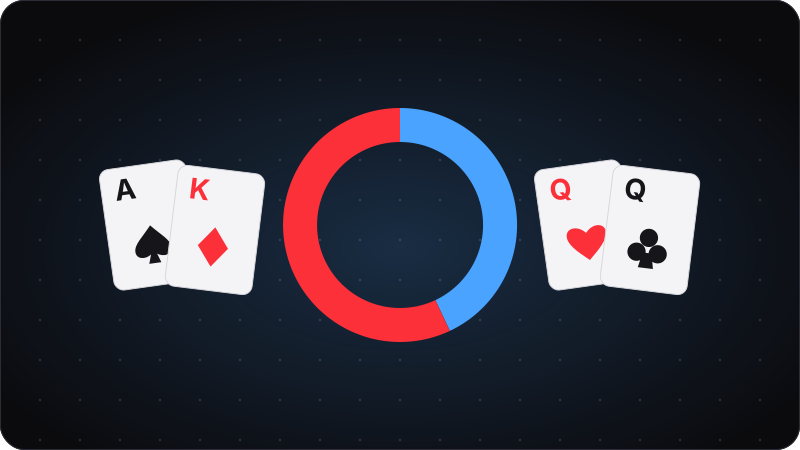
Poker equity is your share of the pot. If the hand runs to showdown from this point, equity tells you how often you win, how often you lose, and how often you split.
That sounds simple, but most mistakes start here. Players often talk about a hand being “strong” or “weak” when what matters is whether it has enough equity against the hands that actually continue. A top pair can have huge equity against one hand and mediocre equity against a range. A draw can look fragile and still have excellent equity once you count all the ways it can improve.
What equity really means
The cleanest definition is this:
Equity = the fraction of the pot you expect to win if all remaining cards are dealt and everyone reaches showdown.
If you win half a pot in a split, that counts as half a win.
A practical formula is:
Equity = (pots won + 0.5 × split pots) / total runouts
So if your hand has 60% equity, it means that over enough runouts, you win 60% of the pot on average from that spot.
That is not the same as:
- current hand strength
- pot odds
- expected value
- how “nice” your hand looks
Those concepts are related, but not identical.
A hand can have high equity and still be a bad call if the price is too high. A hand can have low equity and still be a good bluff-catcher if your opponent is bluffing often enough. Equity is one piece of the decision, not the whole decision.
Equity against one hand
This is the easiest version. You hold one hand, villain holds one exact hand, and you compare them.
For example:
- an overpair against top pair often has strong equity
- a set against one pair is usually a big favorite
- a flush draw against one made hand often has decent equity because of all the turn and river cards that can improve it
On the table, though, you almost never know the exact hand. That is why the real skill is not just reading the board, but estimating the range.
Still, thinking about one hand is useful because it teaches you what gives equity:
- made hands
- redraws
- overcards
- backdoor draws
- blockers that remove villain’s best continues
A hand with no made value can still have a lot of equity if it has many clean outs. A hand with one pair can lose a lot of equity if the board and action make villain’s better one-pair hands and draws very likely.
Equity against a range
In real poker, villain does not have one hand. Villain has a range.
A range is the set of hands they can have after you see:
- their position
- preflop action
- flop action
- turn action
- river action
- stack depth
- player type
When you ask, “What is my equity here?”, the right question is usually:
What is my equity against the range that reaches this spot and continues this way?
That is a weighted average. Each possible hand in villain’s range has some weight, and your equity against that hand contributes to the total.
This matters because the same board can produce very different equities against different ranges.
Example:
- Your top pair can have good equity against a loose calling range full of worse pairs and draws.
- The same top pair can have poor equity against a tight raising range full of two pair, sets, and strong draws.
- The same draw can be ahead against one range and behind against another.
Range thinking is where many players level up. They stop asking, “What hand does villain have?” and start asking, “What part of their range continues here?”
Why equity changes street by street
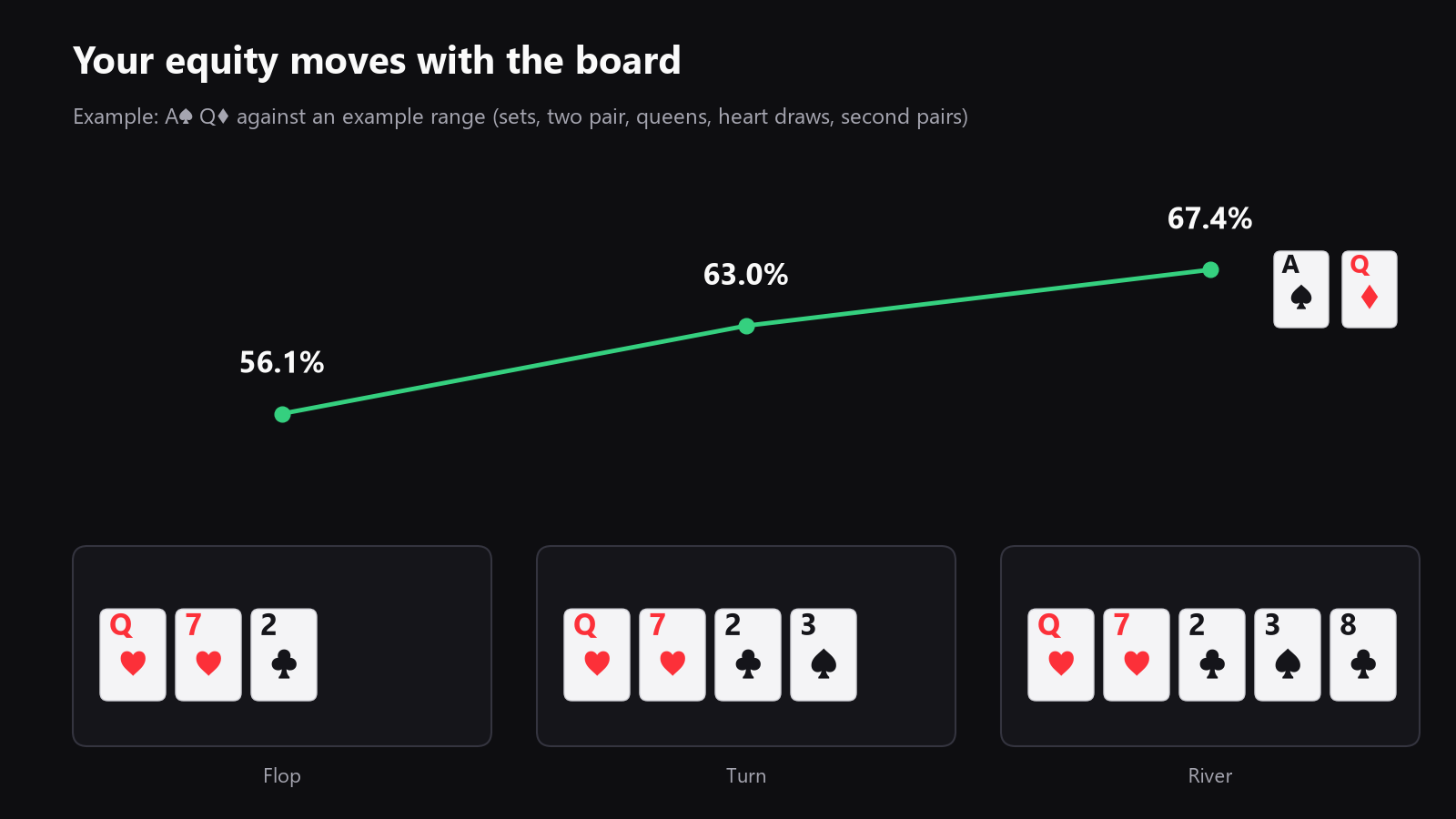
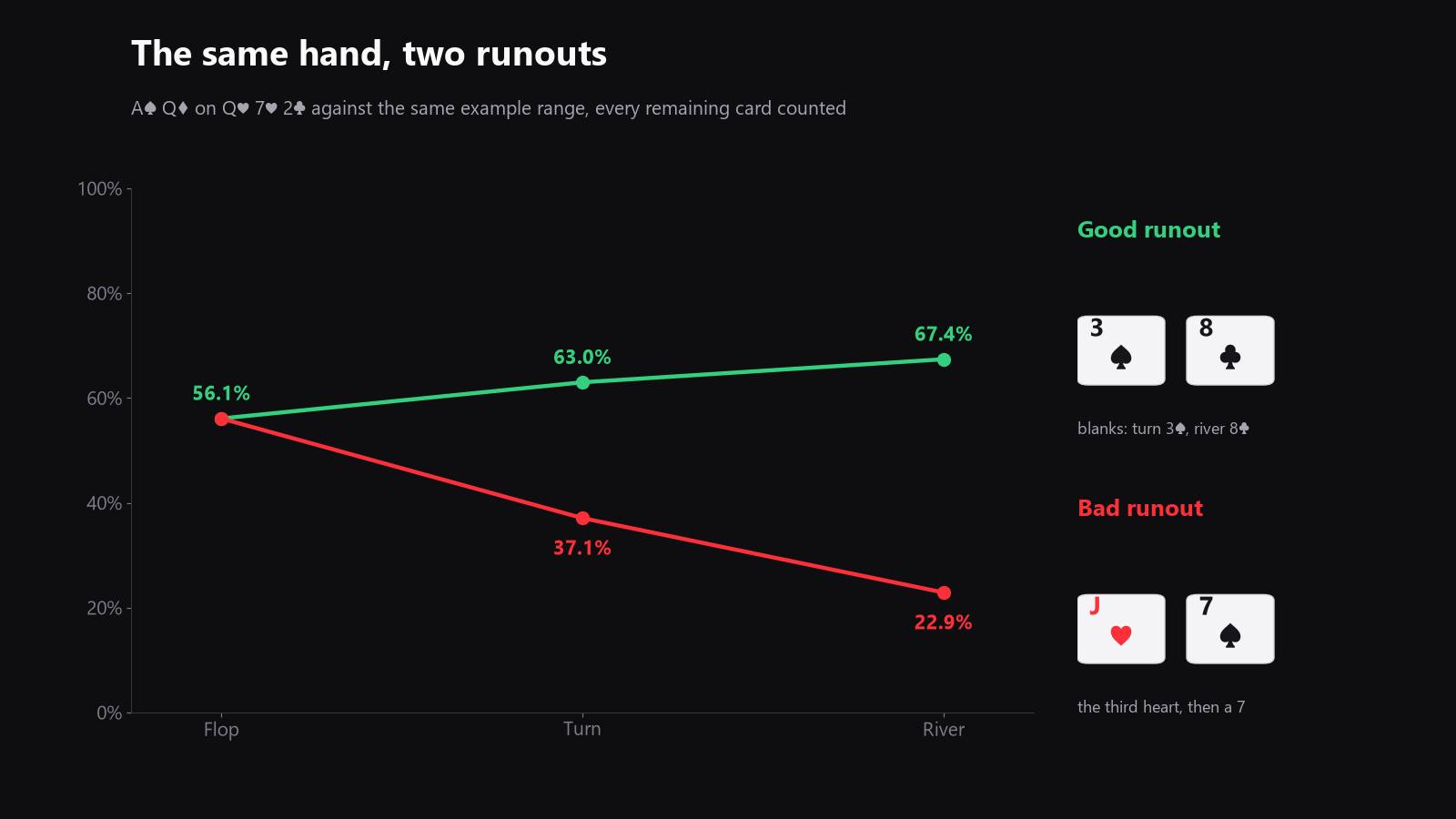
Equity is not fixed. It moves as the board changes and ranges narrow.
On the flop
The flop is where ranges are widest. Equity changes fast because:
- there are many possible turn and river cards
- draws are still alive
- one pair is often not settled
- both players can still have a lot of air
On the flop, backdoor draws matter more than many players think. Two hands that look similar on the surface can have very different equity because one has extra ways to improve.
On the turn
The turn removes one entire street of uncertainty.
That makes ranges narrower and equity more polarized:
- some made hands become much stronger
- some draws pick up extra equity
- some bluff-catchers lose value
- some “safe” cards are not safe at all if they complete the part of villain’s range you forgot to account for
The turn is also where blockers often become more important. If the obvious flush or straight draw arrives, holding one of the key cards can change how much of villain’s range is still available.
On the river
By the river, there are no more cards to come. Equity becomes pure showdown share if money goes in now.
At this point, the question is usually not “How can I improve?”, but:
- do I beat enough of villain’s range?
- do I lose to too much of it?
- does villain bluff enough for my bluff-catcher to work?
River equity is often simpler, but it is also more brutal. There is no extra card to rescue you.
How to estimate equity at the table
You do not need to solve every spot exactly during the hand. You need a good estimate fast enough to make a decision.
A useful table-side method is this:
1. Start with a range, not a hand
Ask what hands can realistically arrive here after the line you saw.
Preflop position, stack depth, and action should narrow it immediately. A button open and a 3-bet cold call do not mean the same thing as a UTG open and a flop check-call.
2. Separate the range into buckets
Think in groups:
- value hands
- strong draws
- medium-strength hands
- air
This is faster than listing exact combos, and it often gets you close enough.
3. Remove impossible combos
Board cards and your own cards block parts of villain’s range.
If you hold the ace of hearts, some flush draws are impossible. If the board pairs, some full houses and two-pair combinations vanish. These blockers matter more than many players realize.
4. Compare your hand to the range that continues
Now ask:
- How often am I ahead right now?
- How often do I improve?
- How often does villain improve more than I do?
- Which runouts are good for me, and which are good for them?
5. Compare equity to the price
If you are calling, compare your equity to the pot odds.
If the pot lays you 4-to-1, you need about 20% equity before rake. If the pot lays you 2-to-1, you need about 33%.
At small stakes, rake can matter a lot. A thin call that looks fine before rake can become a fold once rake is included.
Fast rules that help, and where they fail
These shortcuts are useful, but only if you know their limits.
- Overpairs are usually strong on dry boards.
- Top pair is much better on dry boards than on connected, wet ones.
- Draws gain value when they have more clean outs.
- Paired boards reduce some straight and flush possibilities.
- Monotone boards make suit blockers much more valuable.
- Connected boards favor the parts of ranges that can make straights and strong draws.
The danger is assuming a shortcut is always true. A dry board for one player can be a great board for another if their range is more condensed and stronger.
The difference between equity and realization
This is where many players get confused.
Raw equity is your share of the pot if all cards are dealt and no more decisions matter.
Realized equity is the part of that share you actually get in practice, after betting, folding, raising, and future streets.
For example:
- a hand can have decent raw equity but realize poorly out of position
- a hand can have modest raw equity but realize well if it can bet and deny equity
- a draw can look large on paper but still lose value if it cannot continue profitably on bad runouts
So when you estimate equity at the table, do not stop at the percentage. Ask how well your hand will turn that equity into actual chips.
A worked example in plain language
Suppose you hold top pair with a good kicker on a flop of Q-7-2.
Against one weak pair, your equity may be very high.
Against a continuing range that includes:
- sets
- two pair
- strong queens
- flush draws
- straight draws
- some stubborn second pairs
your equity is much lower, because the range is no longer one weak hand. It is a mix of hands that already beat you, hands that can improve, and hands you still crush.
That is why “I have top pair” is not enough. You need to know what kind of top pair, on what board, against what range, and facing what action.
The quickest way to check your intuition away from the table
Use your hands away from the table.
If you want a close estimate of the share of the pot for a hand or a range, the Equity module computes it over 100,000 runouts.
If you want to see what players at your limits actually continue with after a line, the Reveal module shows the real frequencies from your own hand histories.
If you want to compare your estimate with a strong baseline on a board, the Solver module shows the equilibrium strategy.
Those tools do not replace the concept. They let you test it on real spots.
The short version
If you remember only one thing, remember this:
- equity is your share of the pot
- against one hand, it is exact
- against a range, it is weighted by how often each hand is actually there
- equity changes as the board runs out and ranges narrow
- at the table, your job is to estimate the range, not just the hand
- then compare your equity to the price, and remember rake
That is the core of poker equity. Everything else is detail, and the detail is where good decisions come from.
Do it on your own hands.