
If you are new to poker, the language can feel like a second game hidden inside the first. A hand history, a forum post, or a tracker screenshot can look cryptic until you know the words.
This glossary is here to fix that.
You do not need to memorize every poker term in one sitting. You just need the core words that show up again and again, explained in plain English, with enough detail to make sense at the table and later in study.
1. The table words you need first
Blinds
The blinds are the forced bets posted before the cards are dealt.
- The small blind is the smaller forced bet.
- The big blind is the larger one.
They create action. Without blinds, everyone could wait forever for premium hands.
Button
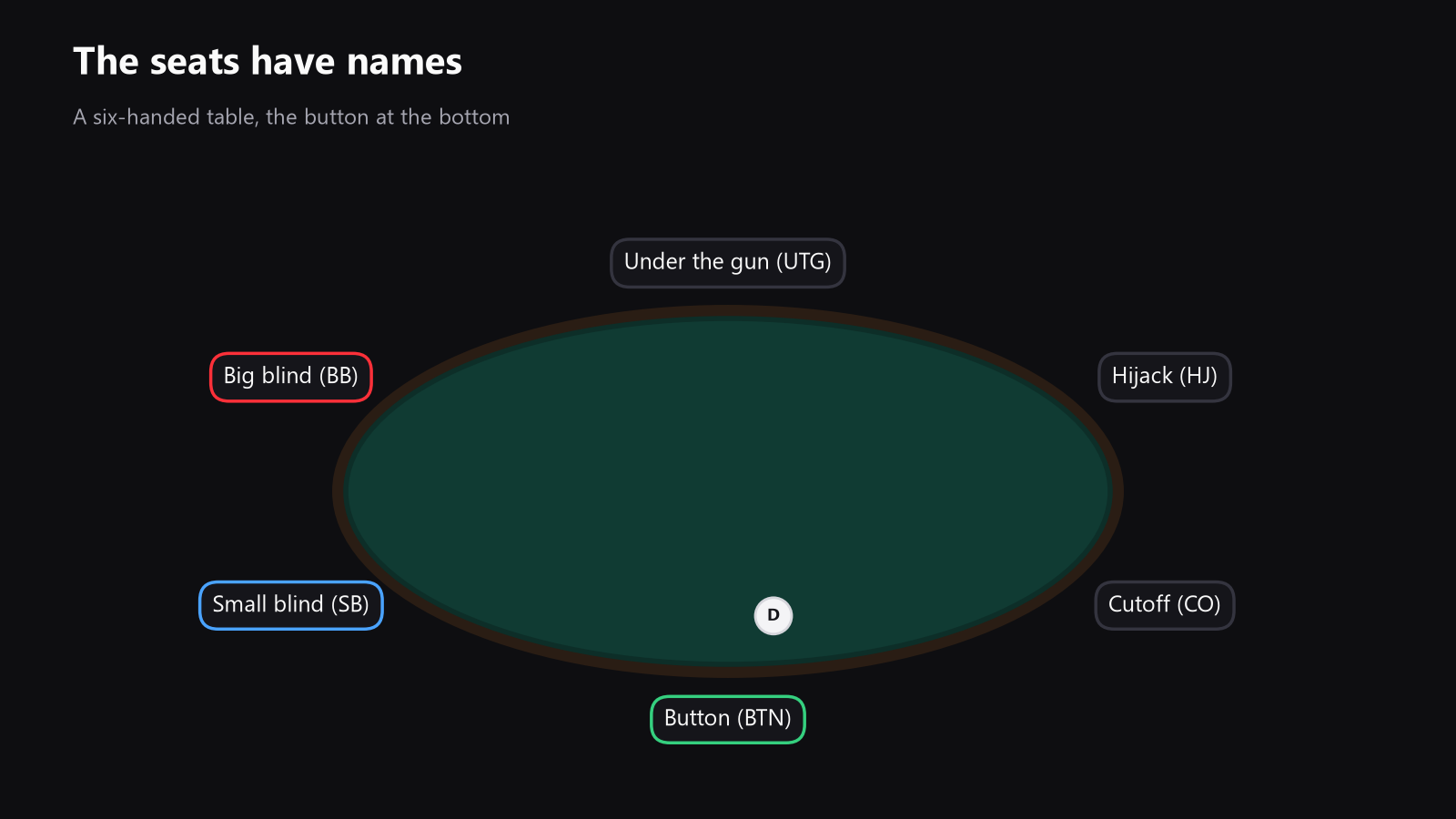
The button is the dealer button, the marker that shows who acts last after the flop. In most hands, the button is the best seat because acting last gives you more information.
Position
Position means where you act in the betting order.
- Acting in position means you act after another player.
- Acting out of position means you act before them.
Poker players care about position because information is power. The later you act, the easier it is to make good decisions.
Common position names
You will often see these abbreviations in hand histories and forum posts:
- UTG: under the gun, first to act preflop
- HJ: hijack
- CO: cutoff, the seat before the button
- BTN: button
- SB: small blind
- BB: big blind
Pot and stack
- The pot is the money in the middle.
- Your stack is the chips you have in front of you.
- The effective stack is the smaller stack involved in the hand, because that is the most either player can win or lose.
Ante
An ante is a small forced contribution from all players before the hand begins. You will see it often in tournaments.
2. The streets of a hand
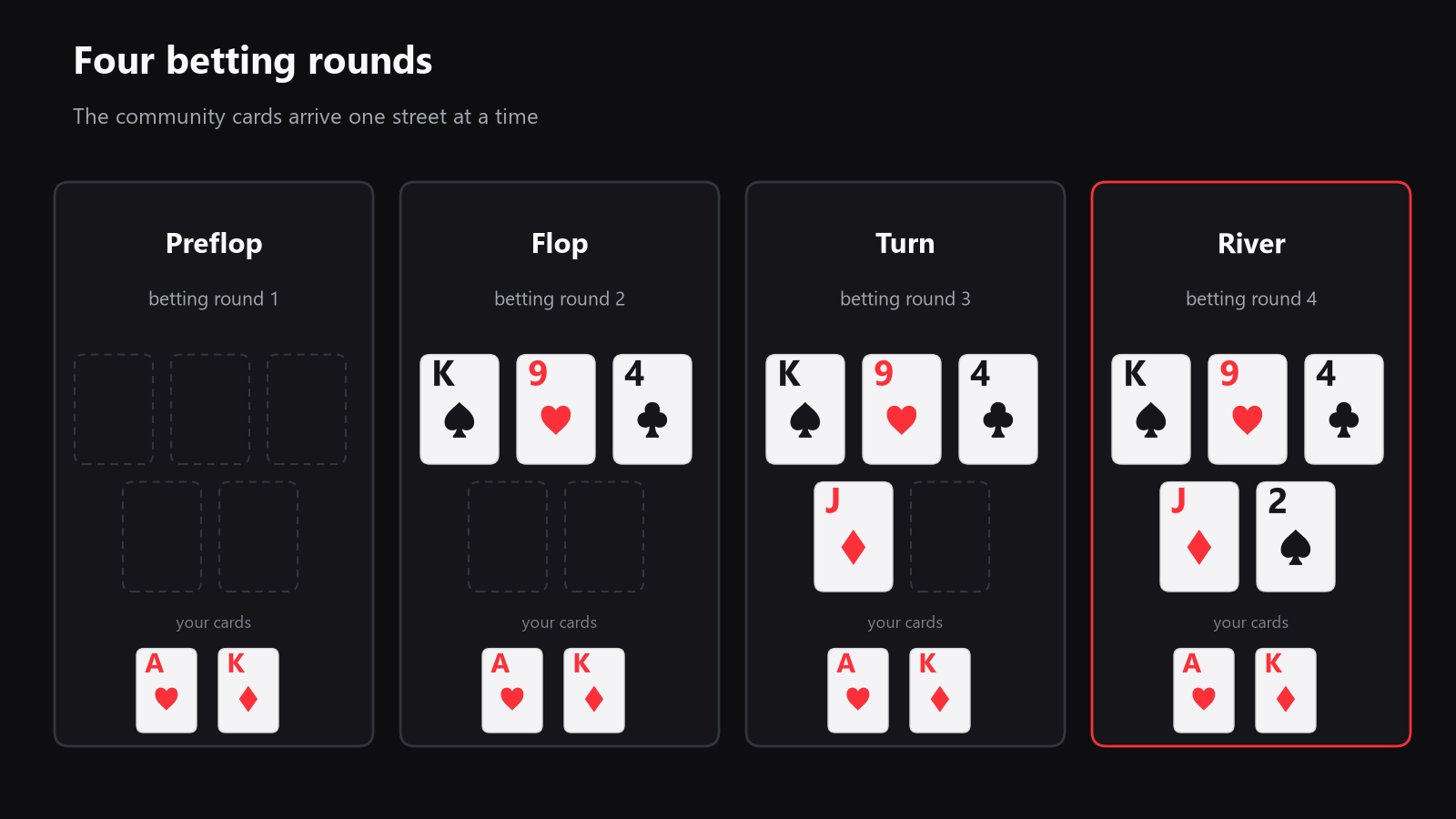
Poker hands are usually described in streets, which are the betting rounds.
Preflop
Preflop is the action before the flop appears. This is where opening ranges, blinds, position and stack size matter most.
Flop
The flop is the first three community cards.
Turn
The turn is the fourth community card.
River
The river is the fifth and final community card.
Board
The board is the shared cards on the table, meaning the flop, turn and river together.
Runout
A runout is the full final board, especially when people discuss what cards completed the hand.
Showdown
Showdown is when the remaining players reveal their cards to see who wins.
Muck
To muck your hand means to throw it away face down without showing it.
3. The actions you will hear all the time
These are the verbs of poker.
Check
To check means to pass the action without betting, when no one has bet yet on that street.
Bet
To bet means to put chips in when no bet has been made yet on that street.
Call
To call means to match the current bet.
Raise
To raise means to increase the current bet.
Fold
To fold means to give up your hand and stop competing for the pot.
Limp
To limp means to just call the big blind preflop instead of raising. Beginners often limp too much, which usually gives away initiative.
Open-raise
An open-raise is the first raise preflop. If everyone folds to you, your raise is an open.
3-bet
A 3-bet is a re-raise preflop. The name comes from betting order, not from the size of the bet.
Example:
- One player opens
- A second player raises again
That second raise is the 3-bet.
4-bet
A 4-bet is the next re-raise after a 3-bet.
C-bet
A c-bet, short for continuation bet, is when the preflop aggressor bets the flop after taking the lead preflop.
Example: you raise before the flop, your opponent calls, and then you bet the flop. That is a c-bet.
Check-raise
A check-raise is when you check, then raise after an opponent bets.
All-in
To go all-in means to put all your chips into the pot.
Donk bet
A donk bet is a lead into the preflop raiser on the next street. You will hear the word, but the important idea is simple: someone out of position bets before the player who was expected to continue the aggression.
Side pot
A side pot appears when players have different stack sizes and one player is all-in. It allows the hand to continue for the chips still behind among the other players.
4. A hand history in plain English
If you can read a hand history, you can read most forum posts.
``text UTG opens to 3 bb CO calls Button 3-bets to 11 bb UTG folds CO calls Flop: Q♠ 7♦ 2♣ Button c-bets 8 bb CO folds ``
What this says:
- UTG opens to 3 bb: the first player raises preflop to 3 big blinds.
- CO calls: the cutoff matches the raise.
- Button 3-bets to 11 bb: the button re-raises preflop.
- Flop: Q♠ 7♦ 2♣: three community cards are dealt.
- Button c-bets 8 bb: the button, who was the preflop aggressor, bets again on the flop.
That line by line reading is the foundation of poker vocabulary.
5. Starting hands and ranges
Hand
A hand is your two private cards.
Pocket pair
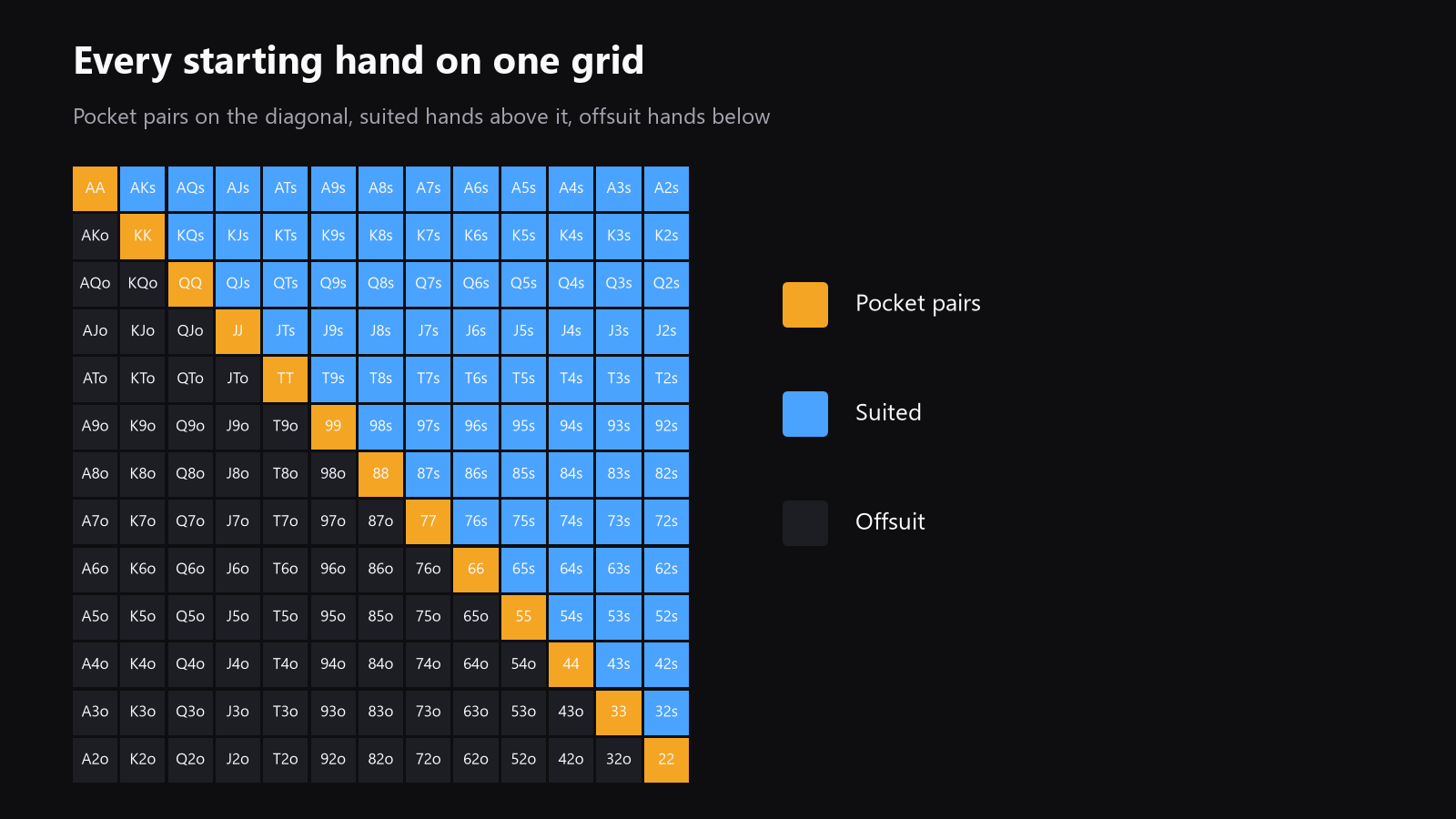
A pocket pair is two cards of the same rank, like 8-8 or A-A.
Suited
Two cards are suited when they share the same suit, like A♠ K♠.
Offsuit
Two cards are offsuit when they are not the same suit, like A♠ K♦.
Connector
A connector is a hand with consecutive ranks, like 7-8 or J-Q.
Range
A range is the set of hands a player could have, not just one exact hand.
This is one of the most important poker ideas. Good players do not think only in one hand. They think in ranges.
13x13 grid
The 13x13 starting-hand grid is a visual way to map all preflop hands. It helps you see where hands sit in a range and how wide or narrow a strategy is.
Board texture
Board texture means how the community cards interact with possible hands.
- A dry board has few draws, like K-7-2 rainbow.
- A wet board has many draws, like J-T-9 with two hearts.
- A paired board has a pair on the board, like Q-Q-6.
Board texture matters because the same hand can be strong on one board and weak on another.
6. The numbers you will see in a tracker or HUD


HUD
A HUD, short for heads-up display, is a panel that shows statistics during play. It does not tell you what to do. It only shows what the numbers say about a player’s past hands.
If you later use a HUD, the first stats you will meet are usually these:
VPIP
VPIP means voluntary put money in pot. It measures how often a player enters a pot before the flop, by calling or raising.
- Low VPIP: tight player
- High VPIP: loose player
PFR
PFR means preflop raise frequency. It measures how often a player raises preflop.
A big gap between VPIP and PFR often means the player calls a lot and raises less often.
3-bet
In stats, 3-bet usually means how often someone re-raises preflop.
Fold to 3-bet
Fold to 3-bet shows how often a player gives up after facing a 3-bet.
C-bet
In stats, c-bet usually means how often a player continuation-bets on the flop after being the preflop raiser.
Fold to c-bet
This stat shows how often a player folds when facing a flop c-bet.
bb/100
bb/100 means big blinds won per 100 hands. It is one of the standard ways to describe poker win rate.
For example, if you win 4 bb/100, that means you win 4 big blinds every 100 hands on average.
Rake
Rake is the fee the poker room takes from the pot or through tournament fees. It is part of the cost of playing, and it matters a lot at micro and small stakes.
Sample size
Sample size is the number of hands you have played. Small samples can mislead you badly. A short winning stretch does not always mean you are beating the game, and a short losing stretch does not always mean you are playing badly.
EV
EV means expected value. In poker, you will often see all-in EV, which estimates what your result would look like if luck on all-in hands were neutral.
These terms are why a tracker is useful. The Dashboard module turns hands into results, win rate, and rake, while the Self Analyser module helps you see which situations actually cost you the most.
7. Words about player types
Tight and loose
- Tight players play fewer hands.
- Loose players play more hands.
Passive and aggressive
- Passive players call more than they bet or raise.
- Aggressive players bet and raise more often.
These four words are used everywhere because they are simple and powerful. A player can be tight and aggressive, loose and passive, and so on.
Nit
A nit is an extremely tight player, often too tight to be dangerous in many spots.
Fish
A fish is a weak player, usually one who makes repeated mistakes. The word is slang, but you will hear it often in poker rooms and forums.
Reg
A reg is short for regular, someone who plays often and knows the game.
Whale
A whale is a very weak player who often loses a lot. The word is slang and can sound rude, so use it carefully.
8. Words about emotion, luck and bad decisions
Tilt
Tilt is a mental state where emotion hurts your decisions. After a bad beat or a frustrating session, many players start playing worse without noticing.
Variance
Variance is the natural swing between short-term results and long-term expectation. In poker, you can play well and still lose for a while.
Downswing and upswing
- A downswing is a period of bad results.
- An upswing is a period of good results.
Run good and run bad
- Run good means to get lucky.
- Run bad means to get unlucky.
Cooler
A cooler is a situation where both players have strong hands and the loser could have done very little differently.
Spew
To spew is to throw chips away with bad, often emotional, decisions.
Grind
To grind is to play many hands or many sessions, usually with discipline and repetition.
9. Study words you will see on forums
Hero and villain
In a hand history, Hero means you, and Villain means the opponent.
Spot
A spot is a specific situation in a hand.
Line
A line is the sequence of actions a player takes, such as check-call, bet-bet-fold, or raise-call-check.
Fold equity
Fold equity is the chance that your bet makes the other player fold. It matters a lot when you bluff or semi-bluff.
Equity
Equity is your share of the pot on average if the hand runs out from here.
Outs
Outs are the cards that can improve your hand to what is likely the winner.
Pot odds
Pot odds are the price you are getting to call compared with the size of the pot you can win.
GTO
GTO means game theory optimal. It describes a balanced strategy that is hard to exploit. You will hear it often in study discussions and solver conversations.
10. A simple way to learn the vocabulary faster
The easiest way to learn poker terms is to read real hands slowly.
Take one hand history and translate it into normal language:
- Who opened?
- Who called?
- What was the flop?
- Who bet?
- Who folded?
Once you can answer those five questions, most poker jargon starts to make sense.
If you then review your own hands, the words stop being only words. VPIP, PFR, 3-bet, bb/100, rake and sample size become signals. That is the point where study becomes practical, and where tools like a HUD, Results and the Self Analyser module can save you time by turning your own hands into something you can actually read.
Do it on your own hands.