
If you are starting out in no-limit hold'em cash games, the first thing to learn is not how to bluff. It is which hands to enter the pot with.
Most beginners lose money because they play too many hands from the wrong seats. The fix is simple: play tight early, wider late, and let position do a lot of the work for you.
If you are searching for a clear answer to "which starting hands should I play?", here it is:
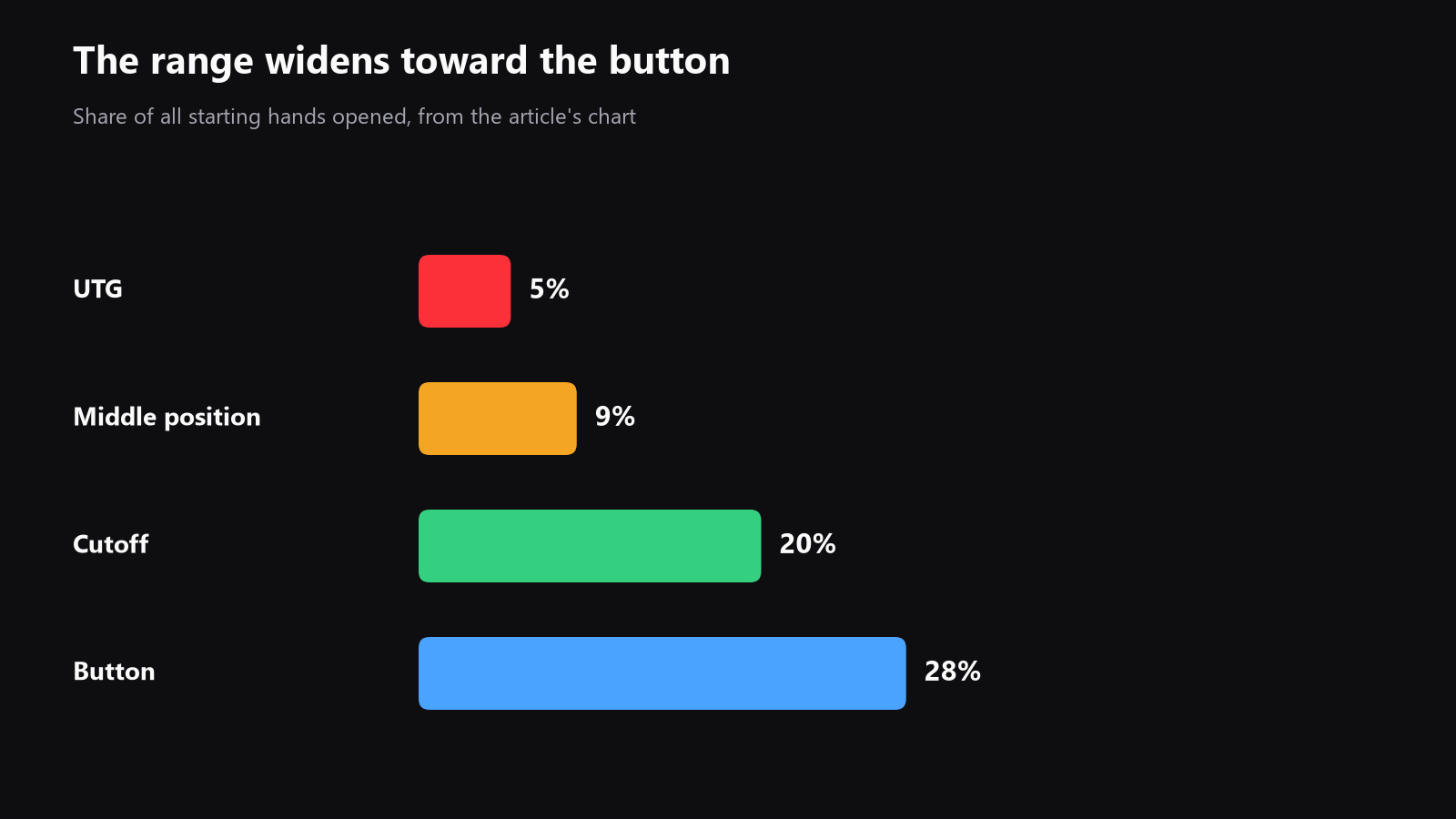
- Early position: mostly strong pairs, strong aces, and strong broadways.
- Middle position: a little wider, but still disciplined.
- Late position: add more suited hands, more connected hands, and more playable broadways.
- Blinds: defend carefully, not automatically.
The one rule that changes everything: position
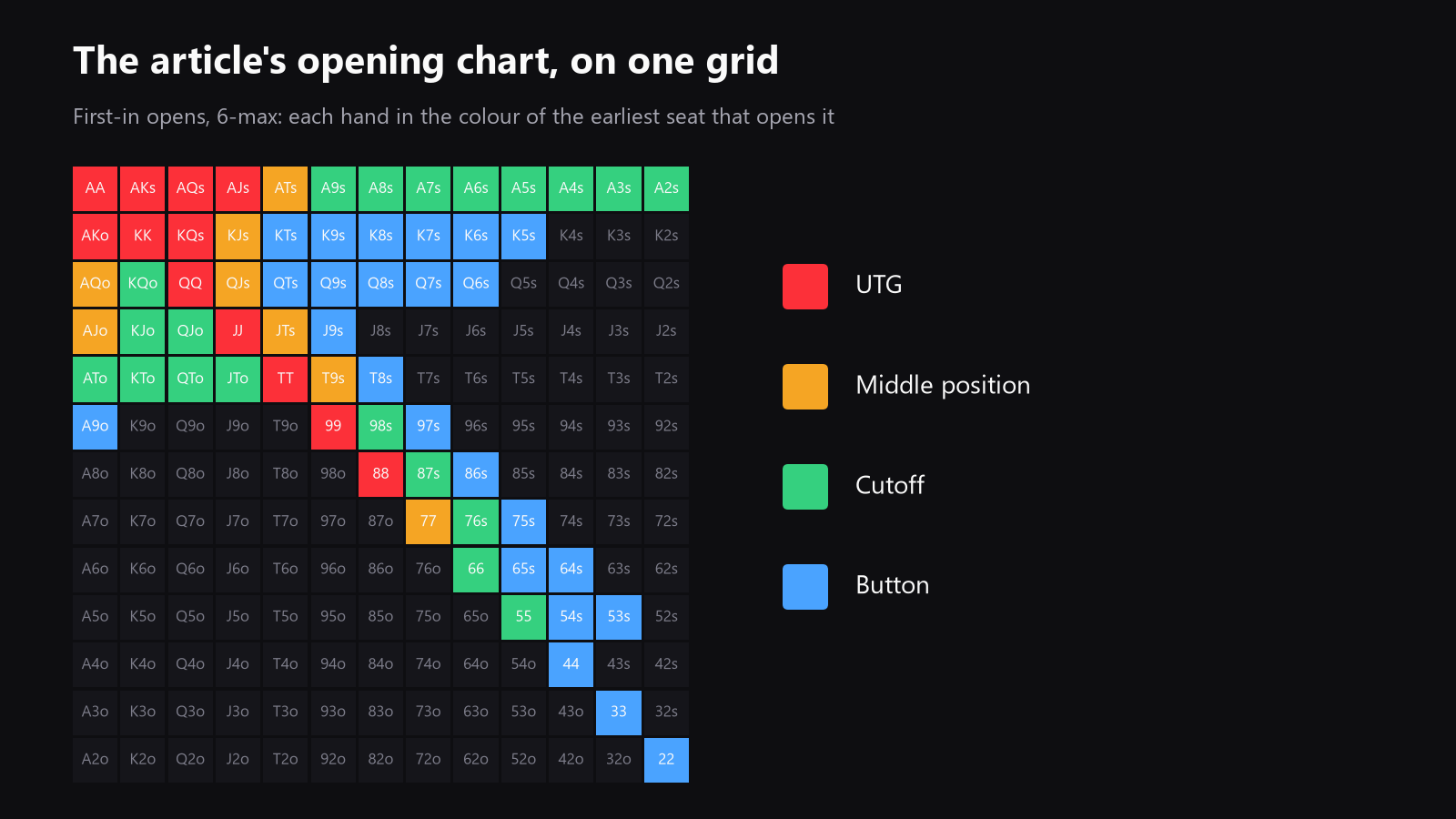
Position means when you act in the hand.
If you act first, you have less information. If you act last, you see what everyone else does before you choose. That sounds small, but it changes almost everything about preflop hand selection.
A hand like KTs can be a fold under the gun and a fine open on the button. A hand like 76s is usually weak early, but it gains value late because it can make strong, hidden hands and you can realize its equity better.
A beginner-friendly starting hand chart
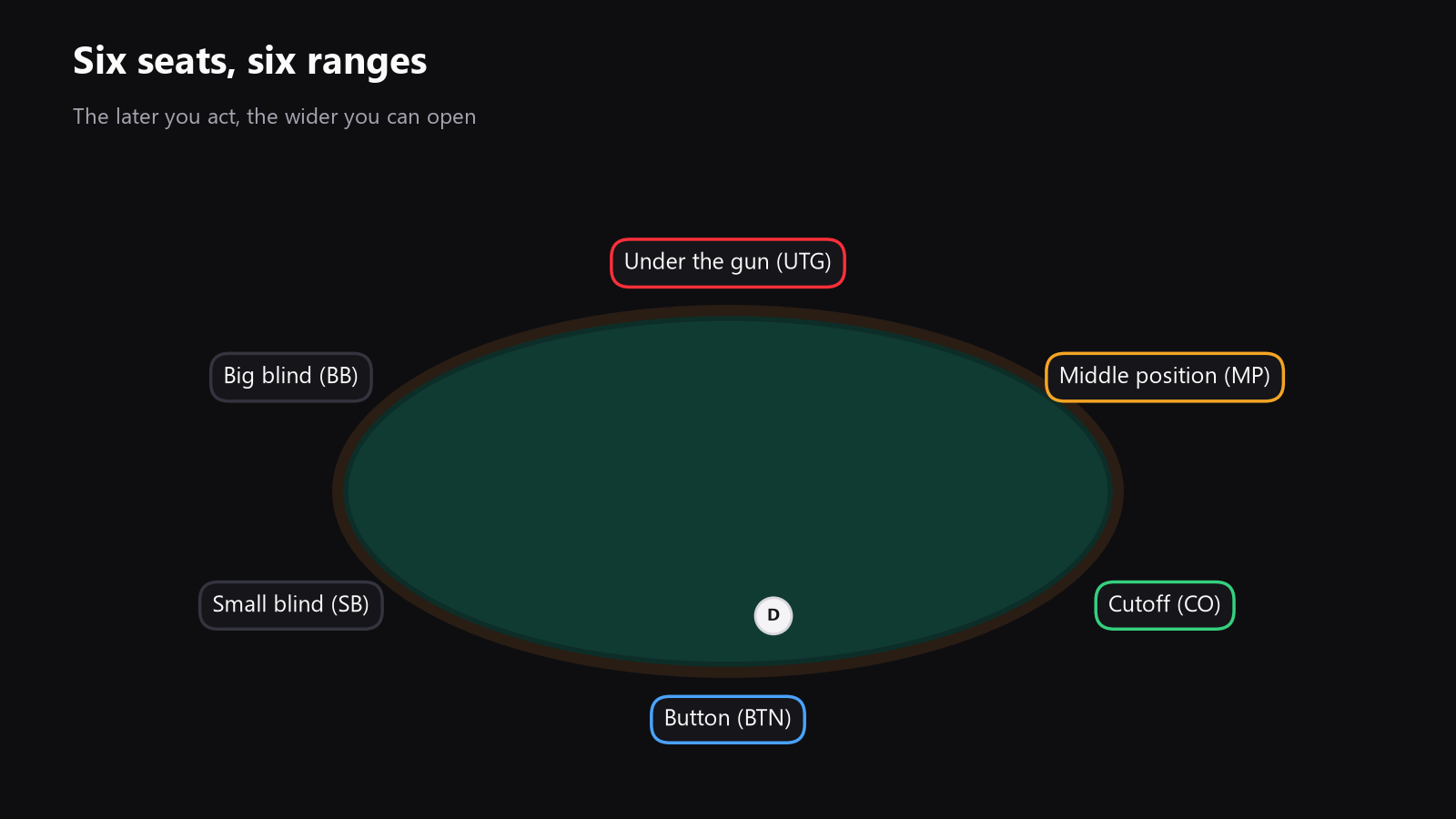
The table below is a safe starting point for cash games, especially if you are learning 6-max. If you play full-ring, tighten the first two positions a bit more.
| Position | Good beginner opens |
|---|---|
| UTG, first to act | 88+, AQs+, AKo, AJs+, KQs |
| Middle position | 77+, ATs+, AJo+, KQs, KJs, QJs, JTs, T9s |
| Cutoff | 55+, A2s+, ATo+, KTo+, QTo+, JTo, KQo, QJo, KJs+, QJs+, JTs, T9s, 98s, 87s, 76s |
| Button | 22+, any ace suited, A9o+, most kings suited, KTo+, most queens suited, QTo+, JTo, KQo, QJo, suited connectors from 54s up, suited one-gappers |
| Small blind, folded to you | Similar to cutoff, but a little tighter, because you are out of position against the big blind |
Important: this table is for first-in opens. If someone has already raised, your range should shrink.
If you only keep one idea from this section, keep this one: early position is for value, late position is for playability.
Why some hands move up or down with position
1. Pocket pairs like more freedom when stacks are deep
Small and medium pairs, like 22 through 99, can win big pots when they hit a set. But they also miss the flop often, so they work best when you can get paid well enough.
That is why pocket pairs become more useful when:
- stacks are deeper,
- you have position,
- there are fewer players left to act.
A pair like 55 is not exciting, but in the cutoff or on the button it can be a profitable open. Under the gun, it is often too thin for a beginner.
2. Suited hands play better than offsuit hands
Suiting gives you a chance to make flushes and stronger draws. More importantly, suited hands usually play more smoothly postflop.
Compare these two hands:
- KQs
- KQo
They look similar, but KQs plays much better because it can make nut flushes and stronger flush draws, and it loses fewer large pots when it connects.
That does not mean every suited hand is good. 72s is still a bad hand. Suited does not make a hand strong by itself.
3. Connected hands like to see flops in position
Hands such as JTs, T9s, 98s, 87s and similar hands do well when:
- you are in position,
- stacks are deep enough,
- you can win more than one street when you hit hard.
These hands are not about one pair. They are about making straights, flushes, strong draws, and disguised top pairs.
That is why they are much better on the button than under the gun.
4. Offsuit broadways can look stronger than they are
Hands like KJo, QJo, AJo look attractive because they are high cards. But beginners often overvalue them.
Why? Because they make second-best top pairs a lot. For example:
- KJo runs into KQ, AK, and better kickers.
- QJo runs into AQ, KQ, AJ, and strong overcards.
- AJo is often dominated by AQ and AK.
These hands are much easier to play late in position than early.
The beginner hands to be careful with
A lot of beginners lose money with hands that look playable but are really just traps.
Be careful with:
- Weak offsuit aces: A9o down to A2o
- Weak offsuit kings and queens: K9o, K8o, Q9o, Q8o
- Random offsuit connectors: J8o, T8o, 97o
- Hands that look suited and pretty, but are too weak: 84s, 73s, 62s
- Cold-calling too much in general
If you are unsure whether a hand is good enough, folding is usually the right beginner choice.
A useful rule is this: if a hand is offsuit, weak, and far from the button, you probably do not need it.
What to play from each position
Under the gun
Under the gun means you act first preflop.
As a beginner, keep this range tight. You want hands that are strong enough to survive when several players still have action behind you.
Good examples:
- big and medium pairs,
- strong aces,
- strong broadways.
Hands like A5s, KJo, QTs, 76s may feel playable, but they are usually better saved for later positions.
Middle position
Middle position lets you widen a little, but not by much.
This is where hands like:
- ATs
- AJo
- KJs
- QJs
- JTs
- T9s
start to enter your range more naturally.
You are still not in the safest seat, so do not get carried away just because the hand looks connected or suited.
Cutoff
The cutoff is a very strong seat because you are close to the button and can often apply pressure well. But it is not true that only the button acts after you. Preflop, the button, the small blind, and the big blind are still behind you.
That said, the cutoff is still one of the best places to widen your range. More hands become playable:
- smaller pocket pairs,
- suited aces,
- suited connectors,
- more broadways,
- more suited kings and queens.
If you are a beginner, this is a very good place to start learning how to open a wider range without losing control.
Button
The button is the best seat.
When you are on the button, you can play a wider range because:
- you act last after the flop,
- you realize more of your equity,
- you punish the blinds more often.
This is where suited hands, connected hands, and many broadways become much stronger. A hand that would be a fold early can become a clear open on the button.
If you remember one strategic idea about starting hands, make it this one: the button lets you profit from hands that are too awkward elsewhere.
Small blind
The small blind looks close to the button, but it is not the same thing.
Yes, you are near the end of the action preflop. But after the flop, you are out of position against the big blind.
That means you should generally be a little tighter than you are on the button. Do not copy your button range into the small blind and expect it to work the same way.
What about the blinds facing a raise?
This is where many beginners make their biggest mistake.
When someone opens in front of you, you should not defend just because you already put money in the pot or because the price looks cheap.
From the blinds against a raise:
- continue with strong pairs,
- strong broadways,
- good suited aces,
- some suited connectors in the right spots,
- and fold the rest.
A hand that is okay to open is not always okay to call. Calling out of position is harder and more expensive than it looks.
Three beginner mistakes to avoid
1. Playing too many hands because they look pretty
Hands with two high cards, a suit, or a connector often look more attractive than they are. Beginners tend to remember how nice a hand looks, not how it performs against a real range.
2. Limping instead of raising or folding
As a beginner, limping creates too many vague, hard spots. If you want to enter the pot, usually raise. If the hand is not good enough, fold.
3. Treating all positions the same
This is the biggest leak of all.
The same hand can be a good open on the button and a bad open under the gun. If you flatten every seat into one range, you will end up playing too many weak hands early and not enough good hands late.
A simple way to remember your ranges
Think in hand families:
- Premium pairs and big aces can go almost anywhere.
- Medium pairs like position, especially when stacks are deep.
- Suited broadways gain value as your seat gets better.
- Suited connectors are mostly late-position hands.
- Weak offsuit hands are usually folds.
That is enough to get started.
You do not need to memorize a solver chart on day one. You need a solid structure that keeps you out of trouble while you learn postflop.
How to know if your ranges are actually working
Once you have a baseline, the next step is not to guess. It is to check your own results.
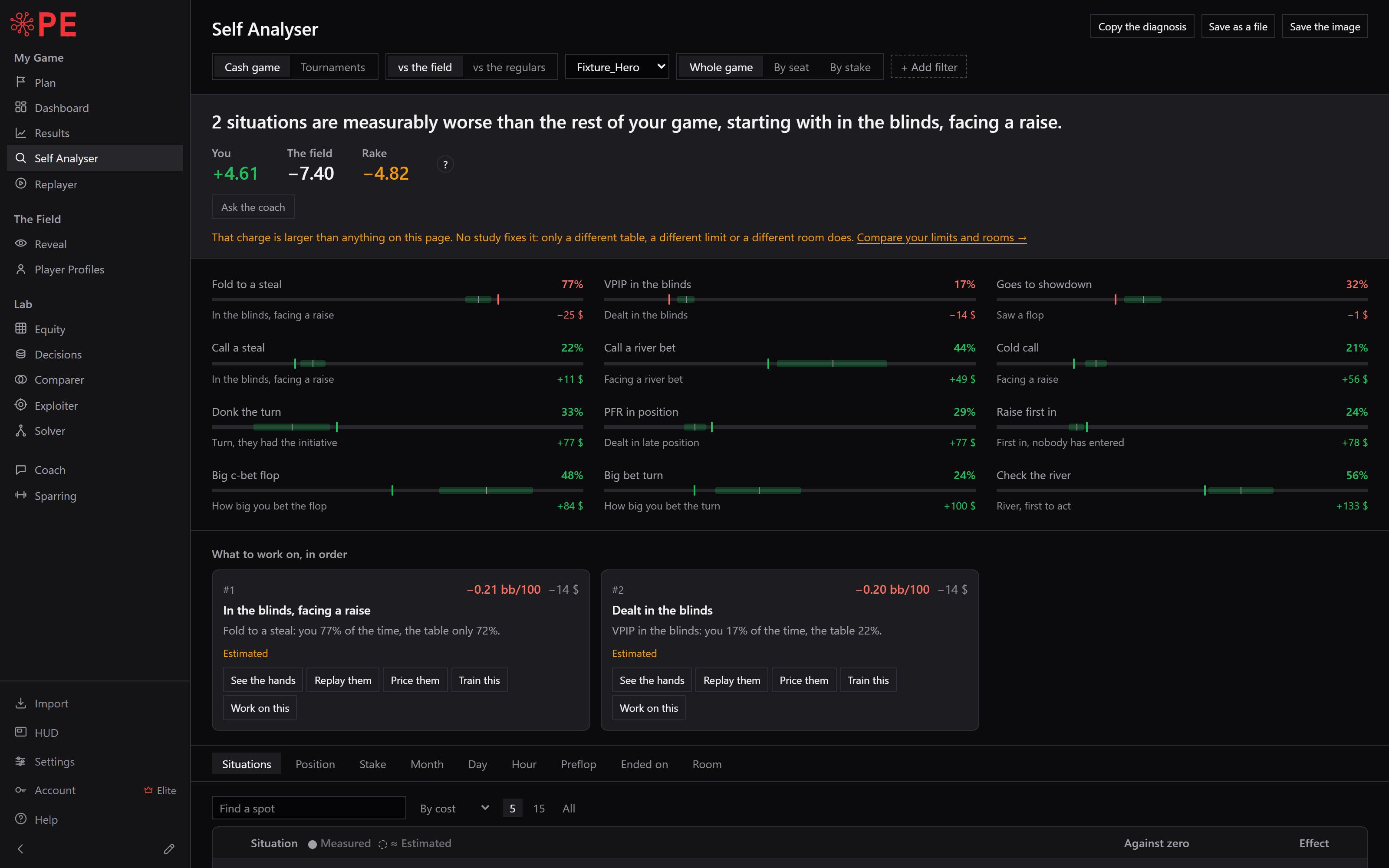
A tracker can show you whether your preflop choices are helping or hurting you, and whether a bad run is just variance. In Poker Exploit, the Dashboard shows your win rate, the rake next to your result, and the variance band around your run. The Self Analyser module then helps you see which positions or situations leak the most. If you want to compare your defaults with the field at your limits, the Reveal module shows what real opponents actually do.
That is the useful next step after a beginner chart: not theory for its own sake, but your own hands, reviewed honestly.


Final takeaway
If you want the shortest possible rule, here it is:
Play tight early, wider late, and let position do the heavy lifting.
For a beginner in cash games, that gives you a clear starting structure for your ranges and makes your preflop decisions much easier to organize.
Start with a tight range, open stronger hands from early positions, add suited and connected hands as you move closer to the button, and do not defend every blind just because you can.
That is how you build a solid foundation.
Do it on your own hands.