
When players say "I play poker," they often mean very different things.
One person plays six-max cash on weeknights. Another fires Sunday MTTs. Another grinds Spins. Another only plays short Sit & Go sessions. Those are not just different schedules. They are different games.
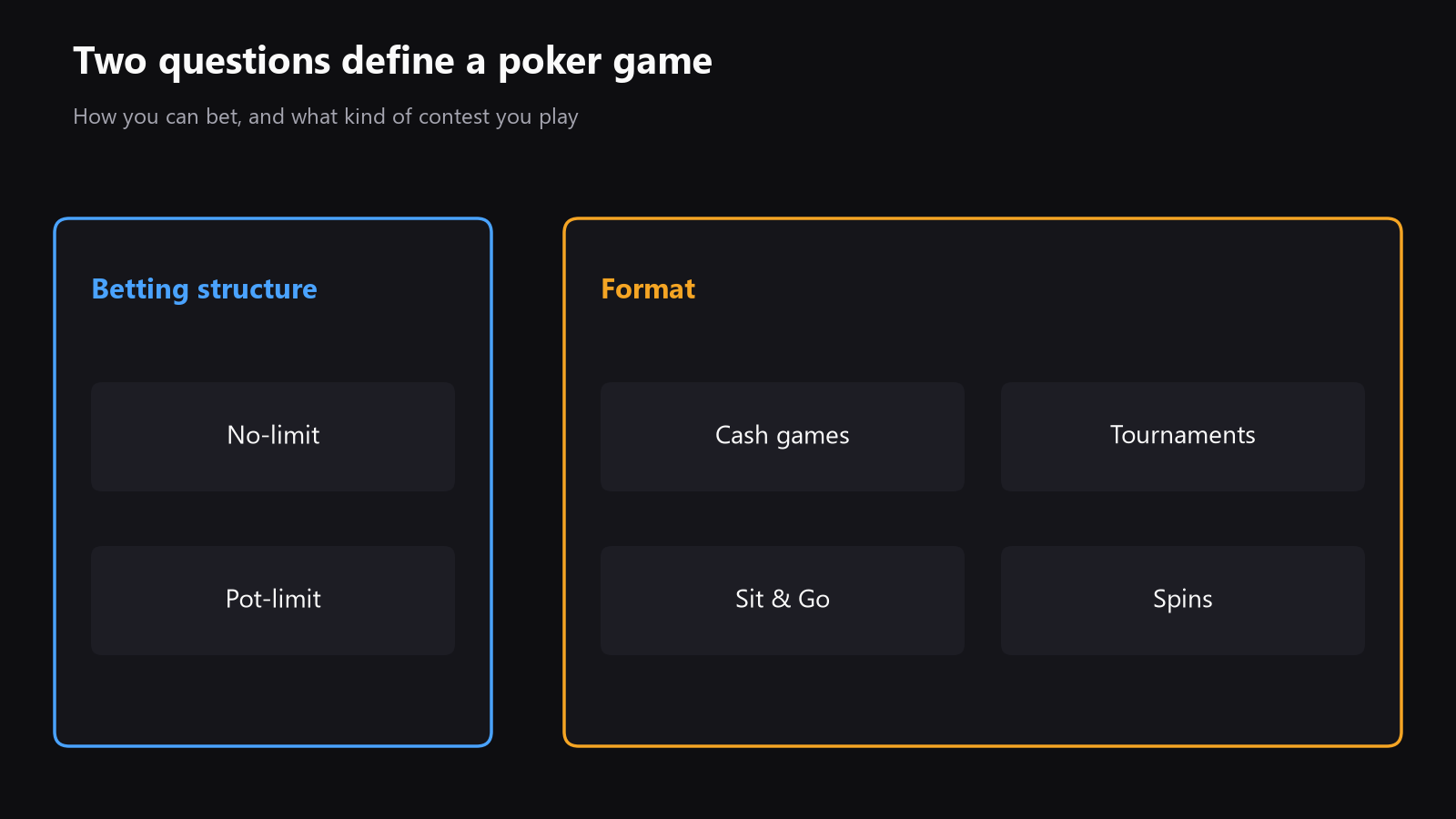
If you want to improve faster, build the right bankroll, and avoid studying the wrong spots, you need to understand the main poker formats. There are two questions to answer:
- What are the betting rules?
- What is the contest structure?
Those two layers shape almost everything that happens at the table.
1) No-limit and pot-limit are betting structures
No-limit means you can bet any amount up to your full stack when it is your turn. That is why no-limit hold'em is so popular. It gives players enormous freedom.
Pot-limit is more constrained. Your raise cannot exceed the current size of the pot after your call. That single rule changes the whole geometry of the hand.
Why the difference matters
In no-limit:
- large bets and overbets are possible
- stack pressure can be extreme
- bluffing can have a lot of leverage
- one decision can put the whole stack at risk
In pot-limit:
- sizing is capped
- it is harder to apply very large pressure in one action
- draws and made hands often play differently
- the hand tends to grow less explosively
If you study a pot-limit game as if it were no-limit, you will overestimate how much pressure you can create. If you study no-limit as if it were pot-limit, you will miss the importance of big bets, polarisation and stack leverage.
For most players, no-limit hold'em is the first format to learn. Pot-limit is especially common in Omaha and some mixed games, where the betting cap changes strategy a lot.
2) Cash games: chips are money
A cash game is the most straightforward format.
- blinds stay fixed
- you can usually leave whenever you want
- each chip has a fixed cash value
- your goal is to win big blinds, not finish in a placement
If you buy in for 100 big blinds and leave with 140, you made 40 big blinds. That is the result. There is no bubble, no pay jump, no blind increase forcing action.
Why many players like cash games
Cash games are ideal if you want repeatable situations and deep study. Because stacks often stay near the same depth, you get:
- more postflop play
- more room to read ranges
- more room for value betting and bluffing
- more consistent hand review
They are also flexible. You can play one hour, three hours, or stop after a few hands if the game is bad.
The downside: rake
At small stakes, rake is often the biggest obstacle. You may make sound decisions and still struggle if the room takes too much from each pot. In other words, you are not only playing the table. You are also playing the rake.
That is why cash games can be excellent for learning, but also brutal at the lowest stakes if the fee is high.
Cash games are a strong choice if you want:
- stable bankroll management
- a clear link between decisions and results
- a deep postflop learning path
- flexible session lengths
They are less attractive if you want one big score or if you dislike paying a fee on many small pots.
3) Tournaments: chips are not money
A tournament is a different world.
You pay once, receive a stack, and keep playing until you bust or finish in the money. Blinds rise. Stacks shrink in big blind terms. Survival matters. And near the bubble or the final table, the value of a chip changes because prize money is not linear.
That is the central idea: in tournaments, chips are not equal to cash in a simple one-to-one way.
What changes in tournament play
- stack depth changes constantly
- blind pressure grows over time
- ICM enters the picture
- survival becomes part of strategy
- pay jumps affect decision making
ICM, or Independent Chip Model, means your tournament chips are worth different amounts depending on the payout structure and the remaining stacks. A call that is fine in a cash game can be wrong in a tournament because busting has a larger cost than the chip EV alone suggests.
Why tournaments are popular
Tournaments offer the chance of a big score. That is the main attraction. You can turn a small buy-in into a very large payout.
They also give you a wider strategic journey. Early levels can look cash-like. Middle stages change with stack depth. Late stages become a mix of pressure, payout awareness and endgame skill.
That makes tournaments exciting, but also very swingy. You can play well and still bust before the money. That is not a contradiction. It is just the format.
Tournaments suit you if you like:
- big upside
- long sessions
- changing stack depths
- ICM and endgame decisions
They are a poor fit if you want steady results or if you get frustrated by long downswings.
4) Sit & Go: the compact tournament
A Sit & Go starts when enough players register. It does not wait for a full scheduled field like a large MTT. The format is smaller, faster and easier to wrap your head around.
Why Sit & Go sits between cash and MTTs
A Sit & Go has tournament payouts, but a smaller field and a more contained structure. That means:
- the session is shorter
- the endgame comes earlier
- ICM matters sooner
- push/fold spots appear more often
You often learn very practical short-stack poker in Sit & Go games, because the structure forces you into decisions with less room for error.
Sit & Go is a good fit if you want:
- short and defined sessions
- tournament payout structure without a huge field
- repeated endgame practice
- a format that is easier to schedule than MTTs
5) Spins: very fast, very shallow, very swingy
Spins are a special form of Sit & Go. They are usually three-handed, very fast, and built around a random prize multiplier. That prize structure can change the size of the reward dramatically from one game to the next.
This is one of the swingiest common formats.
What makes Spins unique
- stacks are shallow
- preflop decisions matter a lot
- push/fold play is central
- repetition is very high
- variance is very high
- the prize can vary a lot
Because the stacks are short, there is less room to recover from mistakes. That puts a premium on precise preflop ranges, blind defense and short-stack decisions.
Who should consider Spins
Spins suit players who want:
- very short sessions
- lots of hands per hour
- fast repetition of the same kinds of spots
- a format that rewards preflop discipline
They are not for everyone. If you dislike volatility, Spins can be emotionally exhausting. Even good players can have long stretches where the graph looks ugly.
6) How to choose your format
There is no universal best format. The right choice depends on your goals, your temperament and your bankroll.
A simple way to think about it:
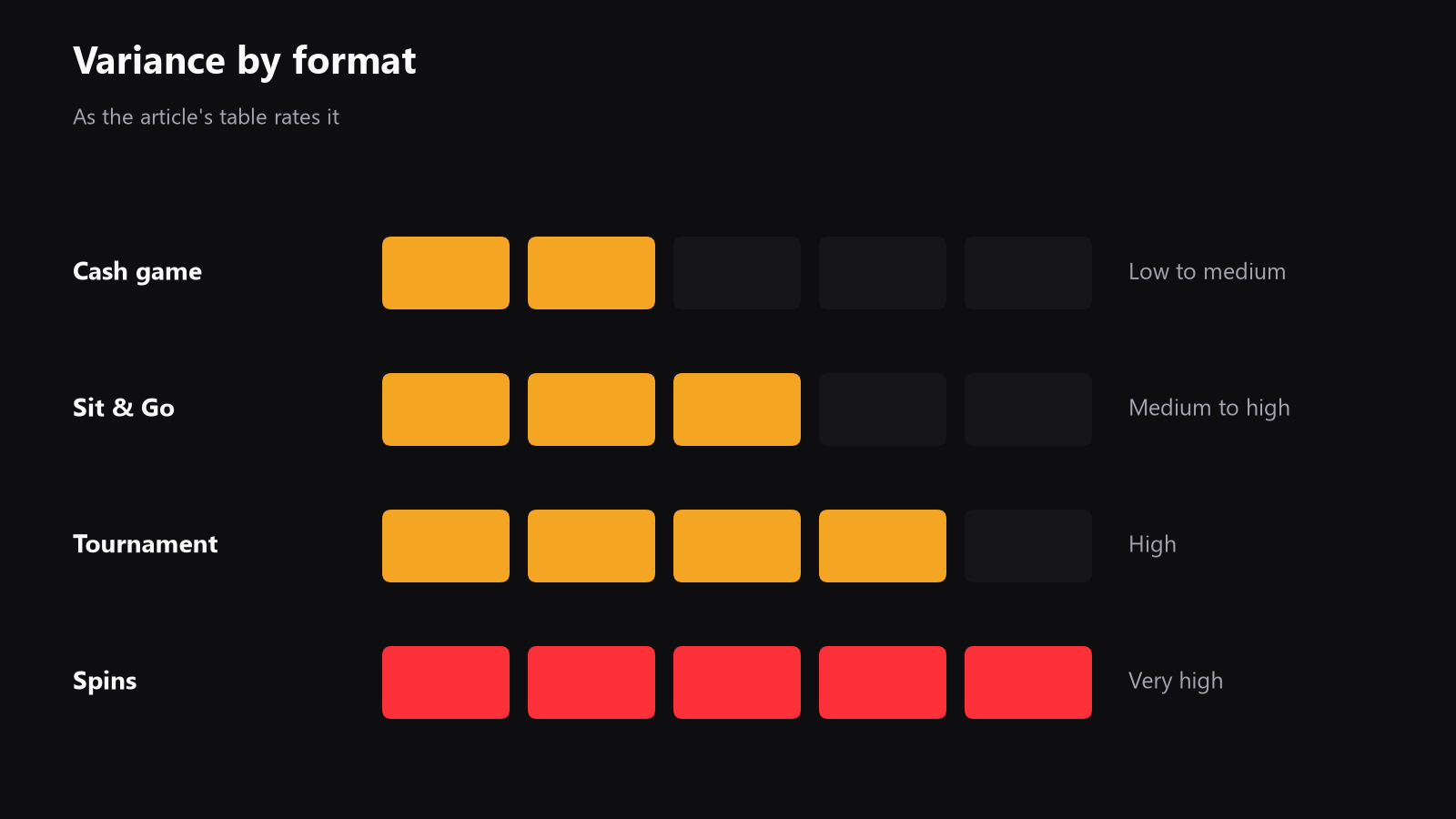
| Format | Main goal | Variance | Session length | Main skill edge | Best for |
|---|---|---|---|---|---|
| Cash game | bb/100 | Low to medium | Flexible | Postflop play, table selection, rake control | Stable volume and deep study |
| Tournament | ROI | High | Long and unpredictable | ICM, stack adaptation, endgame play | Big score potential |
| Sit & Go | ROI | Medium to high | Short to medium | Short-stack and endgame decisions | Compact sessions |
| Spins | ROI | Very high | Very short | Push/fold, preflop precision, fast repetition | High volume and quick games |
The questions you should ask yourself
- How much variance can you handle?
- If you want calmer swings, cash is usually the easiest place to start.
- If you can tolerate variance for bigger upside, tournaments and Spins become possible.
- How much time do you have?
- If you need short sessions, cash or Spins work better.
- If you can sit for long stretches, tournaments become realistic.
- What kind of poker do you enjoy studying?
- Postflop thinking points toward cash.
- ICM and stack transitions point toward tournaments and Sit & Go.
- Rapid preflop repetition points toward Spins.
- What does your bankroll allow?
- Higher variance demands a deeper bankroll.
- A format with high rake needs a stronger edge just to stay ahead.
A useful beginner rule
Start with one format.
Do not try to learn cash, MTTs and Spins at the same time unless you already have a strong base. The strategic problems are different, so your study habits should be different too.
7) Rake and field softness can change the answer
Two players can choose the same format and still have totally different results.
Why? Because the room takes a cut, and the player pool is not the same everywhere.
In cash games, rake can be the difference between winning and losing at micro stakes. In tournaments, the fee is already built into the buy-in, but the structure can still make some events much harder than others. In Spins, both the fee and the prize structure matter a lot.
So when you choose a format, do not only ask:
- "What looks fun?"
- "What has the biggest prizes?"
Also ask:
- "How much does the room take?"
- "How tough is the field?"
- "Where can I realistically create an edge?"
If you already keep your hand histories, it is worth checking your results by room, stake, position and hour. That shows whether the games you choose actually suit you, and where rake hurts the most. The Dashboard and Results modules help you do that on your own hands, instead of guessing from memory.
8) The short version
Here is the simplest summary:
- no-limit gives you the most betting freedom
- pot-limit caps your raise and changes the shape of the pot
- cash games reward steady decision quality and postflop skill
- tournaments reward adaptation, survival and ICM
- Sit & Go sits between cash and MTTs
- Spins are the fastest and swingiest common format
If you want the cleanest path, pick one format and study it properly.
A player who understands one format deeply will usually beat a player who jumps between four formats without a plan.
If you want to see where your results really come from, and how much rake is affecting your game, the Dashboard and Results modules make that visible on your own hands.
Do it on your own hands.