
If you want to get better at poker, one of the biggest mental shifts is this: stop thinking about one hand at a time and start thinking about ranges.
A hand is what you hold right now. A range is the set of hands your opponent can reasonably have, given the action, the position, the board, and the sizing.
That sounds simple, but it changes everything.
When you think in single hands, you ask questions like, "Does he have top pair?" or "Can I beat ace-king?" Those questions are too narrow. Poker is not a guessing game where you try to find the exact two cards. It is a game of incomplete information, so your job is to estimate what kind of hands remain, how often they remain, and how they interact with the board.
Once you think in ranges, you stop trying to be right about one exact combo. You start being profitable against a distribution.
What a range really is
A poker range is not just "all the hands he could have." It is the subset of hands that still make sense after the action so far.
For example:
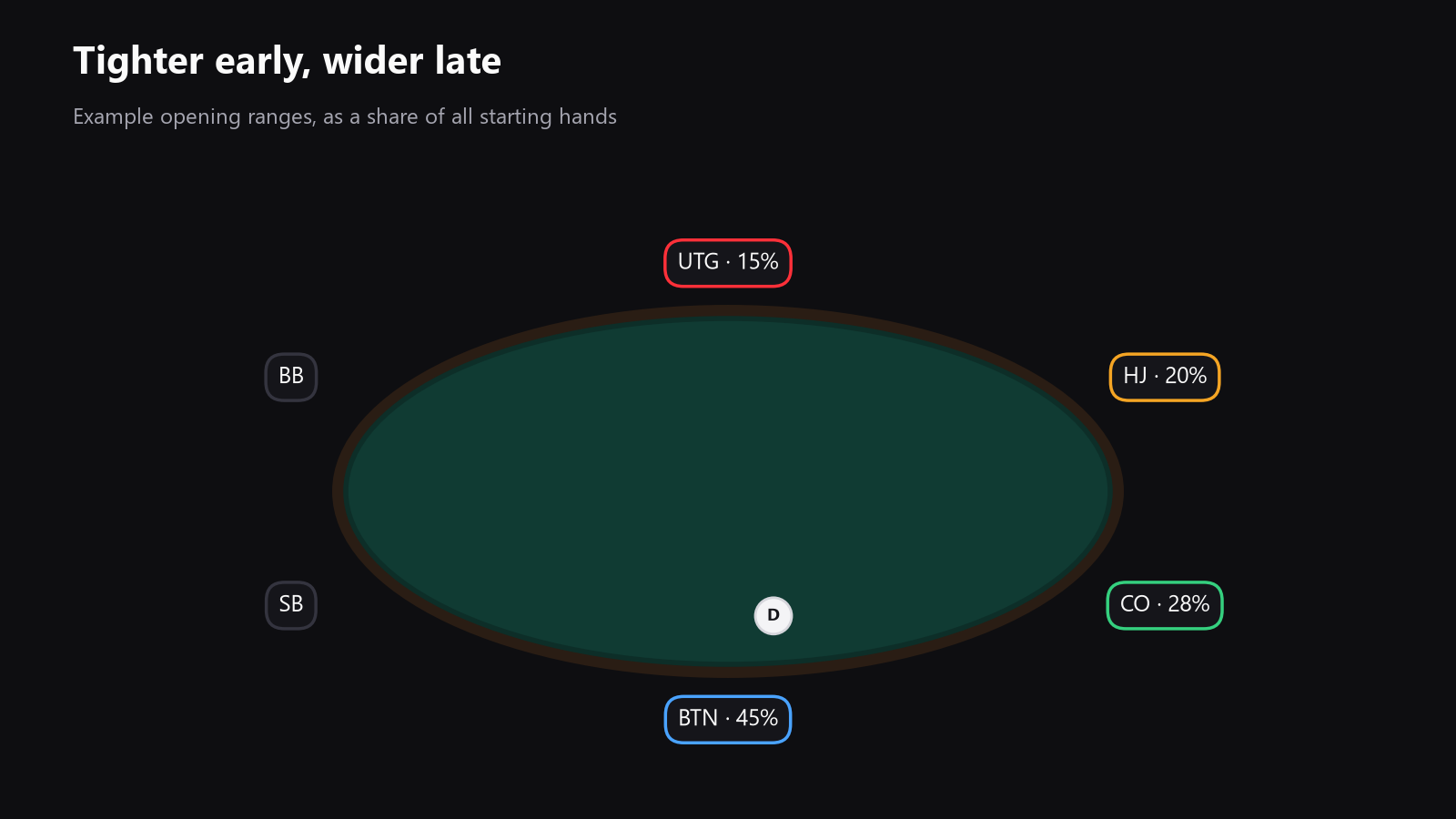
- A player who opens from early position usually has a tighter range than a player who opens on the button.
- A player who calls a 3-bet has a different range from a player who 4-bets.
- A player who bets the flop and checks the turn has removed some hands from the range and kept others.
A range is always conditional. The same player can have very different ranges in different spots.
That is why good players do not say, "He has pocket queens." They say, "Pocket queens are in his range, but how often? And what else is there?"
This matters because poker decisions are not made against one hand. They are made against the whole range. If your hand does well against a large part of that range, you can continue. If it only beats the weakest part, you may need to fold or turn your hand into a bluff.
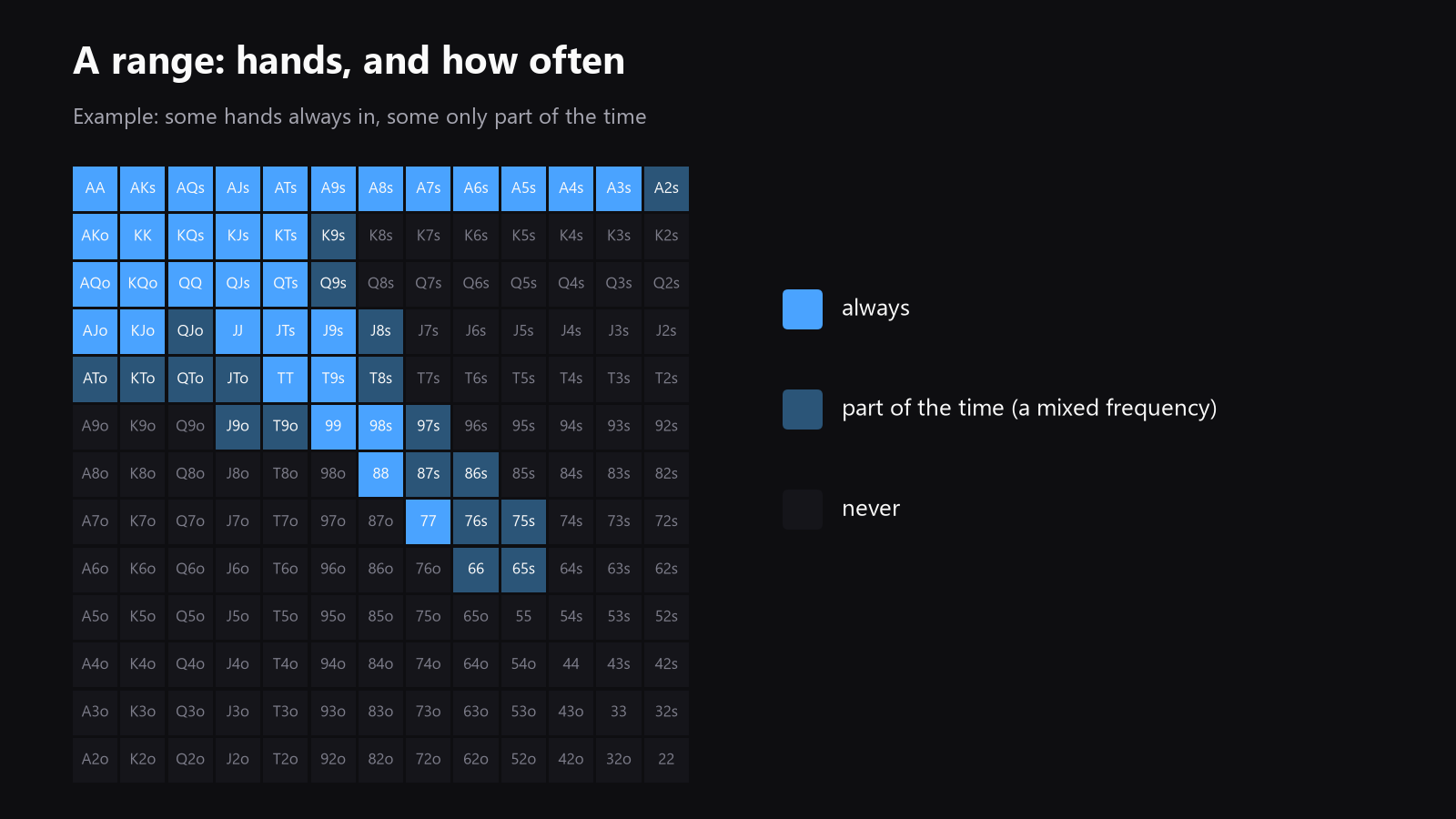
The 13x13 grid, explained
The standard starting-hand grid is 13 by 13, because there are 13 ranks, from ace down to deuce.
That gives you 169 starting-hand classes:
- 13 pocket pairs on the diagonal
- suited hands above the diagonal
- offsuit hands below the diagonal
So:
- AA is one cell
- AKs is one cell
- AKo is one cell
- 72o is one cell
But the cells do not all contain the same number of actual combinations.
A few key facts help:
- Pocket pairs have 6 combinations
- Suited hands have 4 combinations
- Offsuit hands have 12 combinations
That is why a grid is a shorthand, not the whole story. Two cells can look equally important on the chart, but one may contain three times as many combinations as the other.
You do not need to memorize every combo count on day one. But you should understand that ranges are made of frequencies and combinations, not just names.
How to read the grid
When you look at a 13x13 grid, do not read it as a list of "good hands" and "bad hands". Read it as a map of hand classes.
A few practical rules:
- Premium hands sit near the top left, if the chart is arranged in the usual order.
- Bigger pairs are stronger than smaller pairs in many preflop spots.
- Suited hands are usually easier to play than offsuit hands with the same ranks.
- Connected hands, like T9s or 87s, often gain value because they can make straights and strong draws.
- Broadways, like AQ, KQ, and QJ, often appear in many ranges because they make top pair with strong kickers.
But strength alone is not enough. A hand can be strong in one range and weak in another.
For example, AJo is often a strong opening hand. But if an opponent has already shown strong aggression from a tight range, AJo may be in rough shape. Your grid does not give you a final verdict by itself. It gives you the starting point.
A range is not static
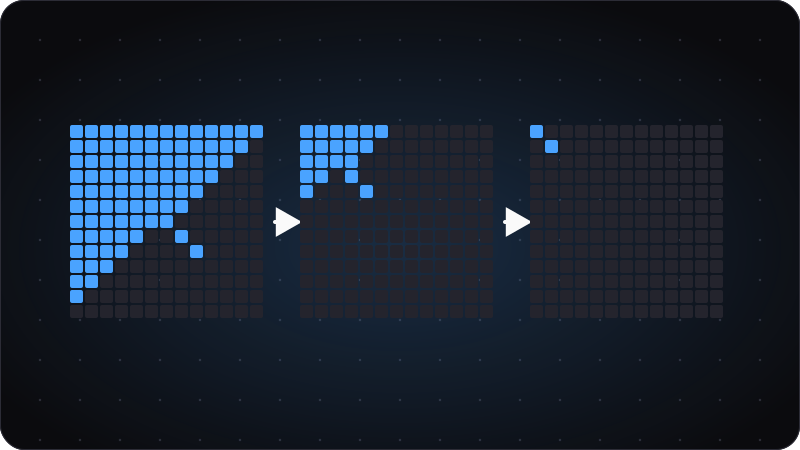
One of the most important ideas in poker is that ranges change street by street.
At the start of the hand, you build a preflop range from position and action.
Then the flop arrives, and some hands become stronger, some weaker, and some disappear from the plausible range because they would have acted differently.
Then the turn changes things again.
Then the river narrows the range even more.
That is why range thinking is a process, not a snapshot.
A player does not arrive on the river with the same hand distribution they had preflop. They arrive with the part of the preflop range that survived every decision before that point.
How to put an opponent on a range
Putting an opponent on a range means using the information you have to estimate which hands are still alive.
You do that with four main clues.
1. Position
Position is one of the strongest clues in poker.
An early-position open usually means a tighter range than a button open. A cutoff caller usually has a different range from a big blind defender. A 3-bet from out of position often means something much stronger than a flat call from the blinds.
Before you even look at the board, position gives you a first range.
2. Preflop action
Open, call, 3-bet, 4-bet, limp, squeeze. Each action removes hands and keeps others.
If a player 3-bets, you can usually remove a lot of weak offsuit hands from the range. If a player only calls, that usually keeps more medium-strength hands, suited hands, and some traps.
Preflop action is the first filter.
3. Board texture
The board changes what makes sense.
On A-K-7, some ranges connect hard, and some do not.
On 9-8-7, connected hands, straight draws, and two pair possibilities become much more important.
On A-7-2 rainbow, top pair and overpairs often matter more than backdoor garbage.
You always want to ask: which part of the range hits this board well, and which part mostly misses?
This is where range advantage and nut advantage matter.
- Range advantage means your range has more hands that are ahead overall on that board.
- Nut advantage means your range has more of the very best hands.
Those two ideas influence who should bet more often, who can use bigger sizes, and who needs to protect their checking range.
4. Bet sizing and line
A small bet, a big bet, a check-back, a delayed c-bet, a raise, all of these reveal something.
Sizing is not a random detail. It is part of the message.
If a player bets small on a board that should be polarized, that may suggest a merged range. If a player overbets the river, that often suggests a range that is heavily weighted toward value and bluffs with blockers.
You are not reading one move in isolation. You are reading how that move fits into the whole line.
Narrowing the range street by street
A good way to study ranges is to imagine them as a funnel.
Preflop: start with the widest plausible range
Start with seat, stack depth, and action.
For example, if a cutoff opens and you are in the big blind, the cutoff range is wide enough to include many broadways, suited aces, pocket pairs, suited connectors, and some weaker hands.
If the same player opens under the gun, that range becomes much tighter.
So your first job is not to guess one hand. It is to build the first reasonable range.
Flop: remove the hands that miss too hard
Now the board comes.
Suppose the flop is Q-7-2 rainbow.
A preflop raiser may still have many overpairs, some queens, some strong draws, and some air. But not every hand continues at the same frequency.
- Strong value often bets
- Some draws bet
- Some medium-strength hands check for pot control
- Air may give up, especially versus resistance
After the flop action, the range is already much smaller than the preflop range.
Turn: the range starts to polarize
The turn is where many lines become clearer.
If the player barrels again on a blank turn, that often filters out a lot of weak one-pair hands and missed overcards.
Now you should ask:
- Which value hands keep betting?
- Which draws keep barreling?
- Which hands would prefer to check?
- Which hands are now unlikely to be in the line at all?
The turn often separates the range into hands that want to continue for value and hands that can still bluff profitably.
River: the range becomes narrow and sharp
By the river, most ranges are much smaller than they were preflop.
That is why river decisions are often about bluff-catchers, thin value, and polarized bluffs.
Ask yourself:
- What value hands reach this spot?
- What missed draws are available as bluffs?
- Which blockers matter?
- What hands were removed earlier by different sizings or checks?
At this point, you should almost never be thinking, "Maybe he has something random."
You should be thinking, "Which exact classes remain, and how many combinations of each?"
A simple example
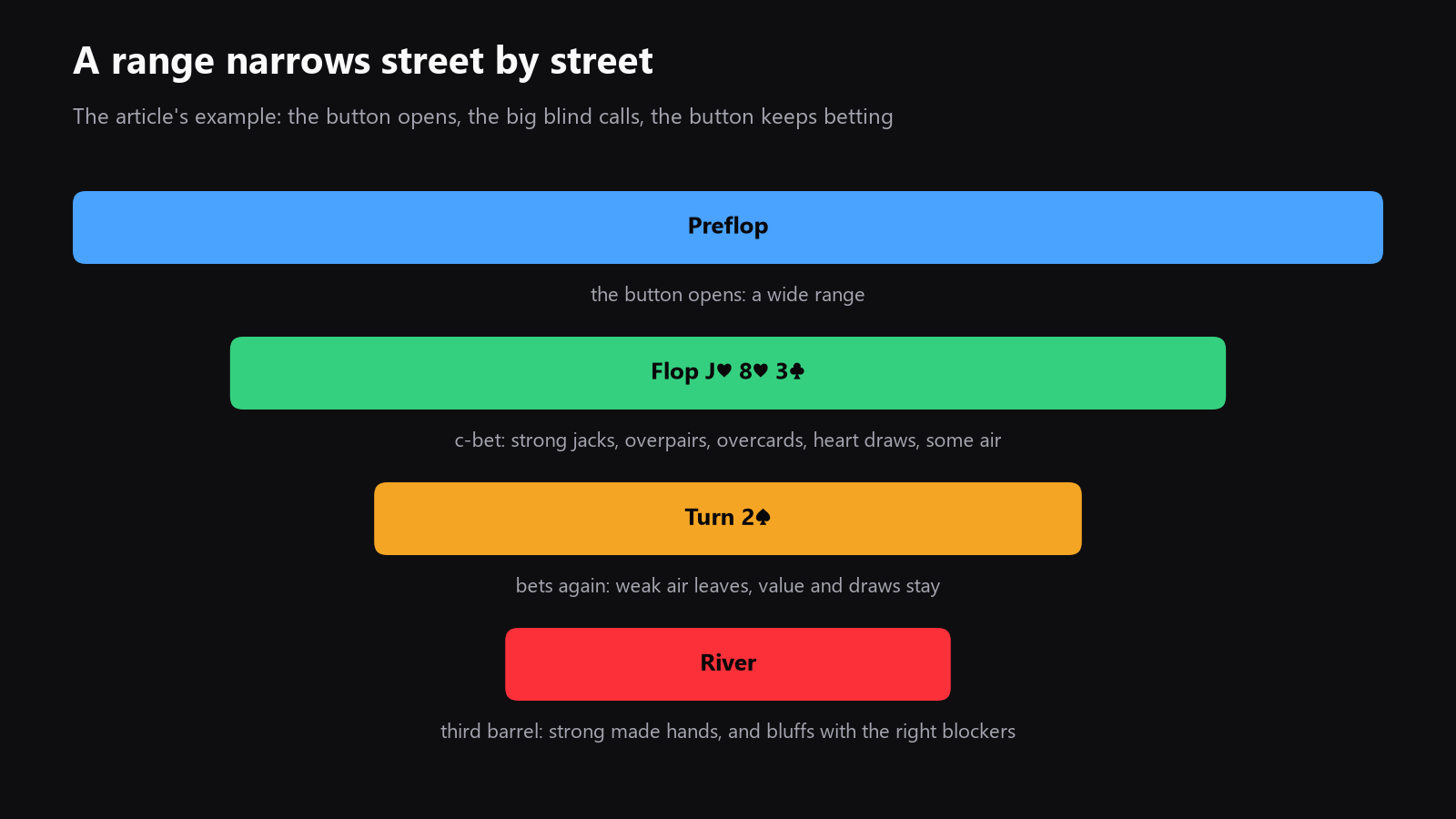
Let us say the button opens, the big blind calls, and the flop comes J-8-3 with two hearts.
The button c-bets.
What is still in the button range?
- Strong jacks
- overpairs
- some overcards with backdoor equity
- some heart draws
- some pure air, depending on sizing and population tendencies
Now the turn is a 2 of spades and the button bets again.
What changed?
- Some weak air can be removed
- Some hands that wanted one stab may now check
- Value hands and draws continue more often
Now the river bricks and the button fires a third barrel.
At this point the range is much more polarised. You are now mostly looking at strong made hands and bluffs that make sense with the right blockers.
That is the real power of range thinking. You did not need to know one exact hand. You only needed to understand which groups survived each street.
Think in buckets first, then in exact combos
When you are learning, it helps to group hands into buckets:
- premium value
- strong value
- thin value
- strong draws
- weak draws
- bluff-catchers
- air
This is not the final level of precision, but it is a great way to train your eye.
Later, you can move from buckets to exact combinations.
For example, not all missed flush draws are equally good bluffs. A missed draw with a blocker to the nuts is often better than one without it. Not all top pairs are equally strong on the river. Not all overpairs are safe on coordinated boards.
The more you work with ranges, the more you start to see these differences automatically.
Common mistakes when you start thinking in ranges
Mistake 1: treating the range as exact
A range is not a perfect answer. It is an estimate.
Mistake 2: forgetting combos
A hand class with 12 combinations can matter more than a hand class with 4, even if both look similar on the chart.
Mistake 3: ignoring position
Two identical actions mean very different things from different seats.
Mistake 4: stopping at preflop
Preflop is only the starting point. Postflop action reshapes the range.
Mistake 5: mixing up your range with villain's range
Your line and your range matter too. Poker is range versus range, not villain versus air.
How this changes your own decisions
Once you think in ranges, your own hand gets easier to play.
Instead of asking, "My hand is second pair, is that good or bad?" you ask:
- What does my range look like here?
- What does villain's range look like?
- How does my hand perform against that range?
- Does my hand have showdown value?
- Can I deny equity with a bet?
- Is my hand better as a bluff catcher or as a bluff?
That is a much more useful way to think.
Sometimes your hand is too weak to value bet but too strong to bluff. Sometimes it is a perfect bluff candidate because it blocks the strong part of villain's range. Sometimes it is a profitable call even though it looks ugly, because villain's range is wider than it appears.
Range thinking gives you structure.
How to train this skill
The best way to build this skill is to review real hands and write ranges down street by street.
A simple routine:
- Write the preflop range first.
- Remove hands after the flop action.
- Remove more hands after the turn action.
- Ask what remains on the river.
- Compare your guess with what the spot actually allows.
If you study your own database, this becomes much faster. You stop learning ranges in the abstract and start seeing how real players at your limits actually behave.
That is where the Reveal module becomes useful. It lets you study what the pool at your stakes really does in spots like the one you are reviewing, so your range work is not built on theory alone.
If you want the clean theoretical picture first, the Solver module shows how a spot is solved by the game. If you want to see where your own range assumptions are costing you money, the Self Analyser module is the place to check. And if you want to keep recurring tendencies attached to the players you meet, the HUD and Player Profiles modules help you do that on your own hands.


Final thought
The next time you are in a hand, try to stop seeing only your cards.
See the preflop range.
See how the flop removes some hands and keeps others.
See how the turn and river narrow the picture.
That shift, from one hand to a range, is where a lot of poker improvement begins.
Once you make it, you will stop asking, "What does he have?"
You will start asking the better question:
"What range does this line represent, and how does my hand play against it?"
Do it on your own hands.