
Fold equity is the part of your profit that comes from your opponent folding.
That sounds simple, but it is one of the most important ideas in poker. It is what turns a pure bluff from a guess into a calculation. It is also what makes a semi-bluff strong, even when your hand is not ahead right now. And it is often the missing piece when you try to decide whether a shove is profitable.
If you only think in terms of showdown equity, you miss half the picture. Sometimes you win the pot immediately. Sometimes you get called and still have a share of the pot. Good aggression uses both.
What fold equity actually means
Imagine you bet and your opponent folds.
You do not need to go to showdown. You do not need your hand to improve. You just win the pot.
That immediate win is fold equity.
So fold equity is not your hand equity, and it is not a separate magic stat. It is the value your bet gets from the chance that your opponent gives up.
A useful way to think about it is this:
- Hand equity is what you win when called
- Fold equity is what you win when they fold
- Total EV is the combination of the two
That is why a bluff can be profitable even with terrible showdown equity, and why a draw can be profitable even when it is behind right now.
The formula you need
If the pot before your bet is P, your bet size is B, your opponent folds with frequency F, and your equity when called is E, then a simple heads-up EV formula is:
EV = F × P + (1 - F) × [E × (P + 2B) - B]
Read it like this:
- if villain folds, you win the pot
- if villain calls, you realize your equity in the final pot, then subtract your bet
This formula is a simplification, but it is the right starting point.
It works best when you want to compare one bet size with another, or decide whether a bluff, semi-bluff, or shove is worth it.
Pure bluff: how much fold equity do you need?
If your hand has no showdown value, set E = 0.
Then the formula becomes much simpler:
EV = F × P - (1 - F) × B
The break-even fold frequency is:
F = B / (P + B)
That is the key bluffing number.
Here are the common shortcuts:
- Half-pot bet needs about 33% folds
- Two-thirds pot bet needs about 40% folds
- Pot-size bet needs 50% folds
- 1.5x pot overbet needs 60% folds
So if you bet 5 into 10 with no showdown value, your bluff needs folds one time out of three just to break even.
That is why bet sizing matters so much. Bigger bets need more folds, but they also win more when they work.
Semi-bluff: when fold equity and hand equity work together
A semi-bluff is a bet or raise that can win in two ways:
- your opponent folds
- your hand improves or already has enough equity when called
This is why draws are so powerful.
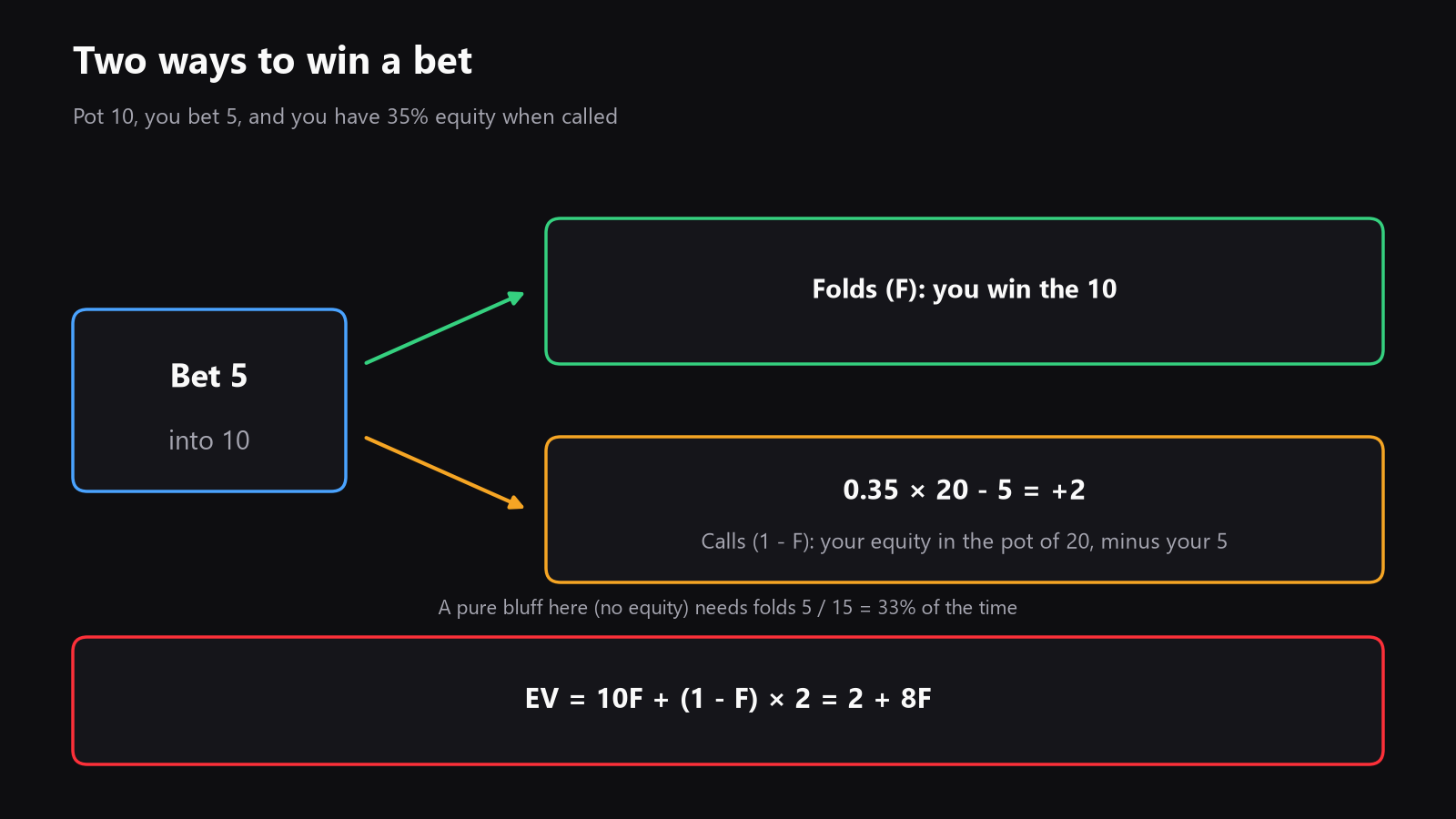
Suppose the pot is 10, you bet 5, and when called you have 35% equity.
Plug that into the formula:
EV = F × 10 + (1 - F) × [0.35 × 20 - 5]
The part inside the brackets is:
0.35 × 20 - 5 = 7 - 5 = 2
So:
EV = 10F + (1 - F) × 2 = 2 + 8F
That means the bet is already profitable even if villain never folds, because your hand still has enough equity when called.
This is the heart of the semi-bluff.
You are not betting only because you expect folds. You are betting because folds add extra profit to a hand that already has a live chance to win.
Why some draws are better semi-bluffs than others
Not every draw is equal.
A strong semi-bluff usually has at least one of these traits:
- high raw equity when called
- good blockers
- the ability to continue barreling on many turns
- some showdown value
- a good price relative to the pot
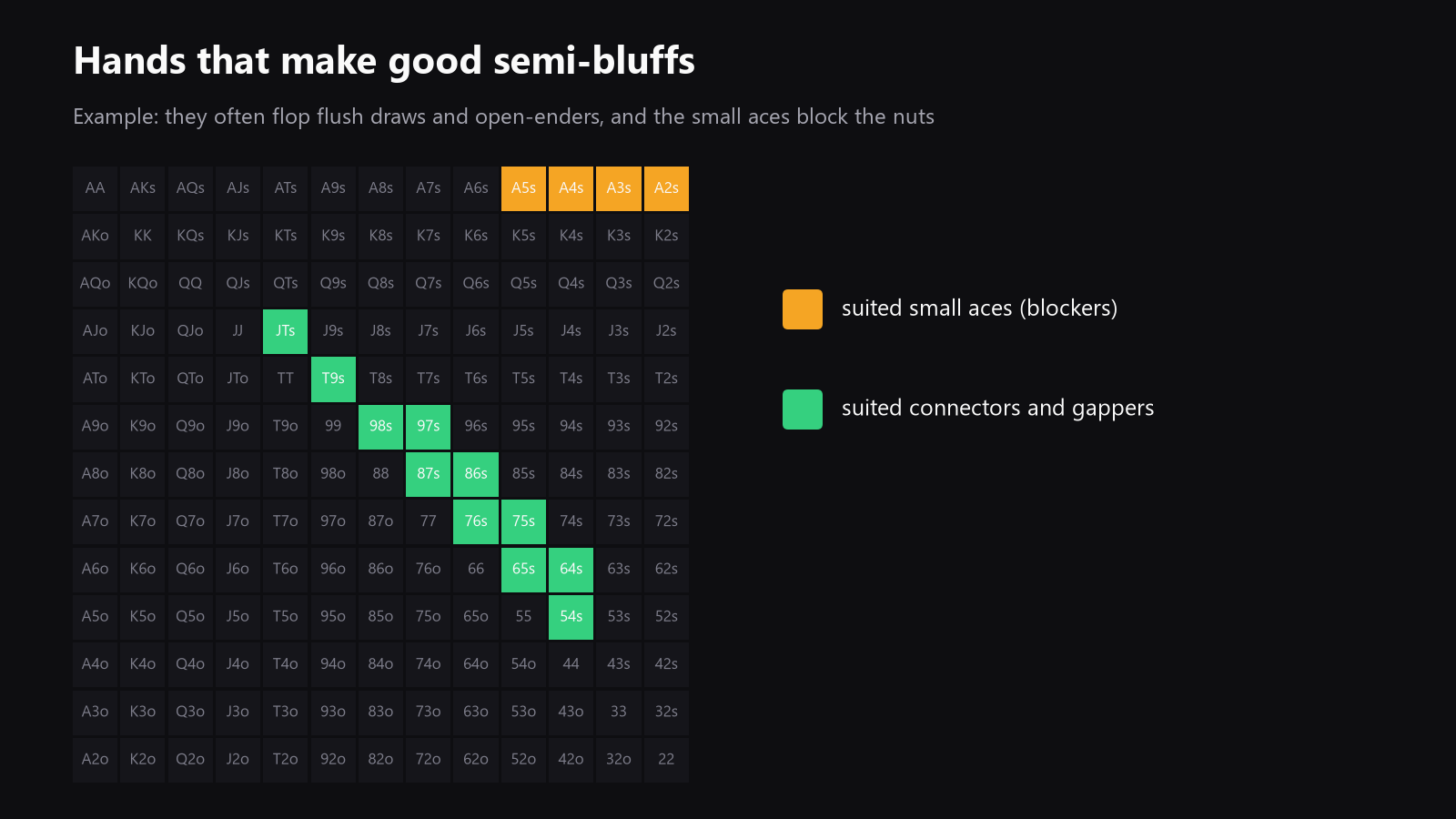
That is why a nut flush draw with overcards is usually much better than a weak gutshot with no backdoors. The first hand can win when called and also remove strong hands from your opponent's range. The second hand often needs too much fold equity just to stay alive.
Blockers matter too.
If you hold cards that reduce the number of strong hands your opponent can continue with, your fold equity goes up. For example, an ace can block top pair and nut combinations on some boards. A suited ace can block flushes and strong redraws. That does not make your bet automatically good, but it makes the math easier.
Shoves: fold equity becomes even more important
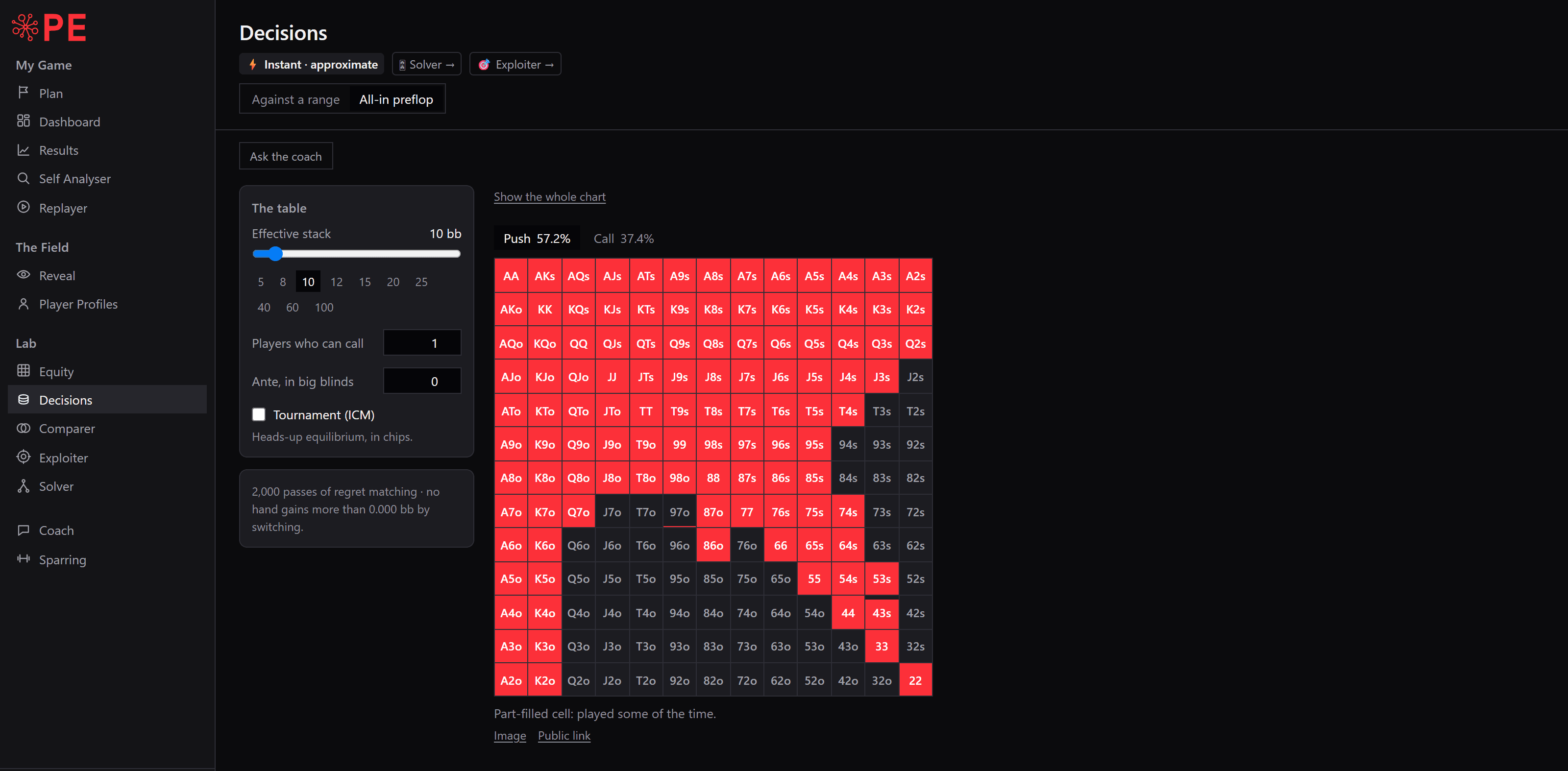
Short-stack poker makes fold equity very visible.
When you shove, you are risking a lot relative to the pot, so the chance of getting folds matters a lot.
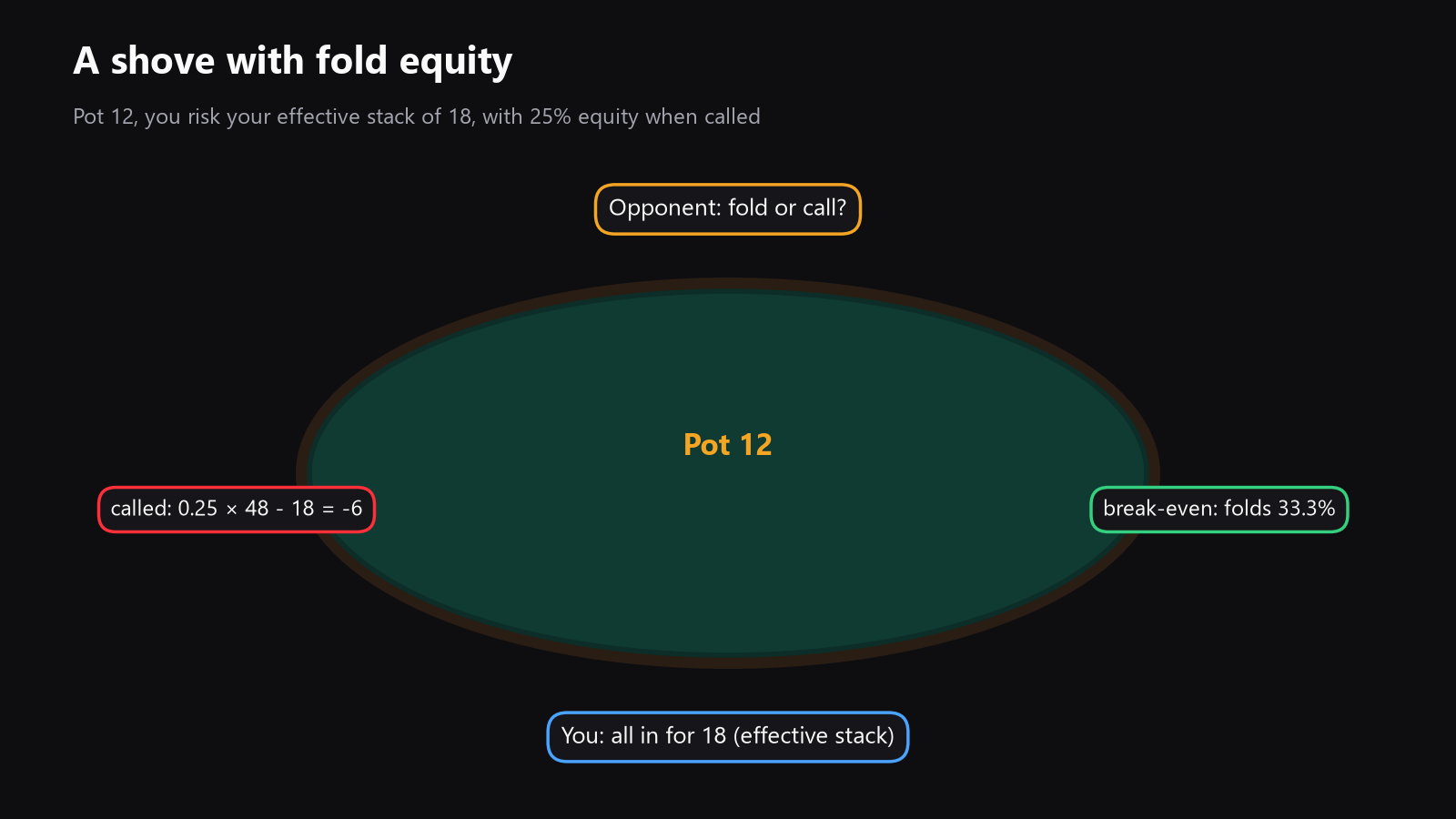
Suppose the pot is 12 and the effective stack you are risking is 18. If your hand has 25% equity when called, then:
EV when called = 0.25 × 48 - 18 = 12 - 18 = -6
That means the shove loses money if you always get called.
So the shove needs fold equity to become profitable.
The break-even fold frequency is:
F = (B - E × (P + 2B)) / (P + B - E × (P + 2B))
In this example:
- P = 12
- B = 18
- E = 0.25
So:
F = (18 - 12) / (12 + 18 - 12) = 6 / 18 = 33.3%
You need folds about one time out of three.
That is a good way to think about many short-stack decisions. The shove does not need to be strong against calling ranges. It only needs enough folds plus enough equity when called.
What makes fold equity go up or down
Fold equity is not random. It changes with the situation.
1. Board texture
Some boards miss ranges hard. Others connect strongly with the caller.
A dry ace-high board often creates more fold equity than a connected low board, because there are fewer natural continues.
2. Position
When you act later, you can apply more pressure. Your opponent has to make the decision first on future streets too, which can increase your fold equity.
3. Bet size
Bigger bets usually create more fold equity, but they also risk more. The right question is not "does bigger bet create more folds?" It does. The real question is "does the extra fold equity pay for the extra risk?"
4. Stack depth
Shallow stacks reduce maneuvering room. That often increases the value of immediate fold equity, especially in all-in spots.
5. Ranges and population tendencies
If your opponent continues too much, your fold equity drops. If your opponent overfolds, it rises.
This is why theory alone is not enough. The same board can have very different fold equity against a tight player, a calling station, or a player who hates playing big pots.
6. Rake
In raked cash games, thin bluffs get worse.
If the room takes a meaningful cut from the pot, the pot you win is not as clean as the math on paper suggests. That matters especially at small stakes, where rake can eat the edge from marginal bluffing lines.
Common mistakes with fold equity
Mistake 1: thinking fold equity is free money
It is not.
If your bet gets called too often, fold equity is too small to save it.
Mistake 2: ignoring your equity when called
A pure bluff needs folds. A semi-bluff can survive with much less fold equity because it still has a chance to win at showdown.
Mistake 3: using the wrong range
You do not need villain to fold their whole range. You need them to fold enough of the hands that continue against your bet.
Mistake 4: forgetting that your bet size changes the math
A small bluff needs fewer folds, but it wins less when it works. A big bluff wins more when it works, but needs more folds.
Mistake 5: treating all draws as equal
A naked draw, a draw with overcards, and a draw with blockers are not the same. Their fold equity and showdown equity are different.
A simple way to think about the decision
Before you bet, ask yourself these five questions:
- How much is already in the pot?
- How much am I risking?
- How often does worse call, and how often does better fold?
- What equity do I have when called?
- What does rake do to the result?
If you can answer those, you are no longer guessing. You are estimating EV.
That is the real use of fold equity. Not a vague feeling that "they might fold", but a decision process.
A quick shortcut you can remember
If you have no showdown value, use this:
Required fold frequency = Bet / (Pot + Bet)
If you have some equity when called, your required fold frequency drops.
That is why a hand like a flush draw can be a profitable semi-bluff in spots where a naked airball would be a mistake.
Study it on your own hands
The cleanest way to improve here is to study the situations where you actually bet, not the ones you imagined.
You want to know:
- how often the field folds in your spots
- which bet sizes get called too much
- which draws are profitable as semi-bluffs
- which shoves work because of fold equity, not because of raw card strength
That is exactly the kind of work the Reveal module in Poker Exploit is built for, because it shows what players at your limits actually do from your own hand histories. And when you want to test a short-stack decision quickly, the Decisions module gives you the push or fold answer without guesswork.
The main idea to keep
Fold equity is the part of poker where pressure turns into profit.
A bet can win because your opponent folds, because you have equity when called, or because both are true at the same time. The best bluffs and semi-bluffs combine those two sources of EV.
If you remember only one thing, remember this:
A profitable bet does not need to win at showdown every time. It only needs to win enough pots now, and enough pots later, to make the math work.
Do it on your own hands.