
When you face a bet in poker, the first question is simple: do you have the pot odds to continue?
That is the right starting point, but it is not the whole story.
Sometimes you call with a hand that is not quite good enough right now because you expect to win more money later if you hit. That extra future profit is called implied odds.
Sometimes the opposite happens. You make a hand, but it is not good enough, and that hand loses more money later. That hidden future cost is called reverse implied odds.
If you want to understand why some calls are correct even when the pot odds look weak, and why some made hands should still be folded or played cautiously, you need both ideas.
What implied odds mean
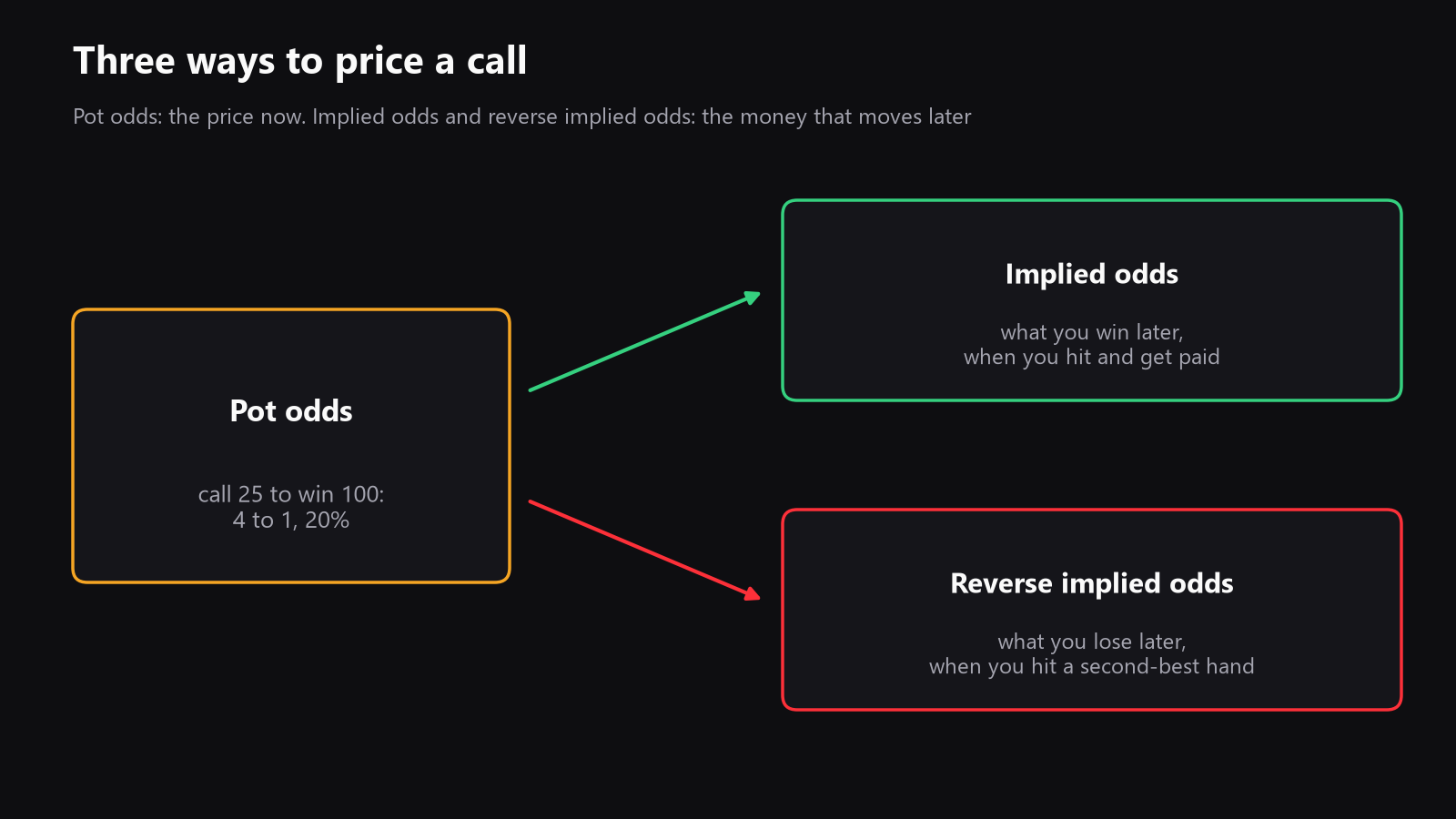
Implied odds are the money you expect to win on future streets if you improve.
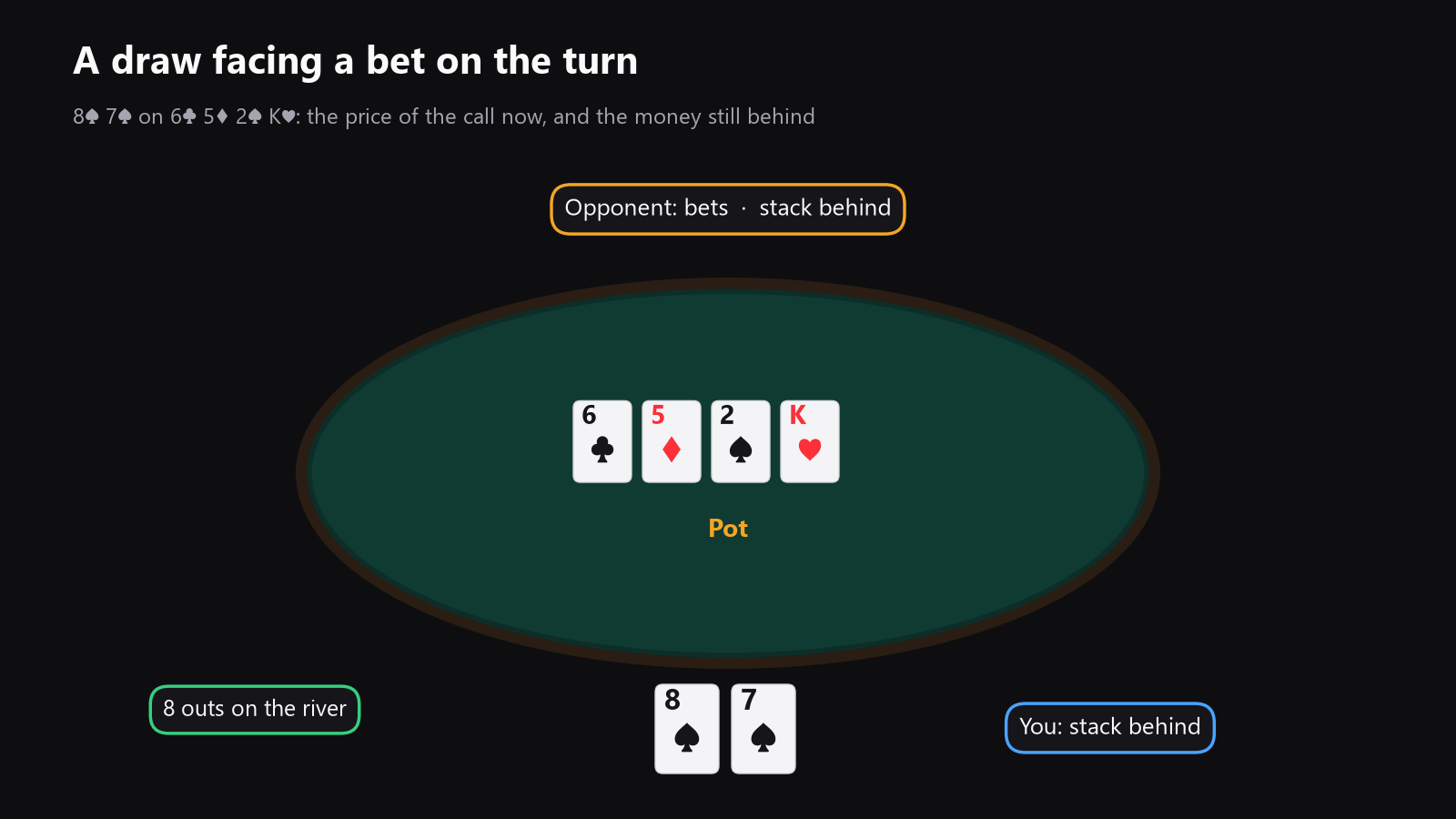
Example: you have 8 7 suited on the button. A player opens, you call, and the flop comes 6 5 2. You have an open-ended straight draw.
The direct pot odds may not be enough to justify a call every time. But if you hit the straight, you may win more money on the turn and river from one-pair hands, overpairs, or bluff catchers.
That extra money is the implied part.
In simple terms:
- pot odds look at the money already in the pot,
- implied odds add the money you may win later if you improve.
This matters most when:
- stacks are deep,
- the opponent is likely to pay you off,
- your draw is strong when it hits,
- your hand is disguised, so the value is not obvious.
What reverse implied odds mean
Reverse implied odds are the future money you are likely to lose when you improve, but to a hand that is still second best.
Example: you call with A J on a Q J 4 board. You pair your jack, but if the action gets heavy, your top pair, decent kicker hand can already be in trouble against better jacks, queens, sets, or strong draws that have already made two pair or a straight.
Or think about a flush draw on a paired board. You make your flush, but the board pairs on the river and someone has a full house. You “hit,” but you still lose a big pot.
Reverse implied odds are why not every made hand is a good hand, and why not every draw is worth chasing.
Pot odds first, then the future
To use implied odds well, you need to begin with pot odds.
Pot odds tell you how much you must risk compared with what you can win right now.
For example, if there is 100 in the pot and you must call 25, you are risking 25 to win the 100 already there. That is 4 to 1 direct pot odds, so you need about 20 percent equity for the call to be profitable if no more money goes in.
But poker is not played in a vacuum. After the call, there may be more betting, more streets, and more chips behind. So the real question becomes:
- how often will I hit,
- how much can I win when I hit,
- how much can I lose when I do not hit, or when I hit but am still behind.
That is the full implied odds picture.
The practical way to think about implied odds
You do not need a complicated formula at the table. You need a useful estimate.
Ask yourself four questions:
- What am I drawing to? A pair? Two pair? A flush? A straight? A set?
- How often will I hit by the river? Not every draw is equal.
- How much money is still behind? If stacks are shallow, implied odds shrink fast.
- Will I get paid when I hit? That depends on the opponent, the board, and how visible your hand is.
A hand tends to have good implied odds when:
- the draw is disguised,
- the opponent likes to call,
- the stacks are deep enough to pay you,
- and your hit is likely to be best.
A hand tends to have bad reverse implied odds when:
- the board is coordinated,
- your made hand is only one pair,
- better hands are common,
- you are out of position,
- the pot is already large enough that you are forced to continue too far.
Set mining: the classic implied-odds spot
Set mining is the clearest example of implied odds.
You hold a pocket pair like 5 5. You call a raise hoping to flop a set.
Why can this be profitable even when you miss most flops?
Because when you do flop a set, you often have a hidden monster. Many opponents will pay off with overpairs, top pair, or strong draws. The money you win then can cover all the times you missed.
But set mining works only when the future payoff is big enough.
You need:
- enough stack depth,
- a reasonable raise size,
- an opponent who will continue with worse hands,
- and a situation where missing costs only the preflop call.
A common mistake is calling too wide with small pairs against short stacks. If both players have only 20 big blinds, the implied odds are poor. There is simply not enough money left to win back enough when you hit.
Suited connectors and hidden value
Hands like 8 7 suited, 9 8 suited, or T 9 suited also benefit from implied odds.
They can make strong hidden hands:
- straights,
- flushes,
- two pair,
- strong combo draws.
They are especially valuable when:
- stacks are deep,
- the raiser is loose or capable of paying off,
- the board texture lets you represent a wide range.
These hands often play better than many dominated broadways in deep games because, when they hit, they often hit hard and not in an obvious way.
But beware of reverse implied odds too. A small flush or a weak straight can become expensive if the board pairs or the runout becomes very obvious.
The danger of dominated hands
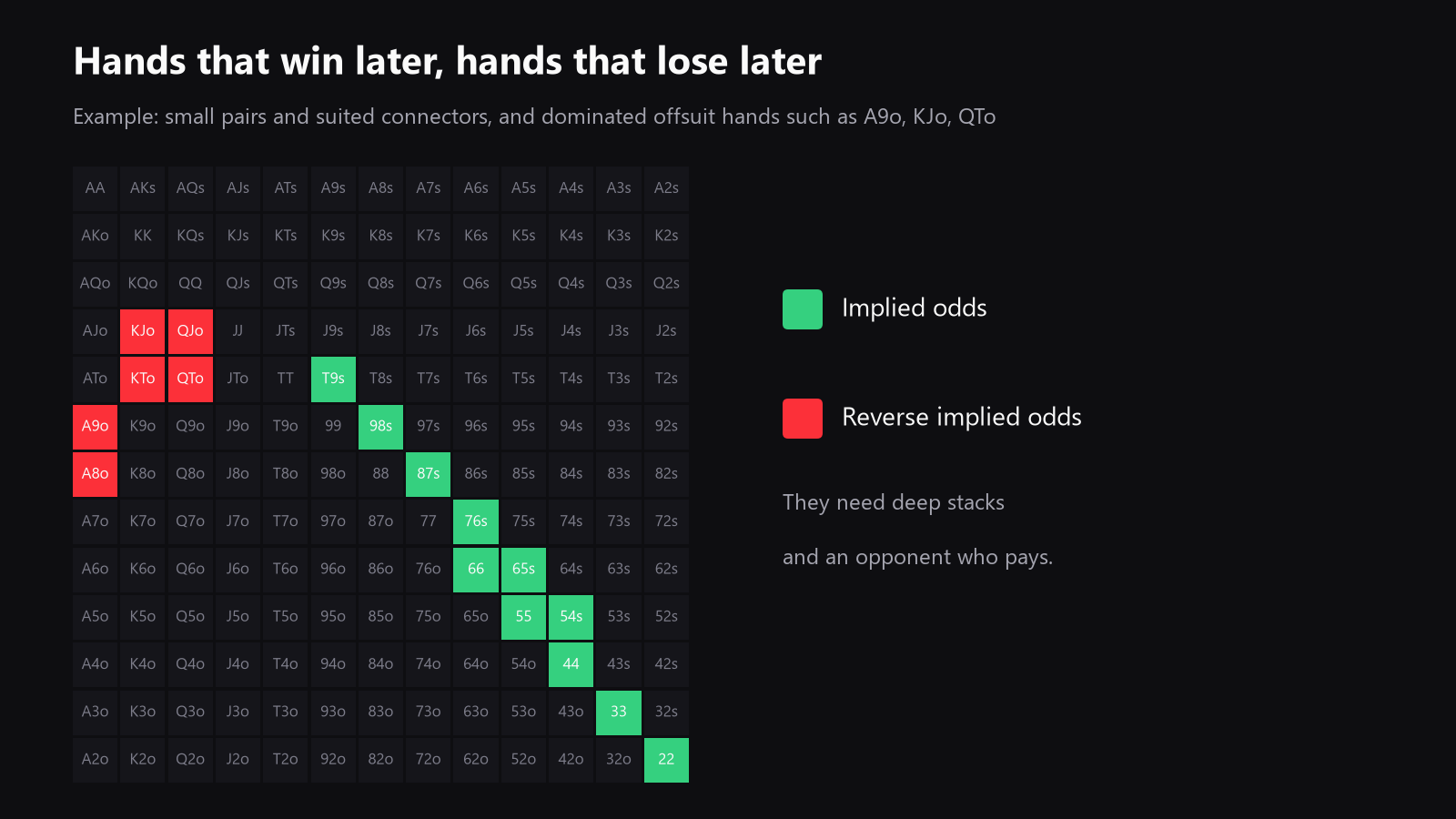
Many players overvalue hands that look clean but are often dominated, such as A 9 offsuit, K J offsuit, or Q T offsuit in the wrong spots.
These hands can make top pair, but top pair is not always enough.
Why are they dangerous?
Because when you flop a pair:
- worse hands may fold,
- better hands may continue,
- and you may pay off worse when you make a second-best top pair.
That is reverse implied odds in action.
For example, A 9 on A Q 7 looks fine at first glance. You have top pair. But against a tight range, your kicker is often too weak. If you face a lot of pressure, your future losses can be large.
This is why “top pair good kicker” is not just about the pair. It is about the whole future value of the hand.
Deep stacks change everything
Implied odds improve as stacks get deeper.
With 100 big blinds, a small pair or suited connector can win a lot when it connects strongly. With 30 big blinds, the same hand often loses much of its appeal because there is not enough money left to make the call profitable.
Deep stacks favor:
- small pocket pairs,
- suited connectors,
- suited one-gappers,
- speculative hands that can make strong hidden value.
Shallow stacks favor:
- direct equity,
- high card strength,
- hands that do well immediately,
- less speculation.
That is one reason tournament players must think differently as stacks change. A hand that is an easy call at 120 big blinds can become a fold at 25.
Position matters a lot
Position improves implied odds and reduces reverse implied odds.
When you are in position:
- you see what the opponent does first,
- you control pot size better,
- you can extract value more easily when you hit,
- and you can realize your equity more cleanly when you miss.
When you are out of position:
- you lose control,
- you face harder turn and river decisions,
- and your draws become harder to monetize.
That means a hand like 7 6 suited is much happier in position than out of position, especially against a player who can apply pressure on later streets.
Board texture: some boards pay, some boards punish
Not all hits are equal.
On a dry board like K 7 2 rainbow, top pair can often get value from worse hands. A weak kicker may still be enough some of the time.
On a coordinated board like J T 9 with two suits, many hands are already highly connected. If you hit a one-pair hand there, your reverse implied odds can be large because better made hands and strong draws are common.
Boards with:
- many straight possibilities,
- many flush possibilities,
- many two-pair or set possibilities,
create more danger for one-pair hands.
Boards with:
- fewer draws,
- fewer natural two-pair combinations,
- less action from strong made hands,
often reduce reverse implied odds.
When a call is right even if the pot odds look thin
This is the part many players want to know.
A call can be correct even when current pot odds alone are not enough if:
- you expect to win a large pot when you hit,
- your opponent does not like to fold strong one-pair hands,
- you are deep enough to realize the payoff,
- your hand is disguised,
- and the downside when you miss is limited.
This is why a small pair can be a good call preflop against a deep-stack raise, but a bad call against a short stack.
It is also why chasing certain draws against a large turn bet can be correct if the implied payoff is huge. But that only works if the future money is real, not imagined.
When implied odds are a trap
Implied odds are often used as an excuse for bad calls.
Ask yourself whether the future money is actually there.
A call is usually a leak when:
- the stacks are too short,
- the villain is very tight and will not pay you,
- your draw is obvious,
- your made hand is usually second best,
- or your equity realizes poorly out of position.
If you tell yourself “I can always hit and get paid,” you are probably overestimating implied odds.
A good rule is this:
If you do not know exactly who will pay you and how, implied odds may be smaller than you think.
A practical checklist before you call
Before you make a speculative call, run through this checklist:
- What are my direct pot odds?
- What am I drawing to?
- How often will I hit by the river?
- How much money can still go in?
- Who is the opponent?
- Will they pay off when I hit?
- What happens if I hit and the board gets scary?
- What happens if I hit but my hand is still second best?
If the answer to the last question is “often,” reverse implied odds are probably high.
A simple rule of thumb
You do not need to memorize formulas to use this well.
Use this simple rule:
- big stacks and hidden hands favor implied odds,
- small stacks and dominated hands create reverse implied odds,
- position and passive opponents increase your future value,
- out of position and aggressive pressure reduce it.
That is enough to improve many decisions immediately.
A worked example
Imagine this spot:
- You have 6 6 in late position.
- A player opens to 3 big blinds.
- Both of you have 100 big blinds.
- The opener is loose and calls too much after the flop.
You are not calling because 6 6 is a strong immediate hand. You are calling because:
- you can flop a set,
- you are deep enough to win a big pot,
- and the opponent is likely to continue with worse.
Now change one thing:
- the stacks are 25 big blinds.
Now the call is much less attractive. Even if you flop a set, there may not be enough money left to win to justify the preflop investment. The implied odds have shrunk.
That is the key idea. The same hand can swing from profitable to unprofitable just because the future money changes.
Why this concept matters when you study your hands
If you review your hands properly, you will start seeing patterns.
You may find that:
- you call too often with small pairs against short stacks,
- you overplay top pair in reverse-implied-odds spots,
- or you miss profitable calls with draws when the payout is actually there.
The Dashboard module can help you see which spots cost you the most over time, while the Self Analyser module can show how your frequencies compare with the field and with the rest of your game. If you want to study implied odds seriously, those two views are especially useful together.
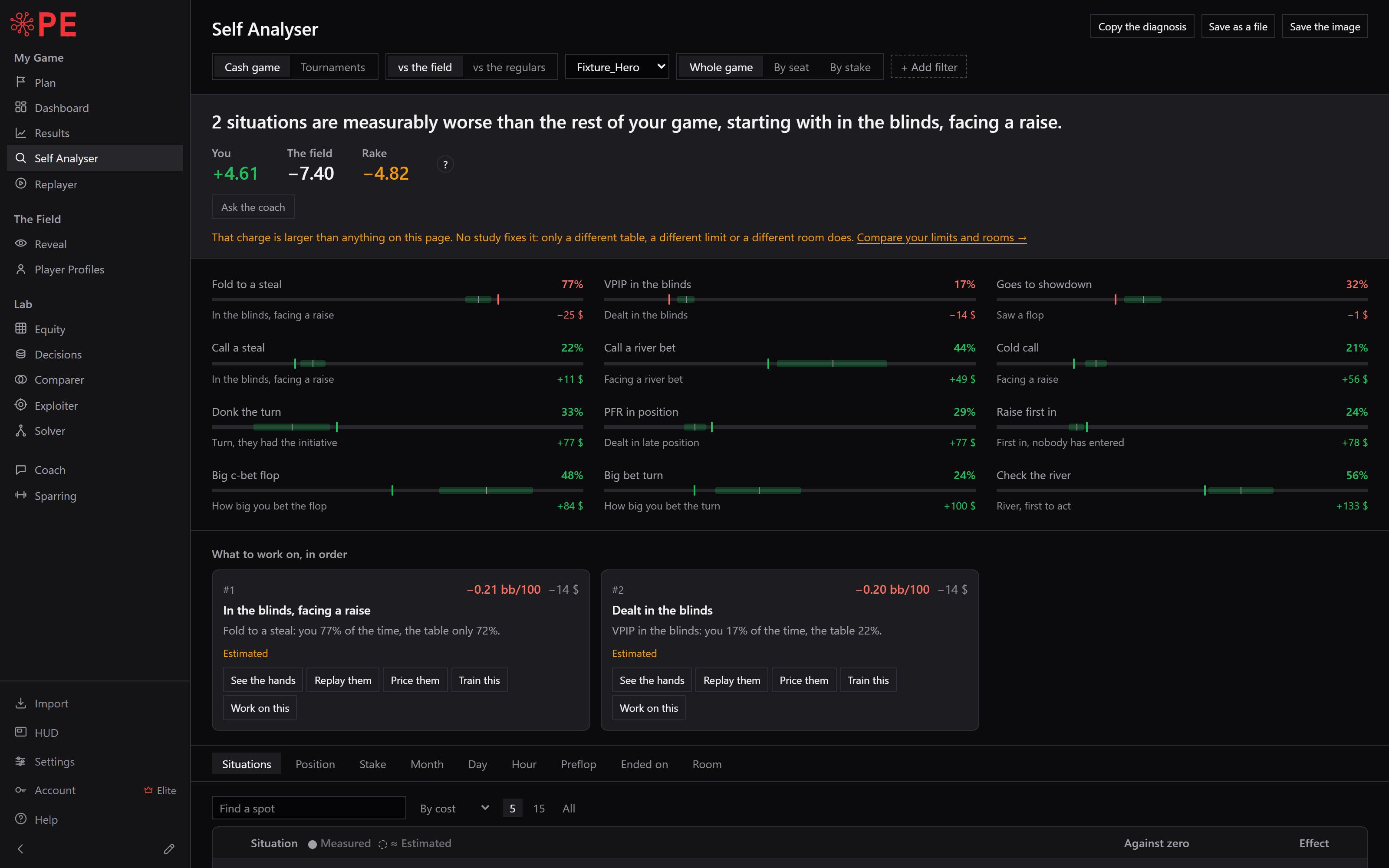
If you want to go further, the Dashboard and Results modules make it easier to see whether a call really helped your win rate, or whether it only looked good in the moment.
Summary
Implied odds are the future money you can win when you hit.
Reverse implied odds are the future money you lose when you hit a hand that is still not good enough.
Together, they explain a huge part of poker calling strategy.
Use implied odds when:
- your hand can make a strong hidden winner,
- stacks are deep,
- and the opponent can pay you.
Respect reverse implied odds when:
- your hand is often second best,
- the board is dangerous,
- or the future streets punish you.
If you understand these two ideas well, you stop thinking only about the pot in front of you. You start thinking like a real poker player: about the whole hand, all the way to the river.
Do it on your own hands.