

If you have ever heard someone say, “You have to defend 67% here,” or “His bluff needs to work 40% of the time,” they are talking about the same family of ideas: minimum defense frequency, or MDF, and the bluff break-even frequency, often called alpha.
These ideas are useful because they give you a fast baseline. They tell you what happens if one player bets and the other player folds too much. They also explain why a bluff can be profitable even when it looks weak, and why some calls are mandatory in theory.
But they are not the whole story. Real players do not bluff perfectly, not by a long shot. That is where theory becomes a starting point, not a final answer.
What MDF means
Minimum defense frequency is the smallest fraction of your range that you must continue with, call or raise, so that a bluff cannot make money automatically.
The cleanest version is for the river, when there are no more cards to come.
If the pot is P and your opponent bets B, then:
- Alpha, the bluff success frequency needed for a bluff to break even, is:
alpha = B / (P + B)
- MDF, the minimum fraction you must defend, is:
MDF = P / (P + B)
These two numbers add up to 100%.
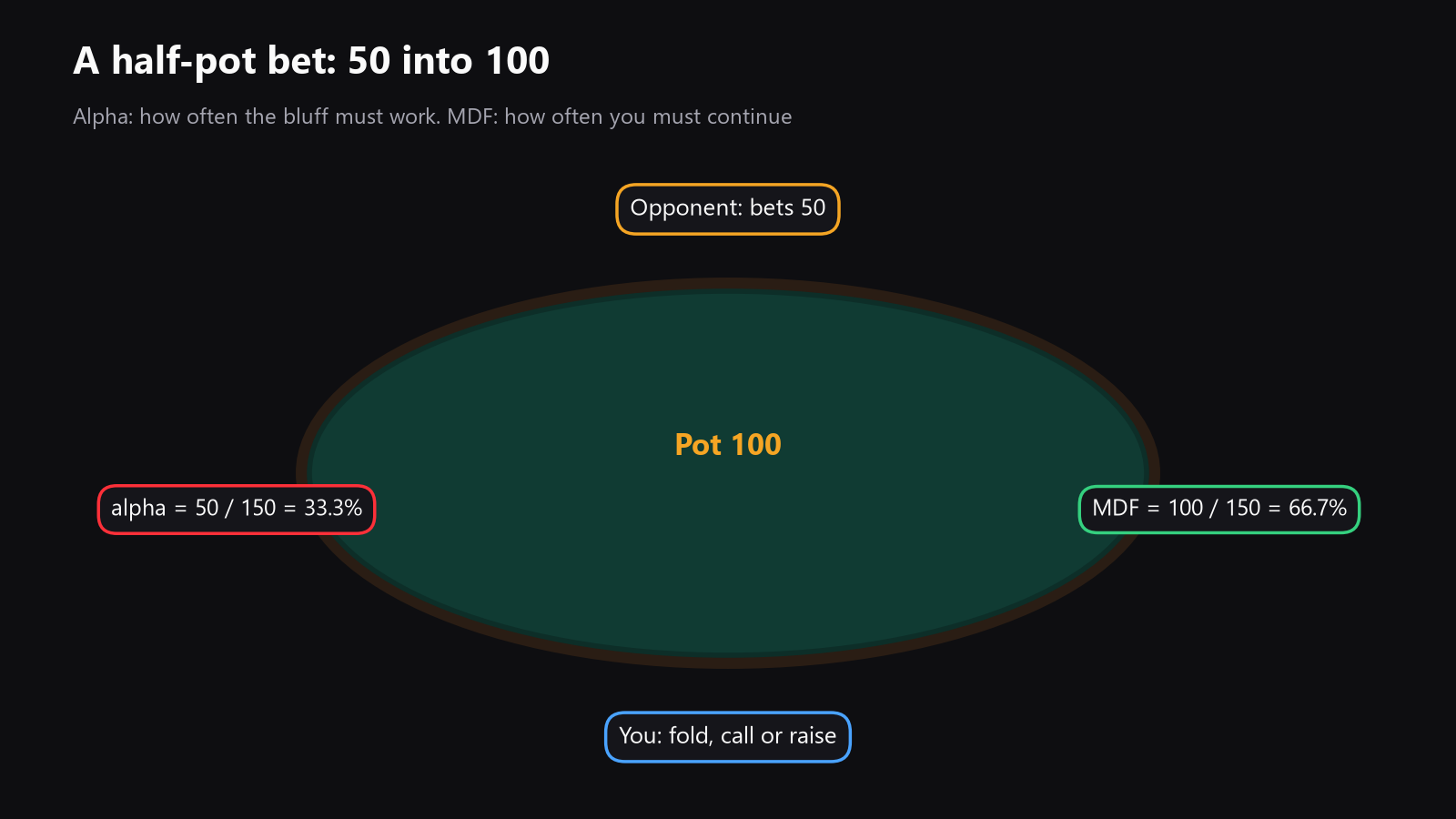
If the bet is half-pot, for example 50 into 100:
- alpha = 50 / 150 = 33.3%
- MDF = 100 / 150 = 66.7%
That means a pure bluff needs you to fold at least a third of the time to break even, and you need to continue with at least two thirds of your range if you want to stop that bluff from printing money on autopilot.
What alpha means in practical terms
Alpha is the bluff’s required fold rate.
A bluff does not need to get called every time to be bad. It only needs to get called often enough that the times it works are not enough to compensate for the times it gets caught.
You can see this by writing the bluff’s expected value:
EV of bluff = fold frequency × pot won − call frequency × bet risked
If the pot is P and the bet is B, then a bluff breaks even when:
fold frequency × P = call frequency × B
Since call frequency = 1 − fold frequency, the break-even fold frequency becomes:
B / (P + B)
That is alpha.
So if your opponent bets:
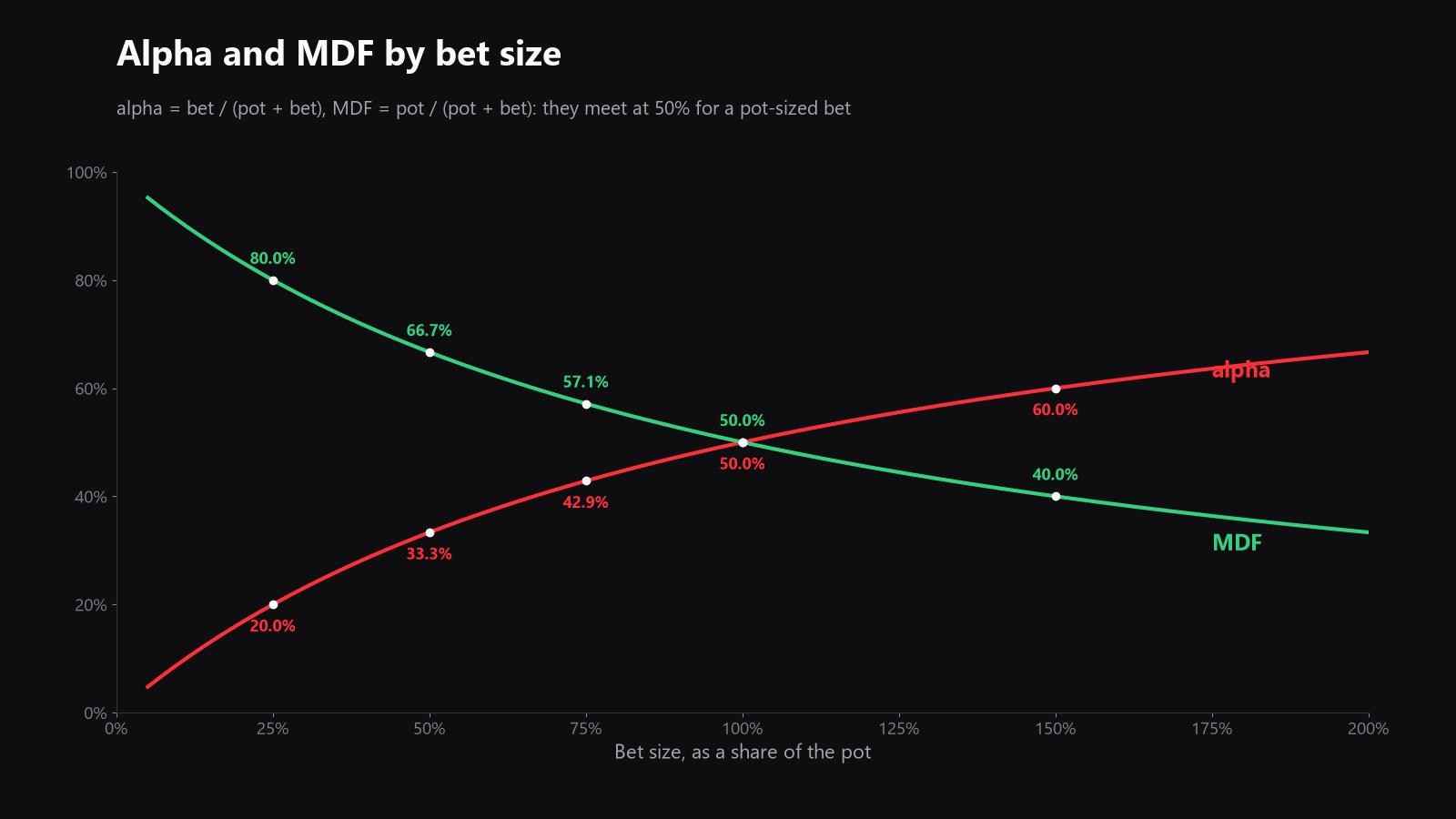
- 25 into 100, alpha = 20%
- 50 into 100, alpha = 33.3%
- 75 into 100, alpha = 42.9%
- 100 into 100, alpha = 50%
- 150 into 100, alpha = 60%
The bigger the bet, the more often the bluff needs you to fold.
MDF is not the same as pot odds
This is one of the most common confusions.
- MDF answers: “How often do I need to continue with my range so his bluff does not auto-profit?”
- Pot odds answer: “How much equity does this hand need to call profitably?”
Those are different questions.
Example: villain bets 50 into 100.
- MDF says you should continue with 66.7% of your range.
- Pot odds say a call needs only 25% equity, because you are calling 50 to win 150.
So a hand can be a profitable call even if it is not part of the top 66.7% of all possible hands in your range, and a hand can belong to your defending frequency but still not be a call if it is better as a raise, if it blocks value, or if it realizes equity poorly.
That is why MDF is a range concept, not a hand-by-hand command.
A quick example you can remember
Say the pot is 100 and villain bets 75.
- Pot after the bet: 175
- Call amount: 75
- Alpha: 75 / 175 = 42.9%
- MDF: 100 / 175 = 57.1%
So if you fold more than 42.9% of the time, a pure bluff wins money too easily.
If you defend at least 57.1% of the time, you deny that automatic profit.
This does not mean you must defend with any random 57.1% of hands. It means your continuing range, as a whole, must be strong enough that your opponent cannot profit by overbluffing every time.
Why the formula is useful, and where it breaks
MDF is powerful because it gives you a benchmark. If you know the pot size and the bet size, you immediately know the pressure point.
But it is still a simplified model.
1. MDF assumes a clean bluffing model
The pure MDF logic is easiest to apply when the bettor is assumed to have:
- a value range,
- a bluff range,
- and no special edge from future cards.
That is closest to the river.
On the flop and turn, hands still have equity, ranges can improve, and there are future decisions. A hand that folds in a river-only MDF model may still continue profitably on earlier streets because it can improve or because it wins sometimes at showdown already.
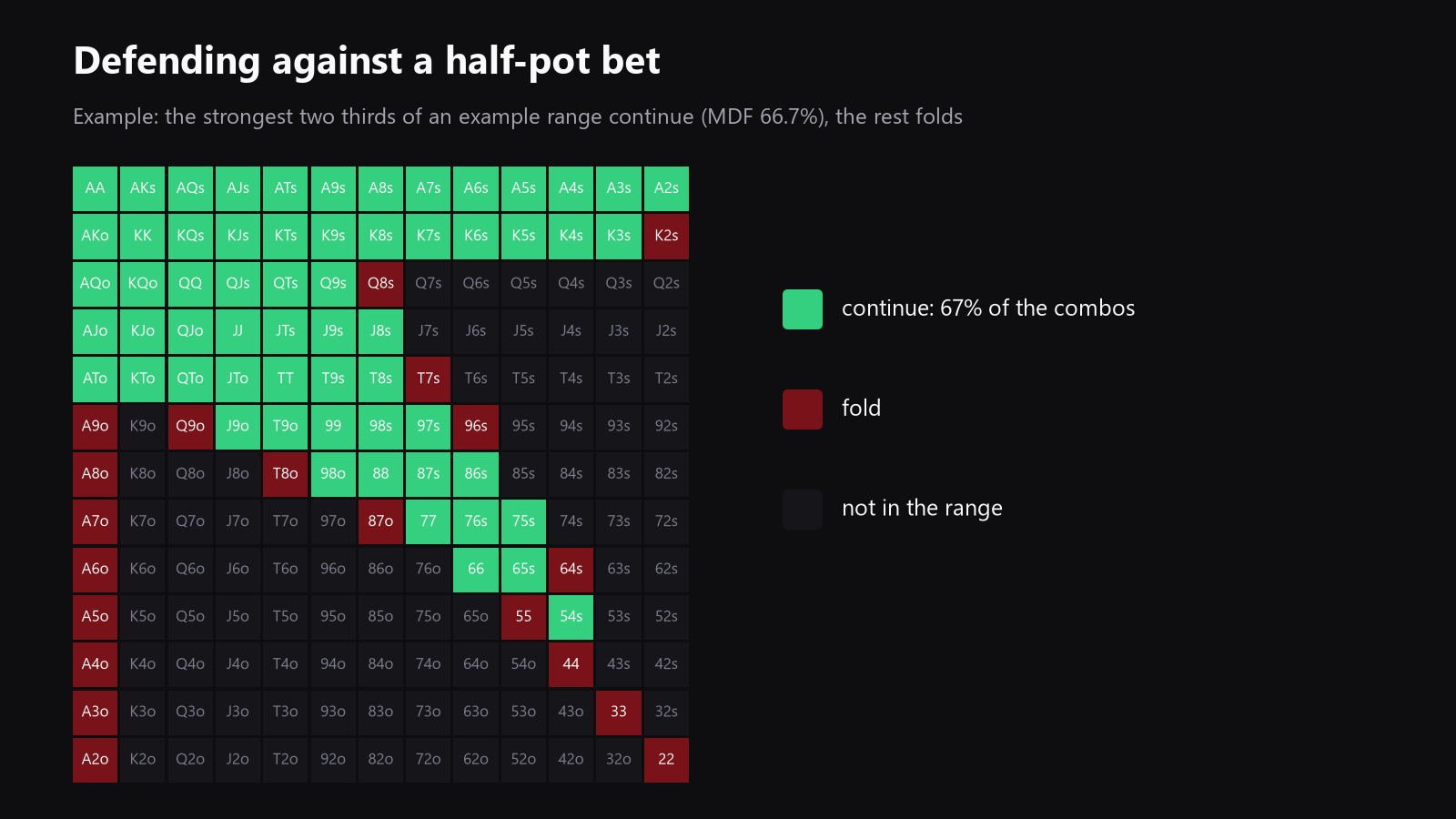
2. MDF does not tell you which hands to continue with
This matters a lot.
You do not defend by picking random hands until you hit the target number.
You defend with the hands that can continue best against the betting range, considering:
- showdown value,
- blockers,
- equity realization,
- position,
- stack depth,
- and future betting streets.
That is why solver outputs are useful. They show which hands continue, not just how many.
3. Real opponents do not bluff at theory frequency
This is the biggest practical point.
In theory, a balanced bettor can choose bluff frequencies that make your decision indifferent. In real games, especially at small and micro stakes, many players underbluff certain lines, and some overbluff others.
That means:
- against an underbluffer, you can often fold more than MDF and print money,
- against an overbluffer, you may need to defend more than your instinct wants,
- against a population that heavily values size tells, your response depends on the exact sizing and line.
So MDF is not a rule that says, “Always defend this much.” It is a baseline that tells you when a bet starts to become theoretically dangerous if you fold too much.
How to use MDF in actual hands
Here is the simplest way to apply it:
Step 1: Identify the pot and the bet size
You do not need anything fancy.
Ask: how much is in the pot before the bet, and how much is villain betting?
Step 2: Compute alpha
Use:
alpha = bet / (pot + bet)
This tells you how often villain needs you to fold for a bluff to show immediate profit.
Step 3: Estimate the population tendency
Now ask the real question: does this player pool actually bluff this line enough?
This is where theory and population data diverge.
If a pool underbluffs a spot, you can fold more than MDF. If a pool overbluffs, you should continue more.
Step 4: Choose the right part of your range
Do not ask, “Do I defend enough hands overall?”
Ask, “Which hands are strongest to continue with here?”
That is where blockers, showdown value, and future play matter.
Step 5: Adjust by street
- River: MDF is most direct here.
- Turn: MDF still helps, but future cards matter.
- Flop: use MDF as a guide, not a rule, because equity realization is huge.
A few common mistakes
Mistake 1: Thinking MDF means you must call more
No.
You can defend by calling or raising.
A strong raise range can satisfy part of your defense frequency, which means you do not need to call every hand that continues.
Mistake 2: Confusing MDF with “good hand strength”
A hand can have decent raw equity and still be a poor continue because it realizes badly.
A hand can also be a weak bluff catcher but a good continue because it blocks value and unblocks bluffs.
MDF does not solve that for you.
Mistake 3: Using MDF against players who do not bluff enough
This is probably the most expensive mistake in real games.
If the pool bets much more value than bluff on a line, folding more than MDF can be correct.
Theory says you should protect yourself against bluffs. Real life says you should protect your win rate against what your opponents actually do.
Mistake 4: Treating small and large bets the same
They are not the same at all.
A small bet has a low alpha, so it does not need to work very often. A large bet needs much more fold equity.
That is why overbets force you to defend differently from tiny block bets.
A practical memory aid
If you want one sentence to keep:
Alpha is how often villain’s bluff must work, MDF is how often you must continue to deny that profit.
Or even shorter:
Villain’s risk over risk plus reward gives alpha, and the rest is MDF.
How this helps you study better
The best way to learn MDF is not to memorize one number. It is to see how different bet sizes push different parts of ranges.
You will learn faster if you compare:
- small bets versus big bets,
- river spots versus flop spots,
- balanced ranges versus population leaks.
That is also why a good study tool matters. If you want to see what players at your limits actually do, the Reveal module shows real frequencies from your own hand histories, not an idealized theory opponent. And if you want to know whether a spot is actually worth your time, the Dashboard shows whether your results are inside variance or whether a leak is really costing you.

The short version
When villain bets B into P:
- alpha = B / (P + B)
- MDF = P / (P + B)
Use alpha to understand how often a bluff must work.
Use MDF to understand how often you must continue, in theory, to stop that bluff from printing.
Then adjust for reality, because most players do not bluff the way equilibrium says they should.
That is the real edge: not knowing the formula, but knowing when the formula matters and when the pool has already broken it.
Do it on your own hands.