
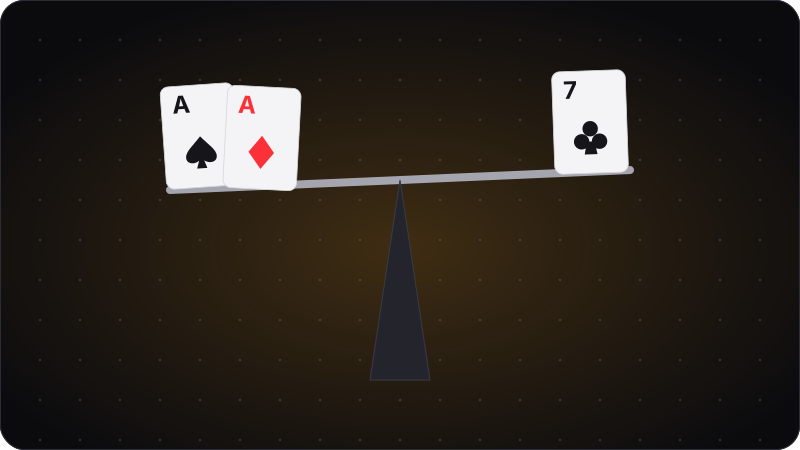
When you bet the river, you are not just choosing between value and bluff. You are choosing a mix.
That mix is the bluff-to-value ratio: how many bluffs you can include for each value bet, given the size you choose. It is one of the most useful river concepts in poker, because it tells you whether your betting range is balanced, too bluff-heavy, or too value-heavy.
It also explains a lot of confusion players have at the table. A half-pot bet does not use the same bluff mix as a pot-sized bet. A turn barrel is not built like a river bet. And against real players, the exact ratio is often only your starting point.
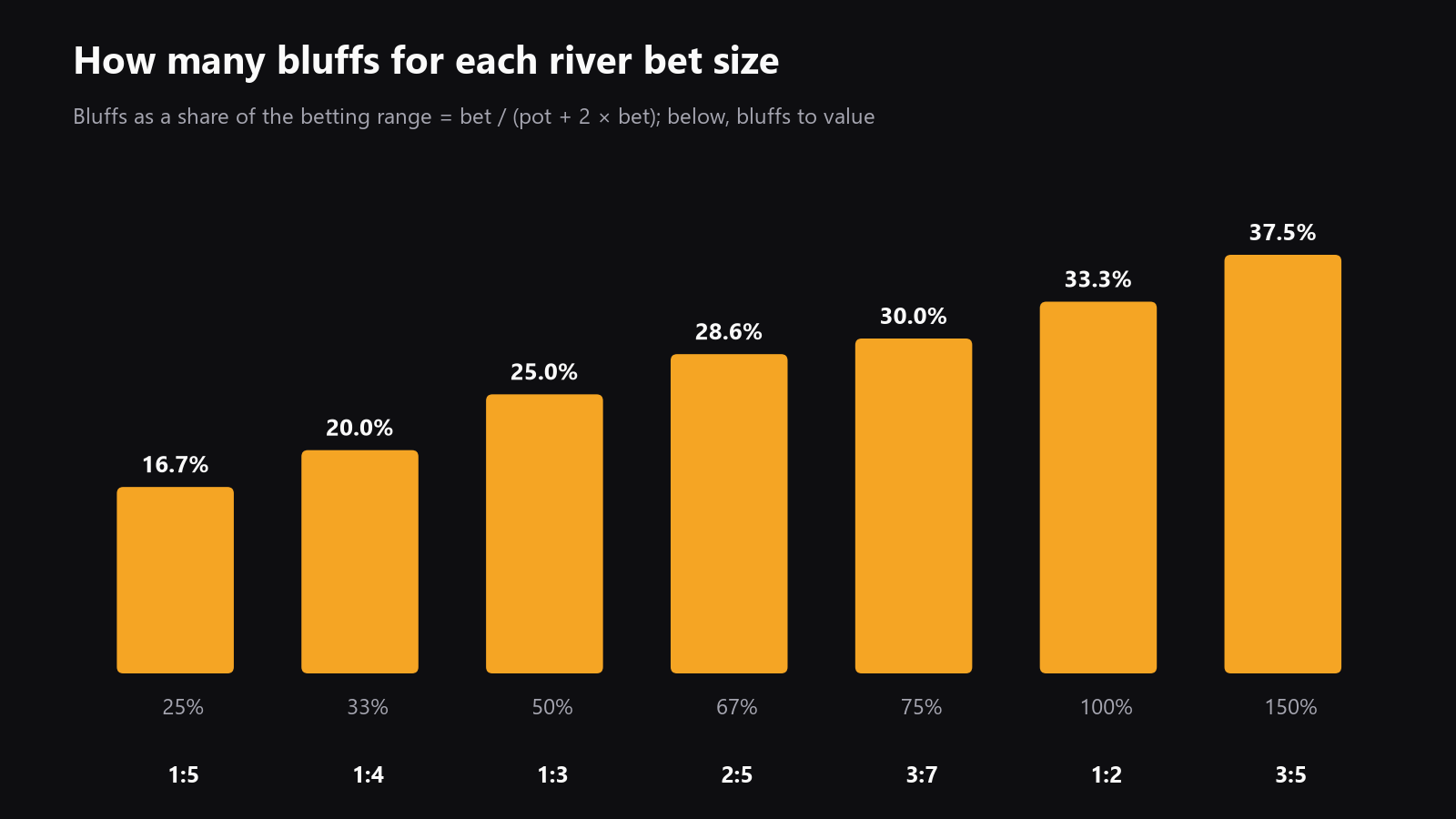
Bluff-to-value ratio vs bluff fraction
These two numbers are related, but they are not the same.
- Bluff-to-value ratio means bluffs divided by value hands.
- Bluff fraction means bluffs divided by all hands that bet.
If you bet 50% pot on the river, those two numbers are:
- bluff fraction: 25%
- bluff-to-value ratio: 1 bluff for 3 value bets
A lot of players mix them up, which makes the river look more mysterious than it is.
The river formula
On the river, if the pot before your bet is P and your bet is B, the clean equilibrium rule is:
- Bluff fraction of your betting range = B / (P + 2B)
- Bluff-to-value ratio = B / (P + B)
That is the number you want if your bet is polarized, meaning you are betting your strong value hands and your weakest bluff candidates.
Here is the practical table most players want.
| River bet size | Bluff fraction of betting range | Bluff-to-value ratio |
|---|---|---|
| 25% pot | 16.7% | 1 bluff for 5 value |
| 33% pot | 20% | 1 bluff for 4 value |
| 50% pot | 25% | 1 bluff for 3 value |
| 67% pot | 28.6% | 2 bluffs for 5 value |
| 75% pot | 30% | 3 bluffs for 7 value |
| 100% pot | 33.3% | 1 bluff for 2 value |
| 150% pot | 37.5% | 3 bluffs for 5 value |
So if you bet half pot on the river, your betting range should be about 25% bluffs and 75% value. That is the same as 1 bluff for 3 value hands.
If you bet pot, your betting range should be about 33% bluffs and 67% value. That is 1 bluff for 2 value hands.
If you overbet, you can include more bluffs relative to value, because the opponent is getting worse pot odds on a call.
Why bigger river bets need more bluffs
The logic is simple.
A bigger bet risks more, so it also puts more pressure on the caller. To keep the opponent indifferent, your betting range must contain more bluffs relative to value as the size grows.
That is why a tiny river blocker bet and a big polar overbet do not use the same construction. A small bet can be merged. A big bet wants a cleaner split between strong value and the weakest hands you are willing to turn into bluffs.
Your bluff candidates are usually the hands that:
- have little or no showdown value
- block the opponent's strongest calls
- do not block the folds you want to force
- do not have enough equity to justify checking
Your value hands are the ones that are happy to get called by worse.
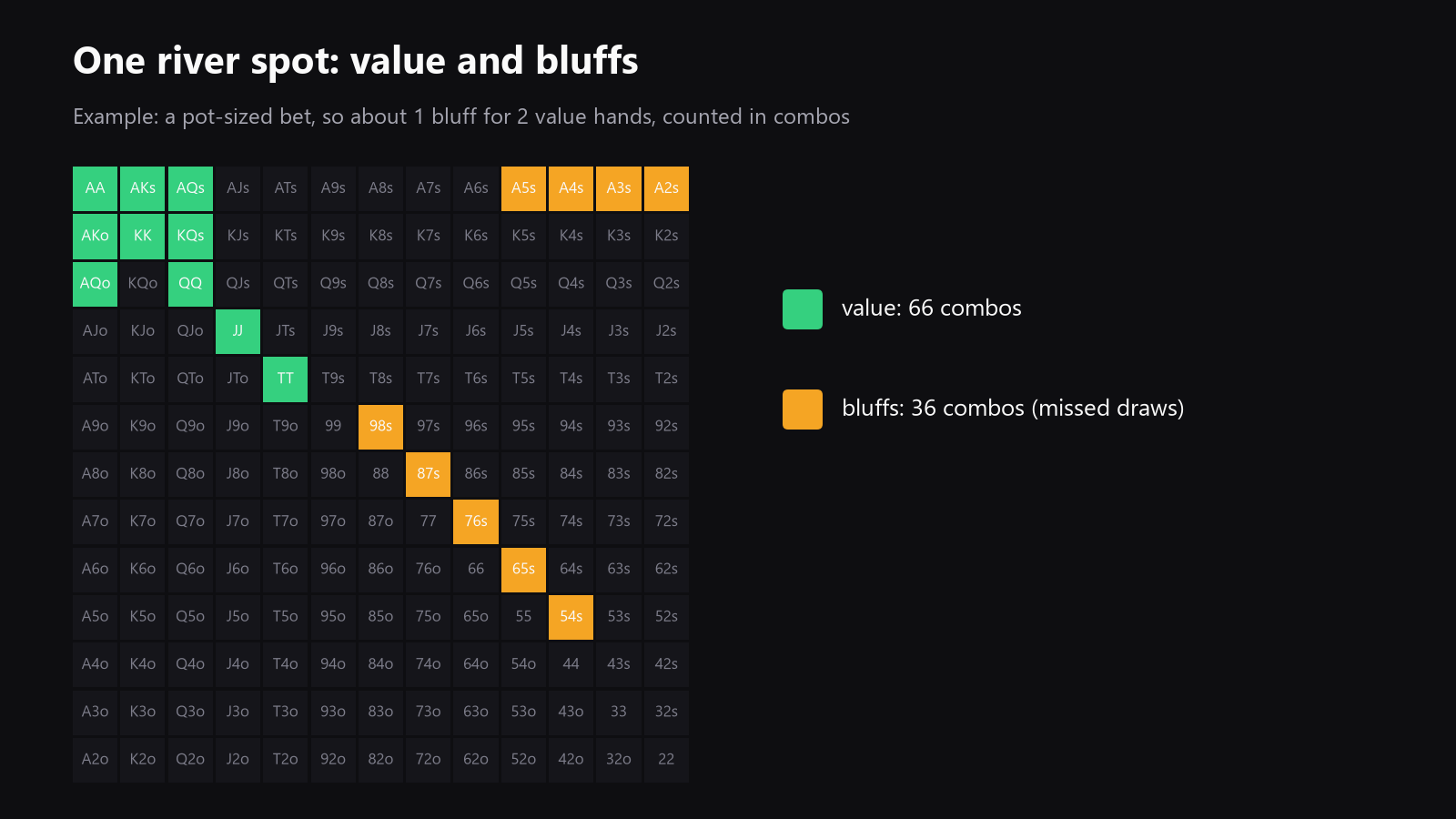
The grid is useful because it shows something the formula alone cannot: the ratio tells you how many bluffs to use, but not which hands should fill those bluff slots.
That selection is a separate skill.
Why the ratio changes on flop and turn
The river rule is exact only when the bet ends the hand.
On the flop and turn, the game is different.
Why?
Because your "bluffs" often still have equity.
A flush draw, an open-ender, a pair with backdoor equity, or a hand with strong blockers is not a pure river-style bluff. It can still improve, it can still realize equity, and it can still profit from future pressure.
That means you should not try to copy the river ratio street by street.
On earlier streets, your betting range is built from:
- hands that already have value
- semi-bluffs that can improve
- hands that gain from fold equity now
- hands that perform well across later streets
So the flop and turn are about more than "how many bluffs for how many value bets". They are about range advantage, equity realization, and future leverage.
A useful way to think about it is this:
- River: pure polarization, exact bluff-to-value math
- Turn: partly polarized, partly semi-bluffed, future cards still matter
- Flop: widest range of hands, the most equity still in play
That is why a solver can show you one ratio on the river and a very different mix on the turn, even with a similar size.
When to leave the ratio against real players
The solver gives you a baseline. Real players give you the adjustment.
If the pool underfolds, your bluffs should come down.
If the pool overfolds, your bluffs can go up.
If your opponents call too much on the river, the value part of your range becomes more important, and thin bluffs lose value fast.
If they fold too often, the opposite happens.
This is where many players make their biggest mistake: they memorize the ratio but ignore the pool.
Against a population that calls too wide, a perfectly balanced bluff mix is not the highest-EV choice. You want fewer bluffs, more value, and often a size that gets paid.
Against a population that overfolds, the reverse is true. You can attack the gap and bluff more often than theory would suggest.
A good rule is:
- use the equilibrium ratio first
- then change it only when the player pool proves you should

That is the right bridge between theory and practice. The equilibrium tells you what a fair game looks like. The field tells you whether your pool actually plays that way.
At small stakes, this matters even more. People often call too much in obvious spots, and rake makes thin, marginal bluffs worse. So the theoretical ratio is useful, but it is not sacred.
A simple river checklist
Before you bet the river, ask yourself four questions:
- What size am I choosing? The size determines the bluff-to-value ratio.
- Is my hand value or bluff? On the river, be honest. Not every medium-strength hand should bet.
- Do I have the right bluff candidates? Prefer hands with blockers and low showdown value.
- Does this opponent actually defend like the theory says? If not, adjust.
If you want one memory shortcut, keep these in mind:
- half-pot river bet: 1 bluff for 3 value
- pot-sized river bet: 1 bluff for 2 value
- overbet river bet: more bluffs than a small bet, but still fewer than value in most pools
The short version
If the pot is P and your river bet is B:
- bluff fraction = B / (P + 2B)
- bluff-to-value ratio = B / (P + B)
That is the exact river baseline.
Earlier streets are different because hands still have equity, future cards matter, and your betting range is not just a pure value-versus-bluff split.
Against real players, do not worship the number. Start from it, then leave it when the pool gives you a reason.
If you want to check what the players at your limits actually do, the Reveal module reads it from your own hands. If you want the clean baseline first, the Solver module gives you the equilibrium mix for the spot.
Do it on your own hands.