
If you play poker long enough, you will hear a version of the same sentence again and again:
"I am running below EV."
Sometimes it is true. Sometimes it is a cry of pain after a brutal downswing. And sometimes it is an excuse that hides the real leak.
All-in EV is useful because it helps you answer one very specific question:
When the money went in before the river, did the cards finish in a way that was better or worse than the equity you had at that moment?
That is a real question, and it matters. But it is not the whole story. If you read the line badly, you can fool yourself into thinking you are getting unlucky when you are actually making poor all-in decisions. Or the reverse: you can blame your play for a result that was mostly variance.
This article will show you what all-in EV is, how it is calculated, what it is not, and how to use it without lying to yourself.
What all-in EV means
All-in EV is short for all-in expected value.
It applies when the money goes into the pot before all five community cards are dealt. That can happen preflop, on the flop, or on the turn. Once players are all in, no more decisions remain. From that point on, the only thing left is to run out the board.
The key idea is simple:
- your result is what actually happened
- your all-in EV is what you would expect to win on average from that spot, based on your equity when the money went in
So if you get it in with 60 percent equity, you do not "deserve" to win that exact pot 60 percent of the time in a tiny sample. You will sometimes lose. Sometimes you will win. Over many repeated situations, your winnings will approach that 60 percent share.
That is all-in EV.
Why it exists
Poker results contain two very different things:
- decision quality
- runout luck
All-in situations mix them together very aggressively.
Example:
- you get the chips in with top pair and a strong kicker against a flush draw
- you are ahead when the money goes in
- the turn and river bring the flush
- you lose the pot
Did you make a bad decision? Not necessarily. If you got the money in as a favorite, the decision may have been good even though the result was bad.
Without all-in EV, you may look at your graph and conclude that you are cursed. With all-in EV, you can at least see that the cards changed the outcome after the point where no more decisions remained.
That is why the metric exists. It helps you separate luck from the decision to go all in.
How all-in EV is calculated
The basic version is easy to understand.
Suppose the pot is 100 big blinds when the money goes in. You are all in with 70 percent equity.
Your all-in EV is not "you win 70 bb every time". Poker is not that literal. You do not get the pot by magic. Instead, your expected share of the final pot is based on your equity.
A simplified way to think about it is:
EV = equity x final pot share you can win, minus what you put in
In practice, poker software usually calculates the EV of the all-in spot by taking:
- the size of the pot at the moment the money goes in
- the amount still behind
- each player’s equity against the other ranges or hands at that moment
Then it assigns you the average monetary outcome you would get if that exact all-in spot were repeated many times.
A simple example
Imagine a cash game hand:
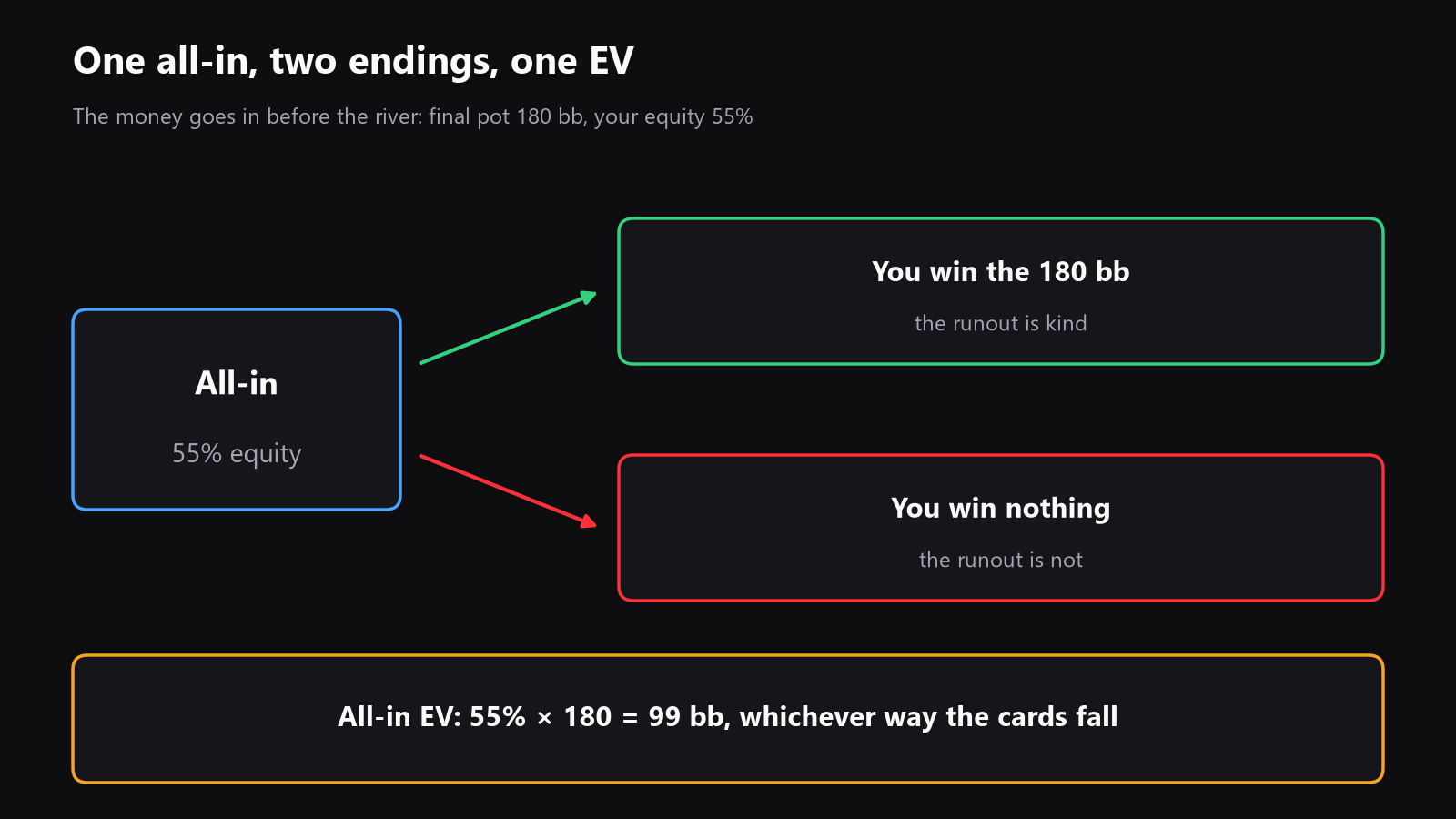
- Pot before the all-in: 20 bb
- You shove 80 bb
- Villain calls 80 bb
- Final pot: 180 bb
If you have 55 percent equity when the money goes in, then your expected share of the final pot is 99 bb before subtracting your contribution, depending on the exact convention used by the tracker. The important part is not the internal bookkeeping detail, but the concept:
- if you win far more than your equity, you run above all-in EV
- if you win far less than your equity, you run below all-in EV
Different tools may present the line slightly differently, but they all aim at the same thing: isolate the part of your results explained by the card runout after the all-in point.
What all-in EV does not tell you
This is where many players go wrong.
All-in EV does not tell you whether your overall game is good or bad.
It only covers spots where the money went in before the river.
That means:
- it ignores pots where you folded earlier
- it ignores non all-in pots that ended on the flop, turn, or river without stacks going in
- it does not measure whether your c-bets are good
- it does not tell you if your turn bluffs are well chosen
- it does not measure rake
So if you only look at your all-in EV line, you are looking at a narrow slice of poker.
That slice is useful, but it is still a slice.
Why your result line and your all-in EV line differ
There are only a few reasons.
1. Variance
This is the main reason.
If you win a lot of all-in pots where you were behind, your results will sit above all-in EV.
If you lose a lot of all-in pots where you were ahead, your results will sit below all-in EV.
This is normal. It does not mean the universe is targeting you personally.
2. Different all-in frequencies
All-in EV only sees spots where the money went in. If you are getting stacked often in good spots, the line may look better than your actual profit. If you rarely get all in, the line may have very little to say.
That is why sample size matters.
3. Rake
In cash games, rake can make a big difference to your actual profit, while all-in EV ignores it as a concept of runout luck.
So even if your all-in EV line looks healthy, your net results can still be dragged down by rake.
4. Tournament equity and payout structure
In tournaments, chip EV and dollar EV are not the same thing. Near pay jumps, final tables, and bubble spots, the value of chips changes.
That means all-in EV is less intuitive in tournaments than in cash games. It is still useful, but you need to remember that chips are not equal to prize money in a linear way.
What a gap between result and all-in EV actually means
A gap is not a verdict. It is a clue.
If you are below all-in EV
This means the cards have been harsh in your all-in spots.
That can happen even if you are playing well.
Before you call it bad luck, ask:
- how many all-in spots is the gap based on
- are those spots spread over enough hands
- is your result line also dragged down by rake
- are you looking at cash games or tournaments
A big gap over a tiny sample is noise. A big gap over many thousands of hands is more meaningful.
If you are above all-in EV
This can feel great, but it should also make you cautious.
A player who is running above EV may be:
- legitimately sunrunning
- getting it in well and winning the coolers
- benefiting from opponent mistakes
- or, sometimes, overestimating how good their game is because the graph looks flattering
If you are way above EV, do not assume you have solved poker. Ask whether the graph is flattering a part of your game that is not sustainable.
How much should you trust the line?
Trust it in proportion to sample size.
A few all-in pots do not tell you much.
Thousands of all-in decisions tell you more.
But even then, the line is not a complete report card. It is a variance-adjusted indicator, not a strategy evaluation.
A player can run below EV and still be a winner. A player can run above EV and still be leaking badly.
The real question is not "Am I below EV?" The real question is:
"Given the size of my sample, what does this gap actually prove?"
Usually, the answer is less dramatic than your emotions want.
A practical way to read your graph
When you look at your results, use this order:
Step 1: Check the sample
Ask how many hands the graph covers.
Over a small sample, the gap is mostly noise.
Step 2: Check the all-in EV line
If the EV line is above the result line, your all-in outcomes have been worse than average given your equity.
If it is below, you have run above average in those spots.
Step 3: Look at the non all-in part of the graph
This matters a lot.
If the gap comes mostly from non all-in pots, all-in EV will not explain it.
Step 4: Compare with rake
In cash games, rake can be a major reason why a player feels they are "running bad" when the real issue is that their edge is too thin for the stake they are playing.
Step 5: Review the actual all-in hands
This is the step most players skip.
Do not just stare at the graph. Open the hands.
Ask:
- was I happy to get it in?
- what range did I put villain on?
- what range did villain likely have?
- was I ahead when the money went in?
- would I take the same line again?
That last question matters more than the graph.
If your hands are good, the graph is allowed to be ugly.
Common mistakes with all-in EV
Mistake 1: Thinking EV means "what you should have won"
No. It means your average expected result given the equity you had at the all-in point.
Mistake 2: Using it as proof that you are good
A strong EV line in a short sample does not make you a winning player.
Mistake 3: Using it to excuse leaks
If you keep getting all in with thin equity or dominated ranges, a bad result is not just bad luck.
Mistake 4: Ignoring rake
In many small-stakes cash games, rake is a huge part of the story.
Mistake 5: Applying it too literally in tournaments
Tournament EV is more complicated because chips are not prize money in a linear way.
Mistake 6: Forgetting that not all decisions are all-in decisions
You can play brilliantly in all-in spots and still lose money by making bad folds, bad bluffs, or bad value bets before stacks go in.
What all-in EV is good for
All-in EV is most useful for three things.
1. Emotional sanity
It stops you from judging yourself only by short-run outcomes.
2. Better review
It helps you identify whether a downswing is mostly card-driven or whether there is a deeper problem.
3. Cleaner conversations about results
It gives you a language for discussing how much of your graph is luck and how much is strategy.
That is valuable, especially if you review your hands seriously.
In practice, a good tracker or results screen should let you see the profit curve and the all-in EV line together, with rake nearby as well, so you do not forget what the room takes from you before you even start arguing with variance.

A concrete example
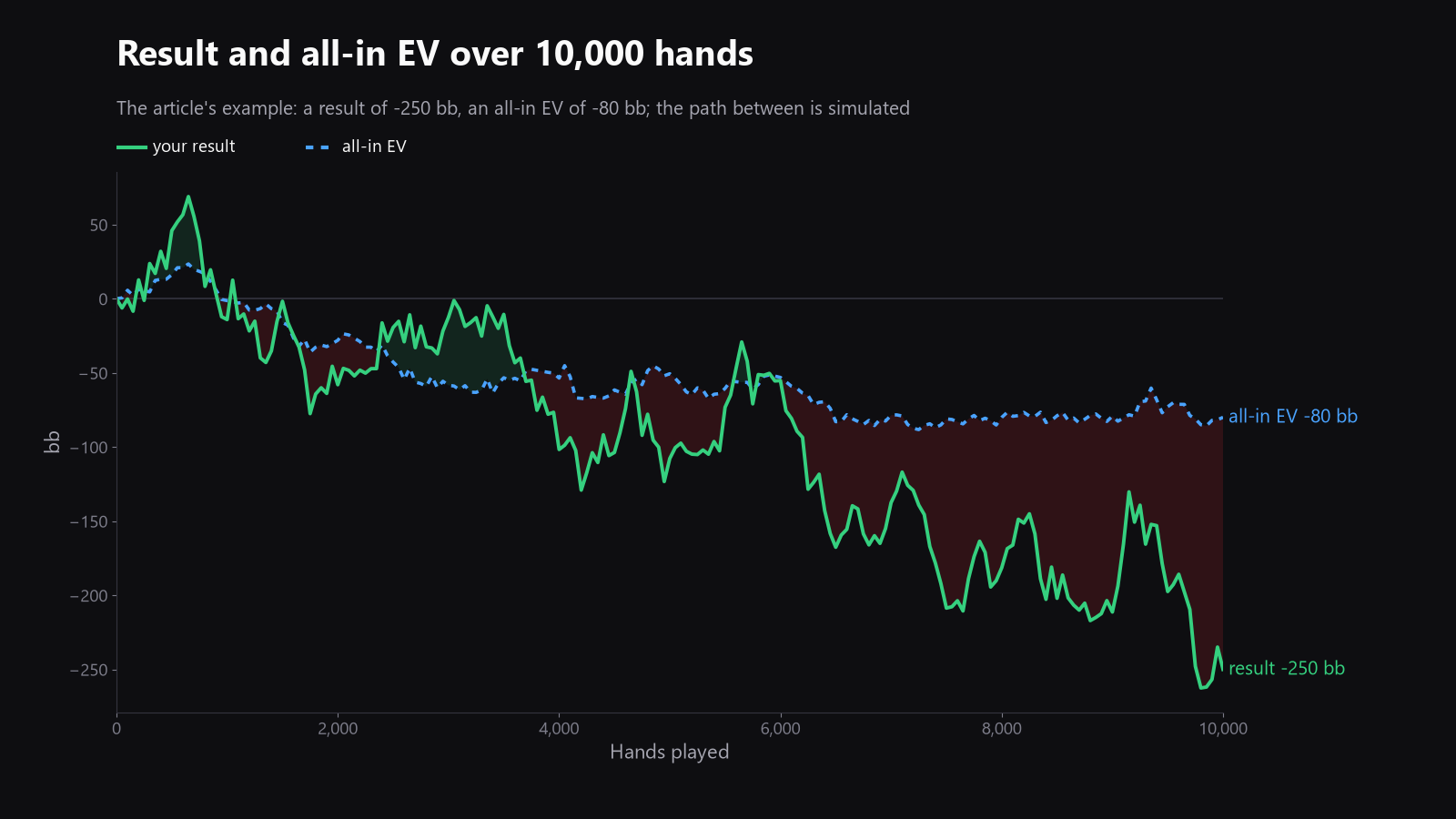
Let us say you have played 10,000 hands of cash games.
Your actual result is minus 250 bb.
Your all-in EV line says minus 80 bb.
What does that mean?
It means that in your all-in spots, the cards have been rougher than average. The gap is 170 bb.
Does that prove you are a winning player who is just unlucky?
No.
It proves something narrower:
- your all-in runouts have been worse than your all-in equity would predict
That is it.
You still need to ask whether:
- your non all-in play is losing money
- your table selection is poor
- your rake is too high for the stake
- your decision making is strong enough to justify the spots you are taking
All-in EV gives you one piece of the puzzle, not the whole picture.
How to use it in your study routine
Here is a simple routine you can follow:
- Review your monthly results.
- Separate total profit from all-in EV.
- Look at the biggest all-in pots.
- Ask whether you were happy with the money going in.
- Mark the spots where you were not confident.
- Review those hands in depth.
If you want your study to stay grounded in your own hands, a results screen that keeps the profit curve and the all-in EV line together makes this review much easier. The point is not to admire the graph. The point is to turn the graph into a better next session.
Final takeaway
All-in EV is a very useful metric, but only when you use it for what it actually measures.
It tells you whether the runout after the money went in was favorable or unfavorable relative to your equity at that moment.
It does not tell you everything about your game.
So when you look at the gap between your results and your all-in EV line, ask the right question:
"How much of this is luck, and how much of this is what I chose to do before the river?"
That is the real value of all-in EV. It does not let you hide from variance, and it does not let variance hide your mistakes.
Do it on your own hands.