
The right time to quit is not when your result feels too good to lose, or too bad to keep looking at. You quit a poker session when continuing would lower the quality of your decisions, or when the game itself is no longer worth your time.
That sounds simple, but most mistakes come from mixing up three very different things:
- your result so far
- the quality of the table
- the quality of your own state
The result is backward-looking. The table and your state affect the next hand.

The short answer
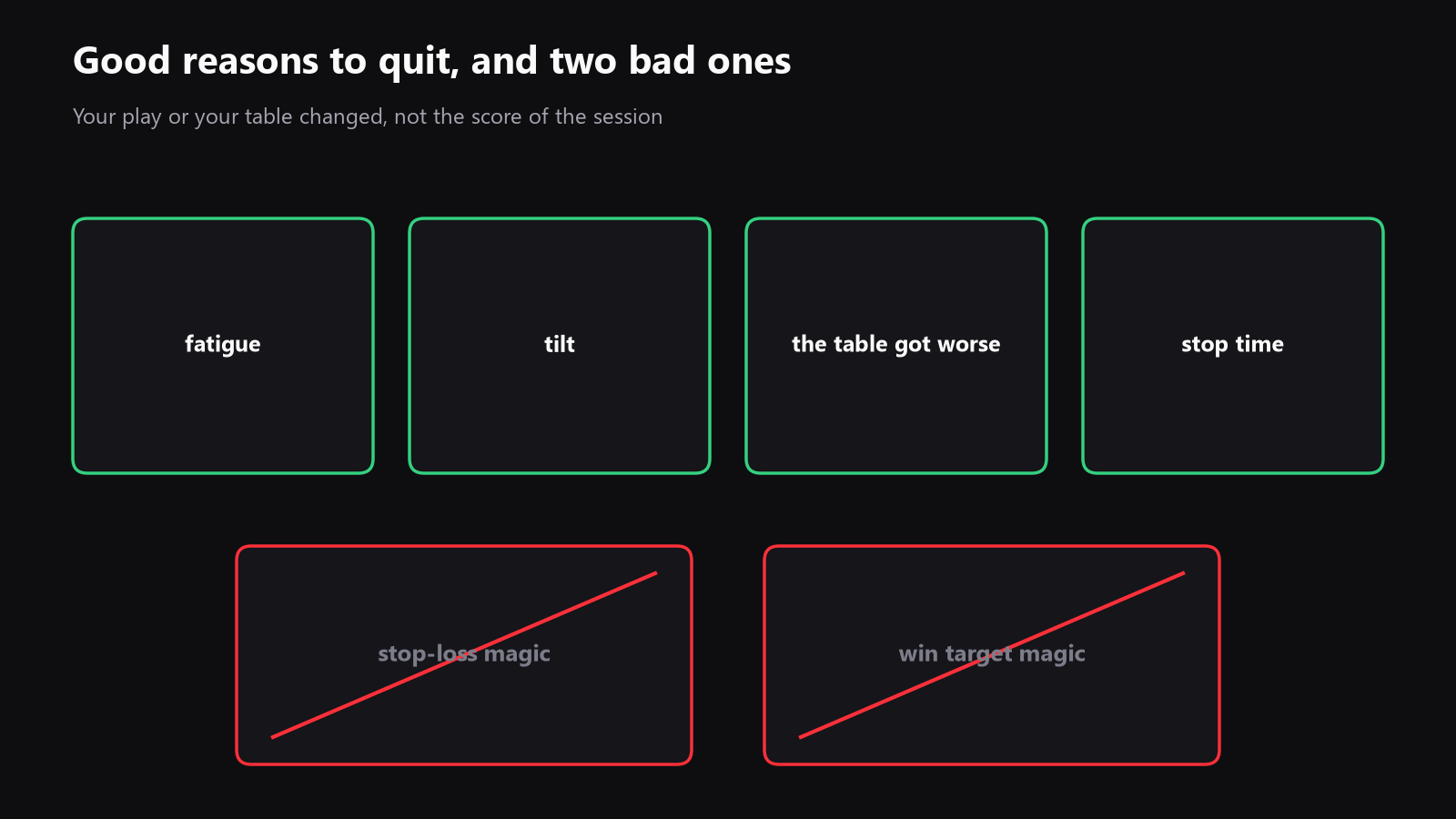
Quit when one of these is true:
- you are tired enough to make worse decisions
- you are tilted enough to make worse decisions
- the table got worse enough that your next hour is less valuable
- your stop time has arrived
Do not quit because you hit a win target, missed a stop-loss, or want to protect a graph.
Those are not poker reasons. They are emotional reasons dressed up as rules.
Good reasons to stop
1. Fatigue
Fatigue is one of the cleanest reasons to stop, because it changes the next decision.
You may still feel "fine", but if your attention is slipping, your bet sizing becomes lazy, your river spots are rushed, and you start missing information that was obvious earlier, your edge is already shrinking.
A good test is simple:
- are you still counting stacks and pot sizes accurately?
- are you still noticing position, stack depth, and player type?
- are you still able to explain why you are taking a line?
If the answer starts to wobble, leave.
2. Tilt
Tilt is not only anger. It is any state that makes you deviate from your normal process.
That includes:
- wanting to win it back immediately
- calling because you "deserve" to hit
- bluffing more because you are frustrated
- folding too much because you are scared to lose more
- changing your strategy because a session result hurts your ego
If you know that a certain loss, bad beat, or runout sends you off your plan, then a stop rule can be useful. But the real reason to stop is not the number. The real reason is that the number changes your state.
That distinction matters.
A stop-loss can be a guardrail. It is not a magic force field.
3. The table got worse
This is the most underrated reason to quit.
If the table was good and then the best seat left, the loose player tightened up, stacks got shorter, the recreational player busted, or a tougher lineup arrived, your future hourly expectation can fall.
That is a real reason to leave.
Notice what matters here: not your result, but the future quality of the game.
If the table changes from soft to tough, and your edge drops, quitting can be the best decision even if you are winning right now.
4. A stop time
A stop time is a good reason because it protects your routine.
You may have work, sleep, family, or another session planned. In that case, you do not need a poker reason at all. You stop because you said you would stop.
That is often better than waiting for emotion to make the decision for you.
A stop time is especially useful if you tend to stay in too long after a good run. The extra hour after a strong win is often where focus starts to slide.
Bad reasons to stop
1. A stop-loss treated as magic
A stop-loss is not bad because it exists. It is bad when you believe the number itself has power.
Example: you tell yourself, "If I lose 3 buy-ins, I must quit because the session is cursed."
That is superstition.
The number does not change the cards, the field, or your range. What changes EV is whether you are still thinking well.
So if the loss makes you play worse, stop. If it does not, the number alone is not a reason.
2. A win target treated as magic
A win target can be just as dangerous.
"If I am up 2 buy-ins, I leave with the money."
That sounds disciplined, but often it is only fear of giving back a good result. You are no longer choosing the best hour of poker. You are choosing to preserve a feeling.
If the table is still great and you are still sharp, leaving because you hit a target can be a leak.
A target can still be useful if it helps you obey a broader routine. But the reason should be "I want a fixed session length" or "I do not play well after a certain point", not "the win number has special meaning."
3. Quitting to lock a win
This is the classic mistake.
You run hot, you protect the result, and you tell yourself you made a smart fold of time. In reality, you may just be reacting to short term variance.
Winning a session does not mean the next hour is dangerous. Losing a session does not mean the next hour is due.
Poker does not owe you a correction.
Why your session result says nothing about the next hour
This is the part many players feel but do not fully accept.
A session result is a sample. It is not a prophecy.
If your true win rate is 4 bb/100, then in 300 hands your expectation is:
4 x 300 / 100 = 12 bb
At four tables, 300 hands is about an hour, as an example.
That is your average expectation, not a guarantee.
You might win 80 bb. You might lose 60 bb. You might break even.
None of those results changes the expectation of the next 300 hands, if the conditions stay the same.
Example 1: You are up a lot
Suppose you play 300 hands and run very well, winning 100 bb.
The next 300 hands still have the same expectation if your game, your table, and your focus are unchanged.
Being up 100 bb does not make the next hour worse. It only means the last hour was better than average.
If you quit only because you are afraid to "give it back", you are reacting to the past, not to the next decision.
Example 2: You are down a lot
Suppose you play 300 hands and lose 100 bb.
That is painful, but it does not mean the next hour is now better or worse because of the loss.
If your edge is still there, the next hour still has the same expected value.
What the loss may change is you. If the loss makes you impatient, scared, or reckless, then you should stop. Again, the reason is your state, not the result itself.
Example 3: The table changed
Now suppose your first hour was great because a weak player was splashing around, but that player left and the seat was filled by a tougher regular.
Now the future has changed.
This is a genuine reason to quit, because the next hour is no longer the same game.
That is the key idea: the last result does not predict the next hour, but the table and your mental state can.
A practical rule you can use
Before you start playing, write down four session rules:
- My stop time
- My fatigue trigger
- My tilt trigger
- My table quality trigger
Keep them concrete.
Examples:
- stop after 90 minutes
- stop if I start missing stack sizes
- stop if I feel the urge to recover immediately
- stop if the best player leaves and the table turns tough
Do not write "stop if I am down 2 buy-ins" unless that number is only a proxy for tilt that you know from experience.
A good session rule is something you can follow without thinking hard in the middle of the game.
What to do after you quit
Once the session is over, then the numbers become useful.
If you want to judge the session honestly, look at:
- the result
- the rake next to the result
- the all-in EV line
- the number of hands
The free Results screen shows your curve, your money by month and over your career, and the rake next to the result. Its all-in EV line removes only the luck of the all-ins.

If the sample is still small, the free Dashboard screen will say so. It shows your win rate with its margin, the headline that tells you whether the sample settles anything, and the run inside its cone of variance. That is exactly the right lens after a short session: not a story, just the size of the sample.
How this connects to improving your game
Quitting well is part of playing well, but it is only one part.
If you keep stopping for the same reason, for example fatigue, boredom, or tilt after a certain spot, then that is not just a session issue. It is a leak pattern.
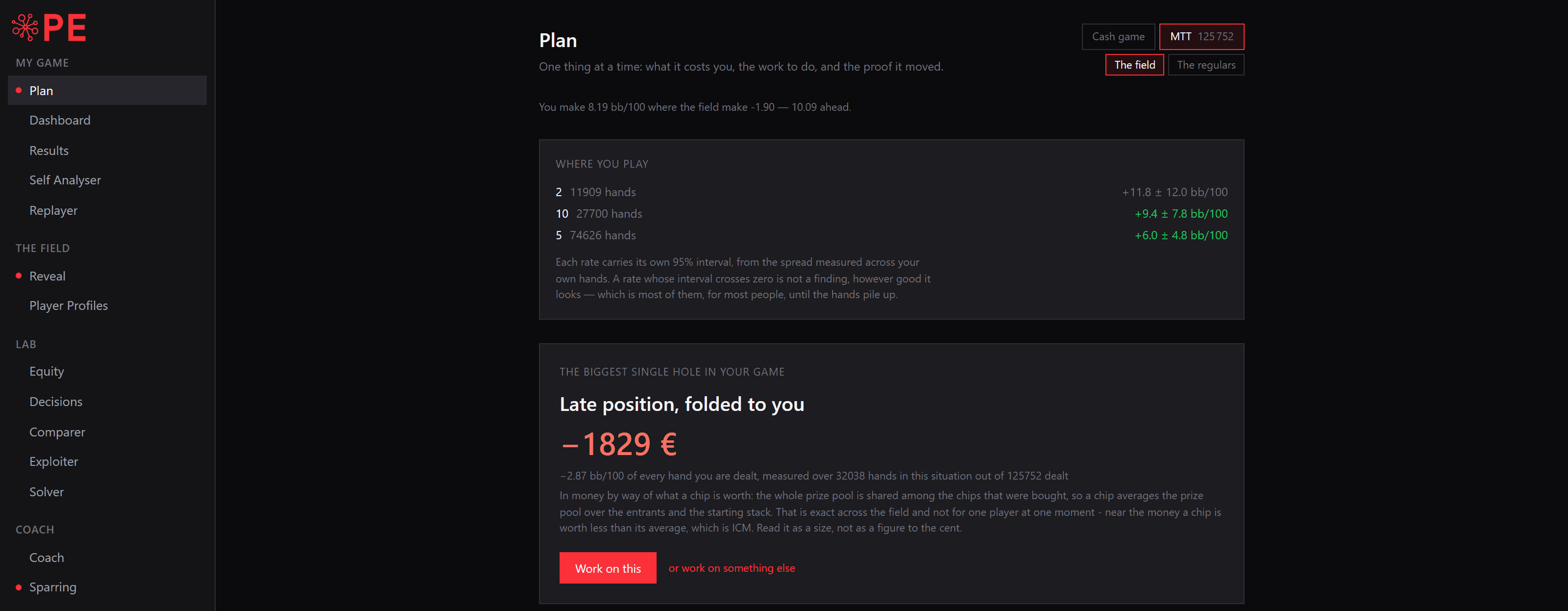
That is where the free Self Analyser and Plan screens help.
The Self Analyser shows which situations cost you the most, and whether they are clearly different from noise. The Plan screen then picks the situation that measurably costs the most and runs a simple cycle: where you stand before, five training sessions, 150 new decisions in that spot, then a verdict.
That is the right use of your time after a session ends: not to chase the emotional shape of the result, but to learn what actually needs work.
The bottom line
Quit a poker session for reasons that affect future decision quality:
- fatigue
- tilt
- worse table
- stop time
Do not quit because a result feels lucky, unlucky, sacred, or dangerous.
A session result is only one sample. It does not tell you what the next hour is worth.
Your next hour is shaped by your focus, the table, and your process. Not by the graph's mood.
Do it on your own hands.