
Multi-tabling is one of the biggest decisions you face once you move beyond single-table play. More tables usually mean more hands, more volume, and often more action per hour. But they also mean less time for each decision, less room to think, and a greater risk of turning solid poker into rushed poker.
So the real question is not, "How many tables can you open?" It is:
How many tables can you play while still making good decisions?
That answer depends on your skill, your format, the speed of the site, the player pool, and how quickly your concentration drops once the table count rises.
The first mistake: looking only at win rate
A lot of players focus only on win rate in big blinds per 100 hands. That number matters, but it is incomplete.
When you multi-table, what matters is hourly value.
Use this formula:
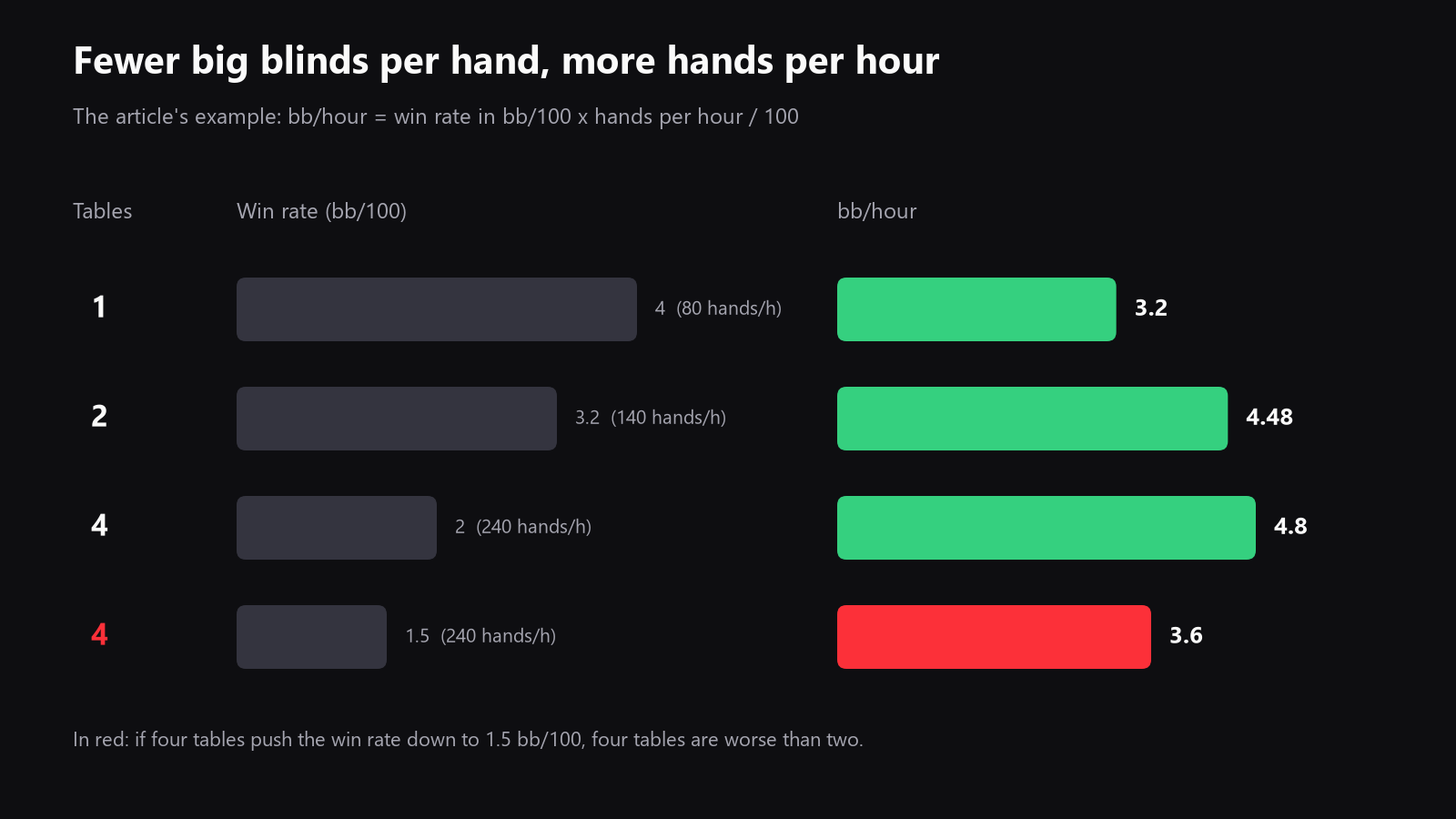
bb/hour = win rate in bb/100 x hands/hour / 100
That means you need to know two things:
- how your win rate changes when you add tables
- how many more hands you play per hour
A worked example
Here is an example, not a rule:
| Tables | Win rate | Hands/hour | bb/hour |
|---|---|---|---|
| 1 | 4.0 bb/100 | 80 | 3.2 |
| 2 | 3.2 bb/100 | 140 | 4.48 |
| 4 | 2.0 bb/100 | 240 | 4.8 |
In this example:
- 1 table gives 3.2 bb/hour
- 2 tables give 4.48 bb/hour
- 4 tables give 4.8 bb/hour
So in this case, more tables still help, because the fall in win rate is smaller than the gain in volume.
But that does not mean more tables always help. If four tables push the win rate down to 1.5 bb/100, then:
1.5 x 240 / 100 = 3.6 bb/hour
Now four tables are worse than two. That is why the hourly number matters more than the raw win rate alone.
How many tables should you play?
There is no universal answer. But there is a practical way to think about it.
One table
Best if you are still learning:
- preflop ranges
- standard postflop lines
- bet sizing
- how opponents react
One table gives you time to think. It is often the best place to build fundamentals, because you can see the hand clearly instead of reacting under pressure.
Two tables
For many players, this is the first real step into multi-tabling.
Two tables often add volume without destroying your decision quality. You still have enough time for tough spots, but the session feels more productive than one table alone.
Three to four tables
This is where concentration starts to matter a lot more.
At this point, a good player can still do well, but only if many decisions are already automatic:
- opening ranges are stable
- common 3-bet spots are quick
- standard c-bets are easy
- routine folds are instant
If every session at this table count feels rushed, you may be playing too many tables for your current level.
Five tables and more
This can work, but only if the math still makes sense.
Add tables only if:
- your hands/hour clearly go up
- your win rate does not fall too far
- your focus still holds in the hardest spots
Do not add tables because it feels ambitious. Add them because the numbers and your decision quality both support it.
Add tables one step at a time
A common mistake is to jump too far too fast. A player goes from two tables to six, then cannot tell whether the result is due to skill, fatigue, or simple overload.
Use a slower method.
Step 1: establish a baseline
Play your current setup long enough to know what normal looks like.
Do not judge from a tiny sample. A few good sessions can be pure variance.
This is where a tracker screen is useful. The free Dashboard screen shows your win rate with its margin, a headline that says whether the sample settles anything, and the run inside its cone of variance.

Step 2: add one table only
If you play one table, move to two. If you play two, move to three.
Do not jump from two to six and expect to know what changed.
Step 3: keep everything else stable
For a fair test, keep these as constant as possible:
- game type
- stakes
- site
- table selection
- session length
- time of day
If you change too many things at once, you will not know what caused the result.
Step 4: compare hourly value and decision quality
After enough hands, ask two questions:
- Did my bb/hour improve?
- Did my decisions stay strong?
A higher number of hands per hour means very little if your mistakes are more frequent and more expensive.
Step 5: look at the spots that get worse first
When players add too many tables, the first leaks are often subtle:
- value bets disappear
- blind defense gets too passive
- bluff catches are missed
- automatic c-bets replace thought
- river decisions get rushed
- table dynamics stop registering
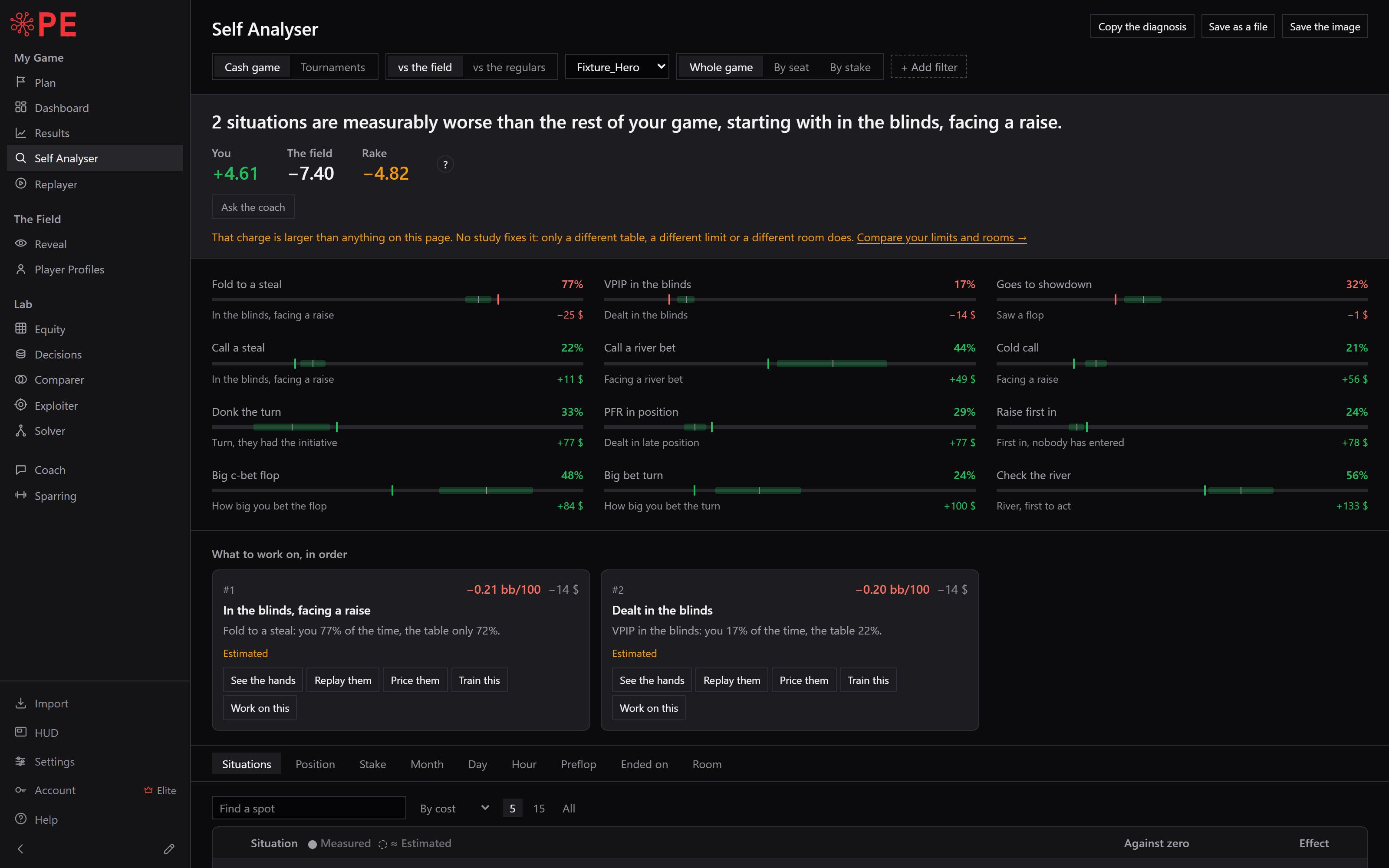
That is why the free Self Analyser can be useful after the session. It shows which situations cost you the most in big blinds per 100 hands and whether those leaks are real or just noise.
Concentration is about decision quality
A lot of players think concentration means "trying harder." In poker, that is not enough.
Concentration means keeping your decisions accurate while the number of tables rises.
You are not trying to feel focused. You are trying to keep the quality of your choices high.
Make the layout stable
If your tables move around all the time, your brain spends energy just tracking them.
Use a fixed layout. Keep it the same from session to session if possible. The less energy you waste on navigation, the more you have left for the hand itself.
Reduce memory load
The free HUD shows the main live-table stats next to each seat: VPIP, PFR, 3-bet, fold to 3-bet, flop c-bet, and fold to flop c-bet, plus notes and colours from Player Profiles.
That does not play for you. It simply means you do not have to remember every opponent in your head. Less memory load leaves more room for the current spot.
Save deep thought for the right hands
Not every hand deserves the same amount of attention.
Think hard about:
- unfamiliar lines
- large pots
- new opponents
- close decisions
- river spots with real money behind them
Think quickly about:
- obvious folds
- routine opens
- standard c-bets
- clear preflop decisions
If you try to think deeply about every hand, multi-tabling becomes exhausting. The goal is not equal attention everywhere. The goal is to reserve attention for the spots that matter most.
A simple routine that helps
Here is a practical routine you can use.
Before the session
Decide your table count in advance.
Also decide:
- how long you will play
- when you will stop adding tables
- when you will reduce them
- which hands you want to review later
If you are working on a new spot, keep the table count lower until that spot feels more automatic.
During the session
Use one rule: if you keep feeling rushed, reduce the number of tables at the next reasonable break.
Signs that you may be over the limit:
- you are behind before action reaches you
- you are guessing instead of reading the spot
- you click on autopilot
- you miss basic table dynamics
- you finish sessions mentally drained every time
That is not a failure. It is information.
After the session
Do not review everything.
Review the hands where you felt rushed, uncertain, or surprised. Those are the hands that tell you whether the table count was too high.
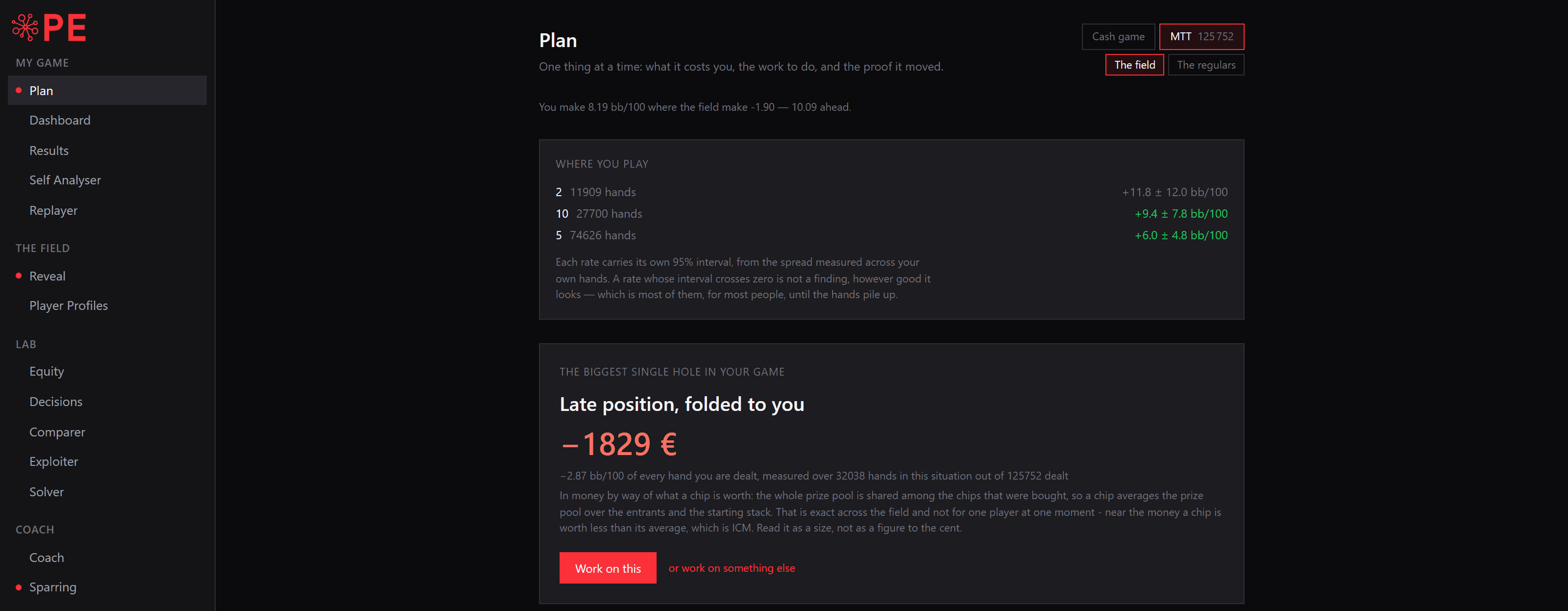
This is also where the free Plan module can help. It picks the situation that costs you the most and makes you work on that one first, instead of studying randomly.
When more tables stops helping
More tables stop helping when one of these happens:
- your win rate falls faster than your hands/hour rises
- your concentration drops in the toughest spots
- you can no longer tell which hands matter most
- the same mistakes keep coming back session after session
At that point, the answer is usually not to try harder. It is to lower the table count and fix the cause.
Sometimes the cause is technical. Sometimes it is mental fatigue. Sometimes it is simply that you have reached your current limit.
That is normal.
The right goal
The goal is not to play as many tables as possible.
The goal is to play the maximum number of tables that still lets you make strong decisions.
A good rule of thumb is this:
Add tables until your hourly value improves, but stop before your decision quality breaks down.
That is the real tradeoff.
If you want to see your own win rate, margin, and run more clearly, the free Dashboard screen is a good place to start. If you want to know which situations are actually costing you money after the session, the free Self Analyser and the Plan module turn that question into something measurable.
That is what multi-tabling should be about: not playing more for its own sake, but playing enough volume without giving up the quality that makes the volume worth it.
Do it on your own hands.