
A good poker session does not begin when you click Sit. It begins when you decide what this session is for.
If you sit down without a routine, you usually get three things you do not want: random goals, random emotions, and random review. If you sit down with a routine, each session has one job. That does not guarantee a better result, and it does not promise a win. What it does is make your work clearer, cleaner, and much easier to improve.
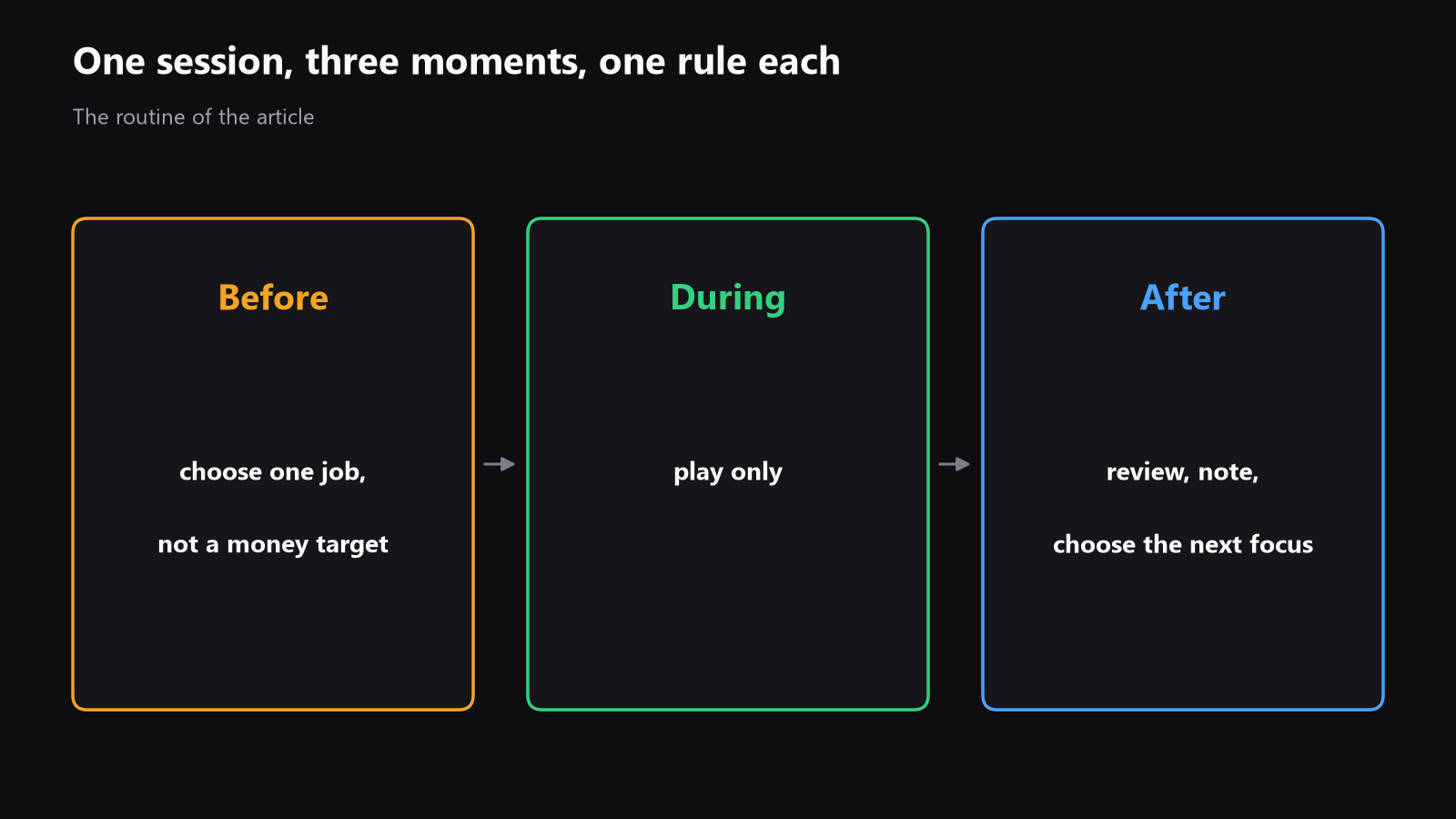
Before the session: choose one job, not a money target
The biggest mistake players make before a session is to set the wrong goal.
“Run good.” “Win two buy-ins.” “Get unstuck.” “Make money today.”
Those are not session goals. They are hopes. A useful session goal is about one situation, one decision pattern, or one leak. It is not about money. It is about how you play.
A strong goal sounds like this:
- “I will play better in single-raised pots when I face a turn probe.”
- “I will stop overdefending the big blind against late-position opens.”
- “I will take more time before river decisions in 3-bet pots.”
- “I will notice when I c-bet too automatically on boards that favor the caller.”
That kind of goal is good because it is specific, observable, and reviewable. You can tell whether you worked on it. You can review it after the session. You can come back to it later.
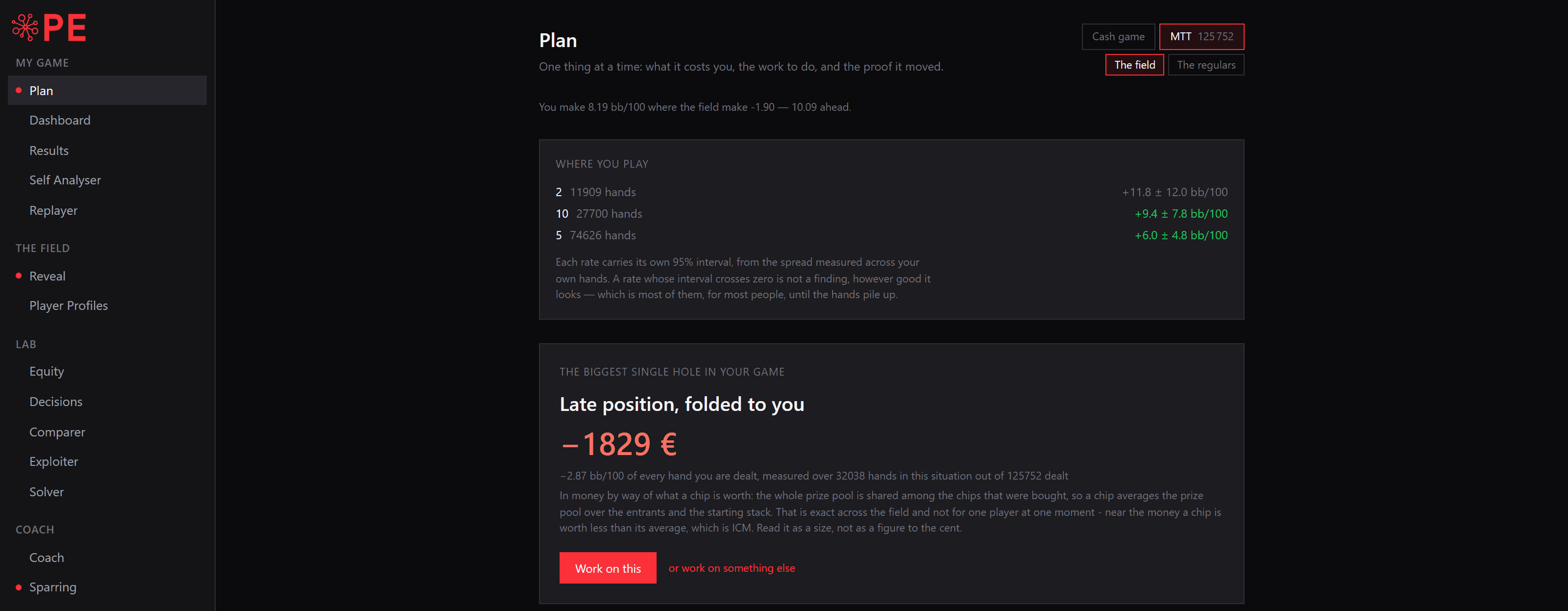
If you do not know which situation deserves your attention, the free Plan module can help. It picks the situation that costs you the most in a measurable way compared with players at your limits, then runs a simple cycle: your starting statistic, five training sessions, 150 new decisions in that spot, then a verdict. That is useful because it keeps you from guessing.
Set your limits before you open a table
A session routine also needs practical boundaries.
Decide in advance:
- which stakes you will play,
- how long the session will last,
- what will make you stop.
That does not have to be dramatic. A simple time limit is enough. For example:
- 60 minutes,
- or 90 minutes,
- or one set block of two hours.
You can also add a mental stop. If you notice you are clicking too fast, losing the thread of hands, or thinking about the last bad beat instead of the current table, that session is over. The best time to protect your focus is before it starts to fray.
Do not make your stop rule about money. A money stop turns your session into a scoreboard. A time stop turns it into a work block.
Read the Dashboard, but do not worship it
The Dashboard screen is useful before and after sessions because it shows your win rate in big blinds per 100 hands, its margin, and whether the sample says anything yet. It also shows the run inside its cone of variance.
That matters because poker samples can lie to you for a long time.
If the Dashboard says, “Not enough hands to call it yet,” believe it. Do not turn one session into a verdict. If you want a reminder of scale, the free variance band on the home page does exactly that: you enter a win rate and a number of hands, and it shows where a player who wins nothing could land after the same volume.
That is the right mindset before a session. You are not going in to prove yourself right. You are going in to make good decisions in a defined spot.
During the session: play only
Once the session starts, the job changes.
Now you do not study. You do not solve. You do not open a calculator. You do not start building notes about the next leak. You play.
That is not because study is unimportant. It is because the session itself is not the place for it.
Nothing helps during a hand. The HUD module shows statistics at the table, but it is not there to coach you mid-decision. The Solver, the Exploiter, and every calculator refuse to work while a session is running. That is intentional. When a hand is live, your task is to observe, think, and act. Not to switch into study mode.
A good in-session routine is simple:
- Notice the spot.
- Use the information available in the hand.
- Make the best decision you can.
- Mark the hand if needed.
- Move on.
That “move on” part matters more than most players think. If you lose a pot and immediately start mentally reviewing it while the next hand is live, you are playing two hands at once. One is on the table. One is in your head. That is where mistakes multiply.
Keep notes light during play
You can mark a hand for review. You can tag a player if something looks important. But do not turn the table into a study desk.
If an opponent shows a repeatable tendency, write it down after the session. The Player Profiles area exists for that kind of work: notes, colours, and opponent memory. Use it as a memory aid, not as a live analysis tool.
After the session: review, note, and choose the next focus
The end of the session is where you turn experience into progress.
Do not close the tables and immediately drift away. Take a few minutes to review what happened while it is still fresh.
A useful post-session routine has three parts:
1. Cool down
First, stop the emotional bleed.
Do not review while angry, rushed, or exhausted. Give yourself a minute or two to reset. If needed, stand up, breathe, drink water, and only then open your review tools.
2. Review a few hands, not everything
Do not try to review every decision from the session. That usually turns into noise.
Pick a small set:
- one hand that felt expensive,
- one hand that felt standard,
- one hand where you were unsure,
- one hand that involved your session goal.
That is enough to spot a pattern.
If you want to see the big picture, open the Results screen. It shows the curve and the money over your career and by month, room, stake, position, and hour of the day. It also shows the rake next to the result, plus the all-in EV line, which helps you separate what the all-ins were worth from what they paid.

3. Write one note, then choose one thing for next time
This is the step most players skip.
After review, do not leave yourself with a vague memory like “I played okay” or “I spewed a bit.” Leave with one sentence that tells your next session what to do.
Good examples:
- “I defend too wide in the big blind against small opens.”
- “I check back too many turn value spots.”
- “I miss thin value on the river when I get to showdown.”
- “I need more patience in 3-bet pots when the board is dry.”
That sentence is your next focus. Not five focuses. One.
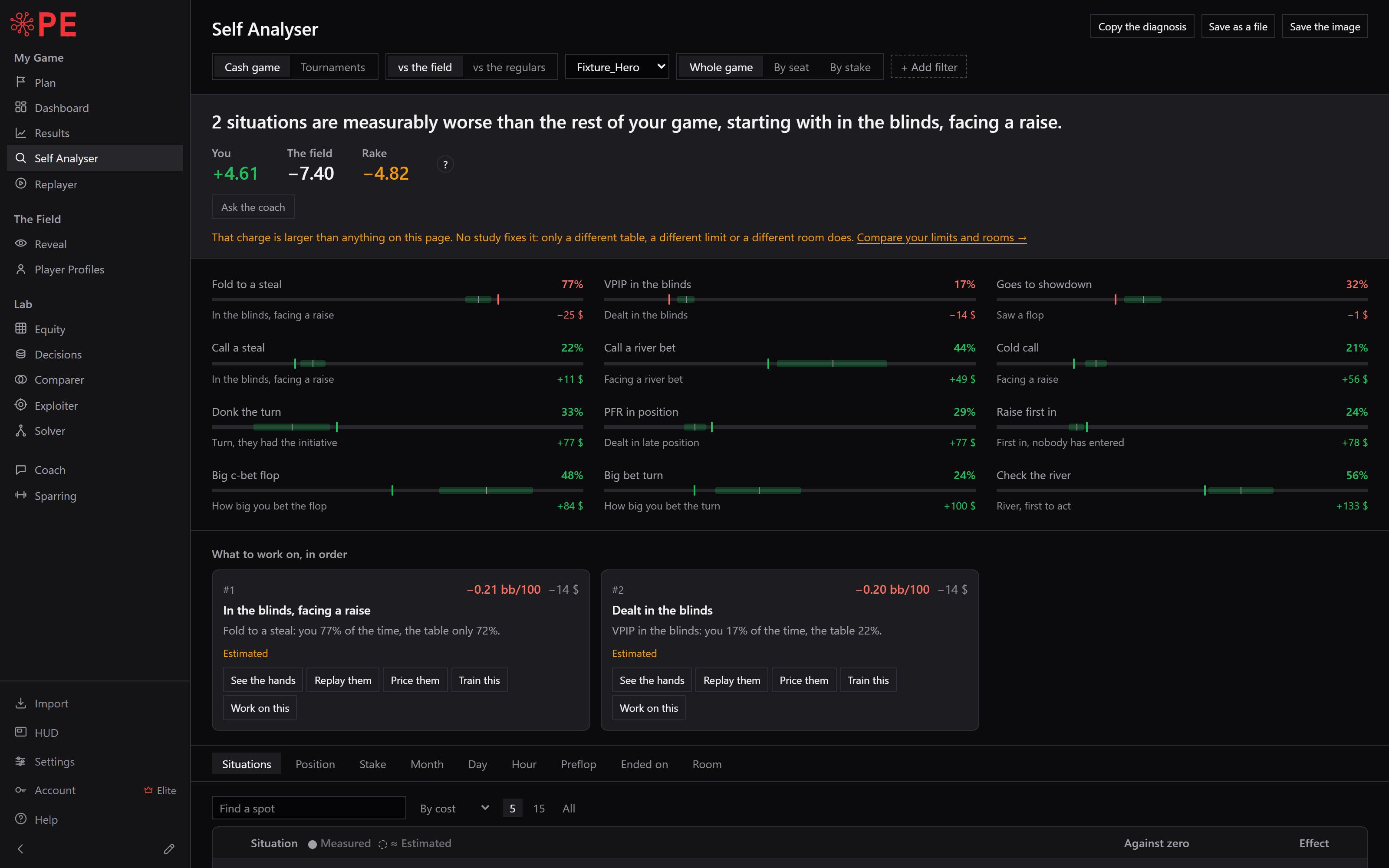
If the issue is broad and you do not know where to start, the free Self Analyser module can help. It breaks your game into about thirty-five situations, from preflop to river and by position, and shows each one’s cost in big blinds per 100 hands. It also tells you whether the gap is real or just noise. That makes it much easier to choose the one thing that deserves the next session.
A clean poker session routine in one minute
If you want the short version, use this:
Before
- Pick one situation, not a money goal.
- Set your stakes.
- Set your stop time.
- Decide what success looks like in terms of decision quality.
During
- Play only.
- Do not study mid-hand.
- Use the HUD as information, not as a crutch.
- Mark hands, then keep going.
After
- Cool down.
- Review a small set of hands.
- Write one note.
- Choose one thing to work on next.
That routine is simple on purpose. The more complicated it gets, the less likely you are to follow it.
Why this routine works
Poker rewards consistency more than drama.
A session routine gives you three advantages:
- it stops you from picking random goals,
- it keeps your attention on the hand in front of you,
- it turns each session into reviewable work.
That is also why the free tools in Poker Exploit fit this theme so naturally. The Dashboard helps you read your sample honestly. The Plan module helps you choose a meaningful focus. The Self Analyser module shows where your game leaks most. The Results screen helps you track the bigger picture. And the Player Profiles area lets you keep opponent notes in one place.
None of that helps during a hand. That is the point. The work before and after the session is what makes the in-session part cleaner.
If you build this habit now, each session starts to look less like a gamble with your attention and more like a block of deliberate work.
Do it on your own hands.