
A 3-bet is not just a bigger raise. It is a decision about range construction.
You are not asking, "Is this hand pretty?" You are asking three things:
- Am I 3-betting for value?
- Am I 3-betting as a bluff?
- Does this spot want a linear range, or a polarized one?
That is the real preflop question.
The answer depends on the opener, not just on your hand. Their opening size, their fold to 3-bet, and how wide they open all change what your best 3-bets look like.
What a value 3-bet is
A value 3-bet is a hand that wants action.
You expect to be ahead of the range that continues, or at least to do well enough that building the pot is good for you. If you get called, you are still happy. If you get 4-bet, you often still have a continue, depending on stacks and positions.
Typical value 3-bets include strong broadways and pocket pairs, but the exact threshold changes a lot by spot.
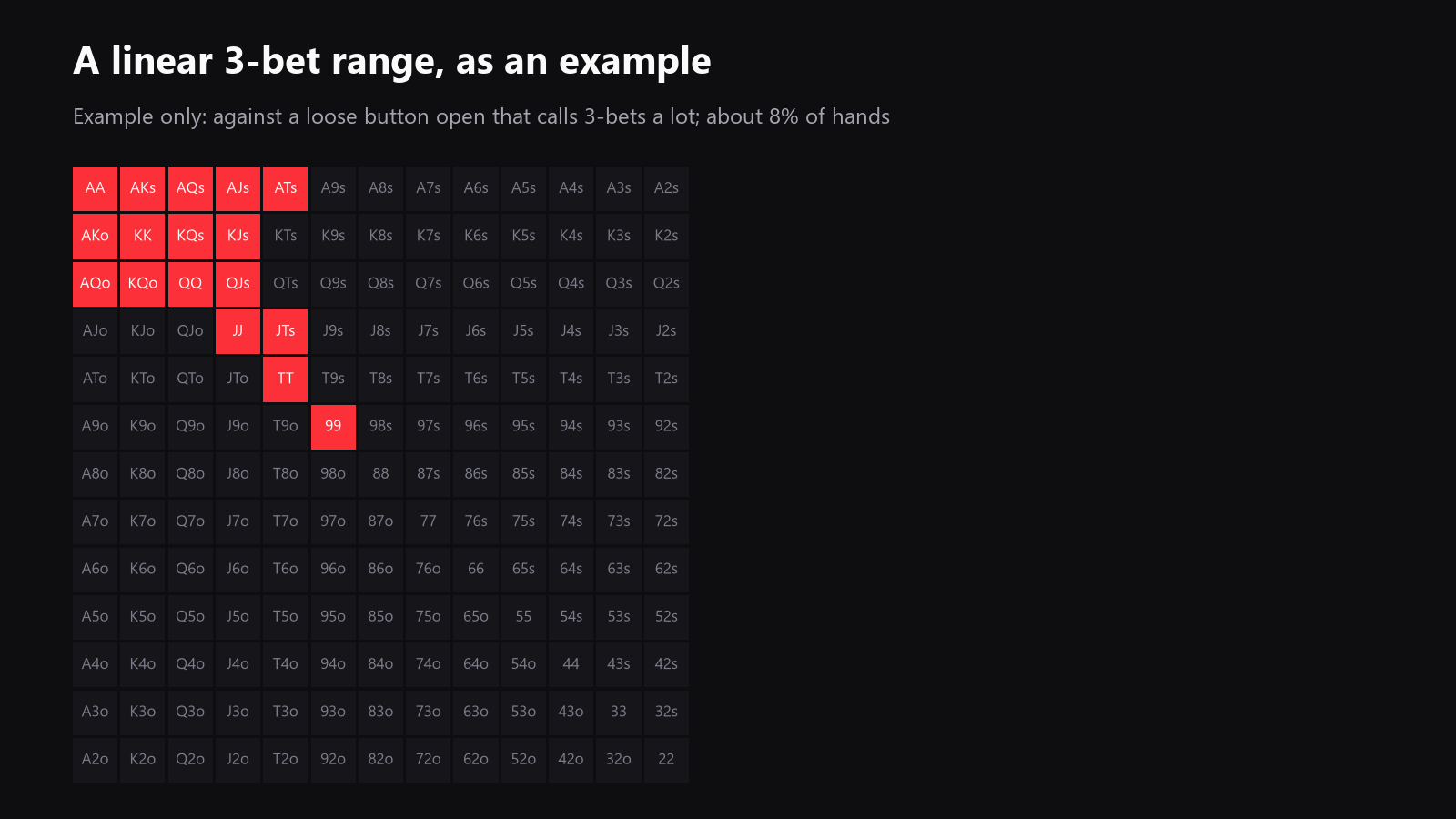
For example, against a loose opener who continues too wide, hands like AQs, AKo, JJ, TT, and sometimes even weaker hands can become value 3-bets. Against a tight early-position open, that same range may be too loose.
The key idea is this:
- Value is not about raw hand strength alone.
- Value is about how your hand does against the continue range.
If villain opens 40% and folds a lot, your value range can be thinner because many hands already print. If villain opens 15% and never folds, your value range has to be much stronger.
What a bluff 3-bet is
A bluff 3-bet is not random aggression.
You are choosing hands that are not good enough to just call profitably, but that gain value from the fold equity created by the 3-bet. The best bluff candidates usually have one or more of these traits:
- Blockers to the opponent's continue range
- Some playability if called
- Good card removal against 4-bets
- Good postflop equity realization when stacks are deep enough
That is why suited aces are so common as bluff 3-bets. They block strong continues like AK and AQ, and they can make top pair with a good kicker or nut draws.
Suited broadways and some suited wheel hands can also work well, depending on position and stack depth. Off-suit trash usually does not. If a hand has no blockers, no playability, and no equity when called, it is usually a bad bluff 3-bet.
A good bluff 3-bet should have at least one reason to exist after the fold equity is gone.
Linear range or polarized range?
This is where many players get lost.
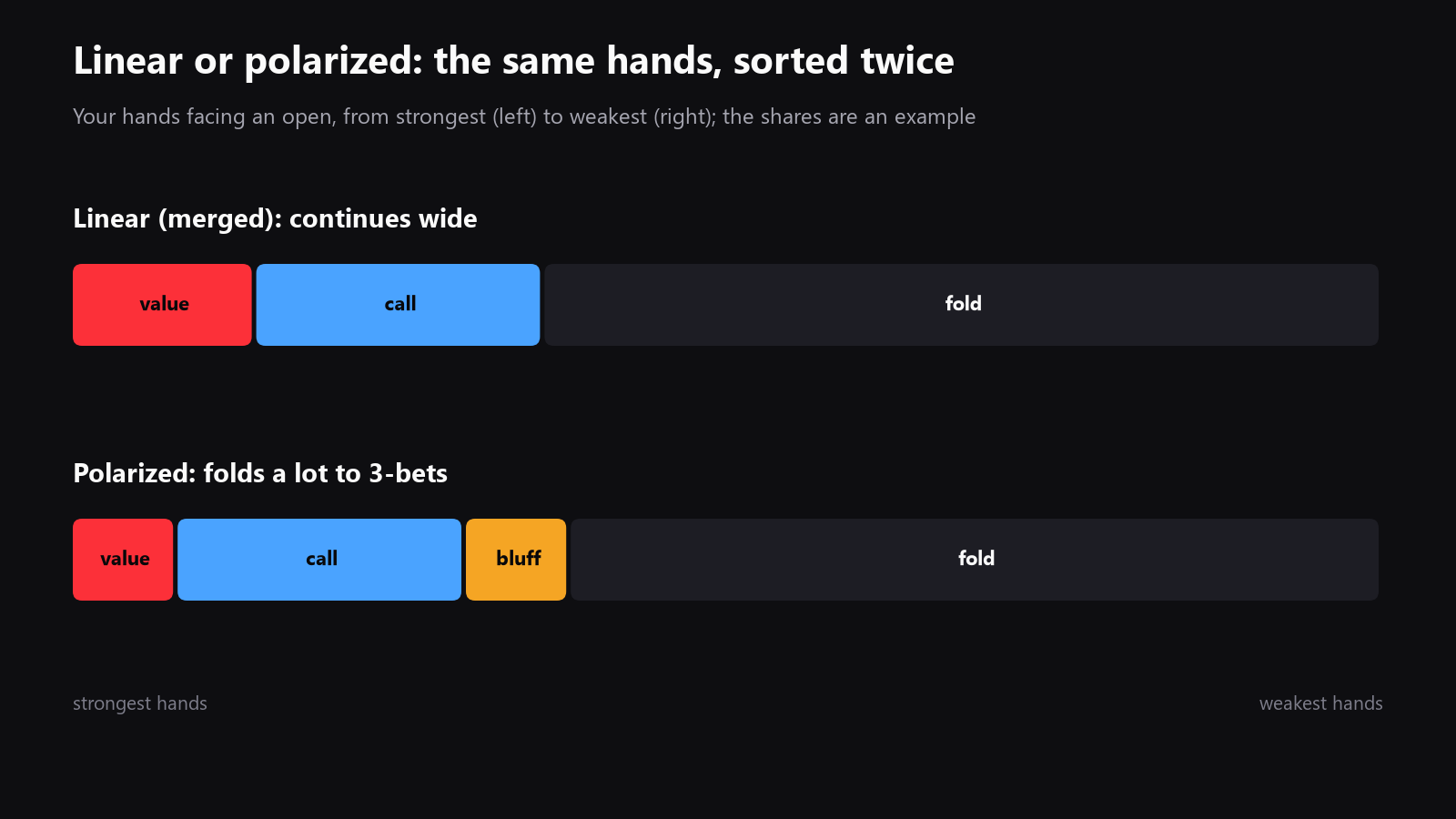
A linear range, also called a merged range, is built from your strongest hands downward. You 3-bet hands that are good enough to keep betting for value. You are not trying to separate your range into monsters and bluffs as much as possible.
A polarized range is split into two ends:
- very strong hands for value
- weaker hands that work as bluffs
The middle hands are often calls, not 3-bets.
Which one should you use?
Usually, a more linear range works better when the opener continues a lot. If they call 3-bets with many worse hands, then hands like AQ, KQ, TT, 99, and similar holdings are often better as 3-bets than as calls.
A more polarized range works better when the opener opens wide but continues more tightly, especially if they fold often to 3-bets. Then you get paid by the folds, and your bluffs do the dirty work.
A simple way to think about it:
- If they continue wide, merge more.
- If they fold a lot, polarize more.
Why the opener changes everything
There is no universal 3-bet chart that stays correct against everyone.
The opener changes the spot in four important ways:
1. How wide they open
A wider open means more weak hands in their range. That creates more fold equity for your bluffs, but it also means they may defend more often if they are aware.
2. How often they fold to 3-bet
This is the most obvious one. If they fold too much, your bluff 3-bets become much better. If they defend often, bluff less and value up.
3. How they continue
Some players fold preflop but 4-bet aggressively. Others call too much. Others only continue with very strong hands. Your range should change for each type.
4. Their open size
A bigger open changes the price of everything. It often reduces the attractiveness of light flats and can make 3-betting more attractive for value, but also makes pure bluffs more expensive. Small opens give you a cheaper continue range and often more room to apply pressure.
A practical rule set
Use this as a starting framework, not as a rigid chart.
If the opener is tight and continues a lot
Lean linear.
You want hands that are strong enough to get value and strong enough to stand a raise back. Pure bluffs go down in frequency.
Examples, depending on position and stacks, might include:
- Strong pocket pairs
- Strong broadways
- Suited broadways that play well
- Some hands that are slightly ahead of the continue range
If the opener is loose and folds too much to 3-bets
Lean polarized.
You can attack with:
- Your best value hands
- Bluff hands with blockers and some playability
Hands like suited aces often become very good here because they block the top of the continue range.
If the opener calls 3-bets too much
Go more linear and value heavy.
Bluffing a calling station is a waste. You want hands that are happy to play for stacks or at least happy to realize equity after the flop.
If the opener is short stacked
Be more value oriented.
As stacks get shorter, postflop maneuvering shrinks. Many speculative bluff 3-bets lose value because you no longer get enough playability or enough fold equity to justify them.
The most common mistakes
Mistake 1: 3-betting hands that are only "fine"
A hand can look good and still be a bad 3-bet. If it neither gets called by worse often enough nor folds out enough better hands, it should probably be in your call or fold range.
Mistake 2: Bluffing without blockers
If your bluff does not block strong continues and does not play well postflop, it usually belongs in the muck.
Mistake 3: Using the same 3-bet range against everyone
This is one of the fastest ways to leak money preflop. A tight opener, a loose opener, and a player who folds to 3-bets too much all deserve different ranges.
Mistake 4: Ignoring rake
At micro and small stakes, rake matters a lot. Thin preflop edges get eaten by rake faster than many players expect. That is one reason why some marginal 3-bet bluffs stop being attractive in lower-stakes pools.
Mistake 5: Trusting tiny samples
If you have seen someone fold to 3-bets eight times, that is not a profile. Wait for a meaningful sample, then adjust.
What this means in real games
Against a loose cutoff opener who folds too much to 3-bets, you can afford to bluff more often, especially from the blinds and especially with blockers.
Against a nitty under-the-gun opener, you should mostly tighten up and value up. The opener's range is stronger, their continue range is stronger, and your bluffs are less likely to work.
Against a player who opens wide but calls 3-bets a lot, you want a range that is closer to merged than to heavily polarized. Your medium-strong hands become better 3-bets, because they do well against the hands that continue.
That is the real answer to "when to 3-bet."
Not "always with this hand."
"Against this player, in this spot, with this stack depth."

How to study this, instead of guessing
If you want to stop relying on memory, start with the numbers.
The HUD panel shows each opponent's observed stats, including fold to 3-bet. That is the first place to look when you are deciding whether a bluff 3-bet makes sense.

The Reveal module goes a step further. It shows what the field at your limits actually does, not what you hope it does. That helps you see whether your pool overfolds, overcalls, or plays close to standard.
And when you want the exact answer for a defined spot, the Solver screen computes the strategy for that spot. That is useful because it shows you a real preflop structure, not a generic chart you found on the internet.

Quick takeaway
If you remember only one thing, remember this:
- 3-bet for value when your hand does well against the continue range.
- 3-bet as a bluff when your hand benefits from fold equity, blockers, and decent playability.
- Use a more linear range when villain continues wide.
- Use a more polarized range when villain folds a lot.
- Always adjust to the opener, not to a chart in the abstract.
That is how you turn the 3-bet from a habit into a weapon.
Do it on your own hands.