
Cold calling, or flat calling, means you face an open raise preflop and call instead of 3-betting or folding.
That move looks simple, but it is one of the most important preflop decisions in poker. A good flat call keeps your range balanced, keeps worse hands in the pot, and lets you realize equity without inflating the pot too early. A bad flat call does the opposite: it leaves you out of position, makes your hand awkward, and invites trouble from behind.
If you understand when cold calling works, you will make better decisions in cash games and tournaments, especially in the seats where many players leak chips without noticing.
What cold calling is really for
A flat call is not just "playing a hand that is okay".
It is a choice to keep the pot in a shape where your hand can still make money.
You call when your hand has one or more of these qualities:
- It realizes equity well
- It plays better in position
- It likes seeing a flop without building a big pot
- It makes strong hidden hands, like sets, straights, flushes, or strong two pair
- It benefits from implied odds
- It does not want to face a 4-bet too often
That is the key idea. A cold call is not only about raw hand strength. It is about how much of that strength you can actually convert into profit.
A hand with modest raw equity can be a great call if it realizes that equity well. A hand with decent raw equity can be a bad call if it plays poorly after the flop.
When flat calling beats 3-betting or folding
There are three main reasons to flat call instead of 3-bet or fold.
1. Your hand plays well postflop
Some hands are awkward 3-bets because they do not want to turn the pot into a battle of big ranges.
For example, hands that like to see a flop and keep the pot manageable often do better as calls than as 3-bet bluffs.
Typical examples include:
- Small and medium pocket pairs
- Suited connectors
- Suited one-gappers
- Many suited aces
- Some suited broadways
These hands often make strong disguised hands or strong draws. That matters more when you can see a flop at a reasonable price.
2. The opener is wide enough
If the opener is very tight, your call has less room to work.
If the opener is wide, your hand is more likely to be ahead of part of that range or to play well against it. That makes calling more attractive.
But wide does not automatically mean 3-bet. Sometimes the best answer is still a call, especially when your hand wants to keep dominated hands in and avoid facing a 4-bet.
3. You are in position
Position changes everything.
When you act last, you can:
- See what your opponent does before you act
- Control pot size better
- Realize more of your equity
- Value bet thinner
- Avoid expensive guessing spots
This is why a hand that is a fine call on the button can be a bad call in the blinds.
Why calling is worse out of position
Out of position, you lose one of the biggest reasons to flat call.
You still have the same cards, but you realize less equity.
That happens because:
- You act first on every postflop street
- You face more pressure and more check-raises
- You cannot control the pot as easily
- You get punished more often when you miss
- Medium-strength hands become much harder to play
This is why many hands that look fine on paper become folds from the blinds.
A lot of players make the same mistake here: they focus on the hand, not the seat.
But the seat is part of the hand.
Why the small blind is especially awkward
The small blind is one of the worst places to cold call an open raise.
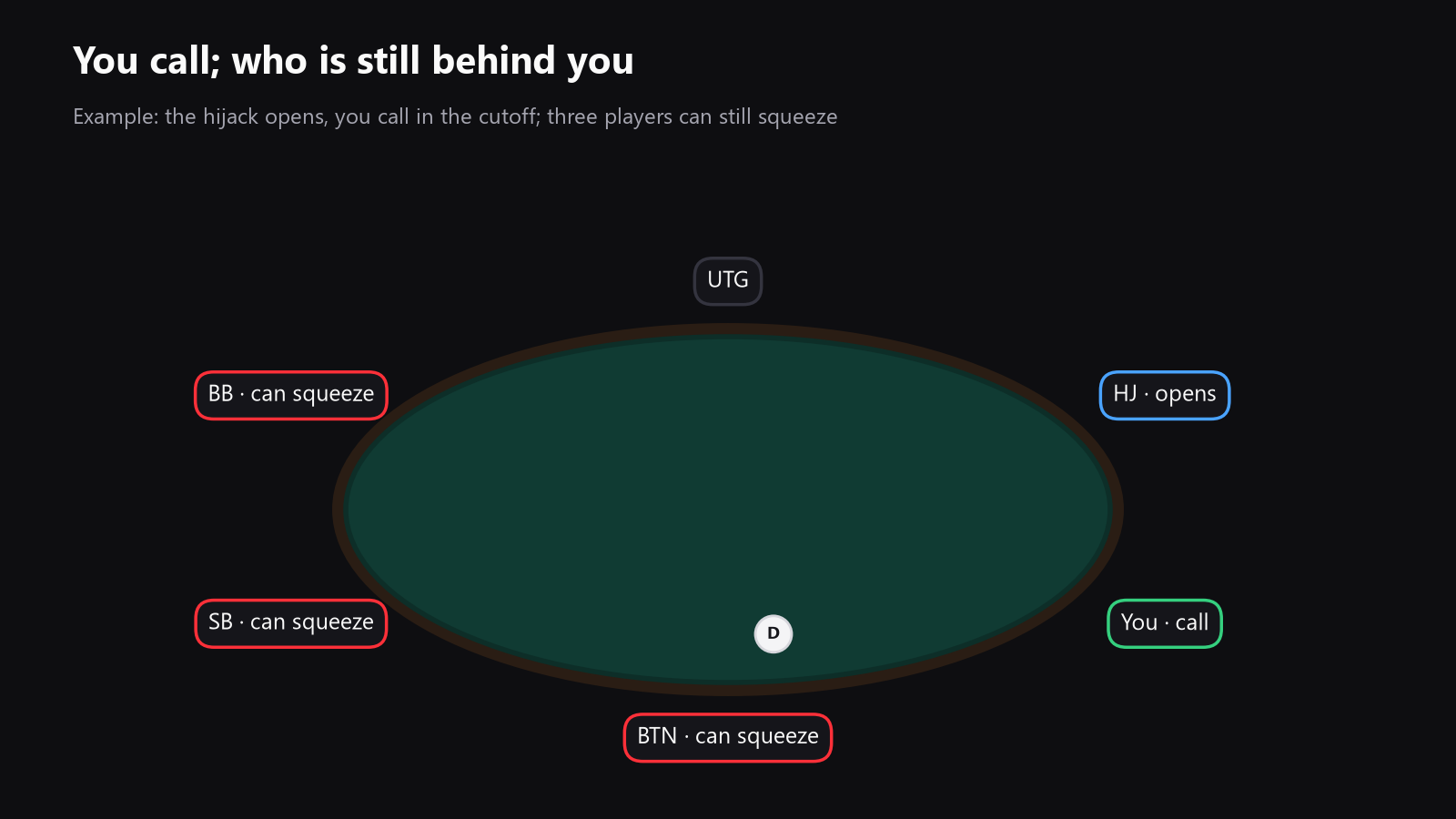
You are out of position against the original raiser, and you do not close the action. The big blind can still wake up and squeeze behind you.
That combination is ugly:
- You do not have position
- You do not close the action
- You risk being squeezed
- You can end up in a pot that is large, awkward, and expensive
This is why the small blind often wants to lean much more toward 3-bet or fold than toward flat call.
That does not mean the small blind can never call. It means the call needs a strong reason, not just "this hand is playable".
Hands that usually play well as a call
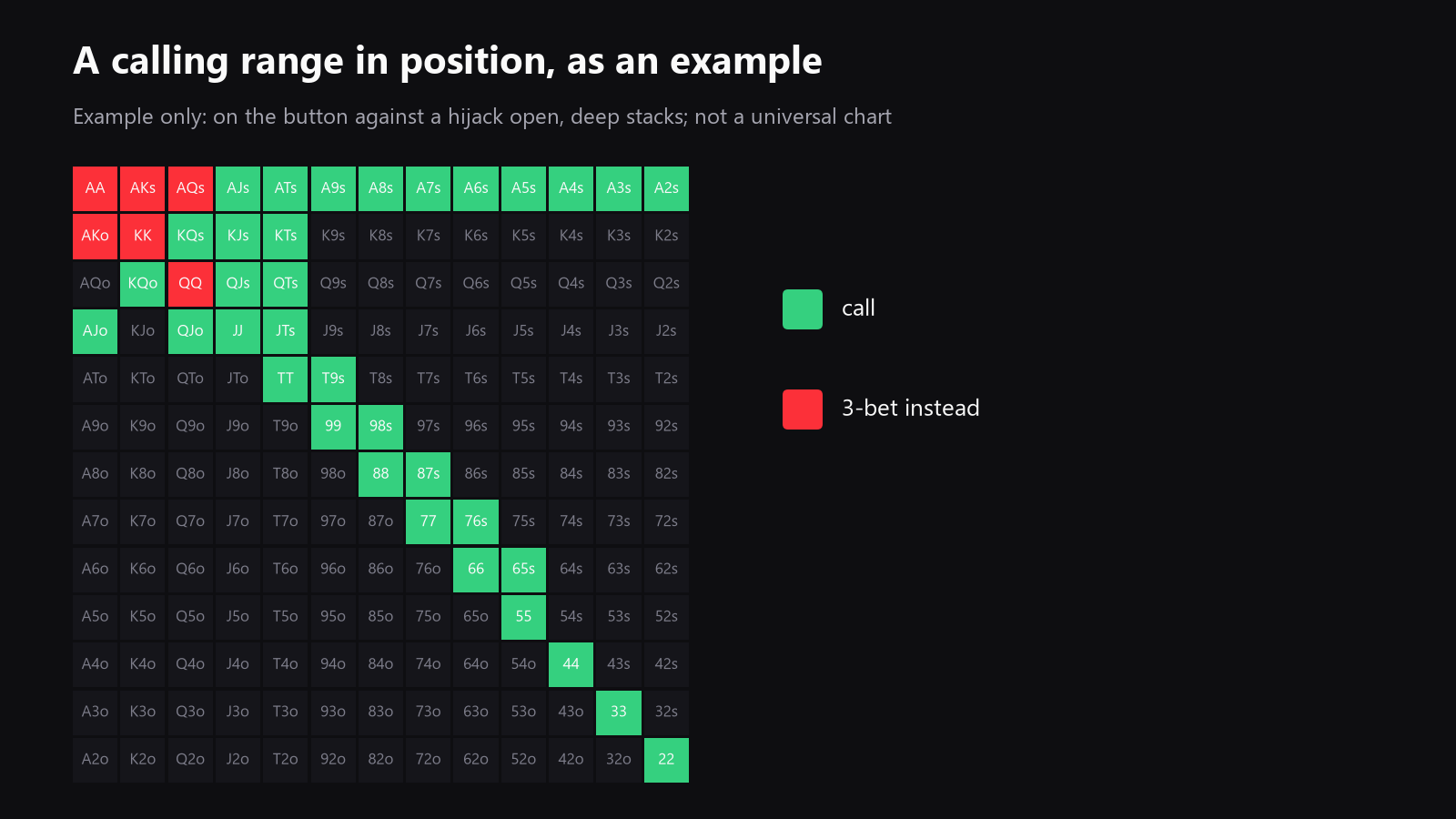
There is no universal cold-calling chart that fits every table, every stack depth, and every rake structure.
Still, some hand classes often call better than they 3-bet.
Pocket pairs
Small and medium pocket pairs are classic cold calls, especially when stacks are deeper.
They like:
- Set mining
- Keeping the pot smaller
- Playing with implied odds
- Seeing a flop in position
They usually dislike:
- Being forced into a bloated pot before the flop
- Facing a strong 4-bet range
- Playing out of position without initiative
A pair that can flop a set has a very different profile from a hand that mostly makes one pair and hopes for the best.
Suited connectors
Hands like 76s, 87s, 98s, and T9s often play well as calls.
They can make:
- Straights
- Flushes
- Strong combo draws
- Hidden two pair and trips
They also perform better when stacks are deep and position is good.
These hands usually lose value when you turn them into 3-bet bluffs without a clear reason.
Suited aces
Axs hands can be nice calls because they can make nut flushes and continue on many boards.
They are often better when:
- You are in position
- The opener is wide
- Stacks are deep enough
- You are not exposed to a big squeeze behind
Suited broadways
Hands like KQs, KJs, QJs, and sometimes JTs can also be good calls in the right seat.
They make strong top pairs, strong draws, and often have solid playability after the flop.
Some offsuit broadways
AJo, KQo, and QJo are more delicate.
In some in-position spots against wide opens, they can be fine calls.
Out of position, they get much worse. They make one-pair hands that are often second-best, and that is exactly how you bleed chips in the wrong seat.
Hands that look playable but are often poor calls
Some hands look tempting because they are not complete trash.
That is not enough.
Be careful with:
- Weak offsuit aces
- Weak offsuit broadways out of position
- Suited hands with poor realization
- Hands that rely on too many things going right
- Hands that hate pressure behind them
The issue is not only equity. It is equity realization.
If your hand often makes a medium-strength pair that cannot stand much heat, or if it misses and must give up too often, the call may be worse than it looks.
The squeeze problem
A squeeze happens when a player behind you 3-bets after you flat call.
That is one of the biggest reasons to tighten your calling range.
When squeeze risk is high, your call gets hurt in two ways:
- You lose more chips when the squeeze comes
- You lose the chance to see a cheap flop with the hand you wanted to play
The more aggressive the players behind you are, the tighter your flat-calling range should be.
Hands that handle squeezes better include:
- Strong value hands
- Some deep-stack speculative hands
- Hands that can continue profitably against a squeeze range
Hands that hate squeezes include:
- Medium-strength offsuit broadways
- Marginal speculative hands without enough depth
- Hands that are uncomfortable facing a 4-bet
If the table is squeeze-happy, you should flat call less often.
A practical way to decide
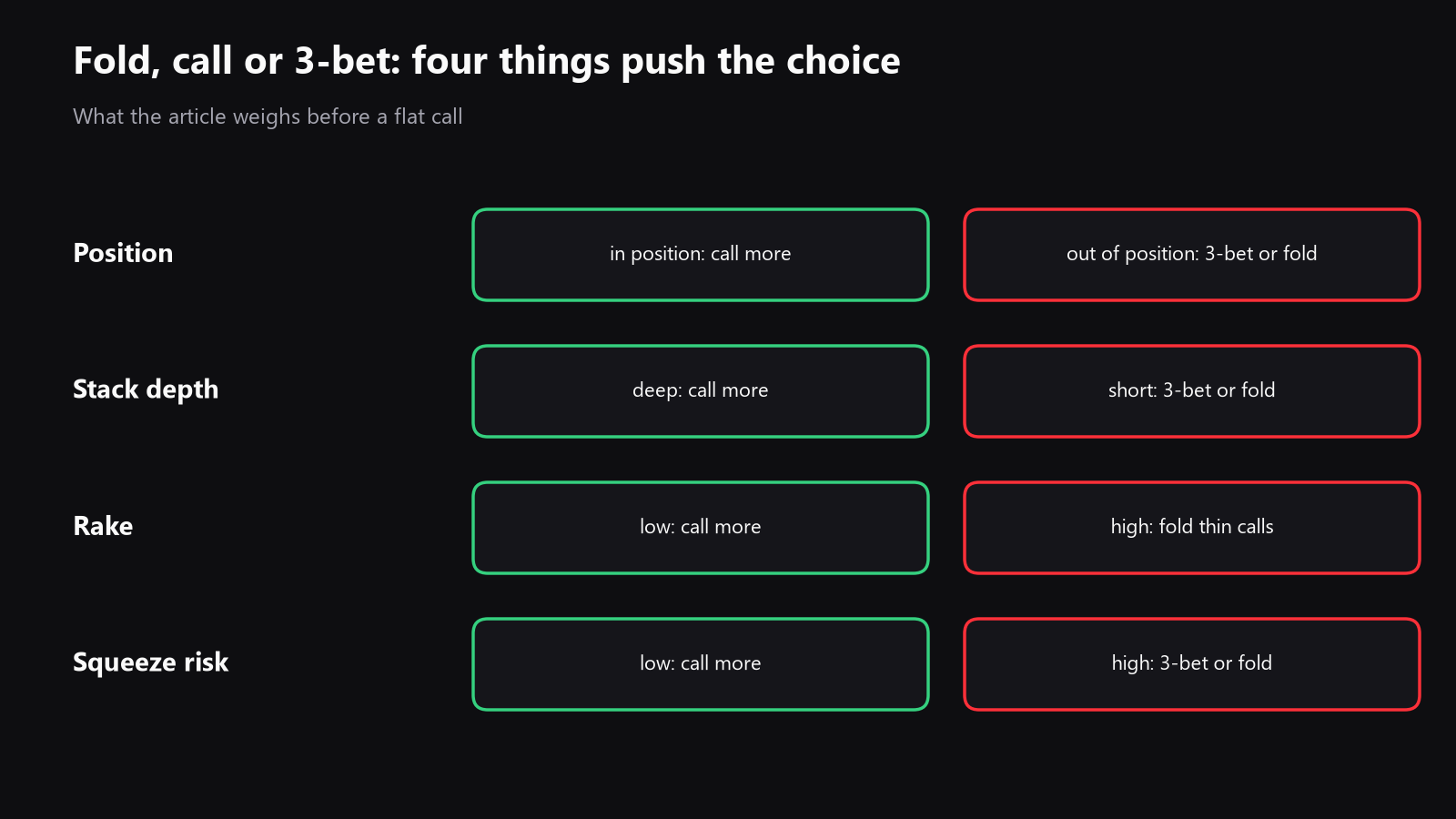
When you face an open raise and wonder whether to flat call, ask yourself five questions:
- Am I in position?
- Does my hand realize equity well?
- Is the opener wide enough?
- How likely is a squeeze behind me?
- Are stacks deep enough, and is rake low enough, for this hand to work?
If most of those answers are yes, a call becomes more attractive.
If you are out of position, shallow, and facing aggressive players behind, the call is usually much worse.
Cold calling in tournaments versus cash games
The same logic applies in both formats, but the details change.
In cash games, stack depth and rake matter a lot.
In tournaments, stack depth, ICM, and payout pressure matter too. Near bubbles and final tables, the value of calling can change fast because chips do not always convert linearly into prize money.
That is why a hand can be a call in one tournament stage and a fold in another.
How to study this spot with Poker Exploit
If you want to know whether your own flat calls are helping or hurting you, use your own hands first.
The Self Analyser module can show whether your cold-calling spots are measurably leaking.
The Plan module can tell you whether this is one of the biggest costs in your game right now.
The Reveal module is useful when you want to know what the pool actually does at your limits after opens and calls, instead of guessing.
And if you want to test a specific postflop spot after you do flat call, the Solver module gives you the equilibrium strategy for that board. That is useful because many preflop mistakes only become obvious once you see what happens after the flop.

The short version
Flat call when:
- You are in position
- Your hand realizes equity well
- The opener is wide enough
- Stacks are deep enough
- The squeeze risk is manageable
- Rake is not crushing the spot
Avoid flat calling when:
- You are out of position
- You are in the small blind
- The players behind are aggressive
- The stack depth is too short
- Your hand looks playable but realizes poorly
The best cold calls are not just hands that can continue. They are hands that can continue profitably in the seat, stack, and table conditions you actually have.
Do it on your own hands.