
A 3-bet size is not a detail. It changes the whole shape of the hand.
It changes the price you give the opener to continue.
It changes the stack-to-pot ratio, or SPR, on the flop.
And it changes how wide the opener can defend without making a mistake.
That is why the usual default is simple: about three times the open in position, and about four times the open out of position.
That rule is not magic. It is a good starting point because it fits two things at once: the opener's odds and the postflop geometry.
The short version
If the open is 2bb, a common 3-bet size is around 6bb in position and around 8bb out of position.
If the open is 2.5bb, a common 3-bet size is around 7.5bb in position and around 10bb out of position.
If the open is 3bb, a common 3-bet size is around 9bb in position and around 12bb out of position.
That is the total size of the raise, not the extra amount you add on top.
| Open size | 3-bet in position | 3-bet out of position |
|---|---|---|
| 2bb | 6bb | 8bb |
| 2.5bb | 7.5bb | 10bb |
| 3bb | 9bb | 12bb |
This is a practical default, not a universal law. Stack depth, rake, antes, and pool tendencies can all move the correct size a little.
Still, if you need one rule before you go deeper, this is the one to keep.
What a 3-bet size actually changes
A 3-bet does three main things:
- it makes the opener continue with a higher price
- it folds out part of the open-raising range
- it sets the flop SPR
The size decides how much pressure you apply before the flop.
A smaller 3-bet gives the opener a better price to continue.
A bigger 3-bet makes continuing more expensive.
That sounds obvious, but the important point is this: the opener does not continue as a single hand. They continue with a range. A size change shifts that whole range.
A small size tends to keep in more suited hands, more pairs, and more playable broadways.
A bigger size forces more folds and leaves mostly stronger continues.
Why you can usually go smaller in position
When you have position, you will act after the opener on every postflop street.
That matters a lot.
Because you get the last decision, you do not need to force the pot as large preflop in order to make your good hands profitable. You can keep the pot under control, play more comfortably with medium-strength value hands, and still put the opener under enough pressure.
So in position, a 3-bet to about three times the open is often enough.
If you go much larger than that without a clear reason, you may give up something for nothing:
- your bluffs risk more chips
- you fold out some hands, but not necessarily enough extra hands to justify the added risk
- when called, the pot becomes larger and the hand becomes less flexible
In short, in position you already have the postflop advantage. You do not need to buy as much fold equity preflop as you do when you are out of position.
Why you usually go bigger out of position
Out of position, everything becomes harder.
You act first on the flop, turn, and river.
That gives the opener more control over the hand and makes your equity realization worse.
Because of that, a small out of position 3-bet can be too generous. It gives the opener a decent price to continue with hands that would rather fold to a larger size.
A bigger size helps in two ways:
- it charges the opener more
- it lowers SPR, which makes the hand more direct when you have the stronger part of your range
That is why about four times the open is such a common out of position default.
You are paying for the disadvantage of position by making the pot less comfortable to play against you.
The opener's price is the first thing to think about
A useful way to think about 3-bet sizing is to ask: what price am I giving the opener?
Take a simple example.
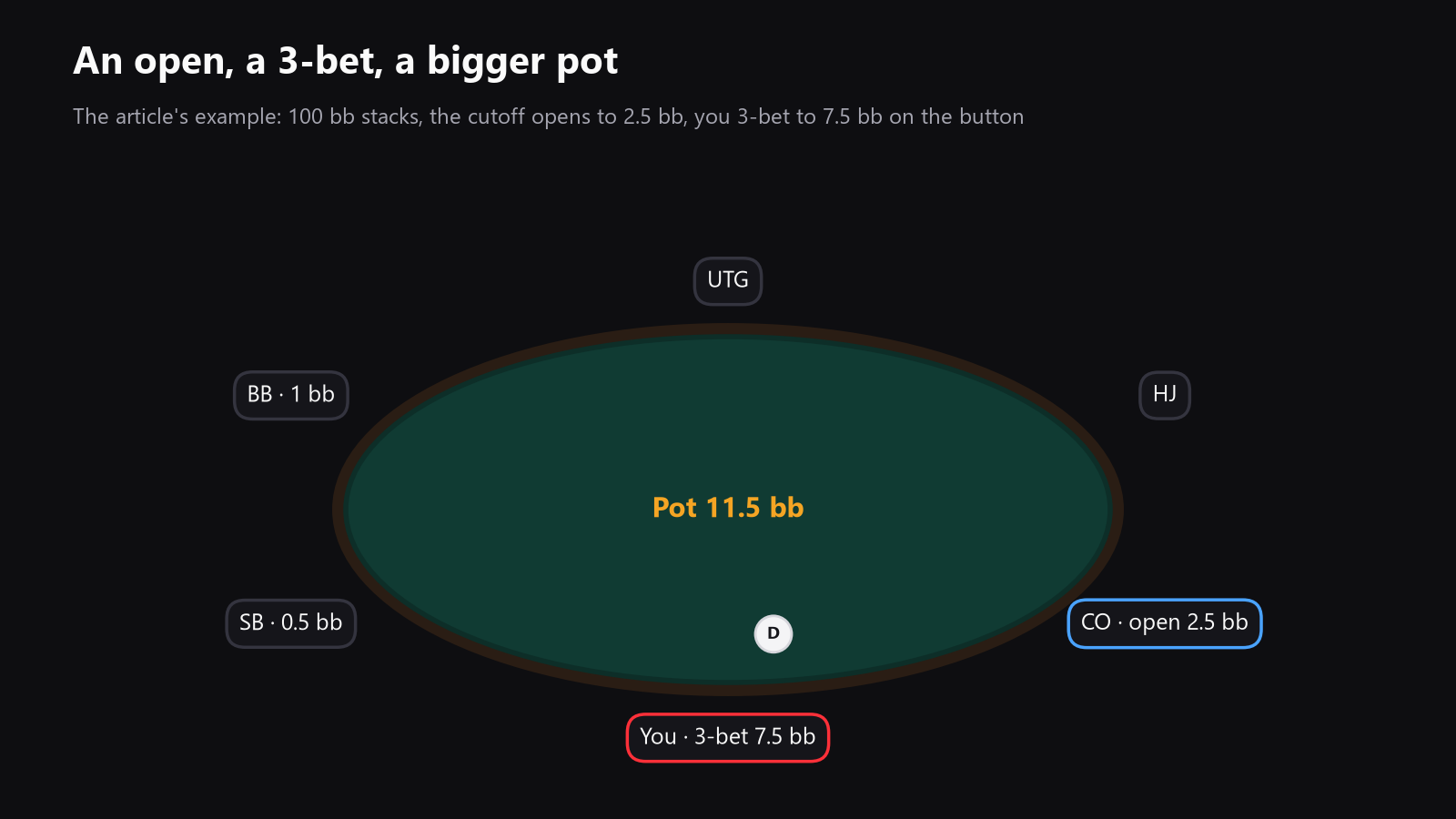
The open is 2.5bb, stacks are 100bb, and you 3-bet to 7.5bb in position.
Before the opener acts, the pot is:
- 1.5bb from the blinds
- 2.5bb from the open
- 7.5bb from your 3-bet
That is 11.5bb total.
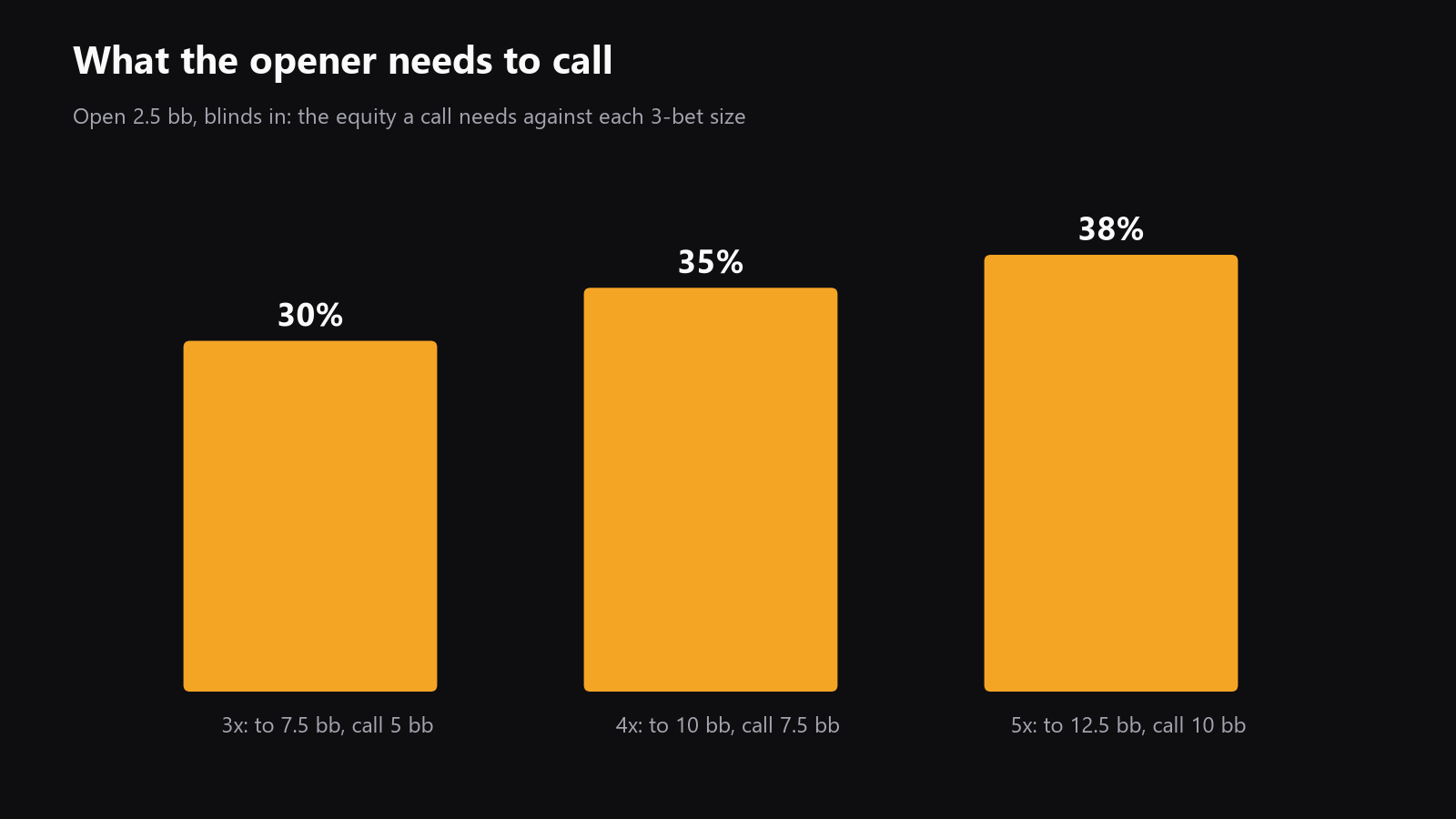
If the opener calls, they must add 5bb more to win 16.5bb total.
So they are calling 5bb to win 16.5bb, which means they need about 30 percent raw equity before you even start talking about realization.
Now change the size to 10bb.
The opener now has to call 7.5bb more to win 21.5bb total.
That is close to 35 percent raw equity.
That difference matters. A hand that can comfortably continue versus 7.5bb may become an easy fold versus 10bb.
So a smaller 3-bet does not only make the opener continue more often. It also changes which hands can continue profitably.
How the size changes SPR
SPR means stack-to-pot ratio.
It is the remaining stack divided by the pot when the flop is dealt.
It matters because it tells you how much room is left to play.
A lower SPR means the pot is already large relative to the stacks. That usually makes strong hands easier to play and reduces the amount of postflop maneuvering.
A higher SPR means more room to navigate. That can be good when you have position, but it can also mean more chances for the opener to realise equity.
Using the same 2.5bb open and 100bb stacks:
- if you 3-bet to 7.5bb, the SPR after a call is about 5.6
- if you 3-bet to 10bb, the SPR after a call is about 4.2
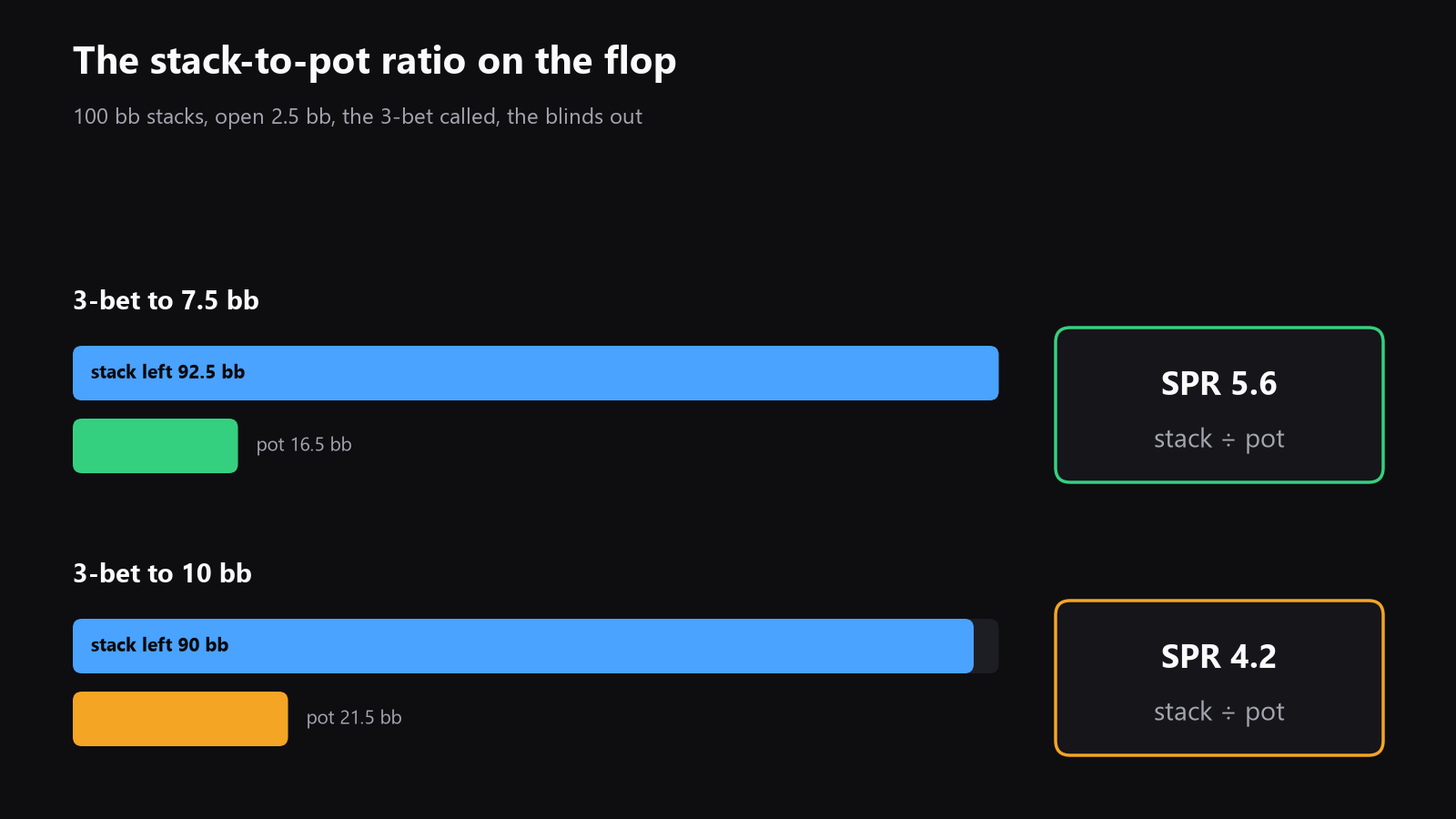
That difference is not small.
At the smaller size, the hand stays more flexible.
At the larger size, the pot becomes more committed.
Out of position, that lower SPR is often a good thing because it reduces the room the opener has to pressure you after the flop.
Smaller is not automatically better for bluffs
A lot of players think a smaller 3-bet is always best for bluffing because it risks less.
That is only partly true.
Yes, you risk fewer chips.
But if the opener continues too often against the smaller size, your bluff may not win enough pots preflop to justify the spot.
So the real question is not, "What is the cheapest bluff size?"
The real question is, "What size gets enough folds, while still leaving me a good postflop structure?"
Sometimes that means a smaller 3-bet in position.
Sometimes it means a bigger one out of position.
And sometimes it means not 3-betting the bluff at all.
Bigger is not automatically better for value either
The same mistake appears on the value side.
A bigger 3-bet does not automatically make more money just because the pot is larger.
If your size only keeps in the top of villain's range and folds out the weaker hands you wanted to target, you may make the hand tougher for yourself, not easier.
Value sizing is about balance in the practical sense, not in the abstract sense.
You want a size that:
- charges weaker continues
- keeps dominated hands in
- does not make the pot awkward for the part of your range that wants action
That is why "bigger" is not always "better."
When to deviate from the default
The 3x in position and 4x out of position rule is a default, not a law.
You may go a bit smaller when:
- stacks are deep and you want more postflop play
- the opener overfolds and does not need much pressure
- the pool is tight and you do not need to charge much to get folds
You may go a bit bigger when:
- you are out of position against a loose opener
- the opener continues too wide
- you want to reduce SPR because your value range is strong
- stacks are shallow enough that extra size matters a lot
In tournaments, antes and stack depth change the picture too.
Deep stacks reward more careful sizing.
Shallow stacks make every sizing step matter more, because one extra blind now changes the commitment threshold more sharply.
A simple way to remember it
If you want one short rule, keep this:
- in position, 3-bet to about 3x the open
- out of position, 3-bet to about 4x the open
- go smaller only when you have a reason
- go bigger when position is against you and you want to deny equity harder
That works because the size is doing two jobs at once: changing the opener's odds and setting the flop SPR.
If you want to study this spot more seriously
If you want to look at one exact situation and compare how the strategy changes, the Solver module shows the equilibrium strategy of a spot as a grid of the 169 starting hands, coloured by action, with the result figures next to it.
That is a good way to turn "I think this size is right" into something much sharper.
And if you want to see where your own game actually leaks, the Self Analyser and Plan modules show which situations cost you the most and what to work on next.

That is usually where the lesson stops being theoretical.
A 3-bet size is not just a number. It is the price of continuing, the shape of the pot, and the kind of hand you are asking the opener to play.
Do it on your own hands.