
If you want a poker style that is simple, disciplined, and strong enough to beat small stakes, tight-aggressive poker is the best place to start.
TAG means tight-aggressive. The idea is straightforward:
- You play fewer hands.
- When you play, you do it aggressively.
That is not just a slogan. It is a practical edge. Many weak players do the opposite. They enter too many pots, call too much, and then hope to “make a hand” after the flop. TAG removes a lot of that noise. You start with better hands, you take the initiative more often, and you put pressure on ranges that are too wide or too passive.
At small stakes, that is often enough to build a winning base.
What tight-aggressive actually means
People sometimes hear “tight-aggressive” and think it means nitty, passive, or timid. It does not.
A TAG player is selective, but not scared. The style has two parts.
Tight
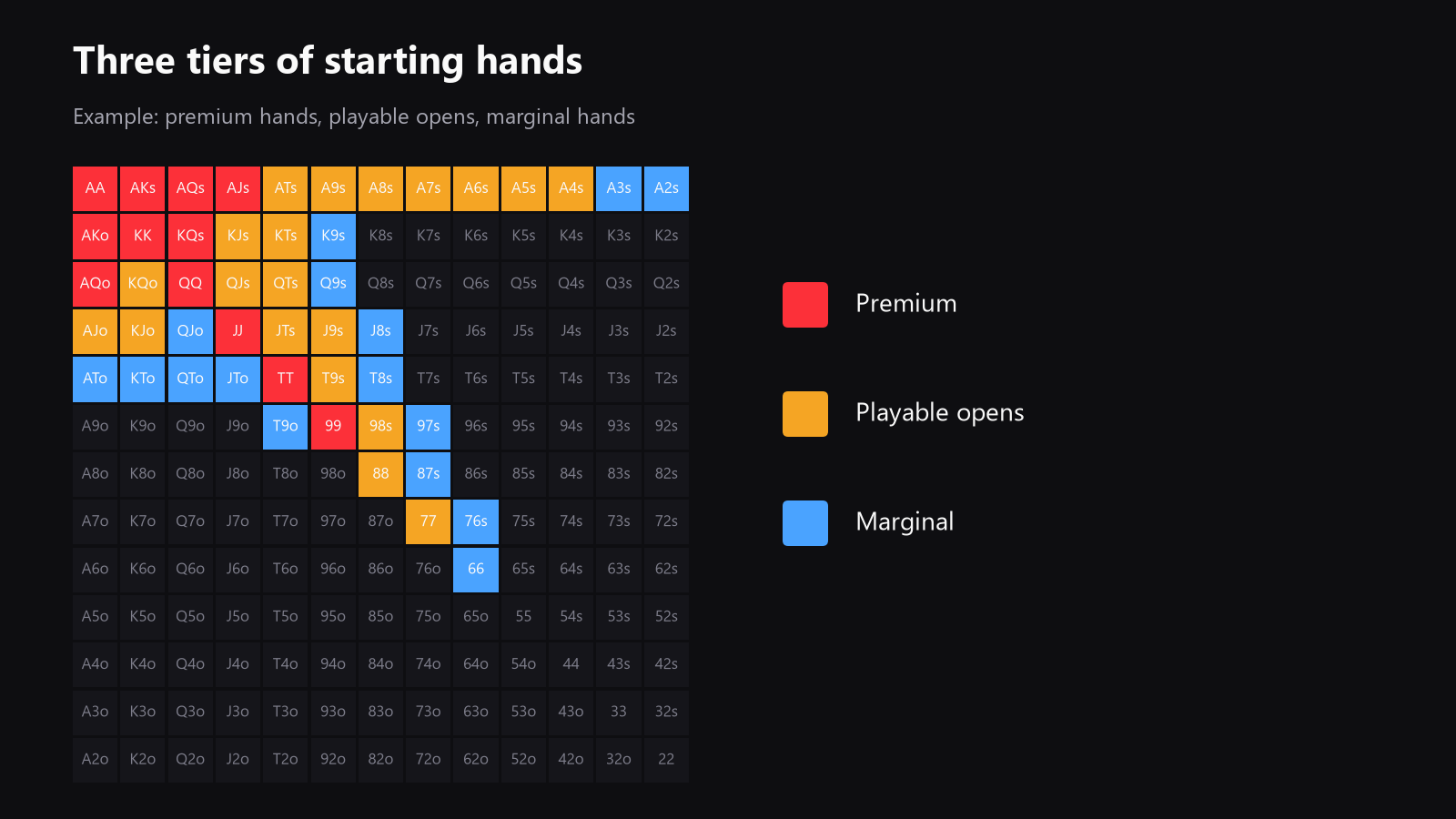
“Tight” means you are selective about the hands you enter with.
You do not play every hand that looks pretty. You ask whether the hand is good enough for your position, your stack depth, and the table conditions. A hand can look attractive and still be a poor choice if it is dominated too often or plays badly after the flop.
Examples of hands that often create trouble when played too loosely:
- weak offsuit aces
- weak offsuit broadways
- small suited connectors from bad positions
- hands that make second-best top pair too often
Tight does not mean only playing monsters. It means avoiding thin spots where the hand looks playable but loses money because it is too often second best.
Aggressive
“Aggressive” means you enter pots with raises and re-raises more often than calls.
When you are aggressive, you do several useful things at once:
- build pots when you are ahead
- win the blinds and dead money more often
- force mistakes from weaker players
- keep initiative and control of the hand
- make your range harder to read
A player can be tight and still lose money if they are too passive. Calling too much gives opponents cheap realization of equity and leaves you guessing. TAG is about combining selection with pressure.
Why TAG works so well at small stakes
At small stakes, many opponents make the same mistakes again and again.
They:
- call too much preflop
- defend too widely from the blinds
- chase weak draws
- fail to fold enough to pressure
- overvalue one-pair hands
- limp and call instead of building strong ranges
TAG punishes those leaks naturally.
When you play fewer hands, your range is stronger on average. When you play aggressively, your strong range gets paid and your bluffs have more fold equity. That means you do not need to outmaneuver everyone in every pot. You just need to make better decisions than the pool often enough.
This is why TAG is such a good foundation for new and improving players. It keeps you away from the most expensive mistakes before you try anything advanced.
VPIP and PFR: the two stats that show your style
If you want to measure whether you are really playing tight-aggressive poker, two preflop stats matter more than almost any others:
- VPIP: Voluntarily Put Money In Pot
- PFR: Preflop Raise
These do not tell the whole story, but they tell you a lot.
VPIP
VPIP is how often you put money into the pot voluntarily preflop. It includes calls, raises, and limps, but not forced blind posts.
A lower VPIP usually means you are entering fewer pots.
PFR
PFR is how often you raise preflop.
A higher PFR usually means you are taking the initiative instead of just calling.
The gap between VPIP and PFR
This gap is especially important.
- If your VPIP is much higher than your PFR, you are probably calling too much.
- If your VPIP and PFR are close, you are usually entering pots more actively.
- If both numbers are high, you may be playing too many hands.
- If both are very low, you may be too tight to capture the spots the table gives you.
A TAG player usually has a reasonable VPIP and a PFR that is not far behind it. The exact numbers depend on format and table size, but the principle is stable: play selectively, and when you enter, often enter by raising.
What a TAG range looks like by position
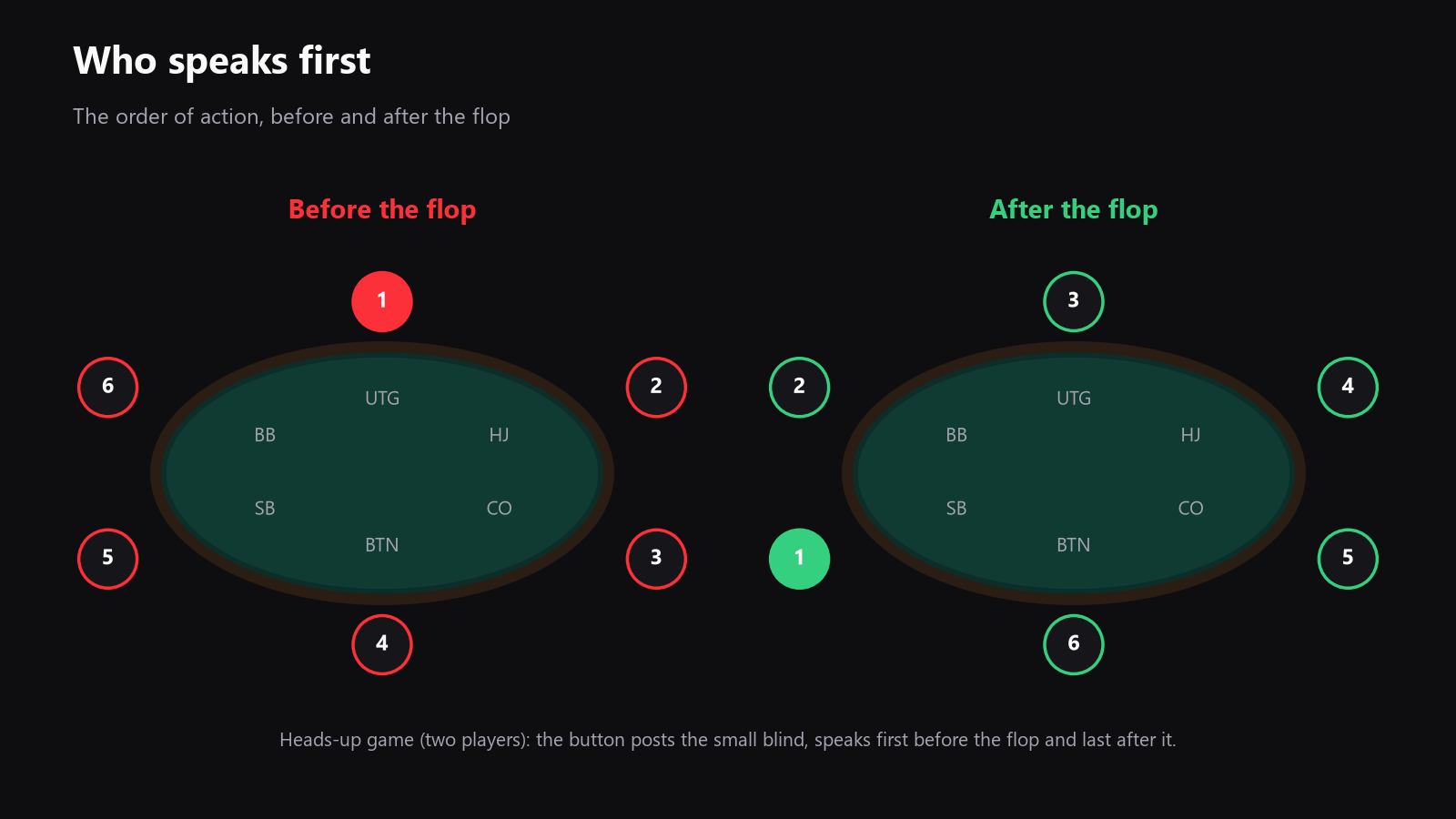
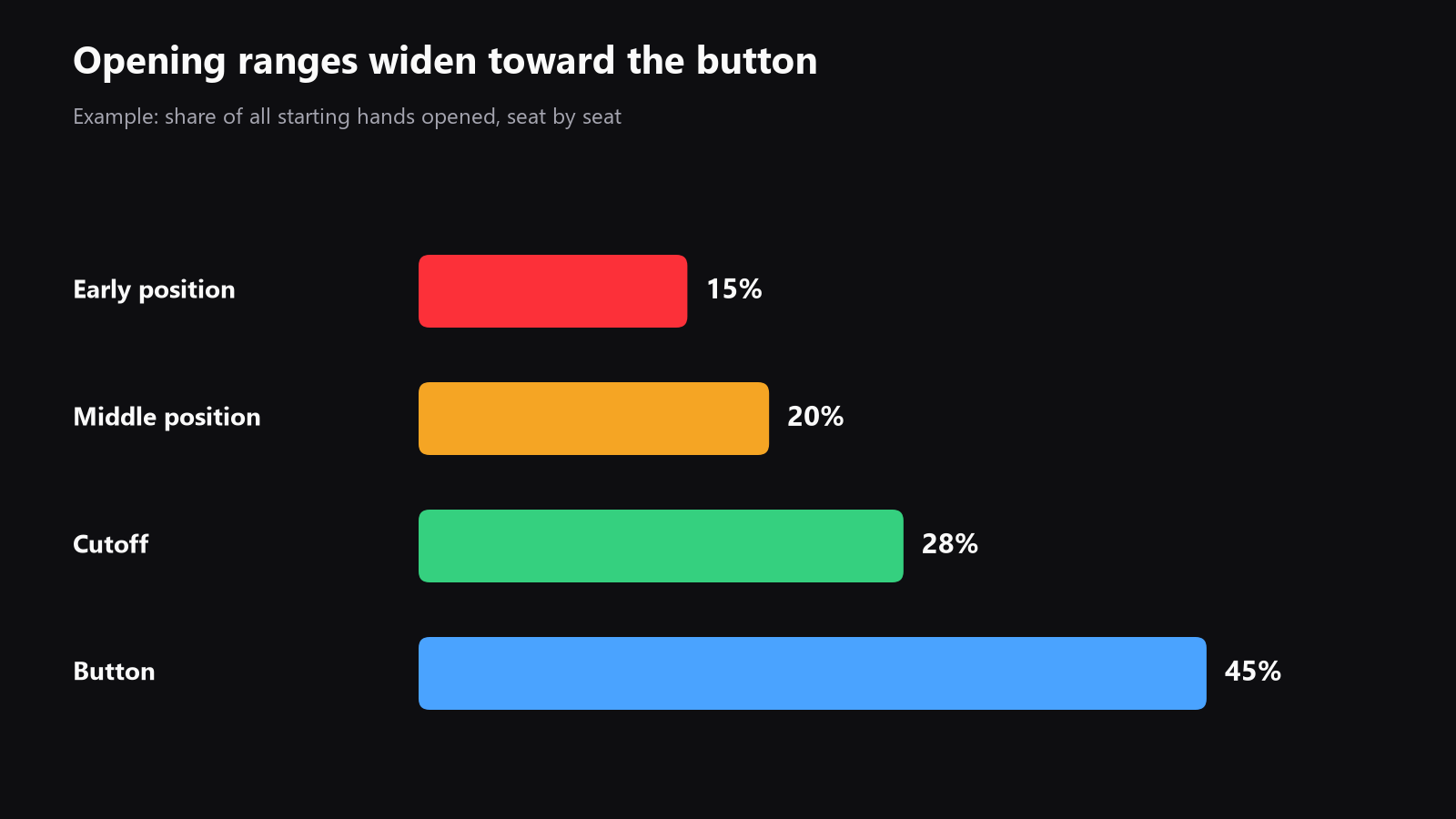
Position is central to TAG poker. The same hand can be fine in one seat and bad in another.
Early position
From early position, you should usually be quite selective. You act before many players, so your hand has to stand up to more pressure and more uncertainty.
This is where loose hand selection gets expensive fastest.
Middle position
You can widen a bit, but not too much. You still need to respect the players behind you.
Cutoff and button
These are the best places to expand your range. You act later, steal blinds more often, and realize equity better.
Late position is where TAG starts to feel powerful. You can open more hands, but the important part is that you are still opening for a reason, not just because the cards look fun.
Small blind and big blind
These seats are tricky because you are often out of position after the flop. Good TAG play here is not about defending everything. It is about defending the right hands and keeping your ranges coherent.
A lot of players think they are “defending aggressively” when they are really just burning money with weak holdings. TAG forces discipline there too.
Aggressive does not mean reckless
This is one of the most important things to understand.
Aggression is not the same as betting every street.
A tight-aggressive player still checks, calls, and folds when those are the best options. The difference is that when the pot should be attacked, TAG players attack it.
That means your aggression should be tied to a reason:
- you have value and can get called by worse
- you have a bluff with enough fold equity
- you have range advantage on the board
- you want to deny equity to weak hands
- you want to keep initiative in a favorable spot
If you bet only to “be aggressive,” you are not using TAG correctly. You are just being noisy.
Common leaks that break the TAG style
Many players think they play TAG, but a few leaks make their game look loose-passive instead.
1. Calling too much preflop
This is probably the most common leak.
Calling with hands that look playable but are dominated often creates trouble later. It lowers the quality of your range and makes postflop decisions harder.
2. Limping too often
Limping usually gives up initiative and makes your range easier to attack. In many games, raising is simply better than limping with hands you want to play.
3. Opening hands that do not fit the seat
A hand is not “good” in the abstract. It is good or bad in a situation.
Stack depth, position, and who is left to act matter.
4. Giving up too much after raising
If you raise preflop and then surrender too often on boards that favor your range, your aggression is incomplete. TAG includes follow-through when the situation supports it.
5. Using the wrong bet size
Being aggressive does not mean using one size everywhere. Your bet should serve a purpose: value, protection, or pressure.
How to build a tight-aggressive style
If you want to make your game more TAG, do it in a structured way.
Step 1: Tighten your starting hands
Do not enter pots because you are bored.
Before you act, ask:
- Does this hand belong here?
- Is my position good enough?
- Will the hand play well after the flop?
- Am I raising because it is profitable, or because I want action?
Step 2: Raise more and call less
If a hand is worth playing, raising is often better than calling.
Raising gives you fold equity, builds the pot when you are ahead, and keeps your range more threatening.
Step 3: Use position as a weapon
A strong TAG player understands that position is not a small detail. It is one of the biggest edges in poker.
The later you act, the more hands you can profitably play.
Step 4: Track your preflop stats
VPIP and PFR are useful because they tell you whether your style is actually tight-aggressive or just feels that way.
If you use Poker Exploit, the HUD module shows each opponent’s observed stats from your own hands on live tables, including VPIP and PFR, plus other key preflop and postflop numbers. It helps you spot who is loose, who is tight, and who is easy to pressure. The Player Profiles module lets you keep notes and colors on opponents, so those reads stay attached to the right player.
Step 5: Study the pool, not just theory
Your baseline strategy should be solid, but the player pool matters.
If the field overfolds, pressure works better. If the field calls too much, value bets matter more. If blinds defend too wide, late-position opens become more profitable.
That is where reading the population helps. Poker Exploit’s Reveal module is built for that kind of study, because it shows what real players at your limits actually do from your own hand histories.
Where the leaks really are
A useful TAG player is not just selective preflop. They also know where their game breaks down.
That is where the Self Analyser module can help. It measures each situation against the field and against the rest of your game, so you can see where your frequencies stand out. That makes it easier to spot whether you are too loose in one spot, too passive in another, or simply different from the field in a meaningful way.
If you want the next thing to work on, the Plan module is the one that picks the situation that costs you the most, then checks whether your improvement really changed the numbers. That is a good companion to a TAG study because tight-aggressive poker is not just about style, it is about fixing the leaks that matter most.
What numbers should you aim for?
There is no single magic VPIP or PFR that fits every game.
But the principles are simple:
- VPIP too high usually means you are entering too many weak pots.
- PFR too low compared with VPIP usually means you are calling too much.
- A healthy TAG style usually shows selectivity and initiative at the same time.
Do not chase someone else’s numbers blindly. Use the stats to diagnose your game.
The real question is not “What is the perfect VPIP?” The real question is “Am I entering good spots, and when I enter, am I taking the lead often enough?”
TAG is the foundation, not the final destination
Tight-aggressive poker is not the only style that exists. It is the base that teaches you discipline, range selection, and initiative.
Once you have that base, you can adjust:
- tighter against tough players
- wider in good late-position spots
- value-heavy against calling stations
- more pressure-heavy against players who overfold
But do not skip the foundation.
If your starting hand selection is weak and your aggression is random, advanced adjustments will not save you. TAG gives you structure first, then flexibility later.

A simple TAG checklist
Before you sit down, keep this in mind:
- I will play fewer bad hands.
- I will prefer raising to calling when it is profitable.
- I will use position properly.
- I will pressure weak ranges instead of hoping to get lucky.
- I will watch VPIP and PFR as style markers.
- I will review my game instead of guessing where the leaks are.
Final thought
Tight-aggressive poker works because it is disciplined, direct, and effective at small stakes.
You do not need to play many hands to win. You need to play the right hands, in the right seats, with the right amount of aggression.
If you want a style that is easy to understand and hard to exploit, TAG is the right starting point.
Do it on your own hands.