
A thin value bet is one of the most useful, and most misunderstood, bets in poker.
You are not betting because you have the nuts. You are not bluffing either. You are betting a hand that is good often enough to get called by worse hands, but not so strong that you want to build a huge pot against everything that continues. On the river, that usually means a medium-strength hand, a hand that is better than many bluff-catchers, but not strong enough to be comfortable against a raise.
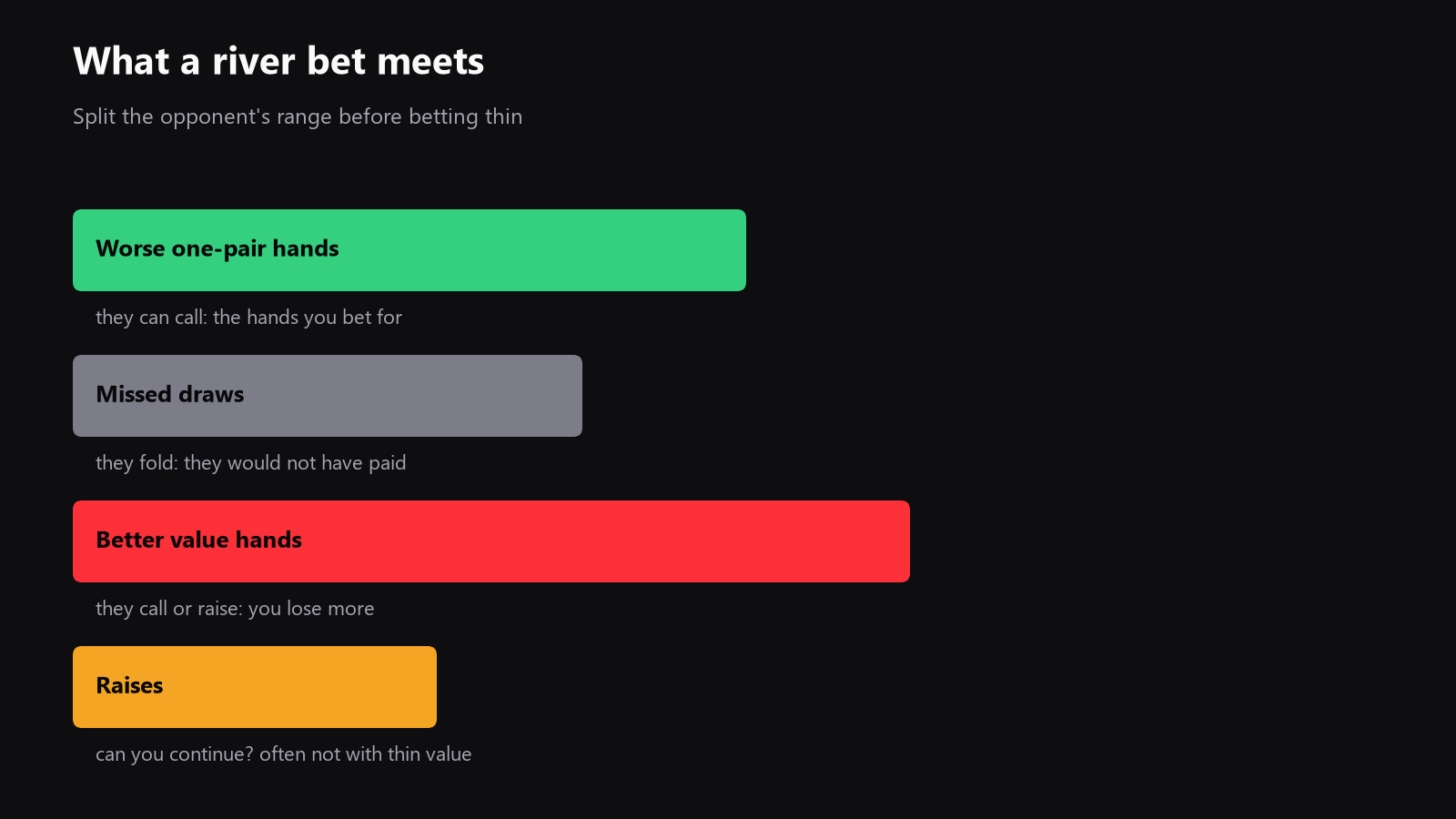
That last part matters. Thin value is not only about "can I get called?". It is also about "who calls, who folds, and who raises?". If you get those three questions right, you can better see when a river value bet is there, and when it is not.
What thin value means
Think of your river hand in three buckets:
- hands that lose to almost everything that continues
- hands that beat some of the hands that can call
- hands that are near the top of your range
Thin value lives in the second bucket.
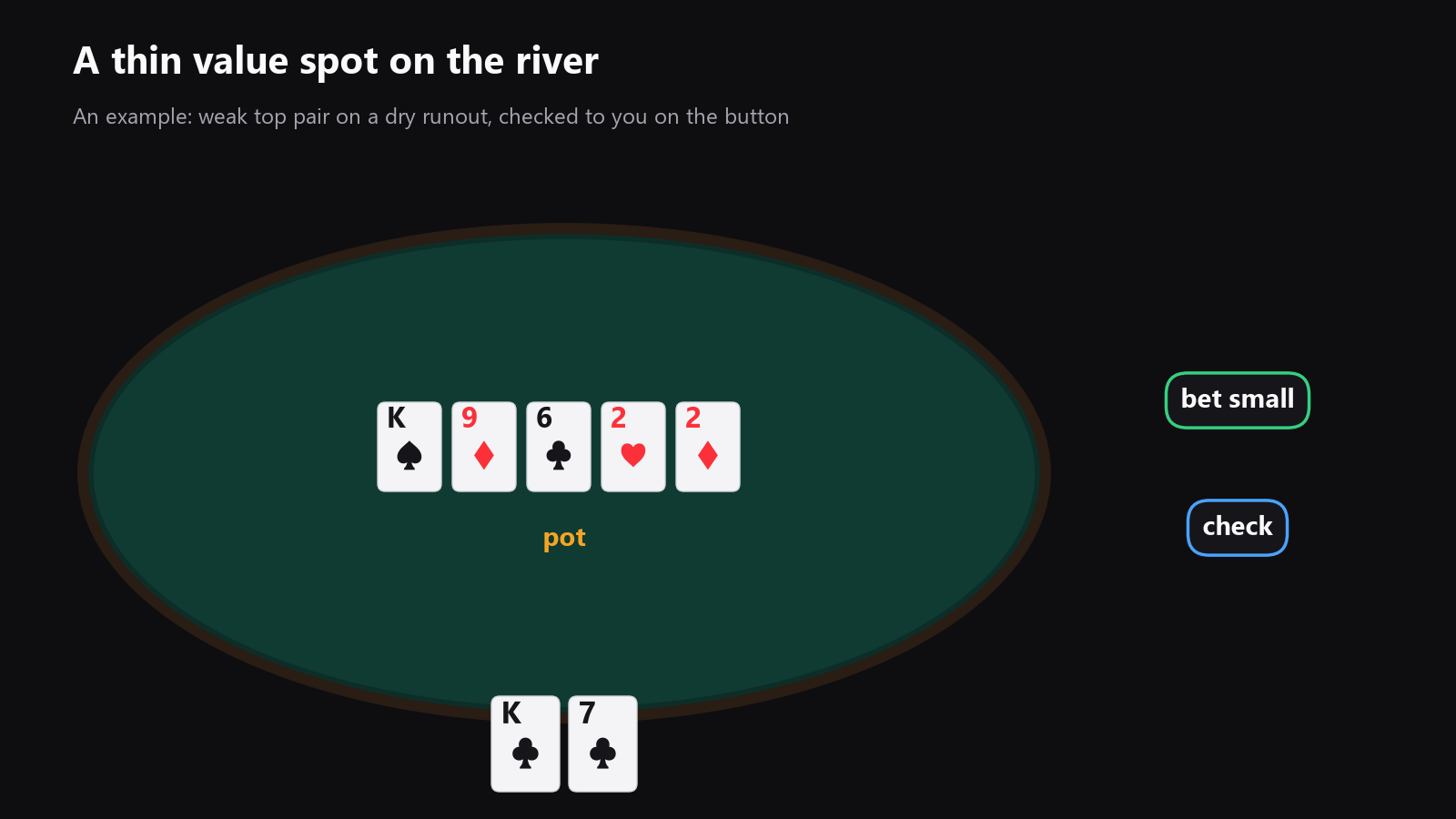
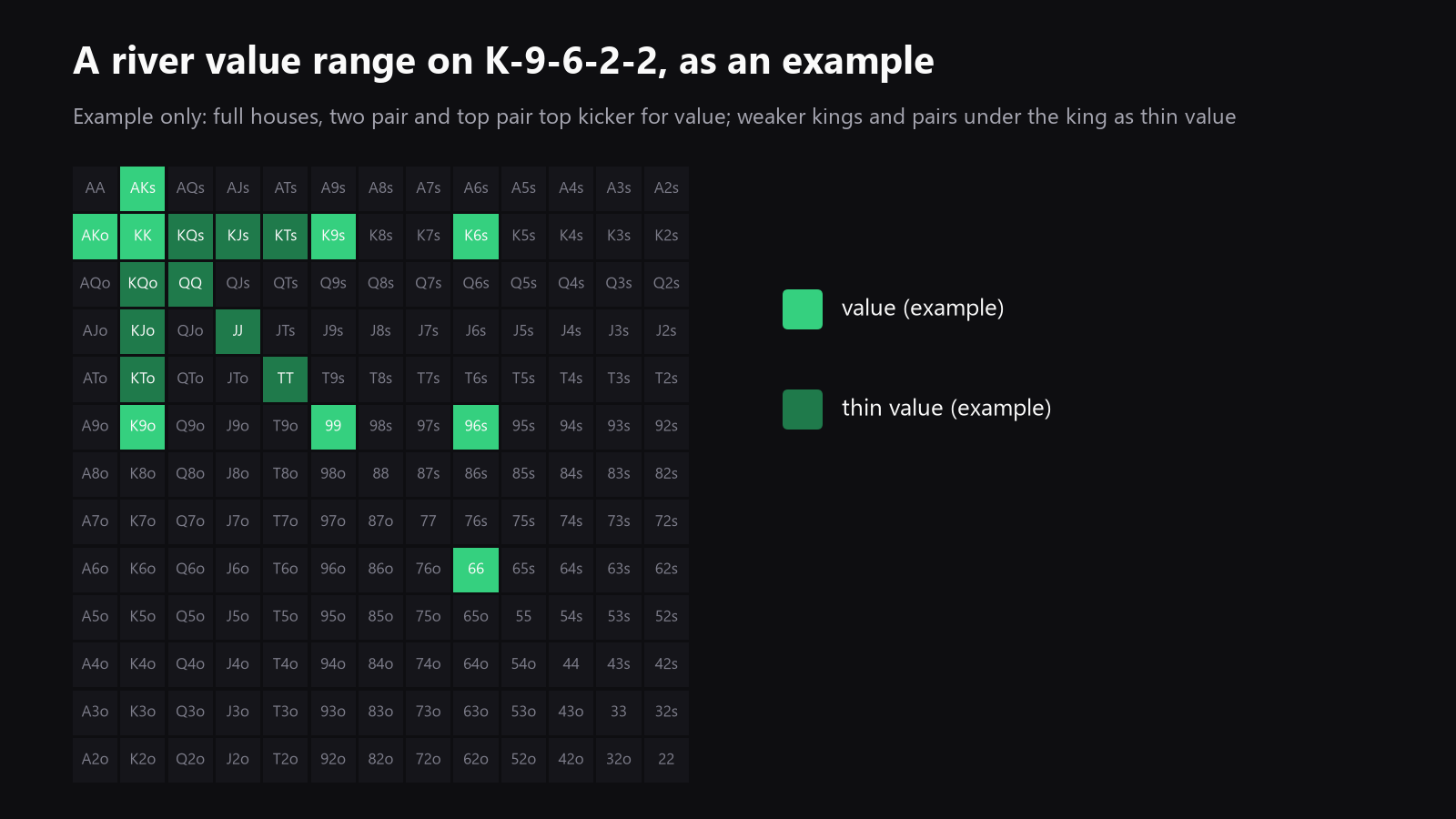
A hand like second pair on a safe river, weak top pair on a dry board, or a bluff-catcher that improved just enough to beat a chunk of villain's range can be a thin value bet. The exact hand depends on the spot. The board texture, the previous streets, position, stack sizes, and the opponent all matter.
The key idea is simple: a value bet is profitable if worse hands call often enough. If only better hands continue, your bet is no longer value. It becomes a bluff or a mistake.
A good shortcut is this:
- If you can name several worse hands that realistically call, you may have a thin value bet.
- If you cannot name them, you probably do not.
Step 1: work out which worse hands can call
This is the real skill.
Do not start with your own hand. Start with villain's range on the river. Ask how they arrived here.
1) Look at the line they took
A river caller is not a random hand. They got there through the earlier streets.
For example:
- they may have checked back the flop with some medium hands
- they may have called flop and turn with draws
- they may have called down with one pair
- they may have value-raised earlier with stronger hands
Once you reconstruct that path, you can sort the river range into categories.
2) Separate made hands from missed hands
A thin value bet usually works best when villain arrives with a lot of bluff-catchers, not just monsters.
Look for:
- weaker one-pair hands
- underpairs
- top pair with a worse kicker
- second pair
- missed draws that may still call at a low frequency, depending on the player
If the river completes obvious draws and villain's range is heavy on those draws, value gets thinner fast. If the river bricks and villain's range contains many one-pair hands, your thin value bet improves.
3) Count the hands that beat you, not just the hands that fold
This is where many players go wrong.
They see that worse hands exist, and they bet. But what matters is not whether worse hands exist in theory. What matters is whether enough of them call in practice.
If worse hands fold too often, your bet does not get paid.
If better hands call or raise too often, your bet is too thin for the size.
That is why thin value is always tied to the opponent type. A calling station allows thin value with very weak hands. A sticky regular may still call wide enough to make thin value good, but only if the board and size are right. A player who folds too much to river bets may not be a thin value target at all, unless you bet very small.
Step 2: choose a size that keeps worse hands in
Bet size changes everything.
A smaller bet allows more worse hands to continue. A larger bet extracts more when you are ahead, but it also forces out the weakest calling hands. Thin value bets often lean smaller for that reason.
Here is the simple logic:
- small bet: more calls from weak pairs and bluff-catchers
- medium bet: a compromise, when the board and the opponent can continue with enough worse hands
- large bet: better when villain calls too loosely, or when your hand is stronger than "thin value" and can get paid by more than just the weakest bluff-catchers
On the river, the bet size also changes the price villain gets.
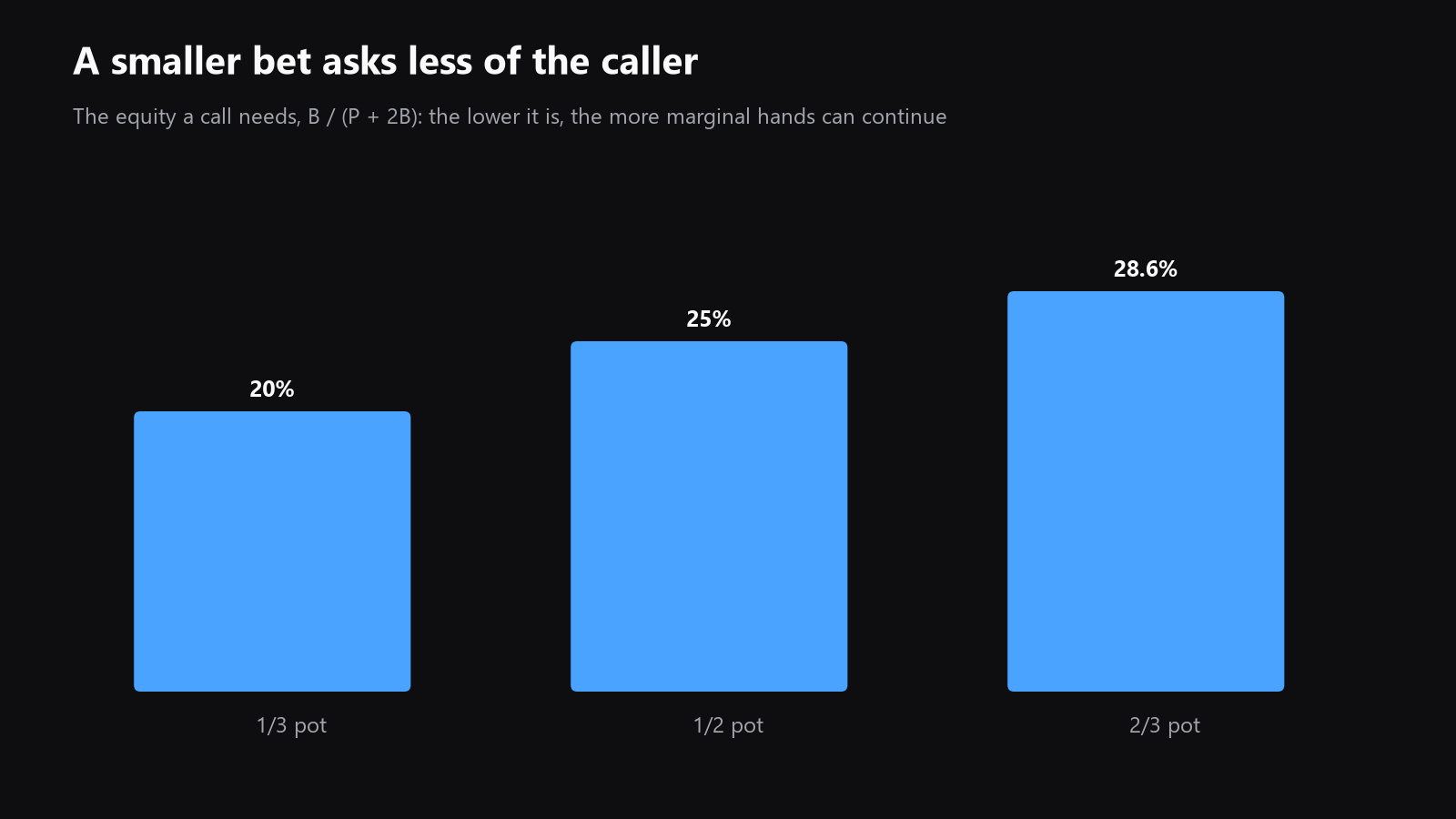
If you bet one-third pot, villain needs a much lower equity threshold to call than if you bet two-thirds pot. That means more of their marginal hands can continue. That is good for you when your hand is ahead of those marginal hands.
If you bet too big, you may scare away the exact hands you wanted to target.
A practical rule:
- if your hand only beats the weakest part of villain's continuing range, lean small
- if your hand beats a large chunk of villain's value-calling range, you can size up
- if you are unsure whether worse hands continue, smaller is usually safer than bigger
A useful way to think about sizing
Ask yourself: what does this bet need to accomplish?
- If you want calls from weak pairs and bluff-catchers, keep the price attractive.
- If you want calls from stronger one-pair hands, you can bet a bit more.
- If you only get called by hands that beat you, the bet is too large, or the spot is not a value spot.
This is why thin value is not just "bet small all the time". Sometimes the right play is a bigger value bet, because the opponent is a station and still pays with worse. Sometimes the right play is no bet at all, because the river kills too many worse hands.
Step 3: respect the raise
Thin value bets become dangerous when you face a raise.
A river raise is usually a strong signal, because it is the final street and the player no longer needs to protect against future cards. That does not mean every raise is the nuts, but it does mean you should pay attention.
When you thin value bet, ask:
- what hands raise for value?
- what bluffs can realistically raise here?
- does this player ever bluff-raise rivers?
- can I comfortably bet and fold if raised?
That last question is important. Many thin value bets are not meant to stack off. They are meant to get called by worse and to fold if the opponent shows unusual aggression.
If the pool rarely raises bluff on the river, you can value bet thinner and fold more often to raises. If the opponent has shown a willingness to turn missed draws into raises, then the same hand may become a call or even a check in some spots.
So do not think of the raise only as a problem. Think of it as part of the spot's structure.
A thin value bet is best when:
- worse hands call often
- better hands do not raise too often
- your hand can profitably bet and sometimes fold
Step 4: tell thin value from a blocker bet
These two get mixed up a lot.
A blocker bet is often made to control the size of the pot and to discourage a bigger bet from the opponent. Thin value is made because you expect worse hands to call.
The overlap is real, but the intention is different.
For example:
- if you think worse hands call a small river bet, that is thin value
- if you think neither worse hands nor better hands like to continue, but you want to buy a cheap showdown, that is more of a blocker idea
Sometimes the same size can do both jobs. But your decision should be based on the range interaction, not on a label.
Step 5: a practical checklist
Before you bet river for thin value, run through this checklist:
- What worse hands call?
- How many of them are there?
- Do better hands fold or raise?
- Is a smaller size enough to get called?
- Can I handle a raise?
- Would checking lose more value than betting?
If you cannot answer at least the first three, the bet is probably too vague.
A good thin value bet is not based on hope. It is based on a reasoned estimate of the opponent's continuing range.
Examples of thin value spots
Here are a few common shapes of thin value spots, without pretending that every player pool reacts the same way:
- A dry board where top pair weak kicker is still ahead of many one-pair holdings
- A paired river where second pair now beats a large part of villain's bluff-catchers
- A river brick after draws miss, when villain still has enough weaker made hands to pay a small bet
- A spot against a player who calls too much and does not fight back often on the river
And here are spots where thin value is less attractive:
- very wet runouts that improve villain's obvious value hands
- boards where your hand is only ahead of busted draws and gets called by better pairs
- opponents who undercall river bets unless they are already strong
- spots where a raise is common and your hand cannot continue
Where Poker Exploit helps
If you want to improve this part of your game, the useful question is not only "what is thin value?". It is also "where do I miss it, and against whom?"
That is where the program becomes practical.
The Self Analyser module can show which river situations cost you the most, so you can see whether you are checking too much, betting too thinly, or missing value in the wrong spots.
The Reveal module shows what real players at your limits actually do from your hand histories. That is especially useful here, because thin value depends on population behavior. If your opponents call river bets too often with worse hands, you can value bet thinner. If they overfold, you should change size or choose different hands.
The Results screen can also help you see whether a line is really paying off over time, with rake shown next to the result. That matters more than many players think, because thin value spots can look fine in chips and still be less attractive once rake is part of the picture.
And if you want to study a specific river spot away from the table, the Solver module can compute it for you. It refuses hands from the session in progress, which is exactly what you want when you are studying instead of playing.
The short version
Thin value on the river is not about guessing.
It is about finding worse hands that actually call, choosing a size that keeps them in, and understanding when a raise changes the story.
If you remember only one thing, remember this:
- no worse hands that call, no value
- too big, and the worse hands disappear
- too weak against a raise, and your value bet stops making sense
If you can name the hands that call, and you can explain why they call, you are already much closer to good river value betting.
Do it on your own hands.