
On the river, you do not get a second chance. If you call, you are saying one of two things: either your opponent bluffs often enough, or their value range is thin enough that your hand still wins enough of the time.
That is what a bluff catcher is for.
A bluff catcher is a hand that usually loses to value bets, but beats enough bluffs to make a call possible. It is not a magic hand, and it is not always strong enough to call. It is simply a hand whose value depends on the price, the range, the blockers, and what your opponent actually shows down.
1. What a bluff catcher really is
A lot of players use the term too loosely.
A bluff catcher is not just any medium strength hand. It is a hand that you are mainly calling with because it beats the bluffs in villain’s betting range, not because it is ahead of value.
For example:
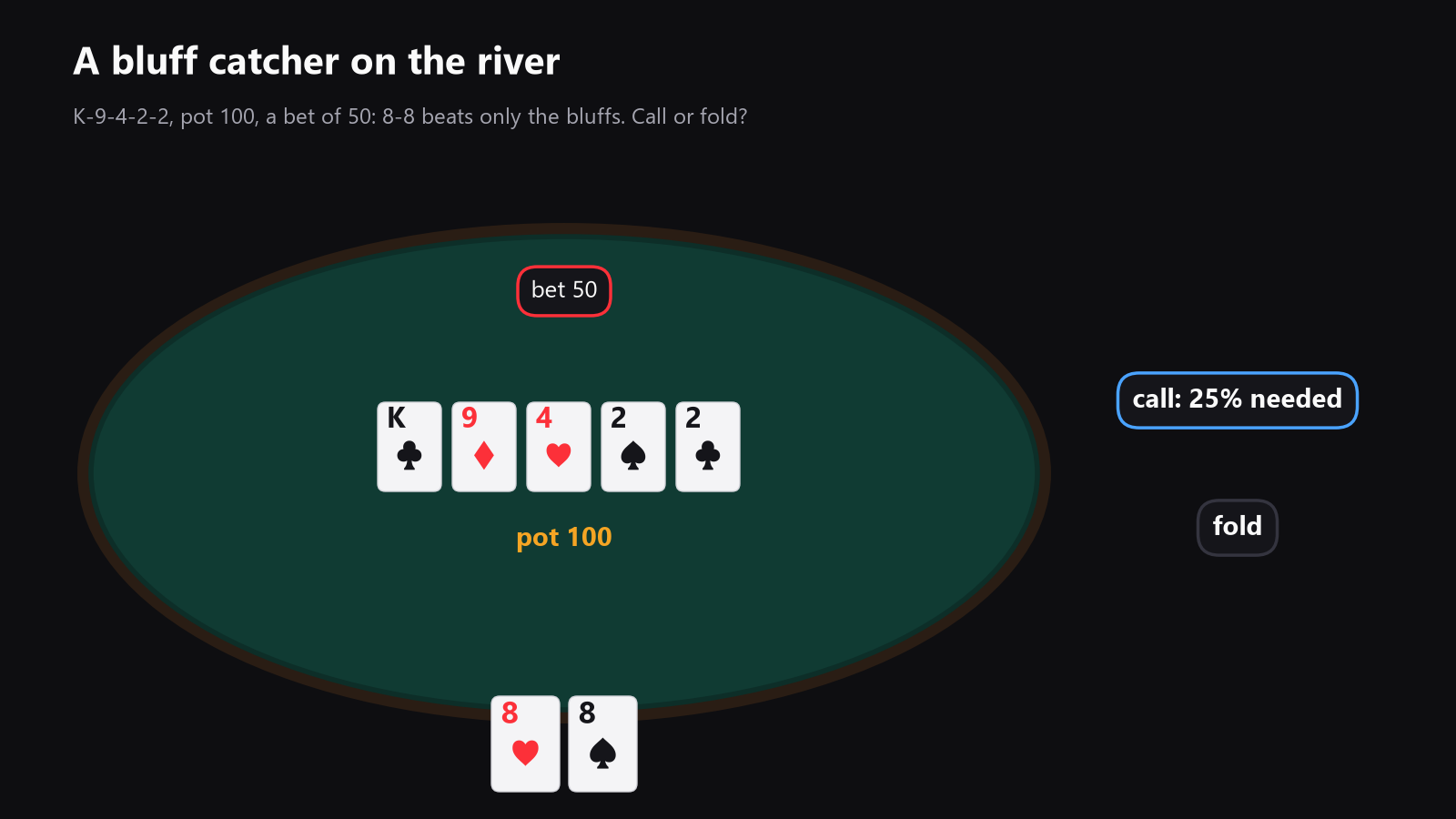
- On a board like K-9-4-2-2, a hand like 8-8 may be a bluff catcher against a river bet.
- On a board like A-K-7-7-2, a hand like Q-J is usually not a bluff catcher, because it often does not beat enough of the betting range.
The point is simple: a bluff catcher is defined by range interaction, not by absolute hand strength.
On the river, that distinction matters because there are no more cards to come. You are not calling to improve. You are calling because you think villain has enough missed hands, weak pairs, or pure air.
2. Pot odds tell you the first price
Before you start guessing about ranges, start with the math.
If the pot is P and your opponent bets B, then you must call B to win a final pot of P + 2B.
So your required equity is:
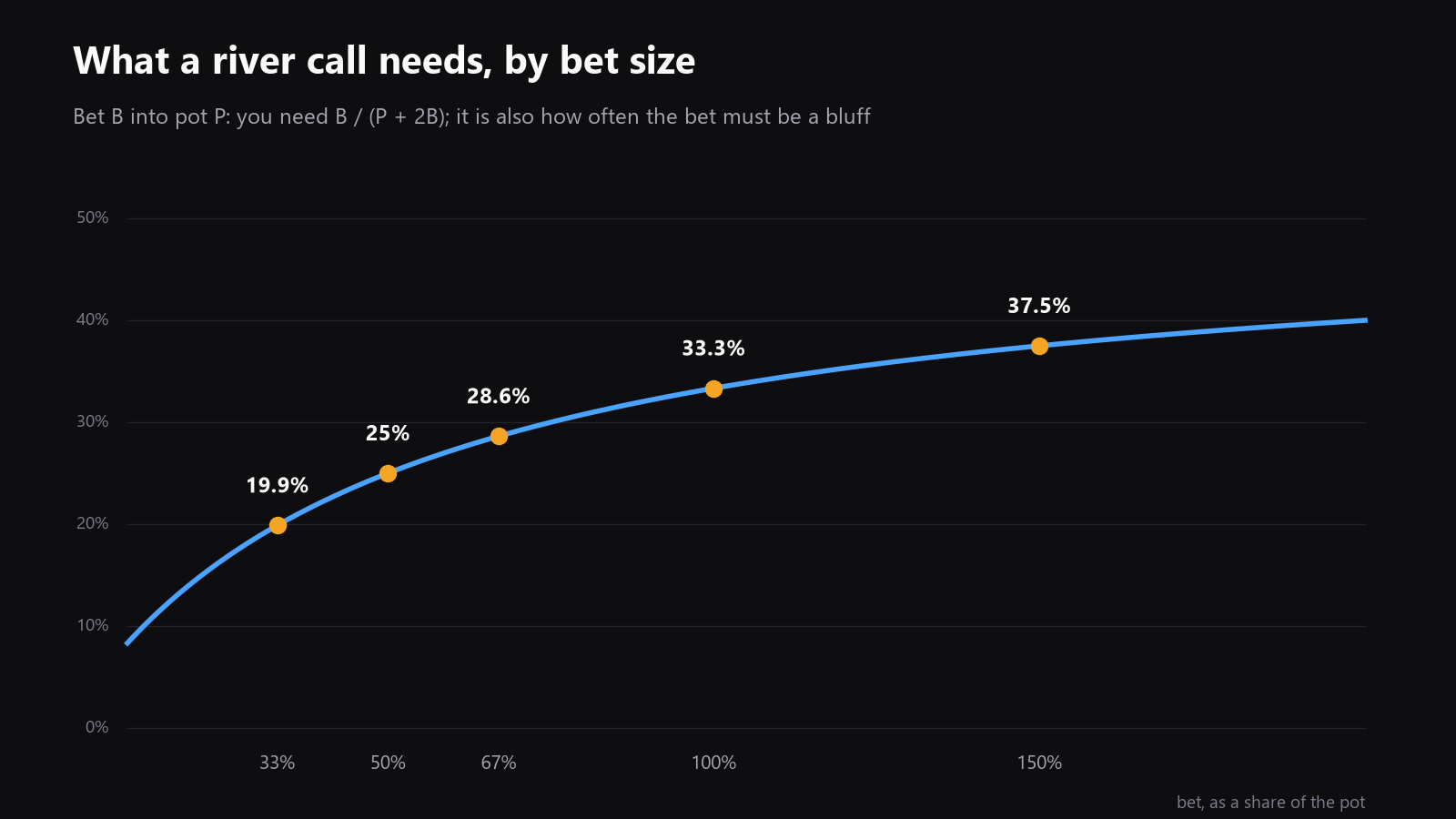
B / (P + 2B)
That is the break-even bluff frequency, if you are holding a pure bluff catcher, meaning:
- villain’s value hands always beat you,
- villain’s bluffs always lose,
- and your hand either wins against the bluff or loses against the value.
A few common examples
If the pot is 100 and villain bets:
- 33 into 100, you need about 20%
- 50 into 100, you need 25%
- 67 into 100, you need about 28.6%
- 100 into 100, you need 33.3%
- 150 into 100, you need 37.5%
So if a player bets half pot on the river, you only need to be good one time out of four for a call to break even.
That is why river bluff catching is so sensitive to bet size. A small bet can be a much wider bluff catch spot than an overbet.
A useful warning
Do not confuse this with minimum defense frequency.
MDF is a range concept. It tells you how much of your range you need to continue with so that villain cannot profit by bluffing any two cards.
Your bluff catcher decision is different. Here, you care about the equity of one hand against one betting range.
3. How often your opponent must bluff
The key question is not, “Do I beat some bluffs?”
The key question is, “Does villain bluff often enough for this call to make money?”
Use this simple rule:
- if villain’s river bet is 75 into 100, your call needs them to be bluffing at least 30% of the time
- if villain’s river bet is 50 into 100, you need 25%
- if villain’s river bet is 100 into 100, you need 33.3%
You can also express the required bluff-to-value mix.
If the pot is 100 and the bet is 75, then villain must have about 43 bluffs for every 100 value hands, or about 3 bluffs for every 7 value hands, for your bluff catcher to be indifferent.
That is the kind of arithmetic you want to know by heart. It saves you from making “hero calls” that are not actually hero calls at all.
4. Blockers decide close spots
Once the price is known, blockers often decide the close river spots.
A blocker is a card in your hand that removes some combinations from villain’s range.
When blockers help you call
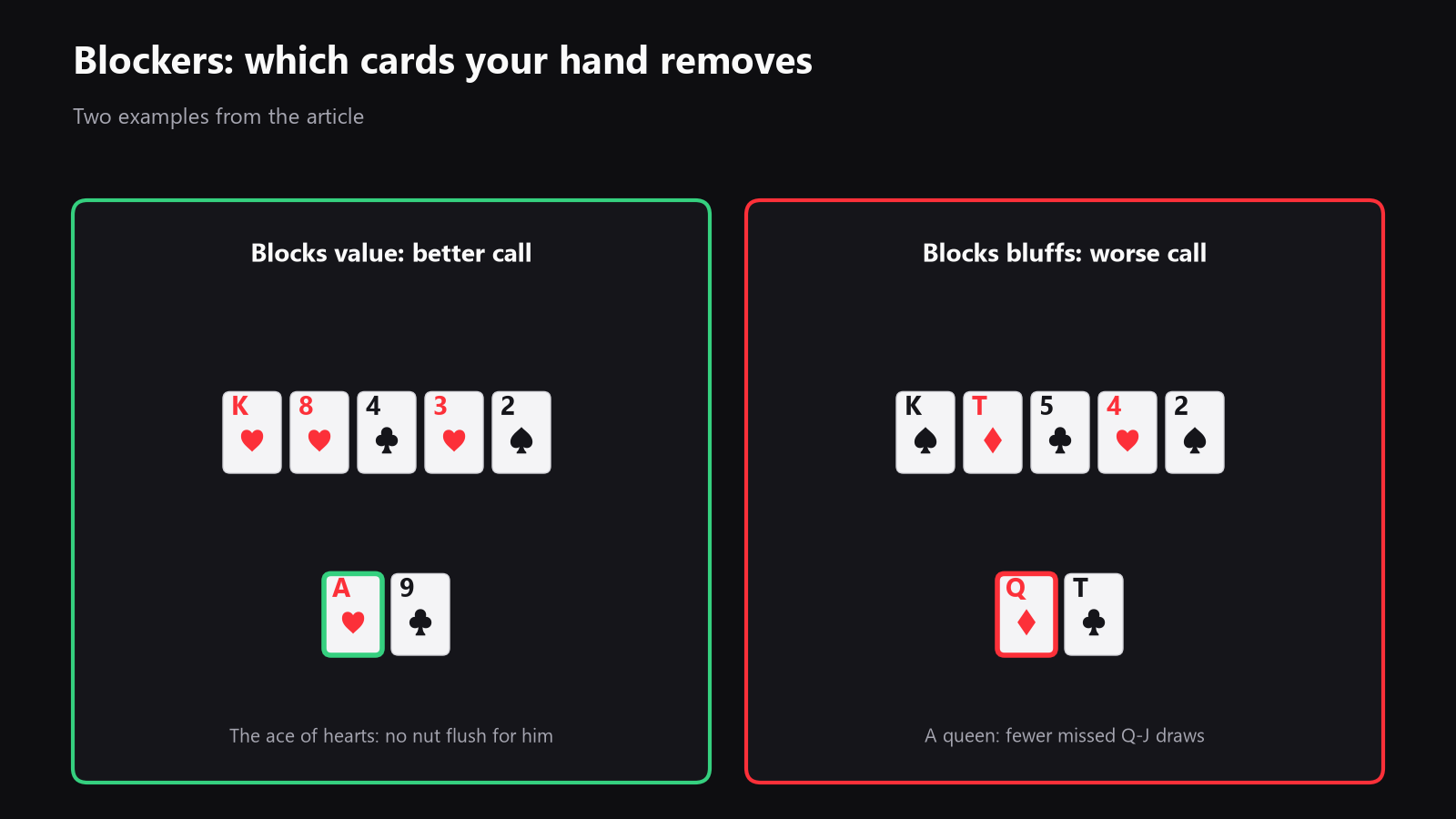
A good bluff catcher often blocks value more than it blocks bluffs.
For example:
- if the board completes a flush, holding the ace of that suit may remove the nut flush from villain’s value range
- if villain value bets mostly with top pair and two pair, holding one of those ranks can reduce the number of value combinations
- if the opponent’s bluffs are missed straight draws, and your hand does not remove those draws, your call gets better
When blockers hurt you
The opposite is also true.
If your hand blocks the natural bluffs, your call gets worse.
For example, if villain’s missed draws often contain a queen, and you hold a queen, you may be blocking part of the bluff range. That can turn a tempting call into a fold.
This is why blockers are not just about “making a hand look nice.” They are about which combinations remain in villain’s range after the river action.
The best bluff catcher is often not the strongest hand
The best bluff catcher is the hand that interacts best with villain’s range.
Sometimes that is a weak pair.
Sometimes it is ace-high with the right blockers.
Sometimes it is a medium pair that blocks value and leaves bluffs intact.
Sometimes it is a fold that feels ugly but is correct.
5. Read showdowns, but read them the right way
Showdowns are one of the best ways to learn whether a player, or a player pool, bluffs enough on the river.
But you have to read them carefully.
Do not ask, “Did they bluff once?”
Ask:
- what board texture was it?
- what size did they use?
- what position were they in?
- how did they get to the river?
- what kind of hand did they show down?
A single showdown is a clue, not a conclusion.
What you want to notice is a pattern.
For example:
- if a player keeps showing down weak missed draws after big river bets, they may be overbluffing that node
- if a player keeps showing strong made hands after a certain line, their river bets may be too value-heavy
- if a pool checks back too many missed draws and then bets mostly strong hands on the river, your bluff catcher should become much tighter
The most useful showdown reads are not dramatic. They are repetitive.
You are trying to answer a practical question: when this line reaches the river, what hands do they actually bet?
That is exactly the kind of question you can study away from the table. The Reveal module is built for that sort of post-session work, because it shows what players at your limits really turn over.

6. A simple river checklist
When you face a river bet with a bluff catcher, run this checklist:
- What value hands can villain realistically bet?
- What missed draws or weak hands can they turn into bluffs?
- How big is the bet, and what does that do to the price?
- Do your blockers reduce value, or do they reduce bluffs?
- What have you seen at showdown from this player, or from this pool?
- Does villain bluff enough for your hand to be a profitable call?
If the answer is yes, call.
If the answer is no, fold.
That may sound basic, but most river mistakes happen because players skip one of those steps and call because the hand “looks too good to fold.”
That is not a plan. That is a feeling.
7. Common mistakes with bluff catchers
Mistake 1: Calling because the price is “not that big”
A small bet can still be value-heavy.
If the player pool underbluffs that spot, a small price does not save you.
Mistake 2: Overvaluing your hand instead of your range
Your hand may beat ace-high, but if villain’s betting range is mostly pairs and better, that does not help much.
Mistake 3: Ignoring blockers
A hand that blocks value but unblocks bluffs is often much better than one that blocks bluffs.
Mistake 4: Trusting one showdown too much
One weird bluff does not mean the player is a maniac.
One thin value bet does not mean they never bluff.
You need a pattern.
Mistake 5: Forgetting the pool
Against many small-stakes pools, river bets are often more value-heavy than players expect, especially on scary runouts and larger sizes.
Your default should be disciplined, then adjusted by evidence.
8. The practical rule
If you want the short version, here it is:
- start with the price
- estimate villain’s value hands
- estimate villain’s bluffs
- check your blockers
- confirm the tendency with showdowns
If the bluffs do not reach the threshold the pot odds demand, fold.
If they do, call.
That is what bluff catching is.
Not bravery. Not hope. Just a clean decision based on the river price and the range in front of you.
If you want to study these spots with your own hands later, that is where the Reveal module and the Solver module become useful. Reveal helps you see what the field actually shows down. The Solver module can then work on a specific river spot away from the table, once you pick one to study.
For the table in front of you, though, the rule stays the same: a bluff catcher is only worth a call when the price, the range, the blockers, and the showdowns all point the same way.
Do it on your own hands.