
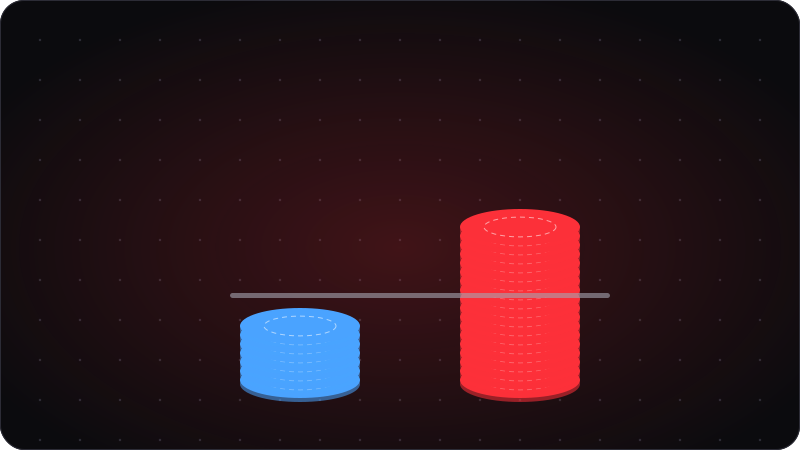
An overbet is a bet bigger than the pot.
That sounds simple, but it changes the hand a lot. Once the bet size goes above the pot, the opponent gets a much worse price to continue, so only the strongest hands, the best draws, and the best bluff-catchers can stay in the pot with confidence. That is why overbets are such a powerful weapon when the board and the ranges are right.
They are also easy to misuse.
If you overbet on the wrong texture, you can make life easier for your opponent, because you only get called by the top of their range. If you use the right size on the right board, you force folds from hands that looked comfortable one street earlier.
What an overbet is trying to do
An overbet is not just "bet bigger". It is a pressure tool.
You use it when one of these is true:
- You have more strong hands than your opponent does.
- Your opponent has many medium-strength hands that do not like large pressure.
- The board gives your range a better nut story than theirs.
- You want to charge draws so heavily that their equity is no longer enough.
In other words, an overbet works best when your range is polarized. That means your betting range is made of strong value hands and bluffs, with not many hands in the middle.
That is the heart of the strategy. A merged, medium-strength range usually prefers smaller bets. A polarized range can profit from a big bet.
Why the turn is often the best street for an overbet
The flop is usually too early for many overbets. Both ranges are still wide, and a lot of hands can continue at least once.
The river is the classic street for overbets, because no more cards are coming. A hand either stands up or it does not.
But the turn is often the sweet spot.
Why?
Because the turn can change who has the nut advantage while both ranges are still wide enough to fold. One card can:
- Complete a straight or a flush draw
- Pair the board
- Bring an ace, king, or queen that helps one range much more than the other
- Kill a lot of second-best holdings
- Turn a hand that looked medium on the flop into a clear bluff-catcher
A turn overbet is especially strong when the new card makes your strong hands more credible and makes your opponent's one-pair hands much less comfortable.
On which boards overbets work best
Not every board likes the same sizing. Overbets are strongest on boards where ranges become polarized and one player has the stronger top end.
Good candidates often include:
- Paired boards, especially when the board runs out in a way that keeps very few strong combinations alive
- Boards where a turn or river card clearly favors the aggressor's range
- Runouts that complete the obvious draws and leave many medium hands in trouble
- Boards where the caller is capped, meaning their line has removed many strong hands from their range
- Boards where the top of the range is narrow, so a big bet can credibly represent a small set of very strong hands
A rough practical rule is this: the more the board creates clear tiers, nuts, bluff-catchers, and trash, the more attractive an overbet becomes.
The less the board creates those tiers, the more dangerous the overbet is.
For example, if the board is so connected that both players can hold many straights, two pair hands, and strong draws, an overbet needs a very good reason. If the board is dry, static, and the nut hands are concentrated on one side, an overbet can be much more effective.
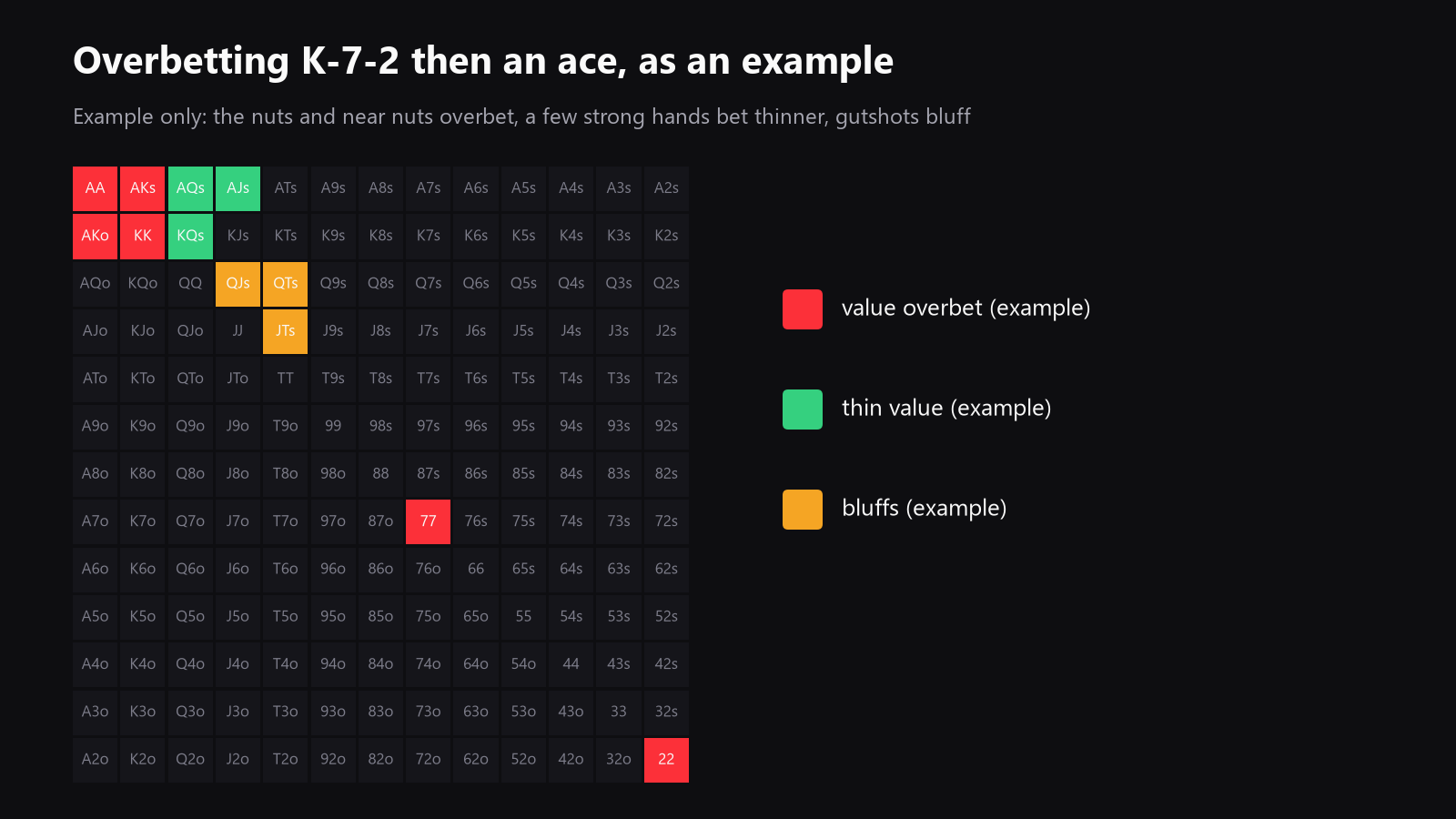
Which hands are good for value overbets
Value overbets are not only for the absolute nuts, though the nuts are obviously perfect candidates.
Good value hands usually have these traits:
- They are near the top of your range
- They get called by worse often enough
- They are not afraid of being raised too often
- They belong to a line that looks strong from the start
Typical value hands for overbets include:
- Nut flushes
- Straights on runouts where worse hands still pay
- Sets and full houses
- Top two pair or strong two pair on boards where worse one-pair hands can still call
- Strong top-pair type hands only when the board and the line make them much stronger than usual
The key question is not "Is this hand strong?"
The key question is "Does this hand get called by enough worse hands to justify the size?"
If worse hands fold too often and better hands continue too often, the overbet is too thin.
Which hands are good for bluff overbets
A bluff overbet is not random aggression. It should usually have one or more of these features:
- It blocks the hands your opponent wants to continue with
- It does not block the hands you want them to fold
- It has little or no showdown value
- It improves your range story better than theirs
The best bluff candidates are often hands that miss, but miss in the right way.
For example:
- Missed nut flush draws with the right blocker
- Missed straight draws that block the nuts
- Hands that hold an ace or king when those cards matter in the value region
- Missed draws that remove strong bluff-catching combinations from the opponent's range
On the river, blockers matter a lot. A pure air hand can still be a bluff, but if it blocks the wrong hands and unblocks the right calls, it becomes a bad bluff even if it missed.
On the turn, a bluff can also be a semi-bluff with real equity. That is often better, because you are not relying only on fold equity.
What an overbet asks of the opponent
An overbet asks a lot from the player facing it.
First, it asks for a stronger continuing range. A player cannot defend the same way against a half-pot bet and a 1.5x pot bet. The larger size removes many hands that were previously easy calls.
Second, it asks for good bluff-catching discipline. The opponent must decide whether their hand is only medium strong, or actually good enough to beat a polarized betting range.
Third, it asks them to understand the board. If they do not know who has the stronger nut region, they often overfold or make curious calls.
A good overbet therefore punishes three common leaks:
- Defending too wide
- Calling too often with the wrong bluff-catchers
- Failing to notice when the line is capped
The math behind an overbet
You do not need advanced theory to use the size well. Basic poker arithmetic already tells you a lot.
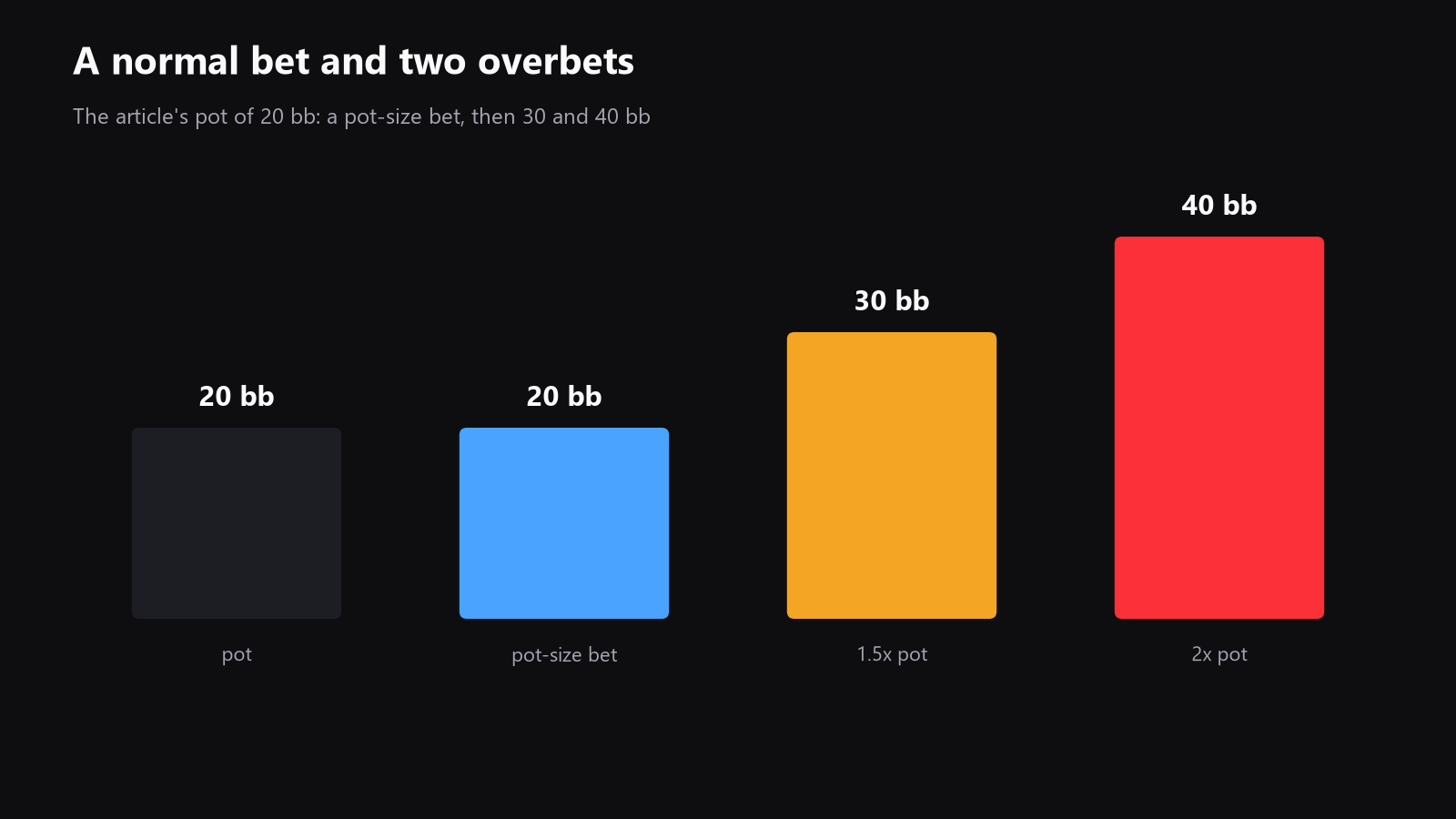
If the pot is 20bb and your opponent bets 30bb, they are betting 1.5x the pot.
- You must call 30bb to win 80bb total
- Your required equity is 37.5%
If the pot is 20bb and the bet is 40bb, they are betting 2x the pot.
- You must call 40bb to win 100bb total
- Your required equity is 40%
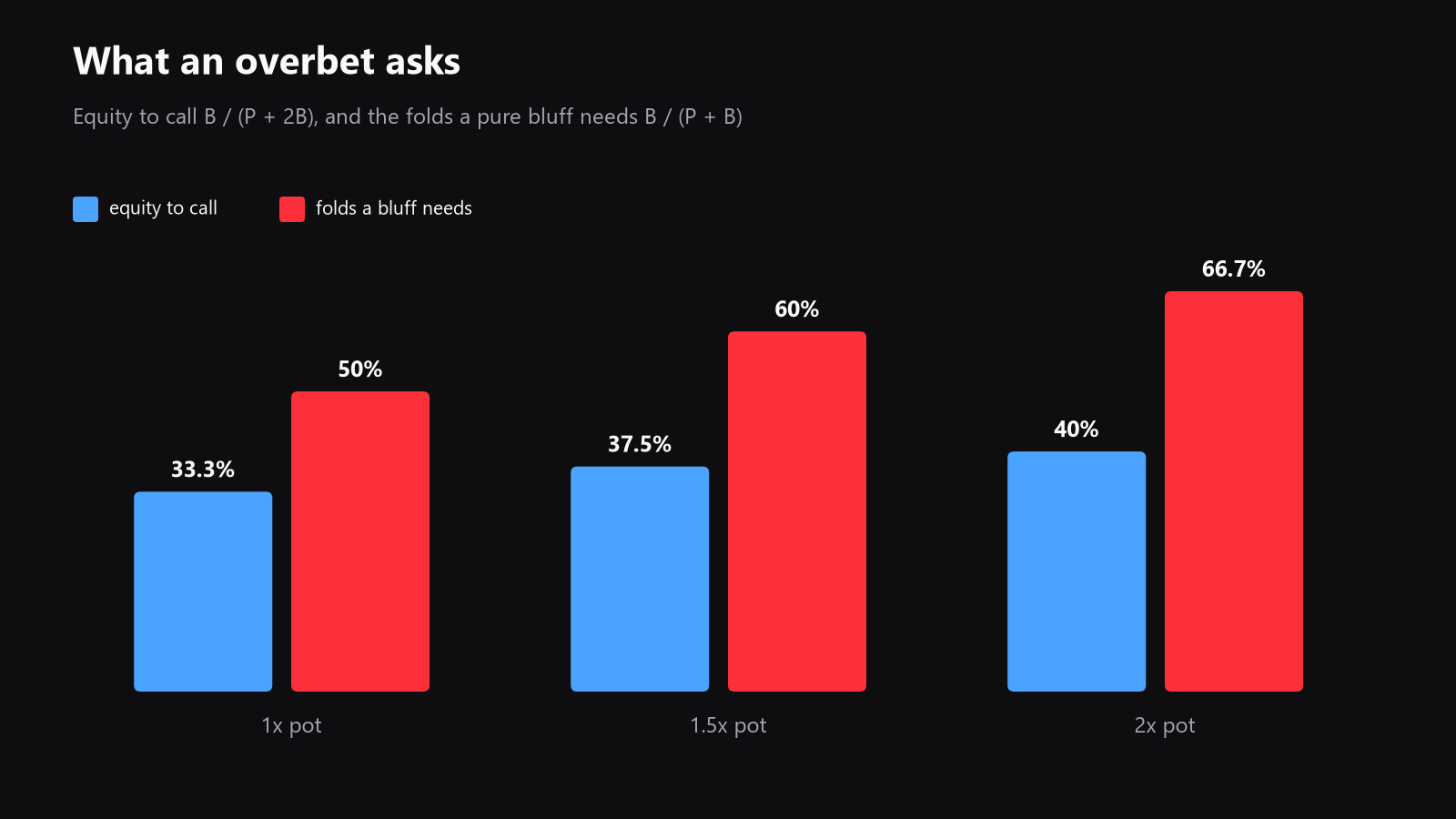
For bluffing, the bigger the bet, the more folds you need.
Here is a useful shortcut:
| Bet size | Equity needed to call | Fold rate needed for a pure bluff |
|---|---|---|
| 1x pot | 33.3% | 50% |
| 1.5x pot | 37.5% | 60% |
| 2x pot | 40% | 66.7% |
That is why overbets are so powerful on the river. A player who is unsure and slightly underdefended can get pushed out of many hands very quickly.
How to face an overbet
When you face an overbet, do not start by asking, "Do I like my hand?"
Start by asking four better questions:
- What value hands does this line credibly represent?
- What bluffs does this line naturally produce?
- Does my hand block value, or block bluffs?
- If I continue, am I beating enough of the betting range?
Then think in categories.
Clear folds
Weak bluff-catchers, low pairs on scary runouts, and hands that block the wrong part of the bluffing range are often easy folds.
Bluff-catchers
These are the hands near the top of your range that can still beat enough bluffs. Good blockers matter here.
Strong continues
The top of your range, and on earlier streets some strong draws with real equity, can continue even against a big size.
The important point is that you do not defend evenly. You defend with the right part of your range.
And against some player pools, that means overfolding is correct. Many players do not find enough bluffs with large river sizes. Others overdo big bets with too many weak hands. The line and the population both matter.
Common mistakes with overbets
Here are the mistakes you want to avoid:
- Overbetting a board that actually favors the caller
- Using the size with thin value that gets paid only by better hands
- Bluffing without blockers
- Calling too wide because the price looks tempting
- Treating every overbet as a bluff
- Treating every overbet as a monster
An overbet is not a trick. It is a size. If the range story is bad, the size will not save you.
A simple practical checklist
Before you overbet, check this:
- Does the board strongly favor your top range?
- Does your opponent have many medium hands that hate pressure?
- Do you have enough value hands to support the size?
- Do your bluffs block the right continues?
- Is the turn or river card a good one for your story?
If the answer is yes to most of those questions, the overbet is probably worth considering.
If the answer is no, a smaller bet or a check is usually better.
One last thing
The best overbets are not dramatic. They are logical.
You use them when the board, the line, and the ranges make a big size the most natural way to make the opponent's middle part of range suffer.
If you want to study a specific overbet spot away from the table, that is exactly the kind of line you can test later in the Solver module, once the hand is over.
Do it on your own hands.