
A lot of poker players spend their energy on one question: how do I fix my biggest leak?
That is a good question. It is also incomplete.
Before you fix a leak, you should ask a second question: am I even sitting in the right game?
Table selection is one of the quietest edges in poker. It does not look as impressive as a tricky river call or a solver line, but it can be worth more than a small technical improvement. A weak table, a good seat, and the right time of day can do a lot of the work for you before the first hand is dealt.
That is why table selection is not just about finding any open seat. It is about choosing the table, the seat, and the hour that give you the best version of the game.
What table selection really means
When players talk about table selection, they often mean "find the softest table."
That is part of it, but not all of it.
A good table is not only soft. It is also a table where:
- the weakest players are in the right places relative to you,
- the lineup is likely to stay profitable for long enough,
- the table texture fits your style,
- the number of players seeing flops works in your favour,
- and the waiting list is worth the time it costs.
In other words, table selection is not only about who is seated. It is also about how the game will play once you sit down.
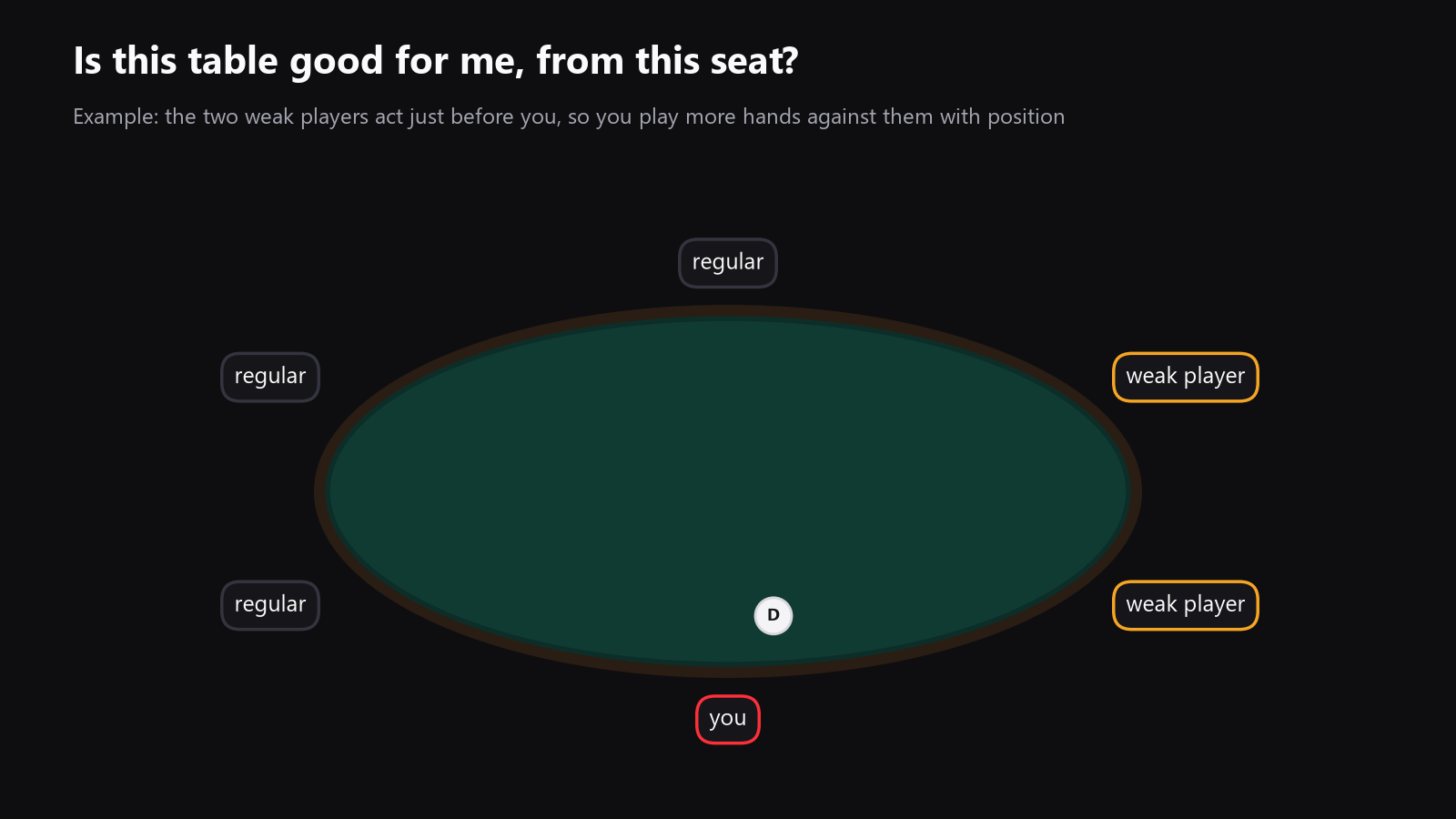
If you want a simple rule, here it is: do not ask only "Is this table good?" Ask "Is this table good for me, right now, from this seat?"
That second question is much better.
Start with the players, not the stakes
Many players look first at the stake and only then at the table. That is backwards.
The same stake can play very differently depending on the lineup. A table full of regulars at a small stake can be worse than a looser table one level higher. A table with one obvious weak player and several ordinary opponents can be better than a table with no obvious target at all.
So what should you look for?
Signs of a good table
You want to see at least one of these things:
- a player who puts money in too often,
- a player who calls too much,
- a player who folds too much,
- a player who limps too much,
- a player who seems uncomfortable with pressure,
- a table where several spots are not being defended well.
If you can identify more than one weak player, that is even better.
The point is not to hunt for a single very bad player and ignore everyone else. The point is to find a lineup where mistakes are frequent enough that your edge appears often.
A table with two weak players is usually much better than a table with one weak player and five strong regulars.
Seat selection matters just as much as table selection
A weak table is good. A weak table with a bad seat can be much less good.
Seat selection matters because poker is a positional game. You do not only care about who is in the hand. You care about who has to act before you and who has to act after you.
The easiest seat is usually the one that gives you the best position on the players you want to play pots against.
That means, in practice:
- you want more good decisions against weak opponents,
- you want fewer difficult spots against strong opponents,
- and you want the aggressive regulars to be in places where they cannot control every pot.
If a weak player is seated in a way that lets you play more hands against them with position, that is ideal. If the table is soft but all the weak players are awkwardly placed and the best regular is directly on your left, the table is still playable, but the value is lower.
A lot of players think "good seat" means "comfortable seat." That is not the right idea.
A good seat is a profitable seat.
Watch how many players see flops
This is one of the most useful table selection clues.
If many players see flops, the table is usually looser. That is not automatically good, but it often means there are more mistakes to exploit. Loose tables tend to create bigger pots, more multiway situations, and more weak calls from dominated hands.
If very few players see flops and the table is full of 3-bets and folds, the game is often tougher. More pots are contested by stronger ranges, and small edges are harder to realise.
As a rough practical rule:
- more players seeing flops usually means a softer, looser game,
- fewer players seeing flops often means a tighter, tougher game,
- but you still need to know who those players are.
A table can be loose and still be good. A table can be tight and still be good if the tightness comes from scared weak players rather than from competent regulars. Texture matters.
What you want is not only a loose table. You want a table where loose mistakes are being made by the right people.
Waiting lists are part of the decision
A waiting list is information.
If a table has a long waiting list, that often means other players think it is worth joining. That is useful, but it is not enough on its own. A long queue can also mean the table is popular because the buy-in structure is attractive, the room is busy, or the table is simply the only one available.
So do not treat the waiting list as proof.
Treat it as a clue.
A waiting list can be worth it when:
- the lineup is clearly soft,
- the table has been stable for a while,
- and you expect the game to stay good long enough to justify the wait.
A waiting list is less attractive when:
- the table is already changing fast,
- the weak players are busting or leaving,
- and the remaining seats are filling with regulars.
The real question is not "How long is the line?" It is "Will the table still be good when I finally sit?"
When a table becomes tough, leave
This is where many players lose value.
They sit because the table was good once, then they stay because they already have chips on it.
Do not do that.
A table can become tougher very quickly. One player leaves. Another regular takes the open seat. The soft spots disappear. Suddenly the game you wanted is not the game you have.
You should think about leaving when:
- the weak players are gone,
- the remaining seats are mostly filled with regulars,
- the action has become more aggressive and less error-prone,
- you no longer have good seat position on the players you care about,
- and the table no longer looks different from the next available one.
A simple habit helps: after every significant change in the lineup, ask yourself whether the table is still the best option you have. If the answer is no, move.
Good table selection is not only about entering the right game. It is also about leaving the wrong one.
Your best hour may matter more than you think
Table selection is not only about the table. It is also about the hour.
Some hours are better because the player pool is softer. Some are better because more recreational players are online. Some are worse because the tables are full of tired regulars or because everyone else is playing the same schedule you are.
You do not need to guess.
You can check.
The free Results module shows your curve and your money by month and over your career, by room, stake, position and hour of the day. It also shows the rake next to the result and the all-in EV line. That is exactly the kind of view you need if you want to stop relying on memory.

When you look at your results by hour, do not rush to declare a winner after a small sample. Poker variance is too noisy for that. A bad hour can look good by accident, and a good hour can look bad because of runout.
What you want is a pattern, not a hunch.
Ask questions like:
- Do I tend to play better at certain hours?
- Are those hours also the times when the tables are softer?
- Am I playing more or less carefully at night?
- Does fatigue matter for my discipline?
- Do I register worse results when I play too late?
A lot of players discover that their best hours are not the hours they expected. Some play best when they are fresh in the afternoon. Others do better in the evening when more recreational players are available. The point is to let your own results tell you something real.
Use the tools that help before and after the session
Table selection happens before you sit and between sessions. That is why the tools that matter here are the ones that help you observe, compare and review.
Once you are seated, the free HUD shows the observed statistics of each opponent from your own hands, including VPIP, PFR, 3-bet, fold to 3-bet, flop c-bet and fold to flop c-bet. It compares each stat with the field, marks the colour you gave the player, and keeps your notes visible. Player Profiles keeps those statistics, notes and colours between sessions.
That does not tell you what to do in a hand. It does not help during a decision. It simply tells you whether the lineup you sat for is still the lineup you wanted.
That is a useful distinction.
If you want to go one step further after a session, the Reveal module shows what the players at your limits actually do from your own hand histories, and shows the sample each finding rests on. That can help you understand how soft or tough a player pool really is. It still does not tell you what to do in a hand in progress, and it does not choose your tables for you. But it can make your table selection more informed.
A practical table selection routine
Here is a simple routine you can use:
- Look for tables with visible weak spots.
- Check whether the seat gives you good position on those spots.
- See how many players are seeing flops.
- Check whether the waiting list is worth the time.
- Sit only if the table is better than the next reasonable option.
- Leave when the table stops being the table you wanted.
- Review your results by hour so you know when you play your best.
That routine will not make every session easy. Nothing will.
But it will stop you from giving away value before the cards are even dealt.
And that is the whole point of table selection.
It is one of the few edges in poker that costs almost nothing, happens before the hand starts, and can quietly improve your long-run results without changing a single bet size.
Do it on your own hands.