
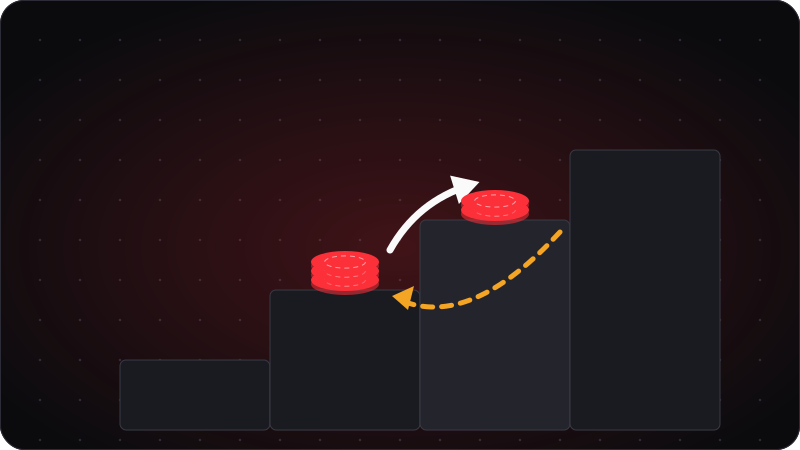
Moving up in poker stakes feels exciting for a reason. The money is bigger, the games can be better, and if you have been beating your current limit for a while, the next step seems close. But "feels close" is not the same as "the numbers say you are ready".
The good news is that you do not need intuition alone. You need two things:
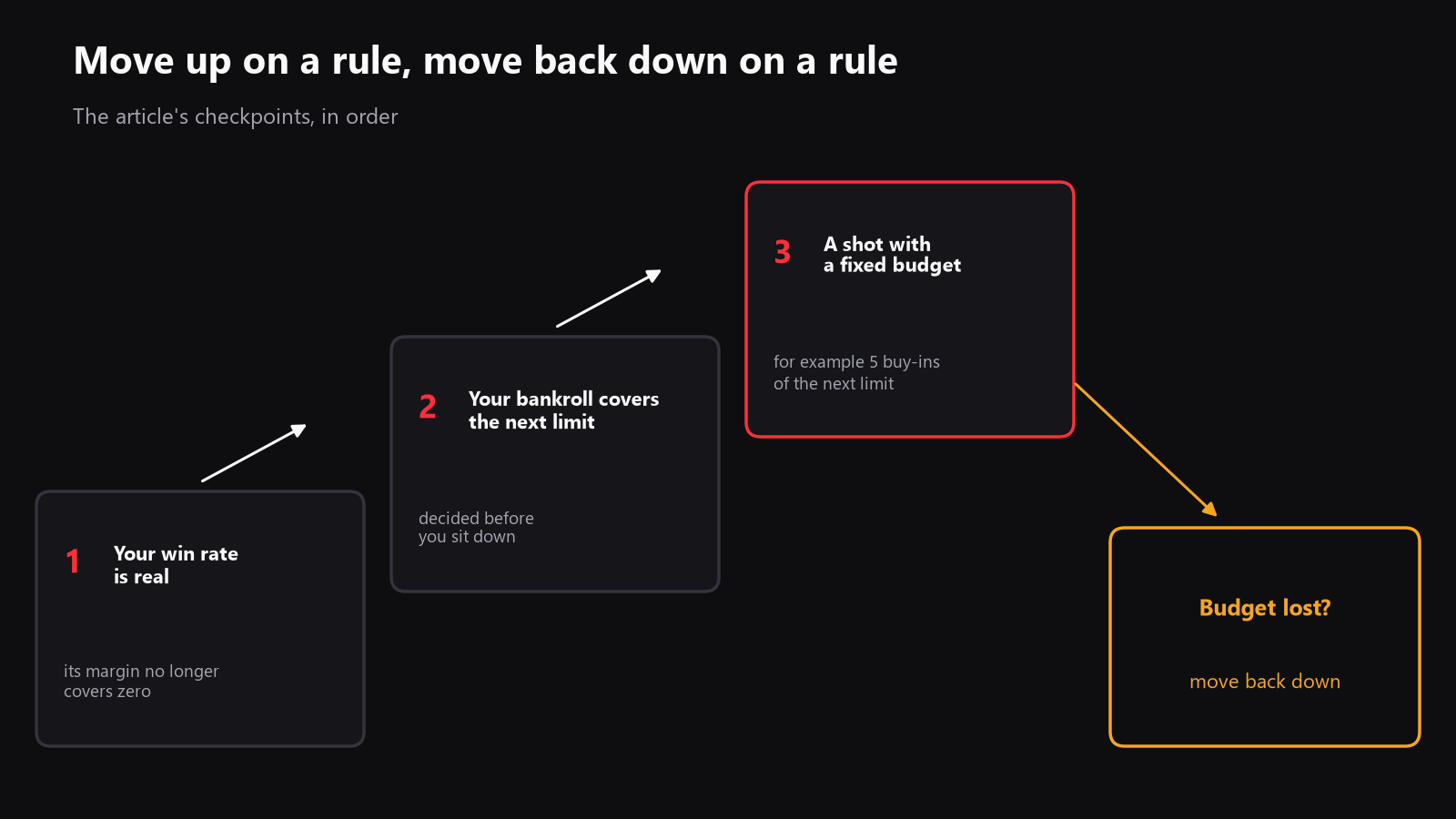
- Evidence that your current win rate is real, not just variance.
- A bankroll that can survive the swings at the next limit.
Then you need a rule for the shot, and a rule for the drop back down.
What it really means to be ready
A lot of players ask the wrong question.
They ask, "Am I good enough for the next stake?"
A better question is, "Do the numbers say I can take a shot without risking my entire roll, and without pretending variance is skill?"
For cash games, that usually means two checkpoints:
- Your win rate estimate is no longer too uncertain to trust.
- Your bankroll covers the next limit with room to breathe.
For tournaments, the second point matters even more, because variance is larger. You need a wider cushion, not a thinner one.
The first checkpoint: your win rate must beat zero for real
This is where many players fool themselves.
A graph can look nice while the sample still says almost nothing. If your tracker tells you something like 4.61 ± 8.2 bb/100, the margin still covers zero. That means the sample does not settle the question yet. You might be a winner, a breakeven player, or a loser. The data has not decided.
When the margin no longer covers zero, the sample finally starts to speak clearly. That does not mean you are guaranteed to win at the next limit. It means your current edge is not just a lucky run.
A simple way to think about it:
- If zero is inside the margin, you do not have proof yet.
- If zero is outside the margin, the current limit is no longer an open question.
- If your edge is only tiny, you can still move up, but you should take a much more cautious shot.
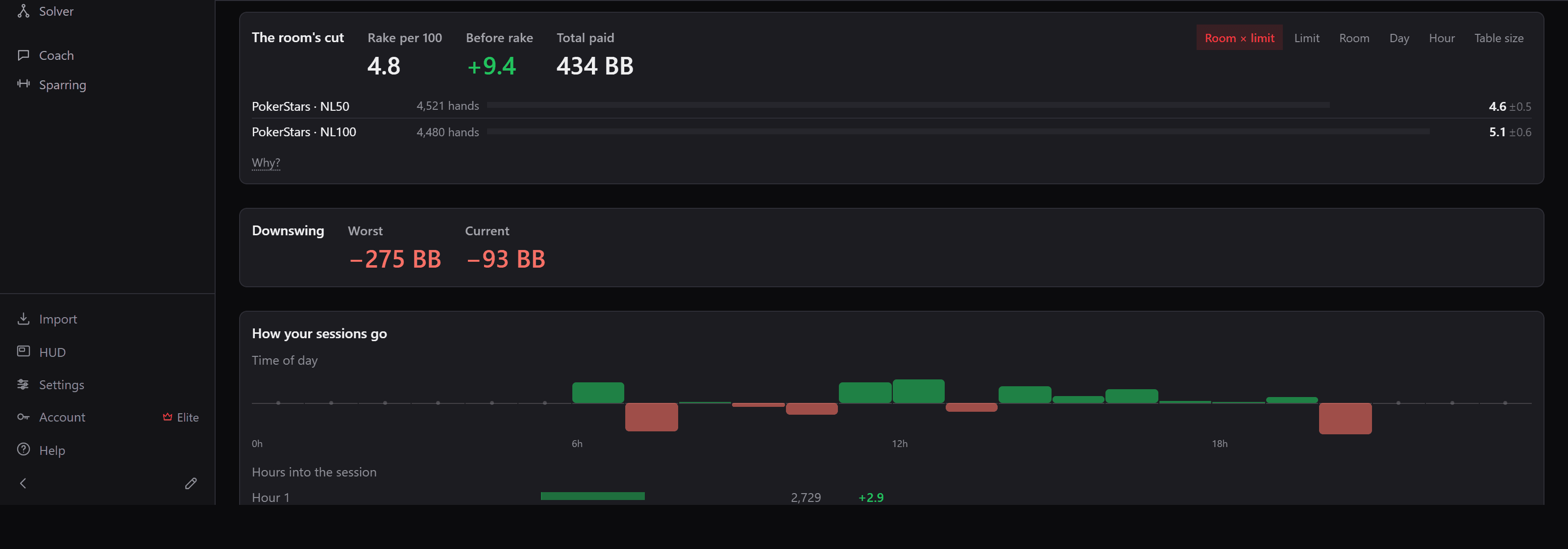
This is one reason the Dashboard screen is useful. It shows your win rate in big blinds per 100 hands, the margin around it, the rake you paid per 100 hands, the number of hands, and a headline that tells you whether the sample settles anything. Sometimes it says, "Not enough hands to call it yet." That is not a failure. It is just a warning not to overread the graph.

The second checkpoint: the bankroll for the next limit
A move up is not only a skill question. It is also a survival question.
Even a solid winner can go broke if the bankroll is too thin for the swings. The higher the stakes, the more painful each downswing becomes in absolute money. And if you play tournaments, the swings are even wider.
That is why a shot should be planned before you sit down. Do not decide the rule in the middle of a downswing.
A conservative example for cash games could look like this:
- You move up only when your bankroll comfortably covers the new stake.
- You set aside a fixed shot budget, for example 5 buy-ins of the next limit.
- If you lose that shot budget, you move back down.
- If the shot works, you do not immediately jump again. You keep collecting data.
This is not about fear. It is about keeping your decision process clean. A shot is meant to test whether the next limit is playable for you, not to prove your worth in one weekend.
What changes at the next limit
A higher stake is rarely just "your current game, but more expensive".
Three things usually change.
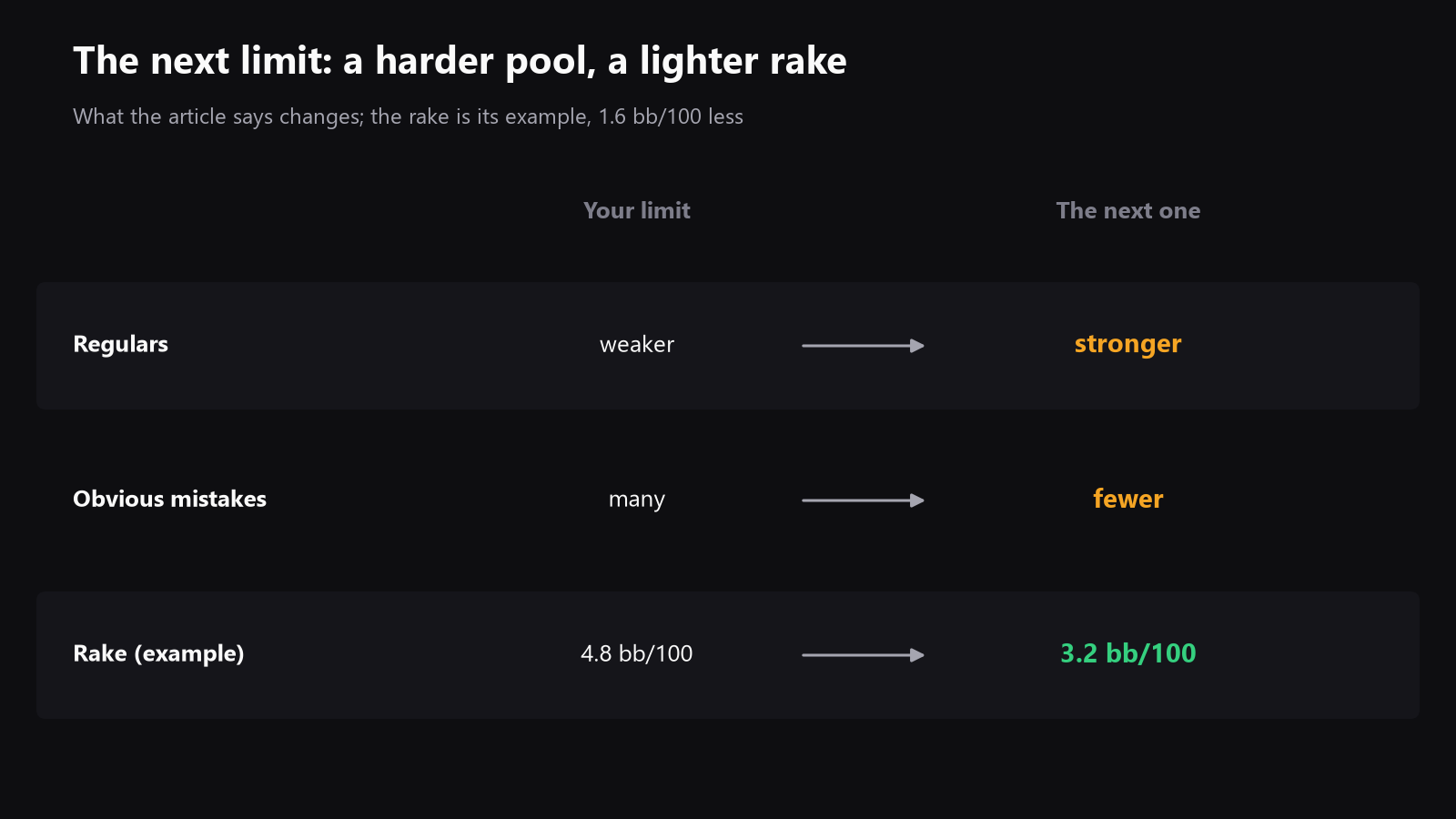
1. The regulars get stronger
At the micros and small stakes, many opponents make very large mistakes. At the next limit, some of those mistakes shrink. Regulars defend better, bluff less randomly, value-bet more carefully, and punish loose habits faster.
That means your current exploit lines may still work, but not as often, and not against the same player types.
If you were printing by calling down too thinly against obvious passivity, that edge can disappear. If you were overfolding and relying on people to underbluff, the pool may adjust less than you expect. The point is not that the next limit is impossible. The point is that the mistakes become smaller and more specific.
2. The rake in big blinds is usually lower
This is the part many players ignore.
The rake may not look dramatically different in nominal money, but in big blinds it can become less painful as stakes rise. That matters. If you are paying a lot of rake at your current limit, the next one can sometimes improve your environment before your skill edge changes at all.
Example: if you pay 4.8 bb/100 in rake at one limit and 3.2 bb/100 at the next, the difference is 1.6 bb/100. That is not a guarantee of profit, but it is a real improvement before you even talk about strategy.
The catch is that the player pool may get harder at the same time. So you do not move up just because the rake looks better. You move up because the whole picture still makes sense.
3. The table quality changes, not always in your favor
At lower stakes, you often get more loose callers, more obvious leaks, and more passive mistakes. Higher up, there may be fewer gift spots and more resistance.
So the question becomes: does your edge survive better opponents and a lower rake, or does the tougher pool eat that gain?
That is why you should not judge a move-up by a single night of cards. You need a sample, a plan, and a way to separate normal swings from actual failure.
A shot-taking rule you can actually follow
Here is a practical structure you can adapt.
Before the shot
- Decide the bankroll threshold in advance.
- Decide how many buy-ins of the new limit count as your shot budget.
- Decide what makes you stop early.
- Decide what data you will review after the shot.
During the shot
- Keep table selection strict.
- Do not widen ranges just because the stakes feel bigger.
- Do not "prove" you belong there by forcing action.
- Play the same process you trust at your current limit.
After the shot
Review three things:
- Your result, in money and in bb/100.
- Your rake, because it can change a lot by stake and room.
- Your behavior, because moving up often exposes leaks you could ignore before.
If your sample is still small, do not overreact to a run of coolers. If the numbers show that your win rate is still unclear, the answer is not "force the move". The answer is "get more hands, or move back down and rebuild".
When moving back down is the correct move
Moving down is not shameful.
It is what disciplined players do when the shot no longer has support. If you ignore the rule and keep playing higher just because you hate the feeling of dropping, you are letting ego make bankroll decisions.
A clean move-down rule protects three things:
- Your bankroll.
- Your confidence.
- Your next shot.
That last one matters. If you come back down early enough, you can keep studying, keep collecting hands, and take the next shot from a stronger position. If you stubbornly stay up while your bankroll bleeds, the next shot may never come.
Think of it this way: moving down is not quitting. It is resetting the test.
What to review after every move
Whether the shot went well or badly, review the same questions.
Did the margin still cover zero?
If yes, the sample still does not prove your edge.
Did the rake eat more than you expected?
Some players discover that they were not moving up because they were beating the game, but because the rake structure at the new stake was less punishing.
Did the pool play differently?
Maybe there were fewer bad calls, fewer obvious bluffs, or more competent regulars. If so, your game plan has to change with the stake.
Did your own leaks show up faster?
Many players do not suddenly become worse at a new limit. They just meet opponents who punish their old habits more reliably.
Cash games versus tournaments
The logic is the same, but the numbers are not.
In cash games, you can usually work with a clearer bankroll framework because each buy-in is a fixed amount and you can reload.
In tournaments, variance is much wider. A move up in buy-in can look harmless on paper and still produce very large drawdowns. That is why tournament players usually need a bigger bankroll cushion and a more conservative shot plan.
The principle stays the same, though:
- Your current results must be meaningful.
- Your bankroll must survive the swing.
- Your move-up rule must be written before the shot.
- Your move-down rule must be automatic.
A small but important detail: results are not enough, rake matters too
If you only look at winnings, you miss part of the truth.
Two limits can produce similar graphs while one is clearly better after rake. That is why it helps to look at your result next to the rake you paid. A move-up is not only about whether you beat the bigger games. It is also about whether the game structure is more favorable once the rake is counted.
The Results screen is designed for that kind of review. It shows your curve and your money by month and over your career, by room, stake, position, and hour of the day, with the rake next to the result and the all-in EV line. If you are making stake decisions seriously, that is the kind of view you want, not just a pretty graph.
A quick checklist before you move up
Use this as a last pass before taking a shot:
- Is your win rate estimate stable enough that zero is no longer inside the margin?
- Do you have enough bankroll for the next stake?
- Do you know your stop-loss for the shot?
- Have you checked whether the rake in bb is better, worse, or unchanged?
- Are the opponents likely stronger, and do you have a plan for that?
- If the shot fails, will you move back down without arguing with yourself?
If you can answer those questions clearly, you are no longer guessing. You are managing a move.
Where a poker tool can help, quietly
If you want to make this decision on your own hands instead of on memory, the free Dashboard and Results screens do the arithmetic for you. The Dashboard gives you the win rate, the margin, the rake, and the "not enough hands" warning when the sample is still too small. Results lets you compare stakes, rooms, and time periods with the rake shown next to the result.
And if you want to know what the pool at your limits actually does, the Reveal module adds that view from your own hand histories. The point is not to make the decision for you. The point is to give you the facts you need before you move up, and the facts you need if you have to move back down.
That is how you take shots without turning them into accidents.
Do it on your own hands.