
Choosing an online poker site is not about finding one universal winner. It is about finding the room that fits your stake, your schedule, your tools, and your own game.
A site can have a softer field and still be a bad fit if the rake is heavy. It can have a fair rake and still be useless if the games do not run when you play. It can allow a HUD and still be a poor choice if your tracker cannot read the hand histories.
So do not ask, "Which room is best?" Ask, "Which room is best for me, at my stakes, in my format, with my tools?"
1) Start with rake, and do not stop at the percentage
Rake is the fee the room takes from the pot. The headline percentage is only half the story. The cap matters just as much, sometimes more.
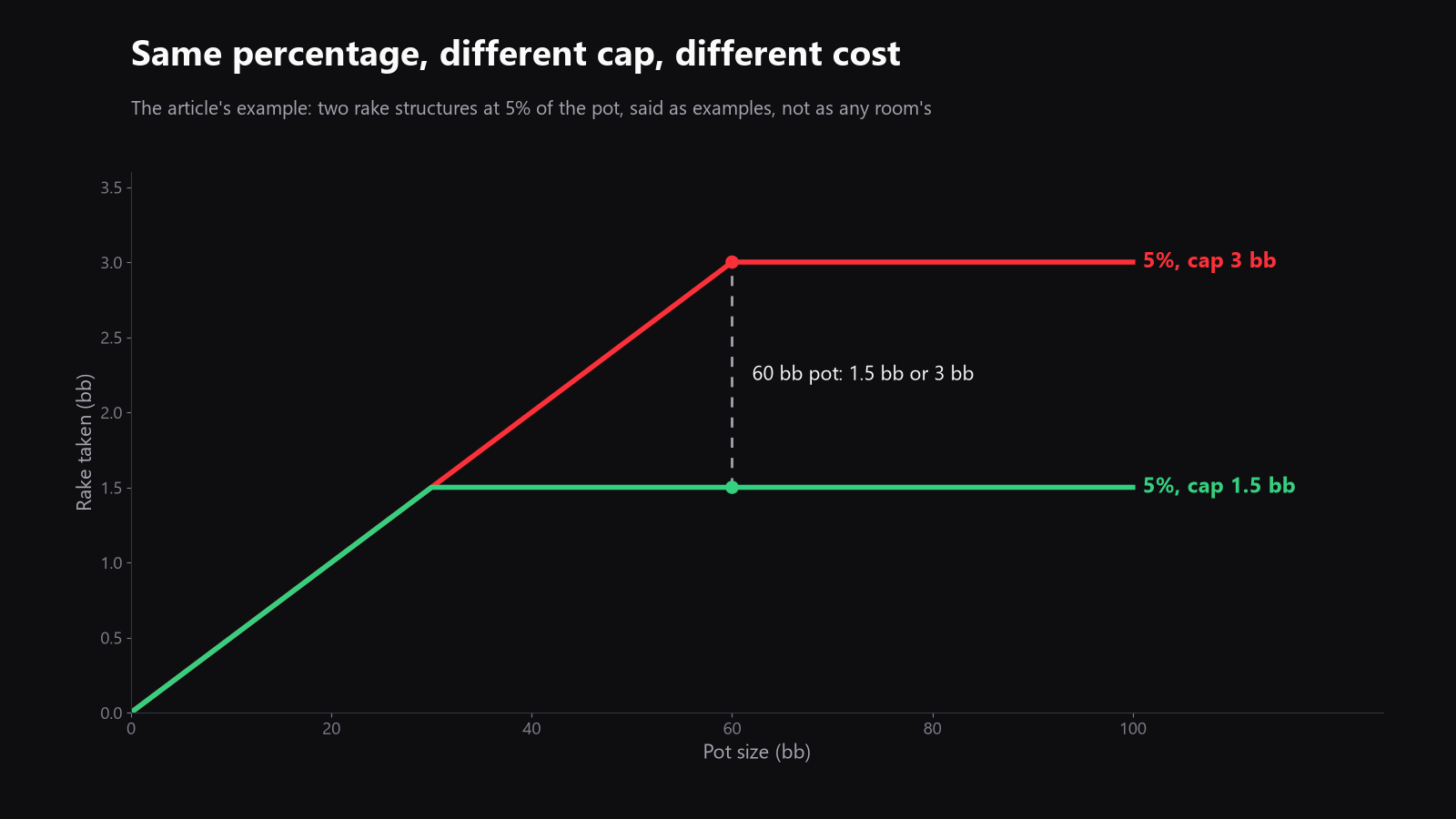
If two rooms both take 5%, but one caps at 1.5 big blinds and the other caps at 3 big blinds, the second room can cost you much more in the pots that hit the cap.
A simple example:
- A 60 bb pot at 5% would pay 3 bb in rake.
- If the cap is 1.5 bb, you pay 1.5 bb instead.
- If the cap is 3 bb, you pay the full 3 bb.
Same percentage, different real cost.
That is why the cap matters most when you play bigger pots, or when your games create lots of medium and large pots. At micro stakes, a few tenths of a big blind per pot add up fast over thousands of hands.
If you want to estimate your own cost, use the free rake page on our site: poker-exploit.com/en/rake. Type your numbers, and it works out how much rake you pay.
A few practical notes:
- Compare the rake at the stake and format you actually play.
- In tournaments (MTT, Sit and Go, Spins), the rake is a fixed fee inside the buy-in, for example $1 on a $10 + $1 tournament, so there is no cap to compare.
- Promotions and rakeback can matter, but read the terms carefully. A headline number is not the same thing as your net cost.
If the room takes too much from your pots, everything else gets harder. A soft field cannot fully rescue a bad rake structure.
2) Check the field at your limits, not in the abstract
A room is soft or tough only in relation to the games you play there.
A soft pool usually means more loose calls, more passive lines, more limping, more mistakes after the flop, and more players who overplay weak hands. A tougher pool usually means more preflop pressure, more disciplined ranges, and fewer obvious leaks.
But do not guess from a feeling or from one night. You want evidence from your own hands.
That is where the Reveal module helps. It reads what the players at your limits actually did from your hand histories, and it shows frequencies by spot and street. It can tell you, for example, how often a pool gives up facing a flop bet, how often it continues too wide, or where the field is unusually passive.
The point is not to memorize one stat. The point is to see whether the room's population creates spots you can exploit.
A few things to look for:
- How often players enter pots preflop
- How often they fold to pressure
- How often they keep going with weak made hands
- How often they check and give up on later streets
- How often you see dominated hands at showdown
Do not assume that one room is soft forever. A pool can be soft at one stake and much tougher at the next. It can also change by time of day, day of week, or format.
3) Traffic matters, because a good game that does not run is not a good game for you
A room only works if the games are there when you want to play.
If you grind after work, the lobby at 8 p.m. matters more than the lobby at 2 a.m. If you play tournaments, the schedule matters as much as the field size. If you play cash games, you need enough tables at your stake, in your preferred format, at your hours.
Use this simple filter:
| Question | Why it matters |
|---|---|
| Are there seats when you play? | A soft room is useless if the games do not run |
| Are the games there at your hours? | Your life schedule is part of the decision |
| Is the format active at your stake? | Cash, MTT, Sit and Go, or Spins can differ a lot |
| Are the games too reg heavy? | Volume alone does not make a room good for you |
Traffic and softness do not always point in the same direction. A busier room may have more regulars. A softer room may have fewer tables. You need the balance that fits your volume and your edge.
4) Check the tool rules before you commit
Before you choose a room, check what it allows in tools.
Every room has its own rules about real time assistance and tools. The real question is whether the room allows HUDs and trackers, and whether your tracker can read the hand histories.
Examples published by the rooms:
- PokerStars publishes a list of permitted tools, and trackers and HUDs are on it, with some features restricted
- partypoker has banned HUDs since 2019
- 888poker allows HUDs at cash game and tournament tables, but not at SNAP
- Americas Cardroom permits HUDs that show numbers from hands you played yourself
- the iPoker network allows trackers, and each skin can add its own rules
Always check the current rules yourself. Do not rely on old forum posts.
The other key question is hand history support. If your tracker cannot read the room's hand histories, you lose one of the cleanest ways to compare rooms properly.
Poker Exploit reads hand histories from PokerStars, Winamax, partypoker, 888poker, iPoker skins listed on the site for cash games only, not yet verified on real hands, and the Winning Poker Network. It does not read GGPoker or its network.
That matters because you cannot compare room by room if the room is invisible to your tracker.
The HUD in Poker Exploit only shows statistics at the table. It never gives an action. The Coach, Sparring, and Solver modules refuse the session in progress, and the LAB never takes anything from a hand being played. That separation matters, both for study and for trust.

5) Judge the room on your own results, room by room
This is the part many players skip.
They read a ranking, pick a room, and hope the ranking was enough.
It is not.
A ranking mixes too many things at once. It may compare different stakes, different formats, different traffic levels, and different tool rules. That can be interesting, but it is not the same as asking what happened to you.
The right question is simpler:
What did this room do to my own results?
Use the Results screen to look at each room separately. Filter by room, stake, position, and hour of day. Then look at:
- the curve
- the money over your career
- the rake next to the result
- the all in EV line for cash games
- ROI and ITM for tournaments
Then use the Dashboard to check whether the sample is actually enough to say something. It shows your win rate in big blinds per 100 hands, the margin around it, the rake paid per 100 hands, and whether the sample settles anything. If it says, "Not enough hands to call it yet.", believe it.

A room that looks worse after 3,000 hands may simply be variance. A room that looks better after a small sample may just be running hot. You need enough hands before you start making big decisions.
A simple rule helps here:
- compare the same format
- compare the same stake
- compare similar table counts
- compare similar hours
- compare after enough hands
If you do not hold those things steady, you are not comparing rooms. You are comparing noise with noise.
6) A practical way to choose
If you want a clean shortlist, go in this order:
- Check the rake and the cap at your format and stake
- Check whether the room's games run at your hours
- Check whether the field is soft enough at your limits
- Check the HUD and tracker rules
- Check whether your tracker can read the hand histories
- Compare your own results room by room after enough hands
That is the real decision process.
A room with slightly higher rake can still be the better fit if the field is much softer. A room with great traffic can still be a bad fit if the rake is heavy or the tool rules clash with your study setup. A room with a nice headline can still be the wrong room for your life if the games do not run when you play.
The point is not to find a perfect site. The point is to find a room that matches your game, and to verify it with your own numbers.
If you want a first pass before you deposit more, use the free rake page to estimate the cost, then use your own results, filtered by room, to see what is really happening. That is the safest way to choose an online poker site, and the only way that stays honest to your own game.
Do it on your own hands.