
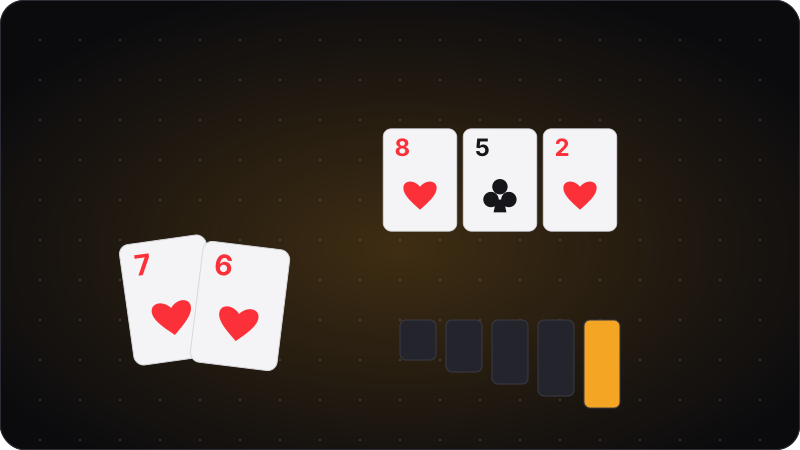
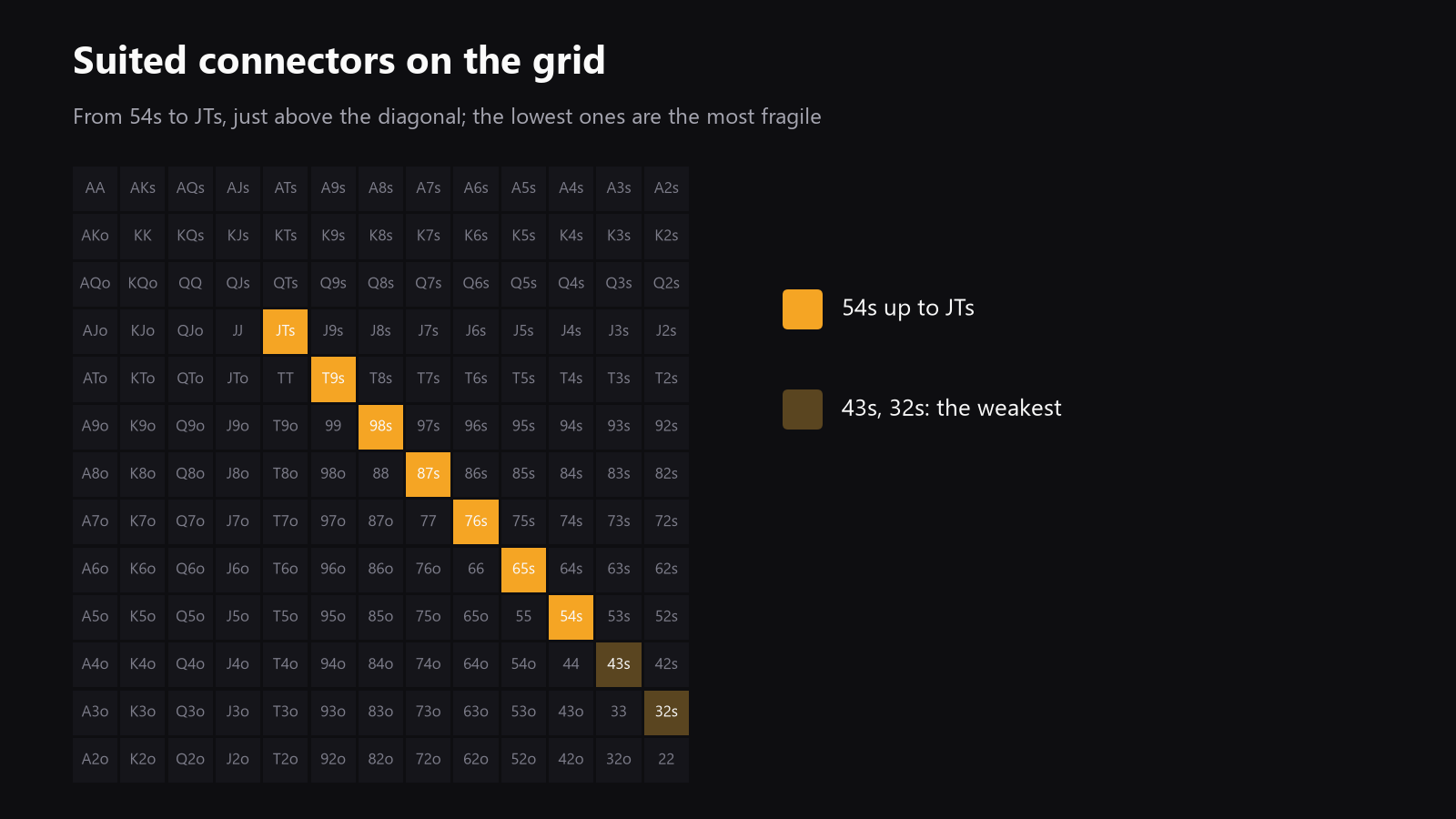
Suited connectors are hands like 54s, 65s, 76s, 87s, 98s, T9s, and JTs. Players like them because they can make straights and flushes, but that is only part of the story.
What matters is not that they “hit big” all the time. They do not. What matters is that when they do hit, they often hit in a way that is hard to read and can win a much bigger pot than a small pair ever could.
That is why suited connectors are powerful only in the right conditions. They are not automatic calls. They are implied-odds hands.
What a suited connector actually makes
A suited connector does three main things for you:
- it makes one pair fairly often,
- it gives you straight potential on many boards,
- and it adds flush potential because both hole cards share a suit.
A useful starting point is this:
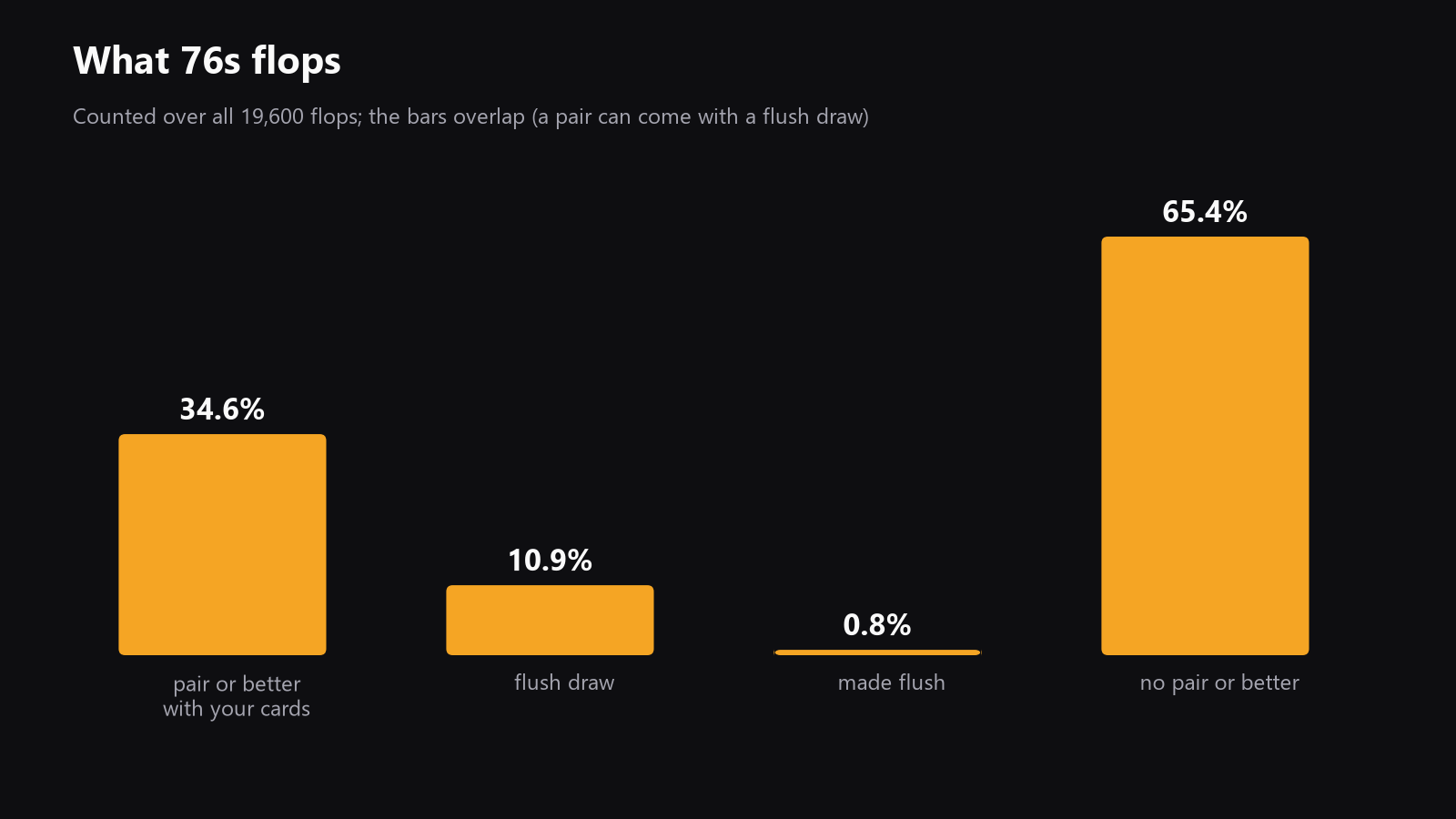
- you flop one pair or better about 34.6% of the time,
- you flop a flush draw on the flop about 11% of the time,
- you flop a made flush on the flop about 0.8% of the time,
- you miss entirely a little less often than two thirds of the time.
That first number matters because many players overestimate how often two unpaired cards connect. But “one pair or better” is not the same as “strong enough to continue happily”. Most one-pair flops are still only medium-strength hands.
The straight part is board dependent, so there is no single neat percentage that covers every suited connector on every flop. Still, the idea is simple:
- on some flops, you make an open-ended straight draw,
- on some flops, you make a gutshot,
- on some flops, you make a made straight,
- on some flops, you have both straight and flush potential at the same time.
That combination is what makes suited connectors dangerous in the right pot.
Why suited connectors are not just “hands that make straights”
A lot of players focus on the sexy part. They think, “I want to flop a straight or a flush, so I should play suited connectors.” That is too simplistic.
You do not make a straight or flush often enough to profit by luck alone. You need the rest of the hand to work too:
- the pot should be big enough,
- the stacks should be deep enough,
- the opponent should be willing to put money in,
- and you should usually have position.
Without those things, your pretty-looking draw often turns into a guessing game.
Why position matters so much
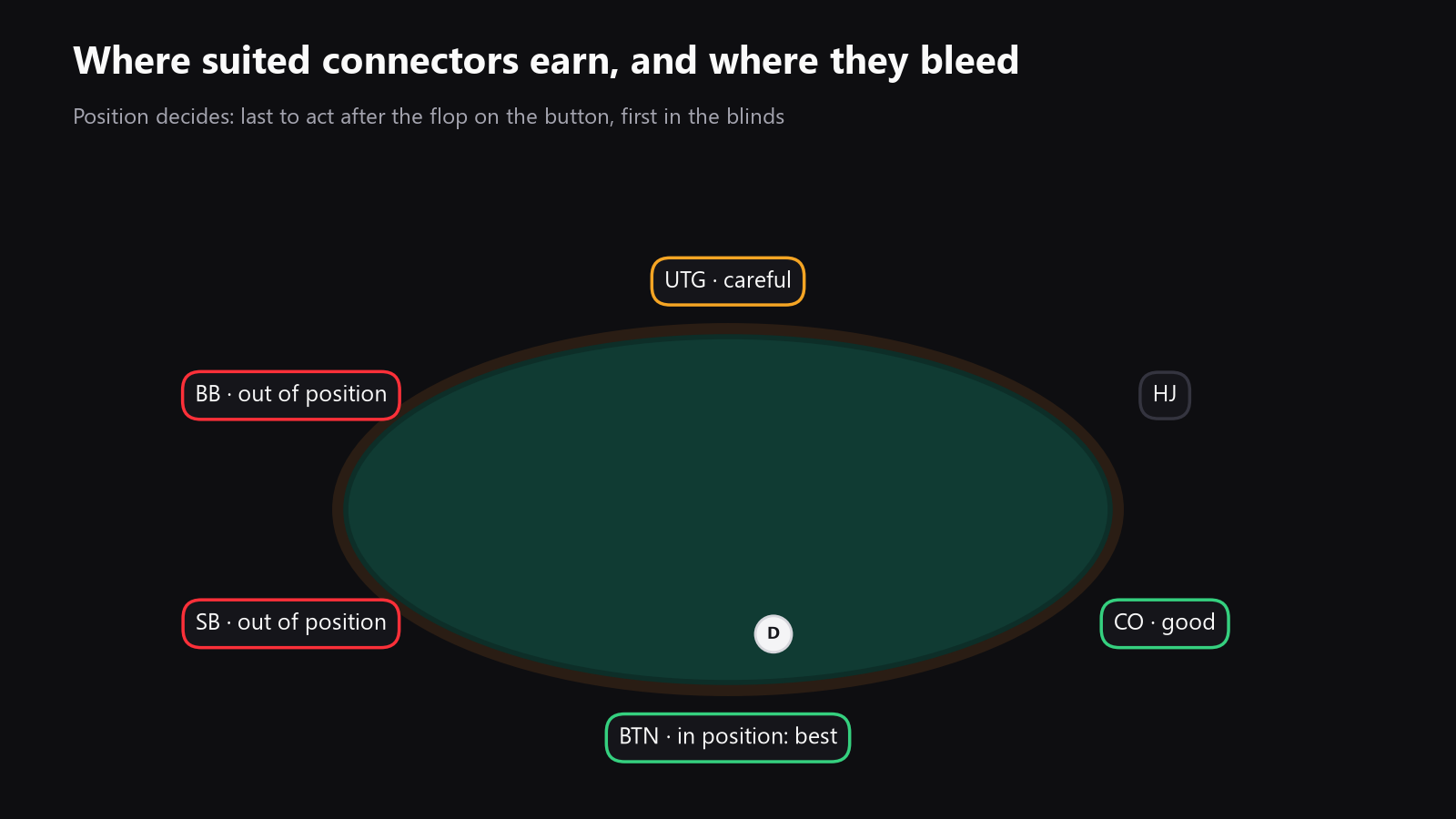
Suited connectors play much better in position than out of position.
Why?
Because when you are in position, you act after your opponent. That gives you information first. You can:
- check back when you need pot control,
- bet when the board and your range support it,
- take the free card when that is best,
- and realize more of your equity.
Out of position, the same hand becomes much harder to use. You check, face a bet, and now you must decide whether your weak pair, your backdoor draw, or your fragile made hand is worth continuing.
This is where many players lose money with suited connectors. They call because the hand looks pretty, then find themselves guessing on later streets with a medium-strength hand that cannot comfortably win a big pot and cannot comfortably fold either.
Why deep stacks matter
Suited connectors like deep stacks because their biggest wins come when the pot can grow after the flop.
That is called implied odds. You are not just buying the current pot. You are buying the chance to win more money later when you make a disguised hand.
That is why suited connectors are much stronger at 100 big blinds than at 25 big blinds.
At 100 big blinds:
- you can call a raise and still have room to win a meaningful pot later,
- your straight or flush can win a stack,
- and your opponent has enough chips left to pay you when they make one pair and cannot let it go.
At 25 big blinds:
- there is less money left to win,
- your draw has less room to pay off,
- and a call preflop often becomes too thin.
The shallower the stack, the less your suited connector gets to use its main advantage.
Suited connectors and rake
Rake hurts these hands more than many players realize.
That is because suited connectors often win smaller pots when they do not make a big hand, and small wins are the first thing rake eats.
So in a high-rake environment, you should be stricter with weaker suited connectors, especially:
- out of position,
- at shallow stacks,
- and in pots where you expect little postflop maneuvering.
If you have ever wondered why a hand that looks playable still loses money in practice, rake is often part of the answer.
Equity versus big cards and big pairs
Suited connectors are not monsters preflop, but they are not dead either.
Against big unpaired cards, they usually have real equity because they can win in many ways:
- pairs can hold up,
- straight draws can come in,
- flushes can come in,
- and both players often miss the board.
Against big pairs, they are usually underdogs, but not hopeless underdogs. They still have ways to win, which is why they can be worth playing deep and in position.
A simple way to think about it:
| Matchup | What to expect |
|---|---|
| Suited connector vs big unpaired cards like AK or AQ | You often have decent equity, but you need to realize it well |
| Suited connector vs big pairs like AA or KK | You are usually an underdog, but you still have live equity |
| Higher suited connectors like T9s or JTs | Better versus big cards because top pairs and high-card boards are friendlier |
| Lower suited connectors like 54s or 65s | More dependent on deep stacks and postflop skill |
Do not read this as a reason to flat-call everywhere. Equity alone is not enough. You also need to realize it.
That is where position, stack depth, and opponent type decide the hand.
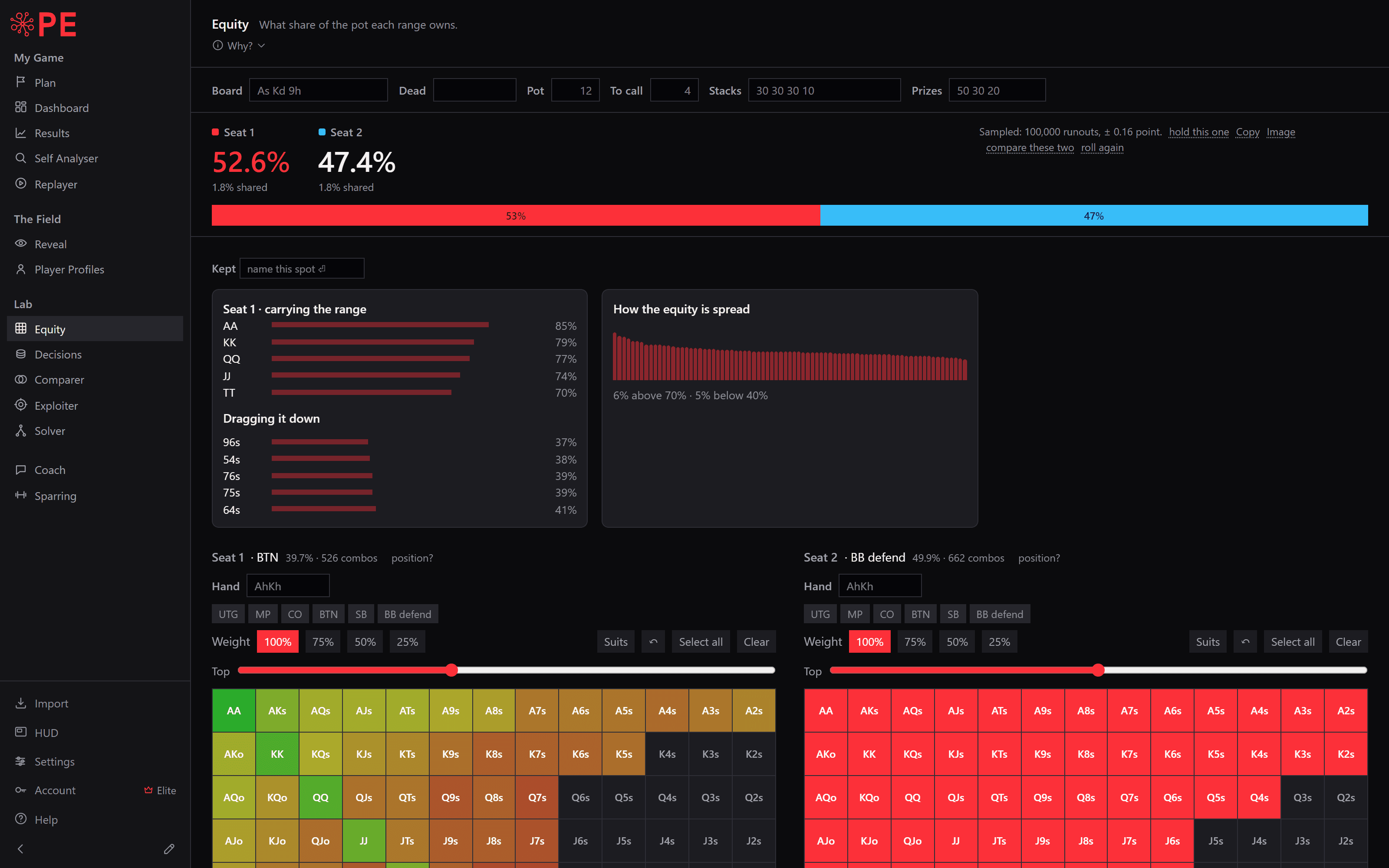
If you want to check a specific matchup, the Equity module computes the hand or range’s share of the pot over 100,000 runouts, which is a practical way to see how close a spot really is.
Which suited connectors are best
Not all suited connectors are equal.
A useful order is this:
- T9s and JTs
- 98s and 87s
- 76s and 65s
- 54s and lower, which are the most fragile
The higher ones are better because:
- they make stronger top pairs,
- they make higher straights,
- and they are less likely to run into “I made a hand, but it is still second best” situations.
The lower ones need more help from stack depth and table softness.
A practical rule:
- the higher the connector, the more often you can play it,
- the lower the connector, the more selective you should be.
When suited connectors are good
Suited connectors are strongest when these things are true:
- you have position,
- the stacks are deep,
- the opener is wide enough,
- the field pays off with one pair,
- and you can win a big pot when you hit.
They are especially good in soft games where players overcall too much and do not fold top pair easily.
That is the ideal environment for implied odds. You are trying to get paid when your disguised straight or flush shows up.
When you should fold them
You should fold suited connectors more often than many players do when:
- you are out of position,
- the stacks are shallow,
- the rake is heavy,
- the table is tight and aggressive,
- or the opponent does not pay off.
You should also be careful in tough lineups. If the pot is likely to become a race for fold equity rather than a deep postflop battle, the hand loses a lot of its value.
Here is a simple shortcut:
- if you expect to see a flop and play a real hand, suited connectors can shine,
- if you expect a lot of pressure before and after the flop, they shrink fast.
A simple way to think about them by stack depth
| Stack depth | Suited connector value |
|---|---|
| 20 to 30bb | Usually too shallow for most flat-calls |
| 40 to 60bb | Playable in the right position and against the right opponents |
| 80 to 150bb | Where the hand starts to earn its keep |
| 150bb+ | Very attractive when the game is soft and implied odds are real |
This is not a chart. It is a way to think.
Your actual decision should still depend on position, rake, opener size, and who is behind you.
The biggest mistake players make
The biggest mistake is treating suited connectors like a license to enter pots.
They are not.
They are a tool for specific conditions.
If you play them because they “look connected”, you will call too much, miss too often, and pay too many small fees to the rake and to better ranges.
If you play them because you understand the setup, they become one of the most useful hands in poker.
A few practical examples
- On the button, deep, against a loose open: suited connectors can be excellent.
- In the blinds, shallow, against a tight opener: fold more of them.
- In a passive game where people call too much: they gain value.
- In a tough, aggressive game: you need stronger reasons to continue.
And when you do continue, remember this:
- one pair is usually not enough to go broke,
- a strong draw can be enough to continue,
- and a disguised made hand is where the money comes from.

The short version
Suited connectors are good because they can make hidden strong hands and strong draws, not because they hit every flop.
They want:
- position,
- deep stacks,
- opponents who pay off,
- and enough postflop room to realize their equity.
They lose value when:
- stacks get short,
- rake gets heavy,
- you are out of position,
- or the game turns into a high-pressure battle.
If you remember only one thing, remember this:
suited connectors are not automatic continues. They are implied-odds hands.
Play them for the right reasons, and they become profitable. Play them because they look pretty, and they become expensive.
Do it on your own hands.