
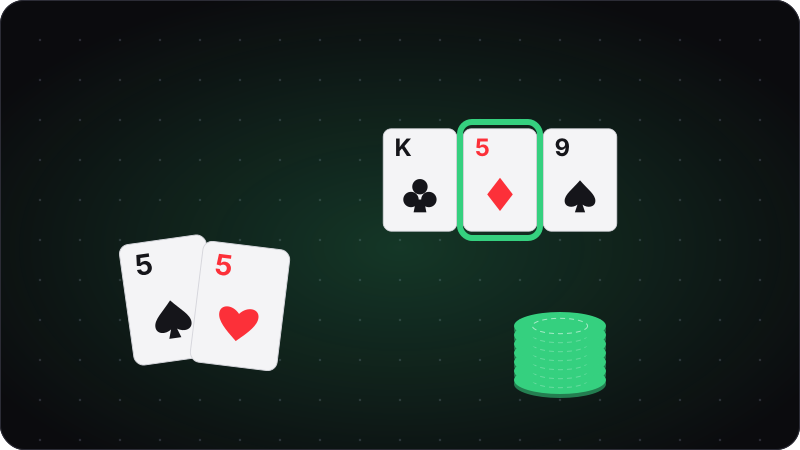
Small pocket pairs are some of the most misunderstood hands in poker.
A lot of players like them because they can turn into big hands in a hidden way. A lot of players overvalue them because they “feel” strong preflop. The truth sits in the middle: pocket pairs are useful, but only when the price is right and the stacks behind them are deep enough.
If you want to play them well, you need to know one thing first: you are usually not calling because your pair is already good. You are calling because you hope to flop a set and win a much bigger pot later.
What set mining means
Set mining means calling preflop with a small pocket pair mainly to hit a set on the flop.
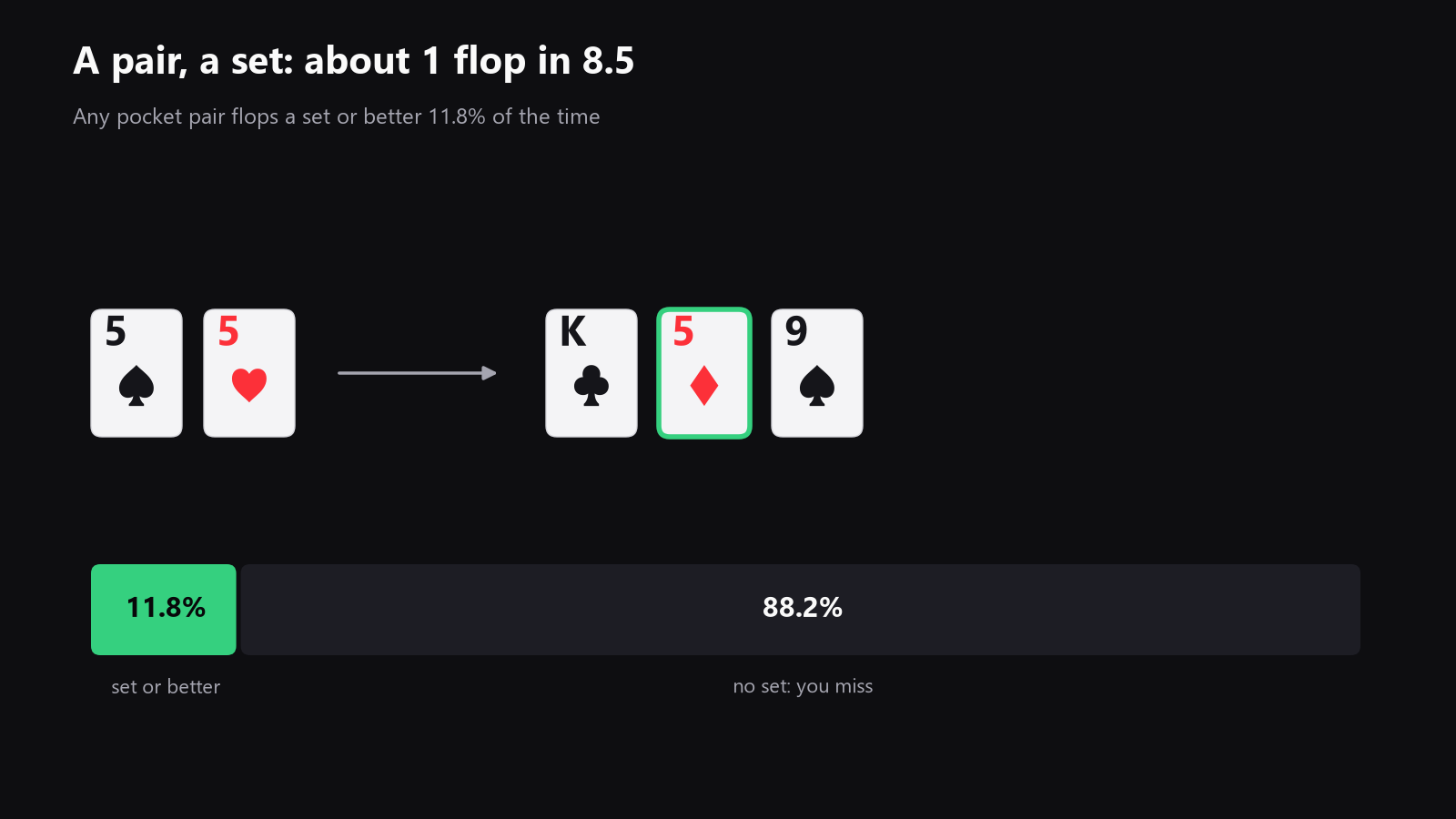
With a pocket pair, you flop a set about 11.8% of the time, which is about 1 time in 8.5. That also means you miss about 88.2% of the time.
That is the first key lesson.
A pocket pair is not a lottery ticket that hits often. It is a hand that hits rarely, but when it hits, it can win a stack. Your whole decision depends on whether the times you win are big enough to pay for the many times you miss.
That is why set mining is really an implied odds question.
Why the flop hit rate is not enough by itself
A lot of players stop at the 11.8% number and think, “If I hit a set, I am ahead, so the call is good.”
That is not enough.
You do not profit from the fact that your hand is sometimes strong. You profit from how much you win on the 11.8% of flops where you connect, compared with how much you lose on the 88.2% where you do not.
So the question is not, “Can I flop a set?”
The question is, “When I do flop a set, can I win enough chips to justify the call?”
That is what implied odds are.
Implied odds are the extra chips you expect to win later, beyond the pot you are calling into now.
If you only win the pot you are already facing, set mining is not enough. If you can make your opponent pay you after the flop, especially with an overpair, top pair, or a strong draw, then small pocket pairs can become profitable.
The stack depth rule of thumb
The usual rule of thumb is that you want around 15 to 20 times the amount you must call in effective stacks behind.
That is the number that matters: the call, not the blind level, not the total stack, and not the size of the pot alone.
For example:
- If you must call 2 big blinds, you usually want at least 30 to 40 big blinds behind.
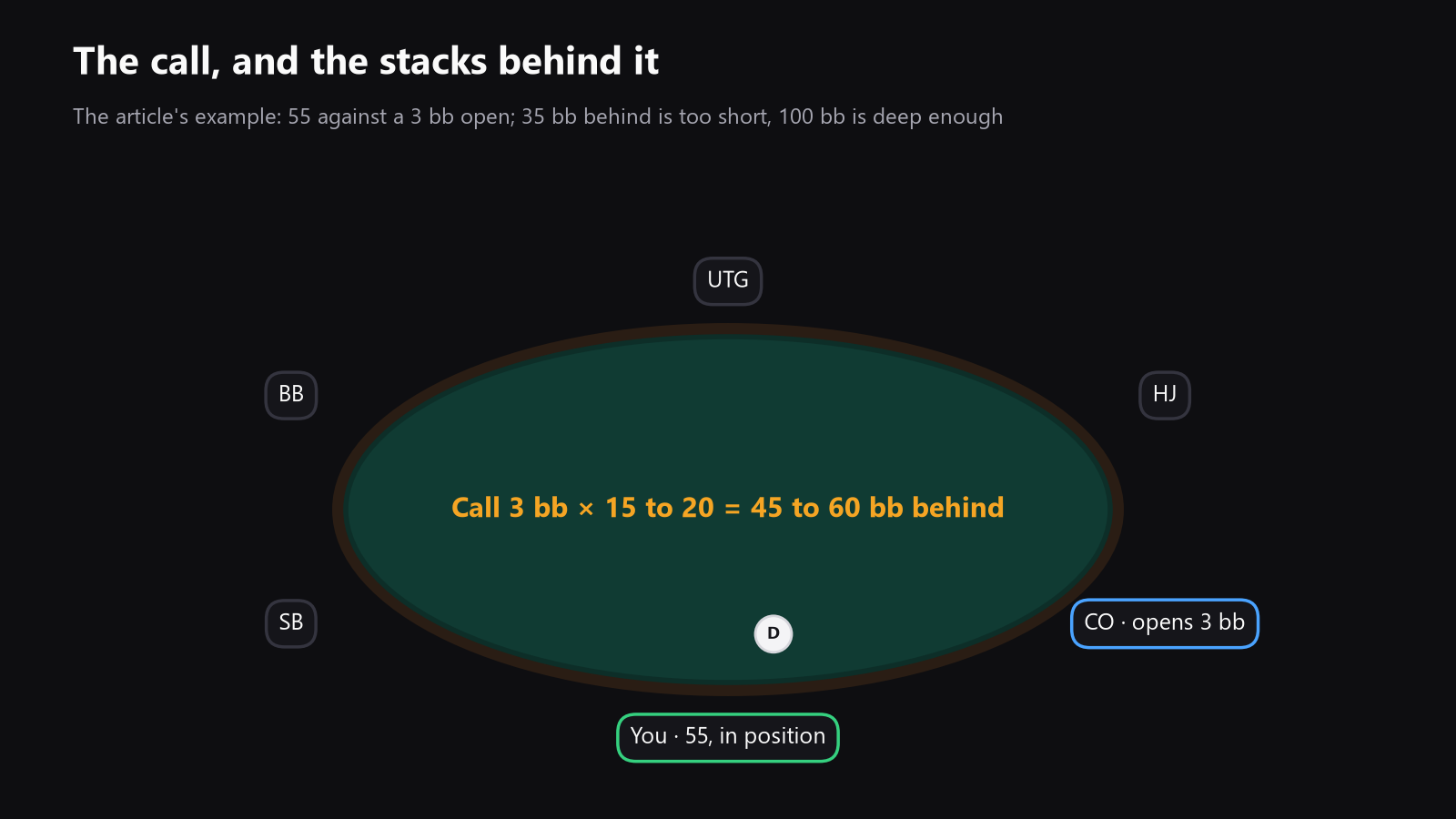
- If you must call 3 big blinds, you usually want about 45 to 60 big blinds behind.
- If you must call 4 big blinds, you usually want about 60 to 80 big blinds behind.
That is still only a rule of thumb. It is not a promise.
The reason it is a range and not a fixed number is simple: you do not always get paid, and rake matters. At microstakes, rake can make thin set mines worse than they look. In tougher games, you often need to lean closer to the top end of the range.
What makes a good set-mining spot
Small pocket pairs are best when several things line up.
1. The effective stacks are deep enough
This is the main condition.
If the stacks are too short, you do not have enough room to win back the times you miss. A small pair becomes much less attractive when the effective stack does not give you enough room to stack your opponent after you hit.
2. The open size is small
A smaller open gives you a better price.
Set mining against a 2x or 2.2x open is very different from set mining against a 4x or 5x open. The bigger the open, the more expensive the call, and the more stack depth you need behind it.
3. You are in position
This matters a lot.
In position, you realize your equity better, you control the pot size more easily, and you are more likely to get paid when you hit. Out of position, you have less control and more awkward decisions on later streets.
4. The opener pays off too much
Set mining wants villains who do not like folding.
If your opponent will call down with one pair, overpairs, or top pair too often, your implied odds go up. If they open wide but give up too easily after the flop, your set mines become weaker.
5. The game is soft enough
In soft games, people make big postflop mistakes.
That is good for small pairs. When players stack off too lightly, you can profit from a hand that otherwise looks like a simple preflop call.
6. The rake is not crushing you
Rake is a silent killer for marginal preflop calls.
At low stakes, a spot that looks okay on paper can become a losing call once rake is added. If the room takes a big cut, your implied odds need to be better.
When you should fold small pocket pairs preflop
This is the part many players get wrong.
A small pair is not an automatic continue. Sometimes folding is the best play.
You should think very seriously about folding when:
- The effective stacks are short.
- The open size is large.
- The rake is high.
- There is a big squeeze risk behind you.
- You are out of position against a competent player.
- The opponent is tight and unlikely to pay you off.
- The tournament pressure is high and ICM matters.
- You are facing a 3-bet and the stacks are no longer deep enough for a set mine.
A simple way to say it is this: if you cannot realistically win enough when you hit, you are just paying to miss most of the time.
That is not a good deal.
A practical example
Imagine you hold 55 and face a 3 big blind open.
If the effective stacks are only 35 big blinds, that is usually too short for a pure set mine. You may hit a set once in 8.5 flops, but the money behind is not large enough to make the misses worth it, especially after rake.
If the effective stacks are 100 big blinds and you are in position against a player who likes to pay off, that is a very different story. Now the stacks behind are deep enough that your set can win a meaningful pot.
The hand did not change. The environment did.
That is what you should train yourself to see.
Small pocket pairs are not all equal
22 is not the same as 66.
The lower the pair, the more you rely on the flop. The higher the pair, the more often you may still have some showdown value or a hand that can continue in more spots.
As a result:
- 22 to 44 are often the purest set-mining hands.
- 55 to 66 can still be set mines, but they may also have a little more value in some spots.
- Once you get higher, the hand starts to behave less like a lottery ticket and more like a real showdown hand.
That does not mean every small pair should be played. It means you should stop thinking of all pocket pairs as one group.
A quick decision test
Before you call with a small pocket pair, ask yourself four questions:
- How much do I have to call?
- How many big blinds are behind after I call?
- Will I get paid enough when I hit?
- Is rake, position, or tournament pressure making this worse?
If the answer to the third question is “probably not,” fold.
That one question saves a lot of money.

What happens when you do hit
When you flop a set, do not assume the hand plays itself.
A set is a very strong hand, but it is not always the nuts. Board texture matters.
On dry boards, sets often want to build pots quickly. On wet boards, you need to think harder about straights, flushes, and full houses. Against some ranges, slow-playing works. Against others, you should start extracting value immediately.
The main point is this: the value of set mining comes from getting paid well when you hit. If you miss the value, you also miss the reason for the preflop call.
How to think about it in your own game
If you want to know whether small pocket pairs are actually making money for you, look at your own hands, not at theory alone.
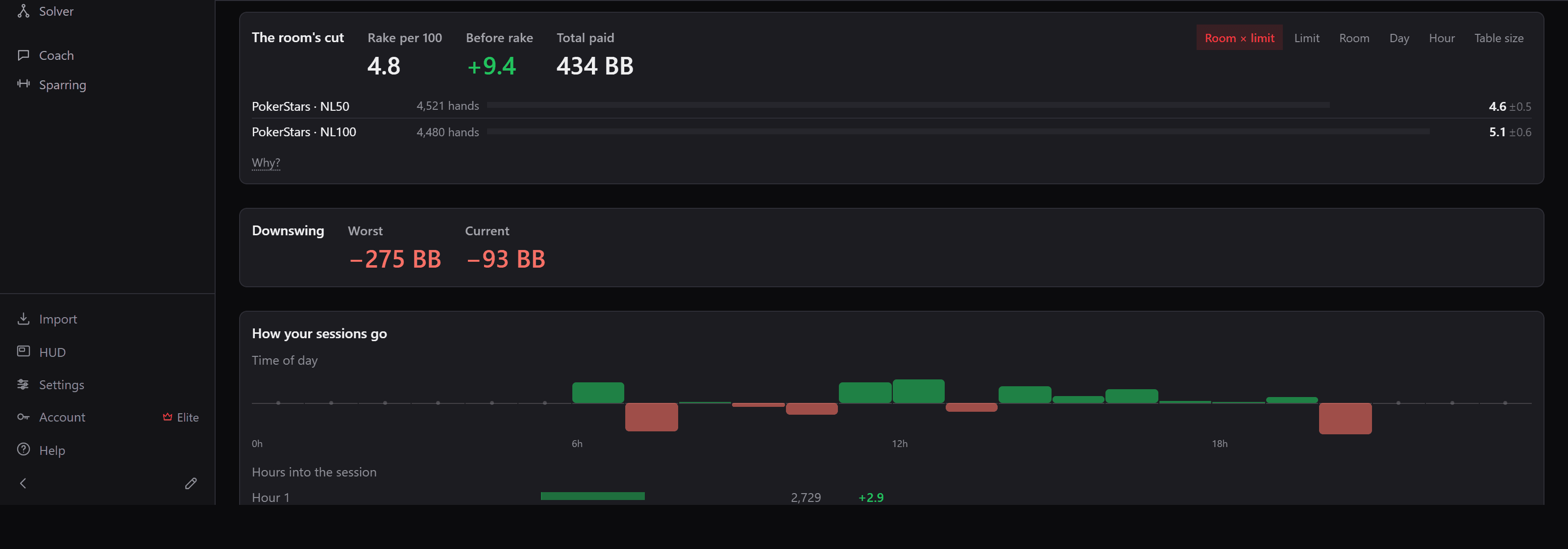
The Results screen can show your money by month and over your career, by room, stake, position, and hour, with the rake next to the result and the all-in EV line. That makes it easy to see the shape of your results, not just your memory of them.
The Self Analyser can help you compare how spots with small pocket pairs sit against the rest of your game and against the field.
If the short-stack question is the one you keep running into, the Decisions module can help you study push, fold, and call spots with a short stack. And if you want to examine a precise postflop spot, the Solver module shows the strategy for that spot instead of making you guess.
The short version
Small pocket pairs are useful because they can make hidden monsters.
But set mining only works when:
- the stacks are deep enough,
- the call is cheap enough,
- the opponent can pay you off,
- and the rake does not eat the edge.
If those pieces are missing, fold preflop and move on.
That is not tight. That is disciplined.
Do it on your own hands.