

If you have ever heard someone say, “This is a low SPR spot, so we can get it in,” they were talking about one of the most useful ideas in poker: the stack-to-pot ratio, or SPR.
SPR helps you answer a simple question: how big is the stack compared with the pot once the flop arrives? That number changes everything. It changes which hands can comfortably continue, which hands should slow down, and which hands are really just bluff catchers.
If you understand SPR well, you stop thinking only in terms of your current hand strength. You start thinking in terms of how much money is left, how many bets fit in, and which hands can actually support a stack-off by the river.
What SPR means
The stack-to-pot ratio is:
SPR = effective stack on the flop / pot size on the flop
The important words are effective stack and on the flop.
- Effective stack means the smallest stack among the players who can still win the pot.
- You measure SPR after the preflop action is complete, once the flop is dealt.
- You use the pot that is already in the middle at that point.
A simple example
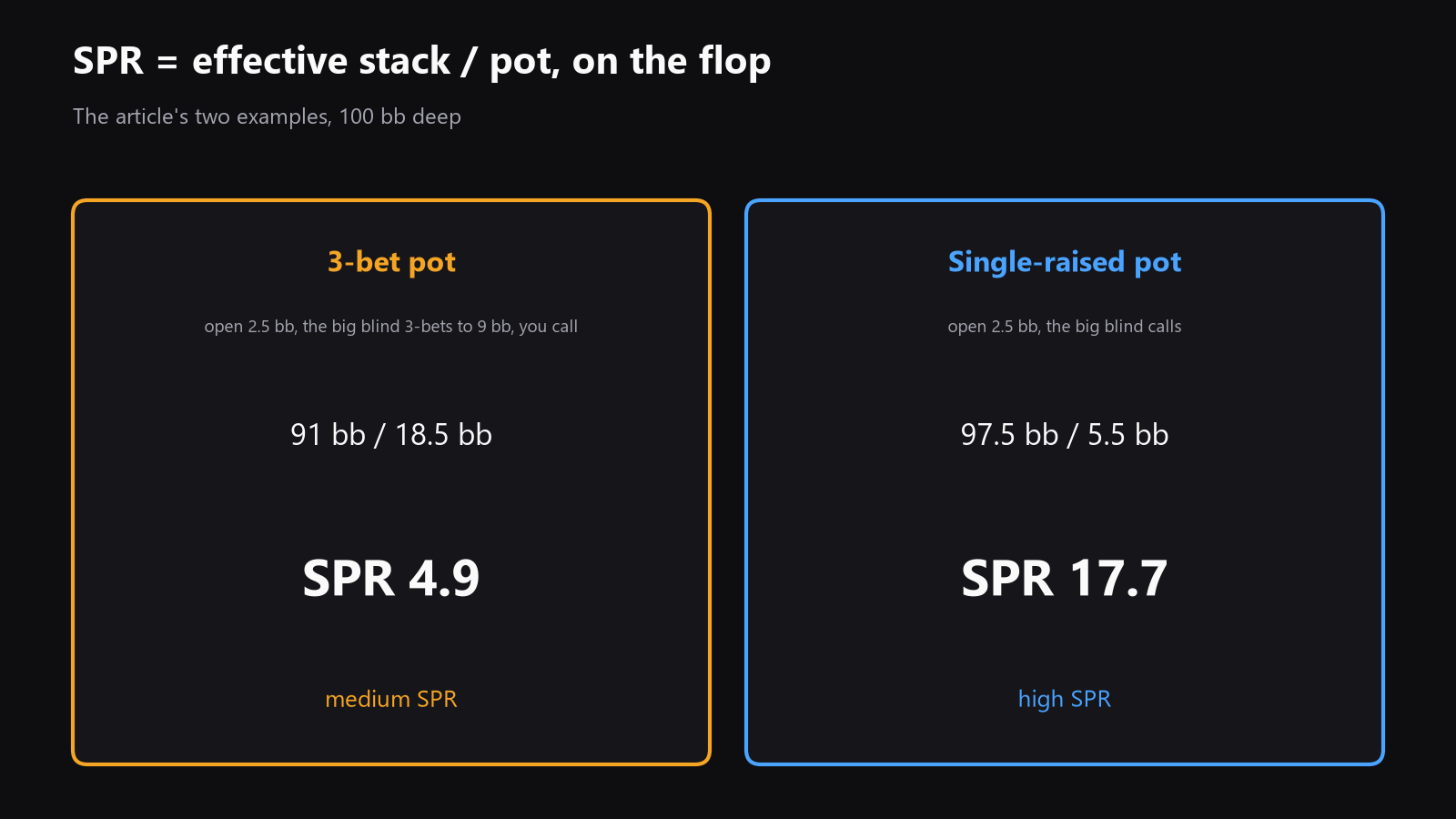
Imagine 100 big blind stacks.
You open to 2.5 bb, the blind 3-bets to 9 bb, and you call.
On the flop:
- The pot is about 18.5 bb
- The effective stack is about 91 bb
- The SPR is about 4.9
That is a medium SPR pot. There is still plenty of money behind, but much more money is already in the middle than in a single-raised pot.
Now compare that with a single-raised pot.
You open to 2.5 bb, the big blind calls.
On the flop:
- The pot is about 5.5 bb
- The effective stack is about 97.5 bb
- The SPR is about 17.7
That is a high SPR pot. There is a lot of money behind relative to the pot.
Why SPR matters so much
SPR tells you how easy it is to commit with a hand.
When the SPR is low, there is not much left behind. That means one pair hands improve in relative value, because it takes fewer bets to get all the money in.
When the SPR is high, there is a lot of stack left. That means one pair hands lose value, because there is room for more aggression and more turn and river decisions.
A useful way to think about it:
- Low SPR: you are playing for stacks quickly
- Medium SPR: you still have room, but stack-off hands matter
- High SPR: one pair is often not enough by itself
SPR is not magic, and it is not a rule that says, “You must stack off here.” It is a framework. It tells you how much strength your hand needs to keep going profitably.
Low SPR, medium SPR, high SPR
There is no universal cutoff that every player uses, but these bands are practical:
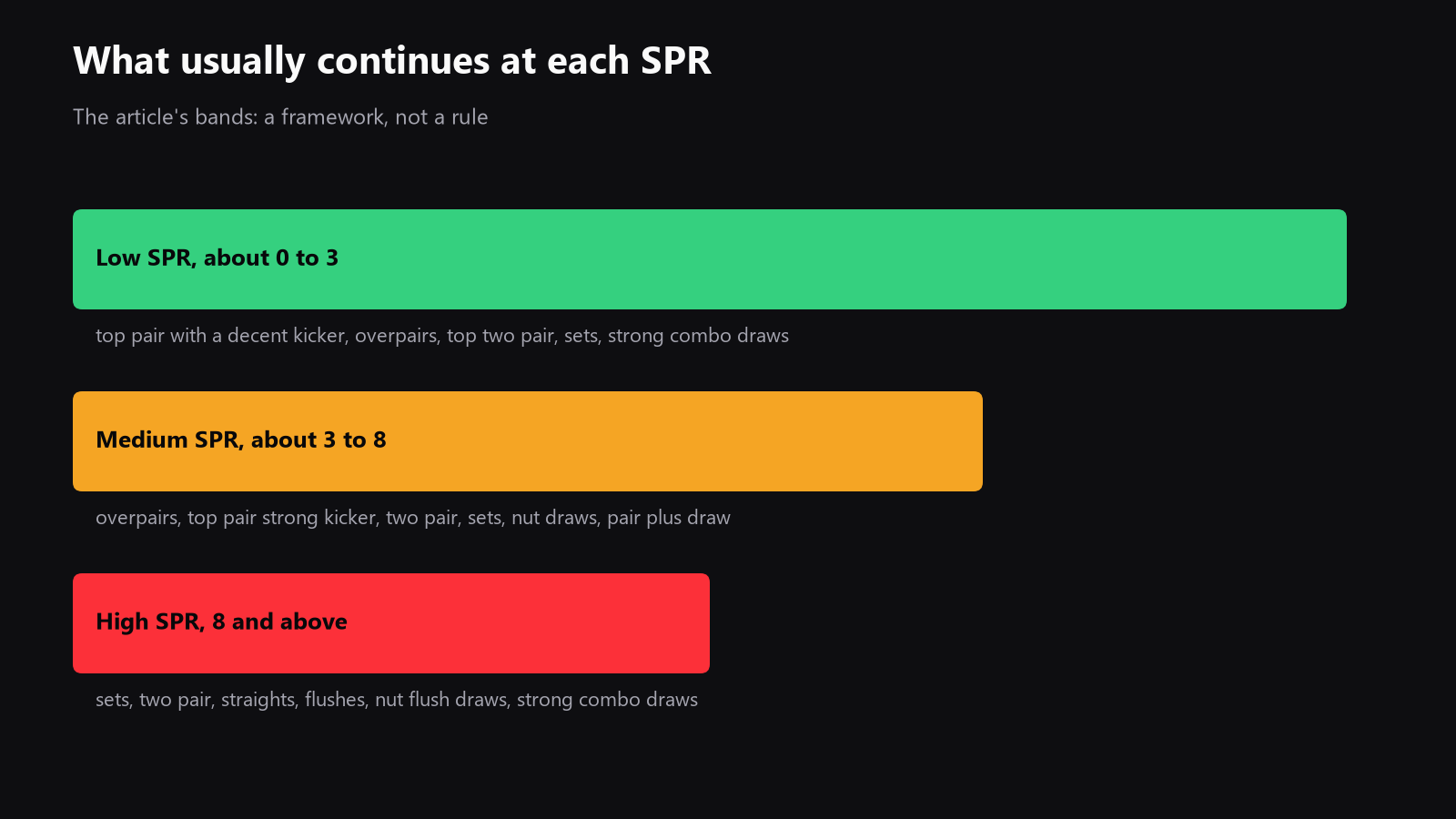
- Low SPR: roughly 0 to 3
- Medium SPR: roughly 3 to 8
- High SPR: roughly 8 and above
Different games, stack depths, and board textures shift the exact meaning. But these bands are a very good starting point.
Low SPR: 0 to 3
This is the land of fast commitment.
With so little behind, hands like these usually gain a lot of value:
- top pair with a decent kicker
- overpairs
- top two pair
- sets
- strong combo draws
At very low SPR, even a hand like top pair top kicker can often continue against pressure, especially heads-up and on not too coordinated boards.
But do not overgeneralize. A low SPR does not mean every top pair is a stack-off hand on every board. If the board is very connected, a one-pair hand can still be fragile.
Rule of thumb: the lower the SPR, the more willing you can be to put money in with a strong one-pair hand.
Medium SPR: 3 to 8
This is where many poker decisions live.
You still have enough stack behind that the turn matters, but not so much that every pot becomes a marathon. In this zone, the strength of your hand depends heavily on:
- board texture
- position
- opponent type
- whether your hand blocks strong continues
- whether your hand has redraws or good equity when called
Typical hands that like medium SPR pots:
- overpairs
- top pair strong kicker
- two pair
- sets
- nut draws
- pair plus draw hands
Hands that become tricky:
- weak top pair
- second pair
- weak draws
- one-pair hands with poor kicker on coordinated boards
Medium SPR is where many players make the biggest mistakes. They either overcommit with medium strength hands, or they undercontinue with strong hands because they are afraid of future streets.
High SPR: 8 and above
High SPR is deep-stack poker.
Here, one-pair hands are often not enough to comfortably play for stacks unless the board is very favorable and ranges are narrow. You need more nuttiness, more equity, or more room to maneuver.
Hands that gain value in high SPR pots:
- sets
- two pair
- straights
- flushes
- nut flush draws
- strong combo draws
- high-card hands with strong blockers and playability, in some situations
Hands that lose value:
- one pair, especially weak top pair
- overpairs on wet boards
- dominated top pair type hands
- marginal made hands with poor future playability
High SPR is where implied odds matter more. If you make a hidden monster, there is more money left to win. That is why set mining and position matter so much in deep stacks.
What “committed” really means
People use “committed” a little too loosely.
Being committed does not mean you must always call because you already invested chips. That is the sunk cost fallacy.
What it really means is this:
- the pot has grown relative to the stack
- future betting streets leave you little room
- if you are ahead now, you may be forced to continue for value
- if you are behind, folding may already be too expensive in pot-odds terms
So “committed” is not a feeling. It is a consequence of the math and the structure of the hand.
How to plan the hand from the flop
The best time to think about SPR is before you start betting the flop.
When the flop comes, ask yourself four questions:
1. How much stack is left?
Do not look only at the chips in front of you. Look at the effective stack.
If your opponent has 40 bb and you have 120 bb, the hand is really about the 40 bb stack. That is the amount you can actually win.
2. What is the SPR right now?
Once you know the pot and the effective stack, you know how many big bets can fit.
Low SPR means stack-off pressure arrives quickly.
High SPR means you need a plan for future streets.
3. Which hands can continue three streets?
This is the key question.
With a low SPR, many one-pair hands can continue.
With a medium SPR, you need stronger one-pair hands or hands with equity backup.
With a high SPR, you should mostly be thinking in terms of:
- strong made hands
- strong draws
- hands with a clear path to improvement
- hands that can represent strong ranges credibly
4. What happens if the turn gets ugly?
This is where many mistakes happen.
A flop call may look fine, but if the turn brings a scare card and the SPR is still large, you may be forced into a bad river spot.
So do not judge the flop in isolation. Ask how the hand will look if:
- the board pairs
- a flush completes
- a straight completes
- the opponent fires a bigger turn bet
Board texture changes everything
SPR is not the whole story.
A low SPR on a dry board is very different from a low SPR on a wet board.
Dry boards
On boards like K-7-2 rainbow, one pair has more value because fewer draws exist.
At lower SPR, top pair and overpairs can often go much further.
Wet boards
On boards like J-T-9 with two suits, one pair becomes much more fragile.
Even a relatively low SPR can still be dangerous if the board is connected and your opponent’s range contains many strong draws and made hands.
So do not use SPR alone. Combine it with:
- board texture
- ranges
- position
- opponent tendencies
Position and SPR
Position makes SPR easier to handle.
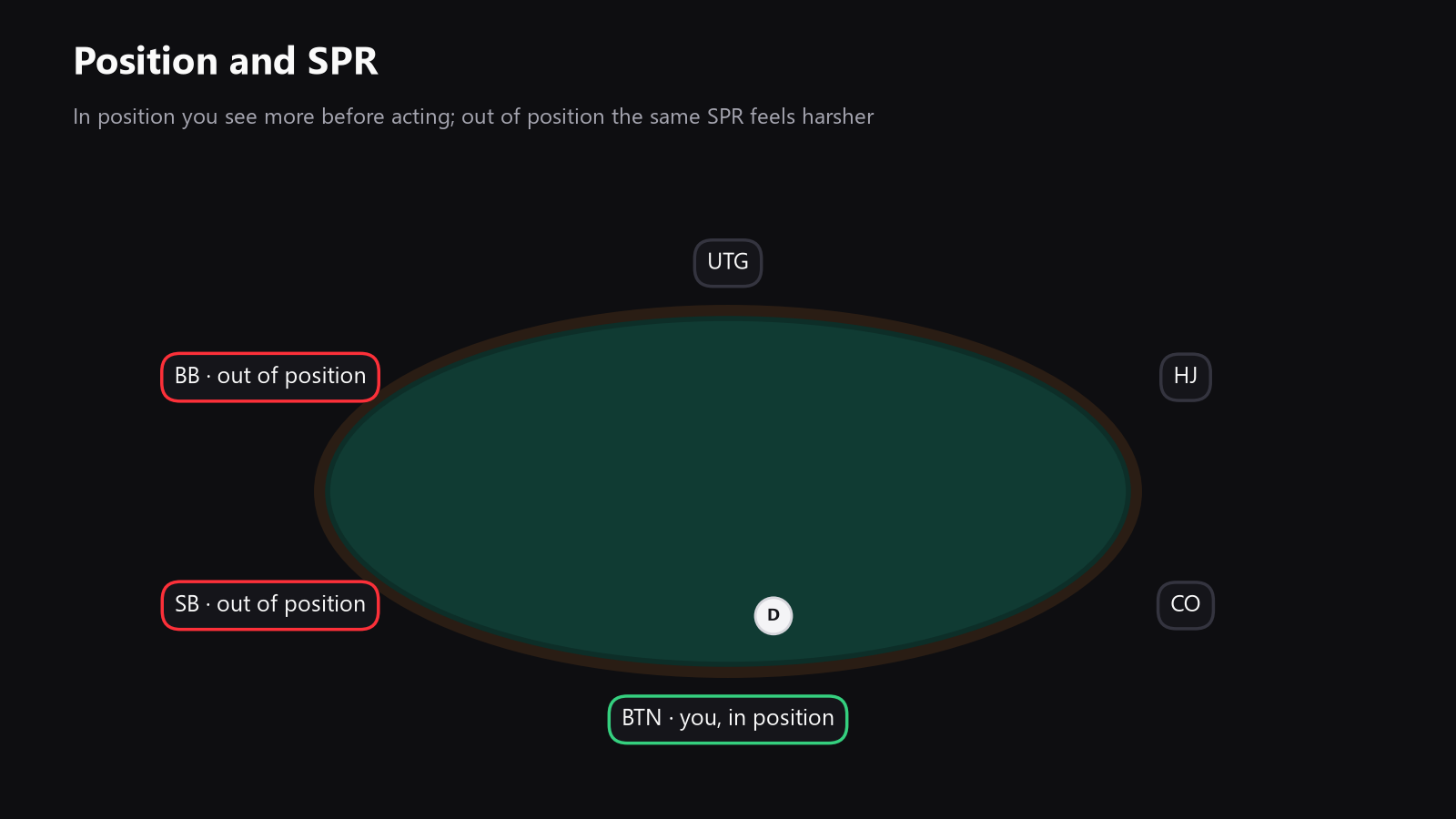
In position, you get more information before acting. That helps you control pot size, realize equity better, and choose the best moments to build the pot.
Out of position, the same SPR feels harsher. You face more difficult turn and river decisions, and one-pair hands suffer more when the pot gets big.
That is why some hands are worth more in position than they look on paper.
A simple practical guide
Here is a quick way to think about it:
- Low SPR: think value, commitment, and fast pressure
- Medium SPR: think structure, range interaction, and future streets
- High SPR: think nuttiness, implied odds, and careful pot building
If you want a very short version:
- the lower the SPR, the more you can continue with one-pair hands
- the higher the SPR, the more you need real strength or strong draw potential
Common mistakes with SPR
Mistake 1: treating every pair the same
A top pair hand is not always worth the same amount. Its value depends on the SPR and the board.
Mistake 2: ignoring effective stack
If one player is shorter, that is the stack that matters.
Mistake 3: planning only one street ahead
SPR is about future betting. If you do not think about turn and river play, you will make expensive flop mistakes.
Mistake 4: overusing “I am already committed”
You are not committed just because you put in chips. You are committed when the math, the ranges, and the remaining stack say you should continue.
A useful way to study SPR spots
The best way to improve here is to review your own hands and ask whether the SPR made your line reasonable.
If you want to test a spot away from the table, the Solver module can help you study the structure later, on your own hands, without any pressure from the clock. If you want to see whether a leak appears again and again in your results, the Plan and Dashboard modules help you find where those expensive spots really are.

Final takeaway
SPR is one of the clearest ways to understand when a hand can truly commit.
If the SPR is low, strong one-pair hands move closer to stack-off territory.
If the SPR is medium, you need to pay close attention to board texture, position, and future streets.
If the SPR is high, you should value hands with nuttiness, redraws, and strong playability much more than simple one-pair strength.
So before you decide whether to bet, call, raise, or slow down, do one thing first: look at the pot, look at the stack, and compute the SPR. That one number often tells you more about the hand than the hole cards do.
Do it on your own hands.