
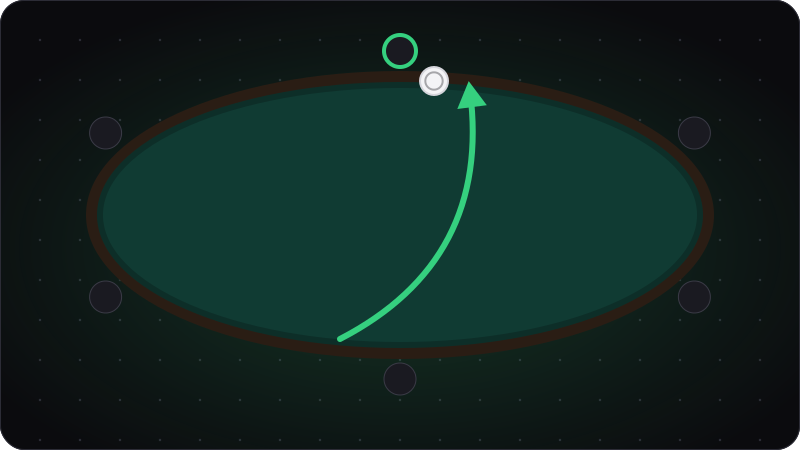
Position is one of the biggest edges in poker, and after the flop it becomes even more important. Acting last gives you more information, better control of the pot, and more ways to turn marginal hands into profitable decisions. Acting first does the opposite: you speak with less information, you are easier to attack, and every mistake is more expensive because you must commit before you know what the other player will do.
If you want to improve your postflop results, you do not need to memorize exotic lines. You need to understand what changes when you are in position and what changes when you are out of position.
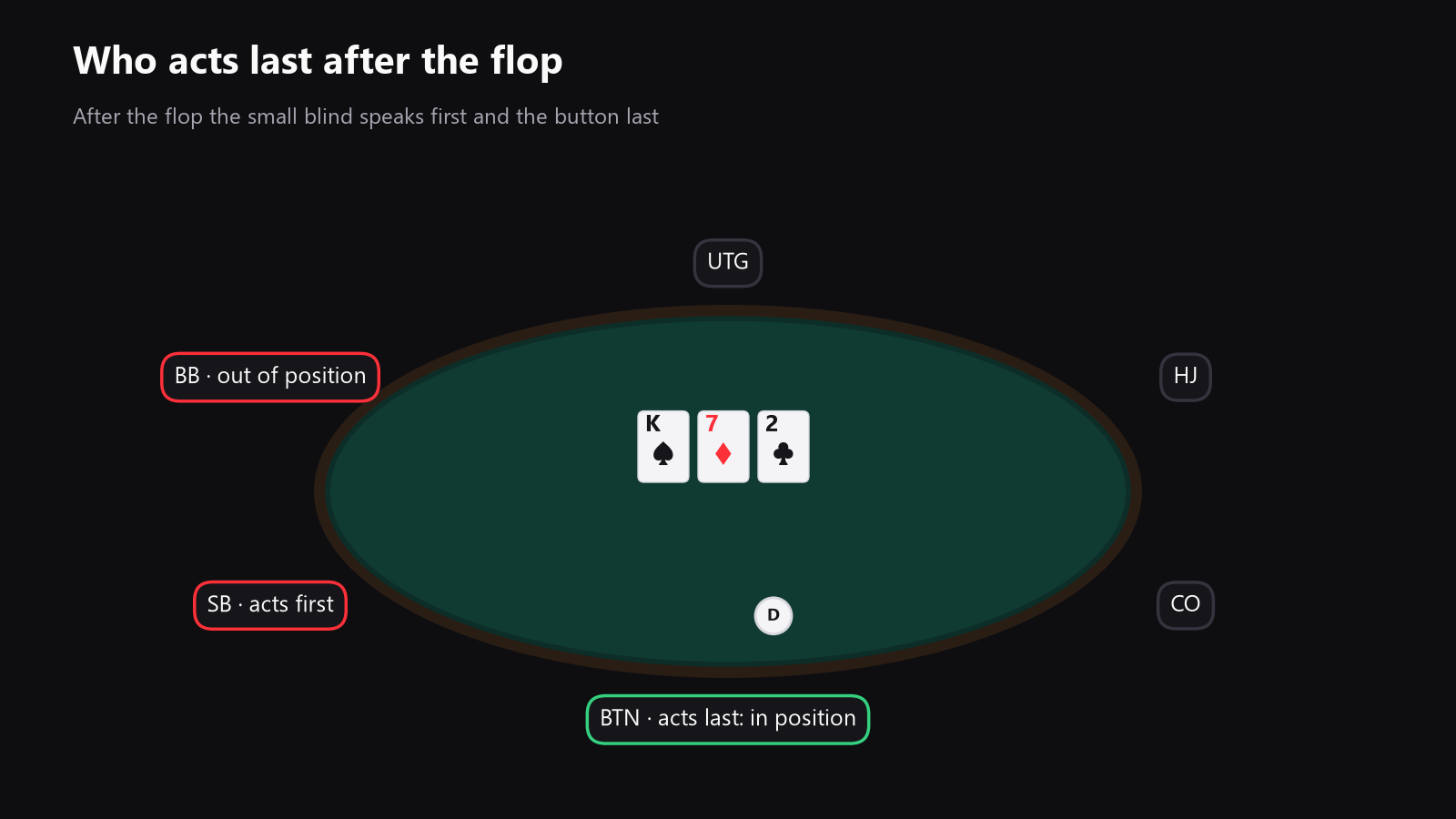
Why acting last is worth money
Postflop poker is a game of incomplete information. The player who acts last sees the most before making a decision.
That matters in three ways:
- You can value bet more precisely. When you act last, you see whether villain checks, bets small, bets big, or gives up. That helps you choose the right size and the right hands.
- You can control the size of the pot. If your hand is strong but not a monster, position lets you keep the pot manageable. You can check back, call once, or apply pressure later.
- You can realize more equity. A hand with decent showdown value is often worth more in position because you get to see one more action before deciding whether to continue.
That third point is easy to miss. A hand like second pair, a weak top pair, or ace-high with backdoor draws can perform very differently depending on whether you are first or last to act. In position, those hands often reach showdown more often. Out of position, they are forced into uncomfortable guesses.
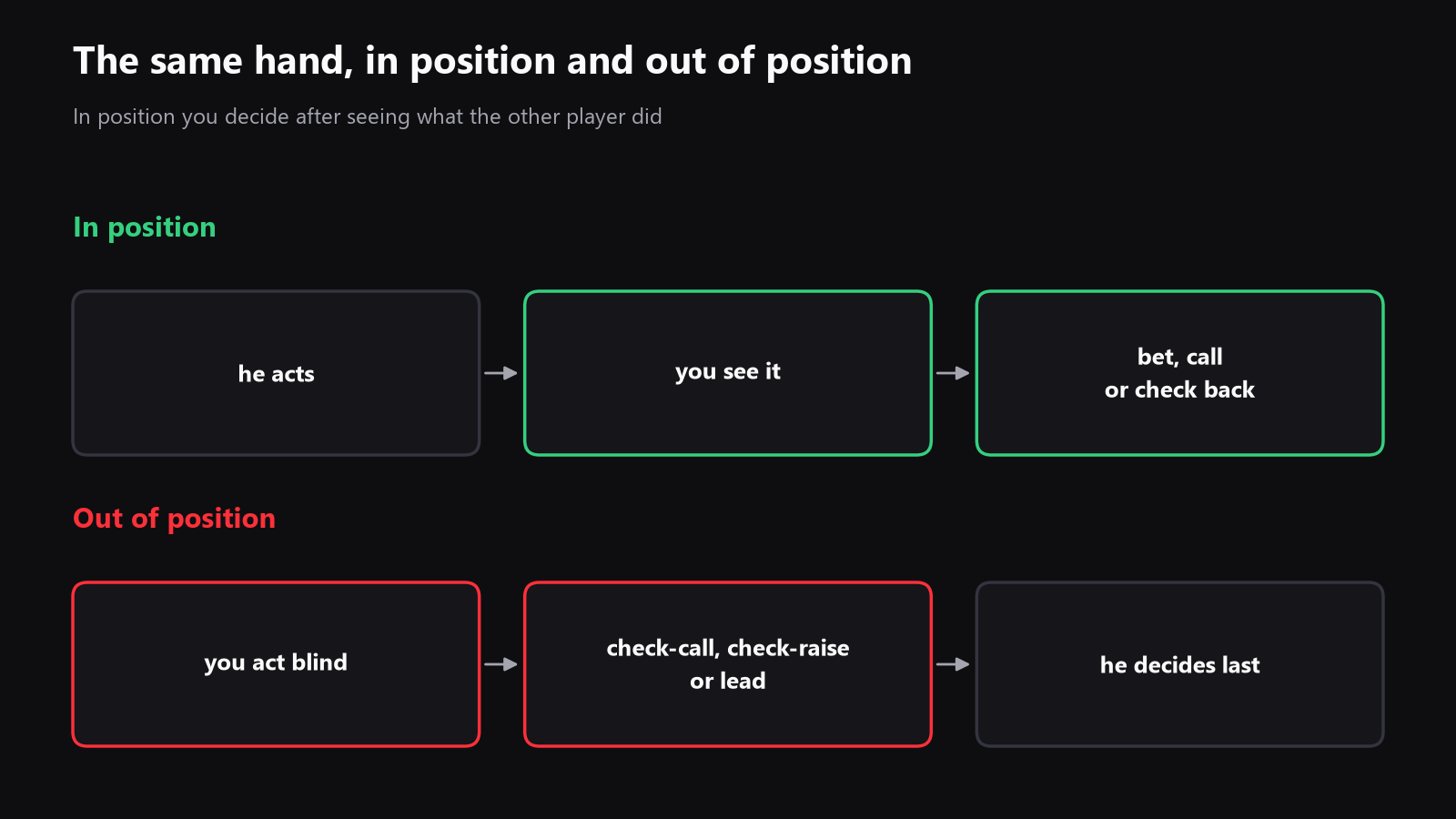
The first big change after the flop: information
When you are in position, you get information before you spend chips. When you are out of position, you must spend chips first or give up the chance to protect your hand.
That is why the same board can play very differently depending on who has position.
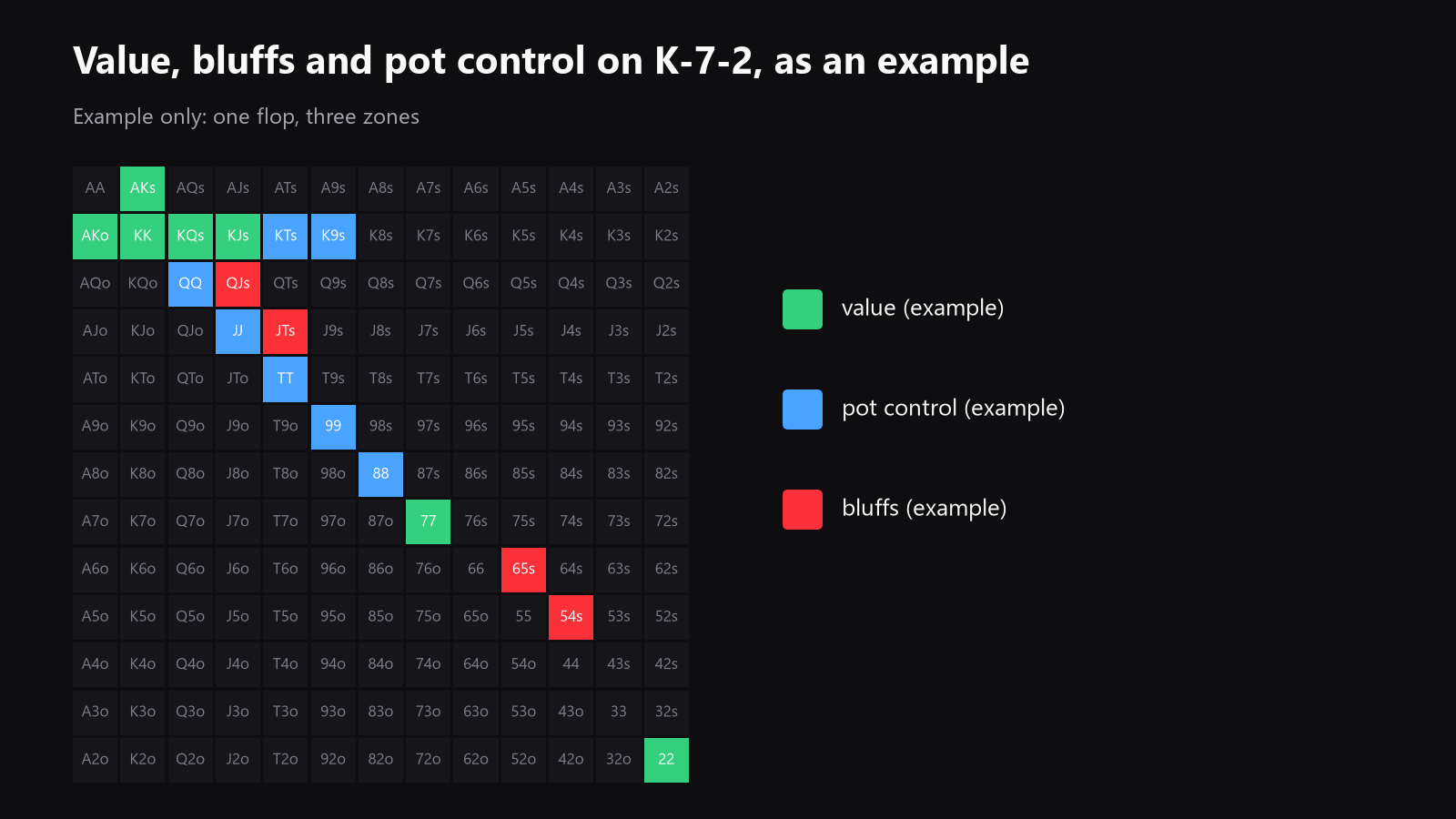
- On a dry board like K 7 2 rainbow, the preflop raiser often has a range advantage and can use small bets often.
- On a connected board like 9 8 6 two-tone, there are more strong draws and more made hands available to both players, so ranges become closer.
- On a paired board, the value of top pair rises and the value of pure air falls.
Position does not cancel board texture. It works with it. The best players think about both at the same time.
How to play in position after the flop
When you are in position, your job is not to bet more just because you can. Your job is to use information well.
1. Bet when you can put pressure on a capped range
If your opponent checks, that does not always mean weakness, but it often means they have a range that can be attacked. In many common single-raised pots, the player out of position checks a wide range on the flop. That gives you room to bet small with a broad range and keep the pot under control.
A small flop bet can work well when:
- the board favors your range,
- your opponent has many medium-strength hands,
- you want to deny equity to overcards and backdoor draws,
- you can continue comfortably against a raise.
2. Check back when your hand wants pot control
Being in position does not mean betting your medium-strength hands automatically. Sometimes the best play is to check back and keep the pot small.
Good check-back candidates often include:
- medium pairs,
- weak top pair with bad kicker,
- hands with showdown value that dislike facing a raise,
- hands that have decent equity but do not need protection immediately.
A common mistake is to bet hands that win often enough at showdown already. If your hand is good but fragile, checking back can preserve its value.
3. Use the turn as a leverage street
One of the biggest advantages of position is that you can wait. If the flop goes check-check, you still get another chance to act on the turn after seeing a second card.
That matters because:
- your opponent may continue to show weakness,
- the board may improve your range more than theirs,
- you can pick a better size,
- you can represent stronger hands credibly.
In position, many profitable lines are not built on forcing action immediately. They are built on choosing the best moment.
How to play out of position after the flop
Out of position, you need a different mindset. Your goal is not to be passive. Your goal is to build a range that can survive pressure.
1. Check more often, and with purpose
A good out-of-position strategy starts with a solid checking range.
If you almost never check strong hands, your checks become weak and easy to attack. If you check everything weak and bet everything strong, the other player can make life miserable for you.
Your checking range should include:
- some strong made hands,
- medium-strength bluff catchers,
- some draws,
- some hands that want to see what the opponent does next.
That balance protects you. It also makes your check-raises believable.
2. Use check-raises for value and for pressure
Out of position, the check-raise is one of your main weapons.
You can check-raise with:
- sets and two pair,
- strong top pair on wet boards,
- strong draws,
- semi-bluffs with equity and block effects.
Why it works:
- you punish small stabs,
- you deny equity to hands that would like a cheap turn,
- you force the in-position player to define their hand.
But do not overuse it. If your check-raises are too frequent or too weak, you create a new problem: you make yourself easy to 3-bet, call down, or trap.
3. Pot control matters more out of position
This is where many players lose money.
When you are out of position with a hand like one pair, you often face a choice between betting and checking. Betting can build a pot that you are not ready to play for three streets. Checking can keep the pot manageable and let you realize your equity more cheaply.
That does not mean you should always check-call. It means you need to ask a simple question:
- Do I want to grow the pot now?
- Or do I want to keep the pot small and see another card?
If you do not know the answer, you are probably betting too often out of position.
4. Do not confuse passivity with discipline
Some players hear "pot control" and become passive. That is a mistake.
Out of position, you still need to defend enough. If you check-fold too much, the player in position can bet almost any board and print money. Your job is to continue with enough made hands and enough draws that betting into you is not automatic profit.
A simple math reminder helps here. If villain bets half the pot, you are getting 3 to 1 on a call, so you need about 25 percent equity to break even on the call itself. That is only the immediate price. Future streets matter too, which is why board texture and hand strength matter so much.
Concrete spots that matter
Button versus big blind on K 7 2 rainbow
This is a classic spot where position matters.
The button has the advantage of acting last and can often use a small c-bet with a lot of hands. Why?
- the board is dry,
- the big blind misses often,
- many weaker pairs and ace-high hands are uncomfortable facing pressure.
Out of position, the big blind should not simply fold everything that missed. The big blind needs to continue with a real range:
- some kings,
- some pairs,
- some strong floats,
- some check-raises with value and draws.
If the big blind never fights back, the button wins too many pots too easily.
Cutoff versus button on Q J 4 two-tone
This board is much less comfortable for automatic aggression.
There are more straight draws, more second pairs, and more dominated but non-trivial holdings in both ranges. In this kind of spot, the in-position player still has the advantage of acting last, but the out-of-position player can defend more actively because the board is dynamic.
Here, pot control becomes more important for both players. A big bet with a medium hand can commit you to lines you do not want. Check-raises become stronger because they can charge draws and deny equity.
A low connected board like 9 8 6
This type of board changes everything.
The board hits connected ranges hard. The player out of position may have more two pair, sets, and strong draws than on a dry board. In many such spots, automatic continuation betting becomes less attractive for the in-position player.
This is a good reminder that position is powerful, but not magical. Texture still decides a lot.
The most common mistakes
In position
- betting every flop without thinking,
- checking back too many value hands and missing thin value,
- overreacting to one check-raise,
- forgetting that a later street is often more important than the flop.
Out of position
- c-betting too much into a range that can continue well,
- check-folding too often and making your checking range weak,
- using the same size on every board,
- check-raising without enough value or enough equity,
- building pots with hands that want to reach showdown cheaply.
If you recognize yourself in one of these, that is good news. It means your leaks are visible.
A simple framework you can use today
When you reach a flop, ask four questions:
- Who has range advantage? Who is more likely to have the strongest hands here?
- Who has nut advantage? Who is more likely to have sets, two pair, and the strongest draws?
- Who benefits most from a big pot? Some hands want pressure. Others want control.
- What happens if I get raised? If you do not know your response, your first bet may already be wrong.
That framework is simple, but it prevents many expensive mistakes.
How to study position away from the table
If you want to go deeper, do not study position only in theory. Study your own hands.
The Dashboard and Self Analyser modules in Poker Exploit help you see where your game leaks money, including the spots that happen when you are first or last to act. If you want to test a specific flop later, the Solver module can compute the spot away from the table. It refuses during a session, which is exactly what you want in real time.

The short version
Playing in position is profitable because you act with more information, choose your sizes better, and realize more equity.
Playing out of position is harder because you must guess more often, protect your checking range, and control the pot without becoming passive.
If you remember only one thing, remember this: position is not just about acting last. It is about making better decisions with the same hand.
Do it on your own hands.