
A continuation bet, or c-bet, is the flop bet made by the preflop aggressor.
Sometimes that player is first to act and bets into you. Sometimes you check to the preflop raiser and they bet. In both cases, it is still a continuation bet: the preflop aggressor is continuing with the betting lead on the flop.
If you want to defend well, you need three things:
- A fast way to judge the price you are being offered.
- A clear idea of which hands can continue.
- The discipline to fold hands that look alive but do not realise enough equity.
This article focuses on flop c-bets, because that is where most players search for help, but the same logic applies on later streets too. The size changes, your range changes, and your threshold for continuing changes with it.
1) Start with the math, then add the poker
When villain bets into the pot, you do not defend by guesswork. You start with two numbers:
- Pot odds to call
- Minimum defense frequency, or MDF
Pot odds to call
If the pot is P and the bet is B, the equity you need to call is:
B / (P + 2B)
That means:
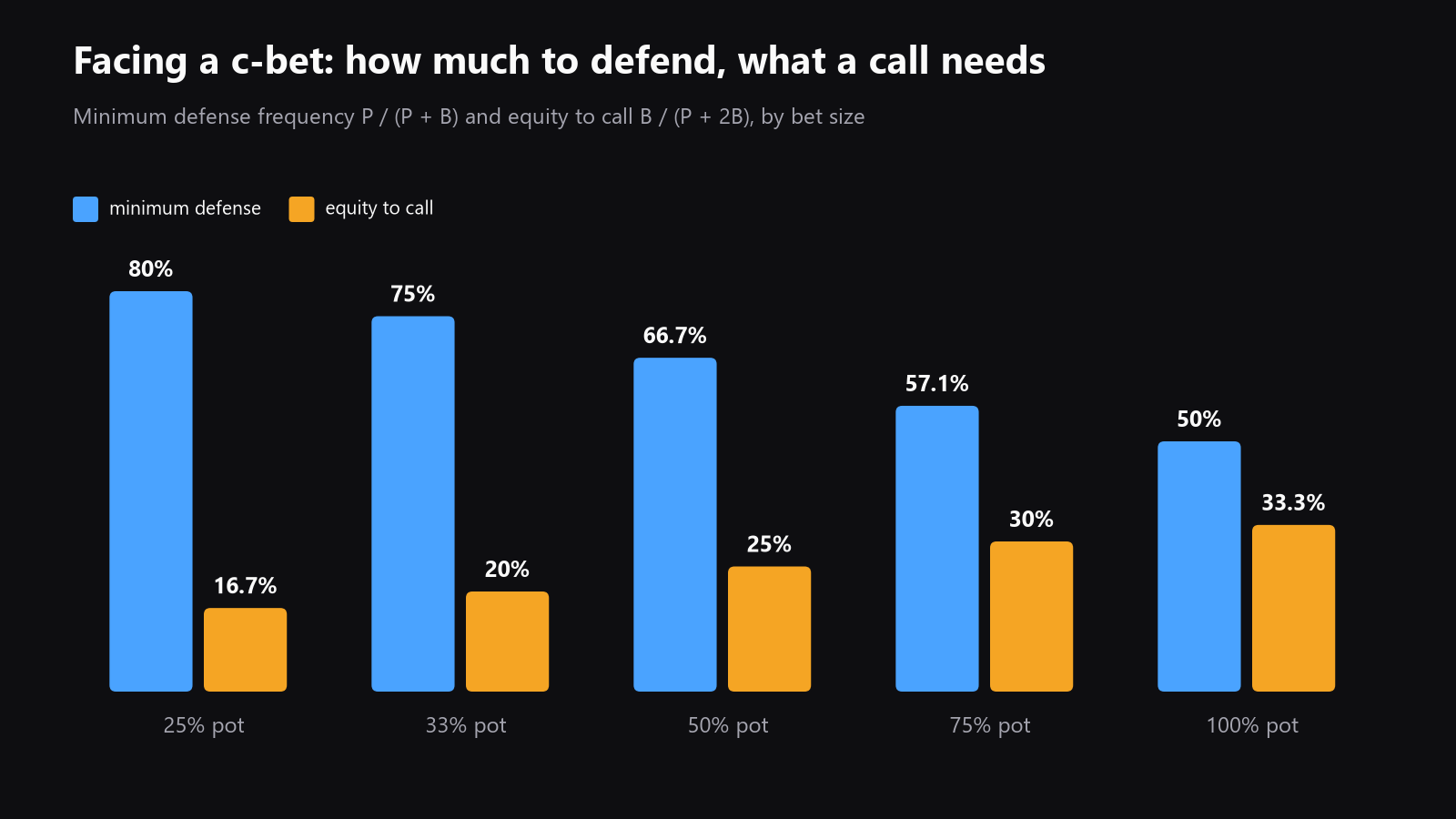
- Versus a 1/3 pot bet, you need 20% equity to call.
- Versus a half-pot bet, you need 25% equity.
- Versus a pot-sized bet, you need 33.3% equity.
Minimum defense frequency
MDF tells you how much of your range you need to continue with so that pure bluffs do not print by betting any two cards.
The shortcut is:
MDF = P / (P + B)
So, if villain bets:
- 25% pot, MDF is 80%
- 33% pot, MDF is 75%
- 50% pot, MDF is 66.7%
- 75% pot, MDF is 57.1%
- 100% pot, MDF is 50%
A useful rule: the bigger the bet, the more hands you can fold.
But do not make the common mistake of thinking MDF means “call that many hands”. Your continue range includes both calls and raises.
| Bet size | MDF | Equity needed to call |
|---|---|---|
| 25% pot | 80% | 16.7% |
| 33% pot | 75% | 20.0% |
| 50% pot | 66.7% | 25.0% |
| 75% pot | 57.1% | 30.0% |
| 100% pot | 50% | 33.3% |
2) MDF is a baseline, not a script
MDF is helpful because it tells you how much of your range must continue if villain is betting a balanced bluffing range.
But real poker is not played against a spreadsheet.
You also need to ask:
- Does your hand realise equity well?
- Are you in position or out of position?
- Does the board favour your range or villain’s?
- Is the bet small and wide, or large and strong?
- Can your hand call one street, or two, or three?
A hand with 25% raw equity can be a good call in position and a bad fold out of position. A hand with enough equity to continue can still be a raise if it gains more from fold equity than from calling.
So the right question is not only “Do I have enough equity?” It is also “How well does this hand play after I continue?”
3) In position, you can continue wider
When you are in position, you see villain act first on later streets. That makes your equity worth more. You can call more hands that would be shaky out of position.
Good candidates to continue in position
On many flop textures, you can continue with:
- Top pair and better
- Second pair on dry boards
- Overpairs
- Strong gutshots
- Open-ended straight draws
- Flush draws
- Combo draws
- Ace-high or king-high with strong backdoors
- Small pocket pairs on boards that do not punish them
The key idea is that in position, hands with future potential improve in value. A hand that is only barely ahead right now may still be worth a call if it can improve, pick up equity, or win the pot later.
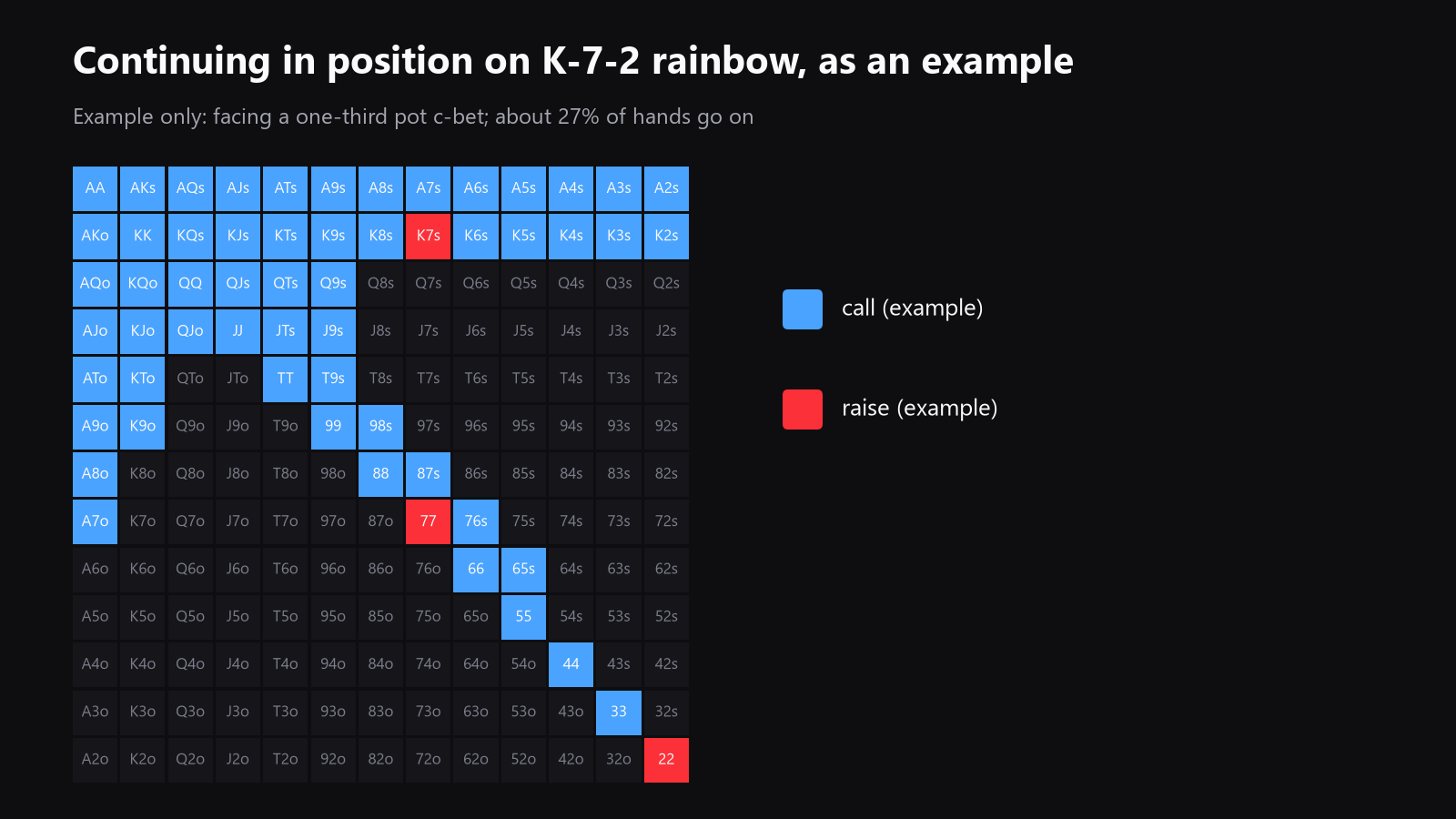
Example of a wide in-position defence
On a dry board like K-7-2 rainbow, facing a small c-bet, many hands can continue in position:
- Any king
- Many sevens
- Pocket pairs
- Backdoor flush draws
- Backdoor straight draws
- Some ace-high hands with backdoors
- Some underpairs, especially if villain bets small
That does not mean you should call everything. It means you can defend with hands that have:
- some showdown value
- some backdoor equity
- or strong playability on later streets
4) Out of position, you must be tighter and more honest
Out of position is where many players leak money. They defend too loosely because the hand looks close, then they get put under pressure on the turn and river and have to fold anyway.
When you are out of position, your continuing range should be more selective.
Good candidates to continue out of position
You want hands that can:
- stand a barrel
- improve often enough
- or generate value with a raise
That usually means:
- Top pair and better
- Overpairs
- Two pair and sets
- Strong draws
- Combo draws
- Some second pairs on dry boards
- Some underpairs only when the board is very safe and the size is small
What to fold more often out of position
You should be much quicker to fold hands like:
- pure overcards with no backdoor
- weak second pair on wet boards
- weak underpairs on coordinated boards
- bluff-catchers that do not beat enough of villain’s value range
- hands that will face too many uncomfortable turns
Out of position, a hand must earn its keep. If it cannot continue profitably against turn pressure, it is often better to fold now.
5) Which hands should call?
A call is best when your hand has enough equity and enough playability to realise that equity.
Call with value plus stability
These are the hands that usually like calling:
- top pair with a decent kicker
- second pair on boards that are not too dynamic
- overpairs
- middle pairs when villain’s range is wide and the board is not scary
- top pair with redraws
- hands that can improve to strong bluff-catchers or strong value
Call with draws that have real equity
Good calls also include:
- flush draws
- open-enders
- double gutshots
- combo draws
- strong backdoor draws in position
- gutshots when the price is good and your hand has extra features, like overcards or backdoor flush potential
Call with bluff-catchers only when they beat enough bluffs
A bluff-catcher is a hand that rarely improves, but can still win at showdown. That can be fine if villain is betting too much.
Examples:
- second pair on a dry board
- top pair with a weak kicker on a passive texture
- underpairs on paired boards
If villain’s c-bet range is value heavy, or if the board is very wet, these hands lose value quickly.
6) Which hands should raise?
Raising against a c-bet serves two purposes:
- You get called by worse when you have value.
- You force folds when your hand has equity but does not want to realise it the hard way.
Raise for value
You should raise with:
- two pair
- sets
- strong made hands on wet boards
- hands that are far ahead of villain’s continuing range
These raises build the pot when you are happy to play for stacks.
Raise as a semi-bluff
Semi-bluffs work best when they have:
- good equity when called
- decent fold equity
- blockers to strong continuing hands
- poor realisation as a passive call
Good examples include:
- strong flush draws
- open-ended straight draws with overcards
- combo draws
- draws that block villain’s top of range
When raising becomes better than calling
Raising is often better than calling when:
- your hand hates difficult turns
- you want to deny equity
- villain folds too much to raises
- the board is wet and equity shifts quickly
- you are out of position and want to take control
Do not raise just because your hand is “not comfortable”. Raise because it has a reason to build the pot or to force folds.
7) Board texture changes everything
The same hand can be a clear continue on one board and a fold on another.
Dry boards
Examples: K-7-2 rainbow, A-8-3 rainbow
- C-bets are often smaller.
- You can defend wider.
- Backdoors matter more.
- One-pair hands keep more value.
Wet boards
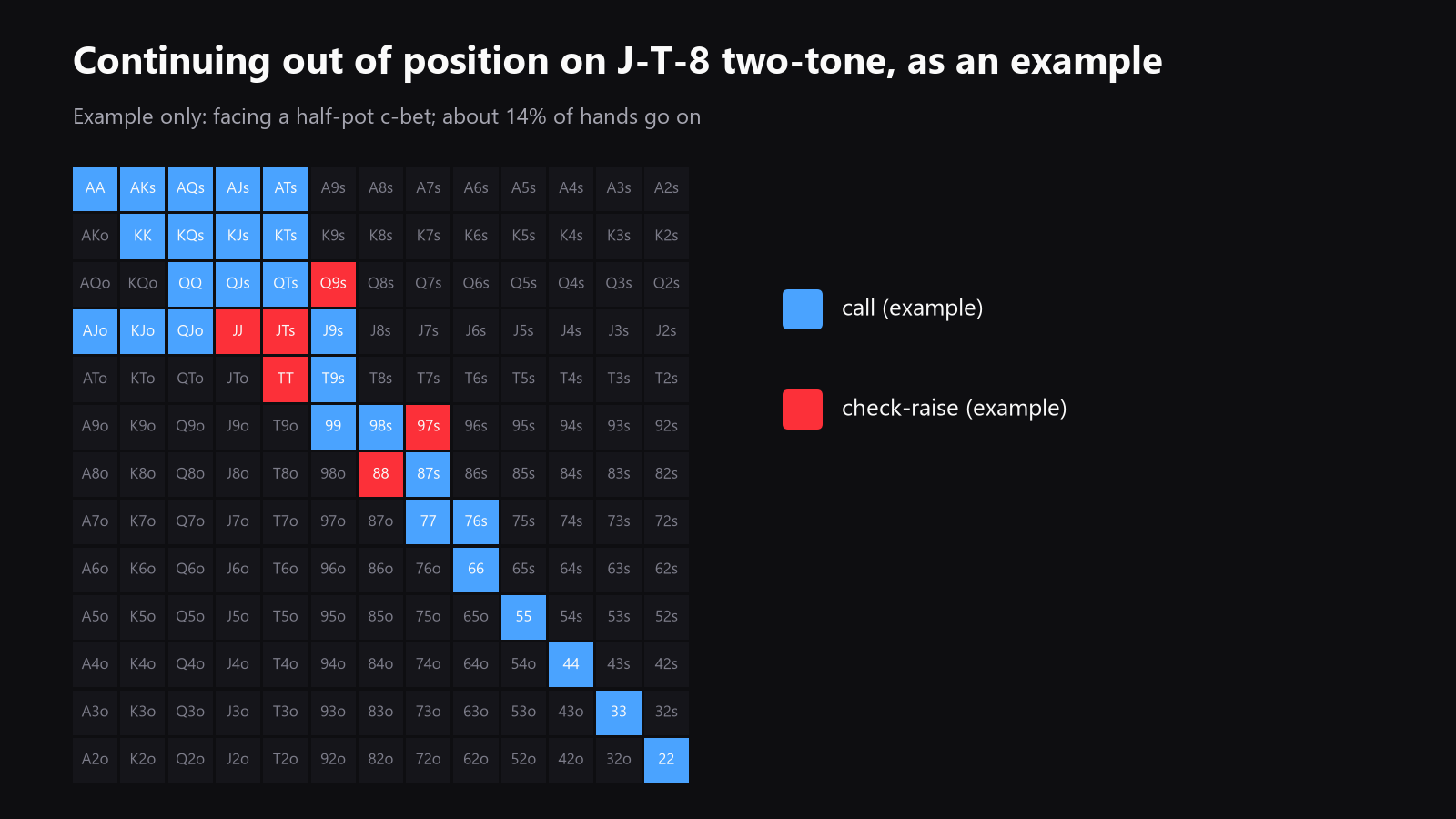
Examples: J-T-8 two-tone, 9-8-6 two-tone
- C-bets are often larger.
- One-pair hands lose value fast.
- Strong draws go up in value.
- Raises become more attractive with big draws and big made hands.
Paired boards
Examples: Q-Q-4, 8-8-2
- Small c-bets are common.
- Many players overfold the wrong hands.
- Pocket pairs, blockers, and strong overcards with backdoors can continue.
- Trips, boats, and strong draw plus pair combinations like to raise.
A simple habit helps a lot: before you act, ask whether the board is helping the preflop aggressor or helping you. If the board is better for villain, your continuing range should be narrower and more robust.
8) A practical way to think about your continue range
When you face a c-bet, sort your hand into one of four buckets:
Bucket 1: Clear continue, often for value
- top pair+
- overpairs
- strong draws
- strong combo draws
Bucket 2: Continue, but prefer calling
- second pair on dry boards
- medium-strength bluff-catchers
- hands with good backdoors
- hands that play well in position
Bucket 3: Continue, but prefer raising
- strong draws that benefit from fold equity
- value hands that want to build the pot
- hands that do poorly as passive calls
Bucket 4: Fold
- pure air
- weak pairs on bad textures
- dominated backdoor hands
- bluff-catchers that do not beat enough of villain’s c-bets
If you use this four-bucket idea, you will stop overdefending junk and stop folding hands that still have a real job to do.
9) A quick example
Suppose the pot is 6 bb and villain bets 2 bb.
- MDF is 75%
- You need 20% equity to call
- Small size means villain is using a wide range, or at least a range that does not need much protection
Now ask:
- Does your hand have showdown value?
- Does it have backdoors?
- Are you in position?
- Can you improve on many turns?
- Can you profitably raise?
If the answer to all of that is no, fold.
If the hand has some equity, some backdoors, and good future playability, continue.
If the hand is strong or gets stronger on many turns, consider raising.
10) Common mistakes when defending against a c-bet
Folding too much to small bets
A small c-bet does not mean strength. Often it means the bettor is using a wide range.
Calling hands that cannot improve or bluff-catch
A weak pair or ace-high hand can look fine, then become a disaster on the turn. If you cannot realise equity, do not pay to see more cards.
Overcalling out of position
Out of position, every mistake gets worse. Your hand needs more raw strength or more robust redraws.
Raising without a plan
If you raise, know what worse hands continue, what better hands call, and which turns you intend to barrel on.
Treating MDF as a target instead of a tool
MDF is not a finish line. It is a reference point. Real defence is built from equity, playability, and board texture.
11) How to study this spot away from the table
If you want to get better at defending against c-bets, study your own hands, not just generic advice.
The Self Analyser module can help you see which flop situations matter most in your own game, measured against the field and the rest of your game.
The Reveal module shows what players at your limits actually do in specific spots, with frequencies of actions by street and spot, so you can compare theory with population tendencies.
And if you want the exact baseline for a specific spot, the Solver module can compute it away from the table.

12) The simple rule set to keep
When you face a c-bet, remember this:
- Small bet, defend wider
- Big bet, defend tighter
- In position, realise equity better
- Out of position, be more selective
- Call with hands that can continue on later streets
- Raise when value or fold equity makes it better than calling
- Fold hands that look alive but do not play well
If you keep only one thought, keep this one: do not defend to satisfy a number, defend because the hand is worth continuing with.
Do it on your own hands.