
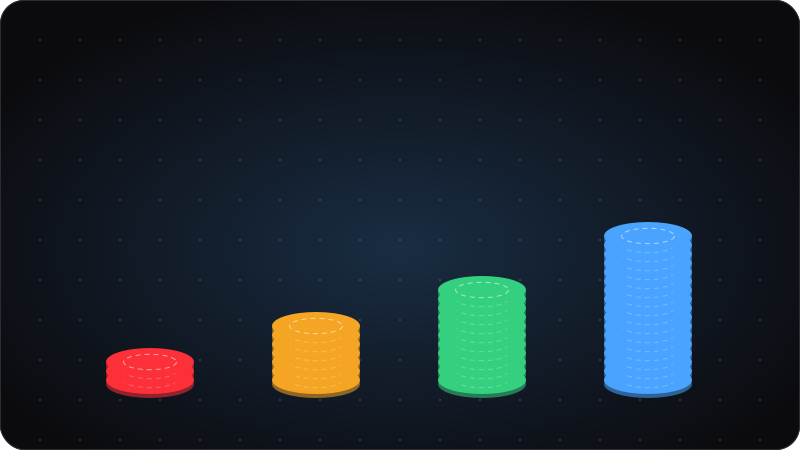
If you want one number to guide your tournament decisions, make it stack depth in big blinds, not chip count.
A stack of 3,000 chips means almost nothing by itself. At 100/200, that is 15 big blinds. At 200/400, it is 7.5 big blinds. Same chips, completely different poker. One stack still has room to raise and play. The other is already close to push or fold.
That is why strong tournament players think in big blinds. Big blinds tell you what your stack can actually do.
The four practical stack zones
These are working buckets, not laws. The exact border shifts with antes, payout pressure, table texture, and your edge. But as a simple tournament map, this is a good start:
| Stack depth | Practical name | Main plan |
|---|---|---|
| 40 bb and more | Deep | Raise and play after the flop |
| 20 to 40 bb | Medium | Raise and fold, with some 3-bet all-in spots |
| 10 to 20 bb | Short | More preflop commitment, more 3-bet shoves |
| Under 10 bb | Very short | Push or fold dominates |
The shorter you are, the less room you have to make a raise and then escape when the pot grows. The deeper you are, the more you can realize your hand’s equity after the flop.
Deep stacks: you are playing poker, not just preflop
With 40 bb or more, you can still open-raise hands that do well after the flop, even if they are not strong enough to stack off preflop. Suited connectors, suited aces, broadways, medium pairs, and position all gain value because you can win pots in many ways.
Deep stacks reward:
- position
- postflop skill
- hand reading
- pot control
- implied odds
They also punish automatic aggression. A big stack does not mean you should fire everywhere. It means you have time to let your range work.
At these depths, the main question is usually not "Can I shove?" It is "Can I raise, continue on the right boards, and still keep my stack healthy if I miss?"
A deep stack is also where your position matters most. A hand that is fine on the button may be awkward under the gun, because you will face more players and more difficult flops.
Medium stacks: the range starts to narrow
At 20 to 40 bb, you still have room to raise and fold. But every decision becomes more sensitive to stack-to-pot ratio.
A normal open raise is no longer innocent. If you open too wide and face a 3-bet, you can end up in a spot where:
- folding feels too tight,
- calling leaves an awkward stack behind,
- and 4-bet jamming is too extreme.
That is why medium stacks are the zone where many players start leaking. They keep using deep-stack habits with a stack that is no longer deep.
This is the stack depth where 3-bet all-in starts to matter. A jam over an open is often cleaner than a small 3-bet if you are short enough that a raise would leave you committed anyway. The all-in move denies equity, simplifies the hand, and puts pressure on the opener.
Medium stacks are especially sensitive to position:
- in late position, you can still steal profitably because fewer players remain
- in early position, you need stronger hands because more players can wake up behind you
- against short stacks, you must respect the possibility of a reshove
Short stacks: preflop mistakes get expensive
At 10 to 20 bb, every chip you invest preflop matters much more. A standard open can start to feel like a commitment decision, especially if the players behind you are aggressive.
This is where many tournament players should start thinking in terms of:
- raise and fold
- raise and call
- 3-bet all-in
- sometimes open-shove
The exact mix depends on position, antes, ICM, and who is left behind you. But the important idea is simple: at short stacks, you no longer have the luxury of raising just because a hand is playable.
Ask yourself:
- If I get called, do I still have a plan?
- If I get 3-bet, can I continue?
- If I shove, am I folding out enough hands to make it work?
When stacks get shorter, fold equity becomes a major source of profit. Hands that are not beautiful in a big multi-street pot can still be very strong as shoves because they pick up the pot now.
Very short stacks: push or fold becomes the language
Under 10 bb, push or fold is usually the cleanest model when you are first in.
At that point, small open sizes often create more problems than solutions. You rarely have the room to raise and then fold comfortably. You also do not gain much by leaving a fraction of a stack behind if the rest will go in anyway.
That is why very short stack strategy is built around:
- jam now
- fold now
- call only when the price and the range justify it
This is also where many players overvalue chip count and undervalue big blind count. A 900 chip stack can sound less desperate than a 9 bb stack, but if the blinds are high enough, both may be the same stack in practice.
Position changes everything
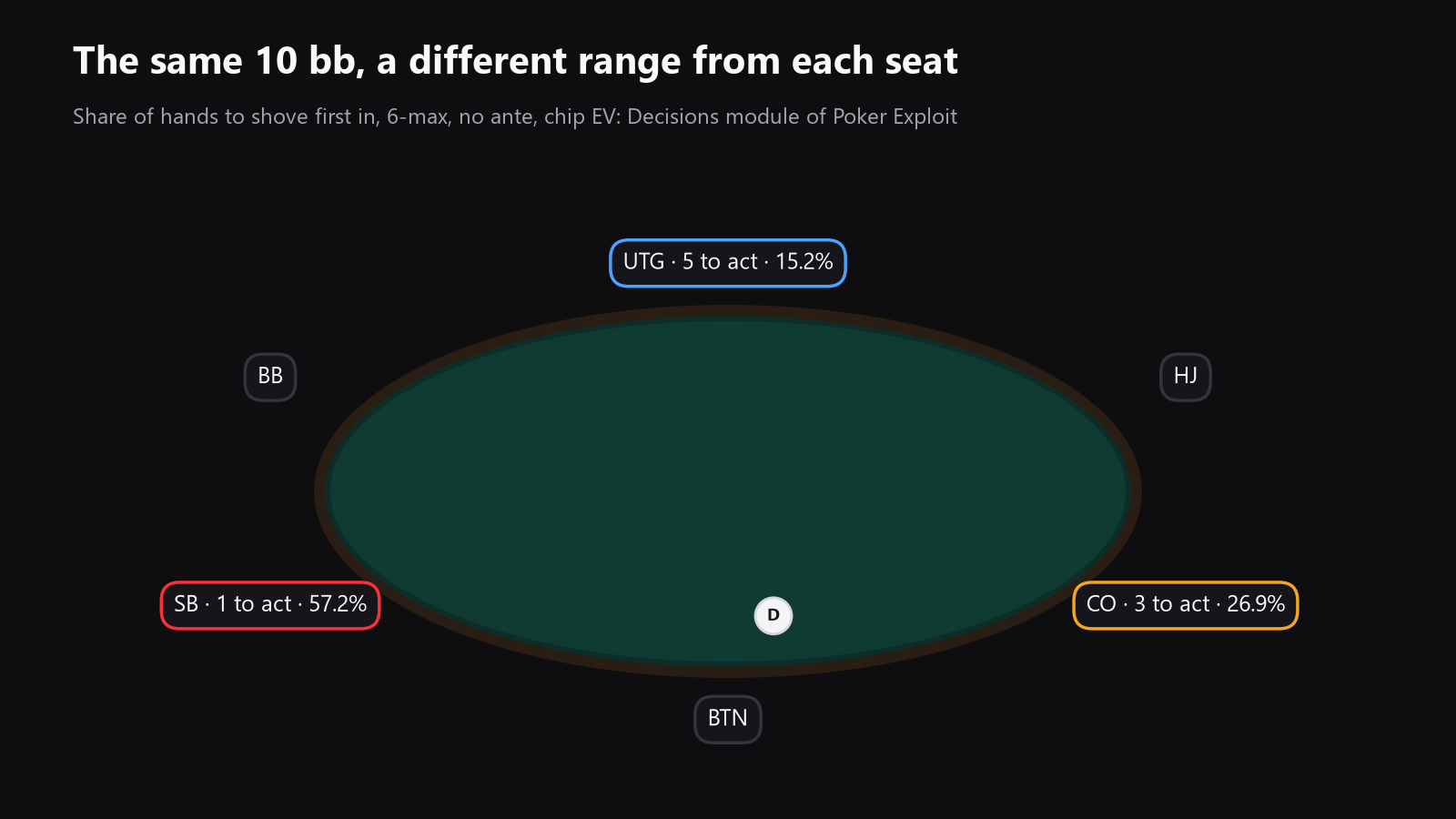
The same stack depth can play very differently depending on where you sit.
A simple rule helps: every player left to act is a tax on your range.
If you are first to act, more players can wake up with a hand, and your open needs more strength. If you are on the button, only the blinds remain, so your steal works much more often. The cutoff sits in between.
That is why stack depth cannot be studied alone. You must combine it with position.
A 15 bb stack on the button can often attack very profitably. The same 15 bb stack under the gun is much tighter, because six to eight players still have a chance to punish you.
The blinds are also special. In the small blind, for example, only one player remains if the action folds to you, but you are out of position after the flop. That makes hand selection and jam frequency a different problem from the button or cutoff.
How many players are left to act matters just as much as depth
The more players still behind you, the tighter your opening range needs to be.
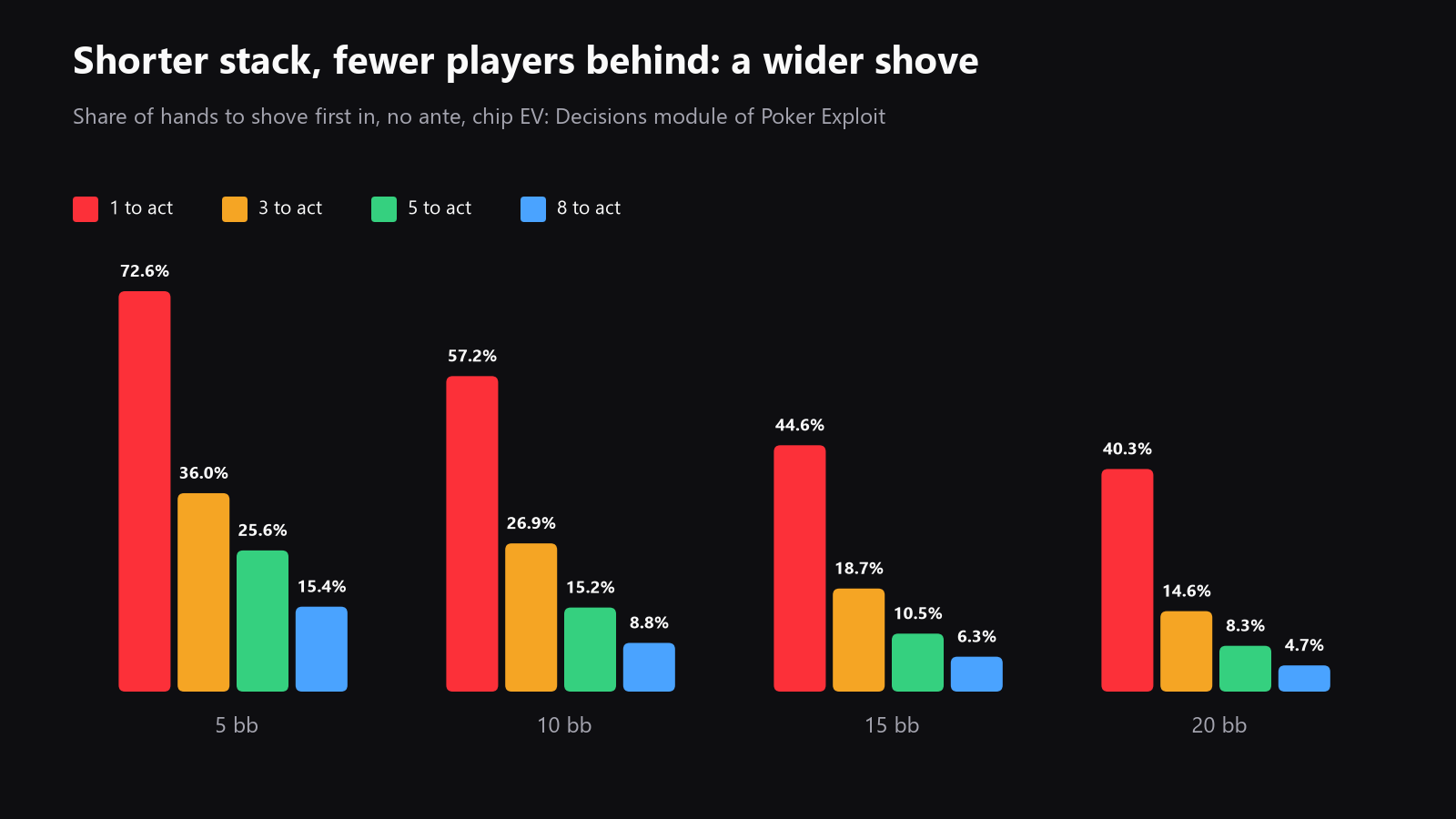
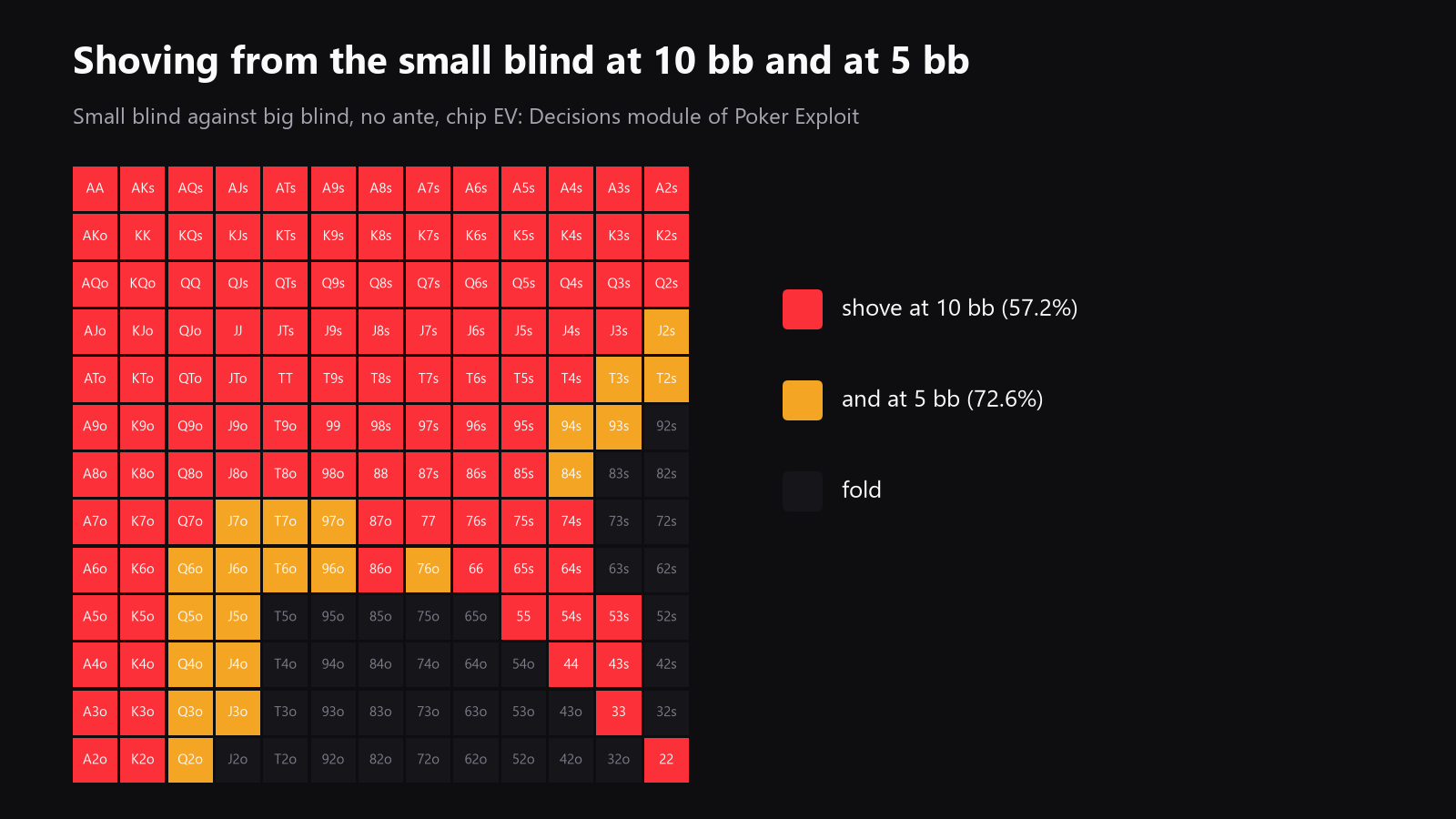
The cleanest way to see this is with first-in shove frequencies. Computed with Poker Exploit, here is the share of all starting hands to shove first in, in chips and without antes:
| Stack depth | Only the big blind left to act, when you are in the small blind | Three players left to act, cutoff at a full table | Five players left to act, first to speak six-handed | Eight players left to act, first to speak nine-handed |
|---|---|---|---|---|
| 5 bb | 72.6% | 36.0% | 25.6% | 15.4% |
| 10 bb | 57.2% | 26.9% | 15.2% | 8.8% |
| 15 bb | 44.6% | 18.7% | 10.5% | 6.3% |
| 20 bb | 40.3% | 14.6% | 8.3% | 4.7% |
This is the same idea in four different seats:
- the more players behind you, the narrower your shove range
- the deeper you are, the narrower your shove range
- the later your position, the wider your shove range
Notice how fast the numbers collapse as more players remain. At 20 bb, a small blind shove can still be a large part of your first-in game. But first to speak nine-handed, even 20 bb is already much too deep for a pure shove-or-fold strategy except in special spots.
The model only knows shove or fold, so these numbers are a baseline, not your whole tournament strategy. Real play also includes raise sizes, min-raises, and postflop plans. But the pattern is still useful. It shows how much position reshapes the value of the same stack.
A simple way to think about each depth
If you want a mental shortcut, use this:
Deep
You are trying to keep hands in, build pots in position, and exploit postflop edges.
Medium
You are balancing pressure and control. Open too wide and you get trapped. Open too tight and you surrender too many blinds.
Short
You are looking for spots where fold equity and immediate pressure are worth more than postflop maneuvering.
Very short
You are deciding whether to go all in now or wait for a better spot. Waiting is often expensive.
ICM can change the answer
In tournaments, chip EV is not the whole story. Near a bubble, a pay jump, or a final table, the same stack depth can play tighter because losing chips costs more than winning the same amount gains.
That means a 12 bb shove that is fine in chips can become too thin under ICM. The stack depth is still measured in big blinds, but the decision is no longer pure chip math.
So do not treat stack depth as a complete strategy by itself. It is the starting point. ICM is the overlay.
What to study first
If you are working on this part of your game, start with the spots that happen most often:
- first in from the button, cutoff, and blinds
- 3-bet reshove spots around 10 to 20 bb
- short stack spots near the bubble and final table
- hands where you are tempted to raise and then give up too often
A good study routine is to separate the game into stack bands and ask one question per band:
- What can I raise and continue with?
- What should I open and fold to pressure?
- What should I 3-bet shove?
- What should I just jam first in?
That keeps your tournament game from becoming a pile of disconnected hand charts.
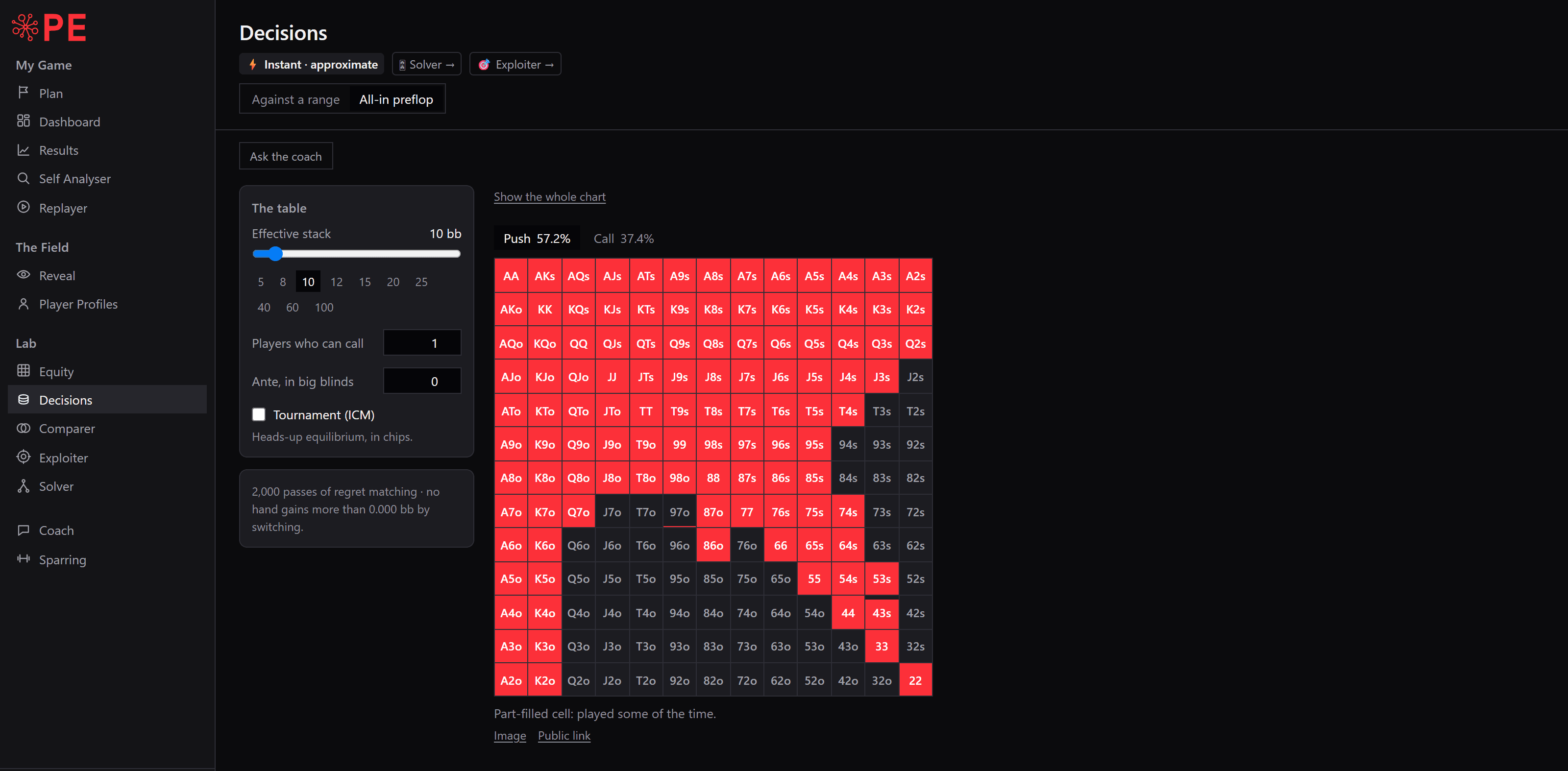
If you want to check those spots off the table, the Decisions module can compute push, fold, or call with a short stack, and the Reveal module shows what real players at your limits actually do in tournament spots too. Nothing in Poker Exploit helps during a hand in progress, so this is study only, not in-game advice.
The main takeaway
Stack depth in big blinds is the number that tells you what kind of poker you are playing.
- Deep stacks let you raise and play after the flop.
- Medium stacks force you to respect commitment pressure.
- Short stacks turn many decisions into preflop pressure spots.
- Very short stacks often reduce the game to push or fold.
Then position decides how wide you can go, and the number of players left to act decides how much risk you can take.
If you learn to read those three things together, stack depth stops being a vague number and becomes a real strategy tool.
Do it on your own hands.