
At around 10 big blinds, poker changes shape.
You are no longer playing a normal deep-stack game where you can raise, call, c-bet, barrel, and play rivers with room to maneuver. You are playing a short-stack game where the preflop decision often matters more than the postflop one. That is why push/fold at 10bb is such a big topic in tournaments, Sit & Go, and Spins.
If you want the short version, it is this:
At 10bb, your main job is to know when shoving is better than raising, calling, or folding, and when a push/fold chart is the simplest correct answer.
This article will show you what push/fold means, why it works, how to read a push/fold chart, and how to use it without turning into a robot.
What push/fold means
Push/fold means that your only preflop options are usually to go all-in or fold.
That does not mean every hand becomes a shove. It means that with a short stack, many hands are no longer worth a small raise, a limp, or a call that leaves you with an awkward stack behind. The value of fold equity becomes huge, and the value of postflop skill drops because you often do not have enough chips to play a full hand.
At 10bb, a stack might look like this:
- Blinds 500/1,000, no ante, stack 10,000
- Blinds 100/200 with ante, stack 2,000
- Same stack depth, very different pressure
The stack size in big blinds tells you the real depth. The blinds and antes tell you how much dead money is already in the pot. That matters a lot.
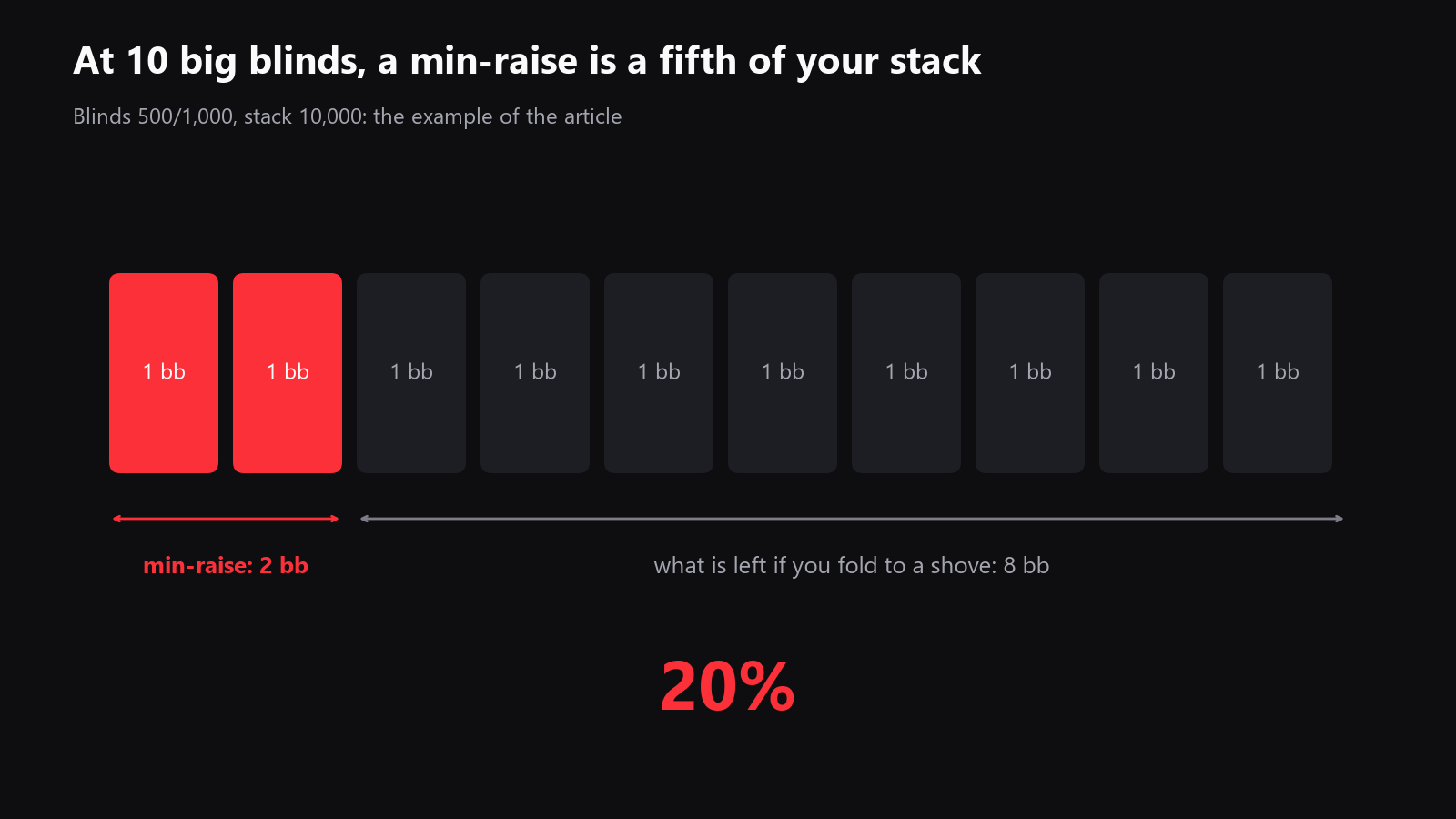
At this depth, the size of the pot matters almost as much as the cards.
Why 10bb is the classic push/fold stack
Ten big blinds is not magic. It is just a very useful reference point.
At around 10bb, three things happen:
- A min-raise becomes expensive If you raise and then fold to a shove, you lose a large part of your stack.
- Your fold equity becomes valuable When you shove, your opponent has to risk a meaningful portion of their stack to continue.
- Postflop play becomes cramped If you do get called, the pot is already large relative to the stacks left. There is little room to outplay people street by street.
That is why many tournament charts become much simpler at this depth. The game is no longer about finding thin postflop edges. It is about finding the highest-EV preflop action.
This is especially true in:
- Sit & Go
- Spin & Go
- Late-stage MTT spots
- Bubble and near-bubble situations
- Blind versus blind spots
In all of those formats, stack pressure is constant, and a push/fold chart often saves you from expensive guesswork.
Why shoving works
A shove works because it creates pressure in two ways.
1. You can win the pot immediately
If everyone folds, you take the blinds and antes without seeing a flop. At 10bb, those chips matter a lot.
2. When called, you still have equity
Even when villain calls, your hand usually is not dead. You often have enough equity to continue making money over the long run, especially when you include the dead money in the pot.
That combination is the heart of push/fold strategy:
- win now when they fold
- still realize equity when they call
The smaller your stack, the more valuable this becomes.
How to read a push/fold chart
A push/fold chart is a baseline guide that tells you which hands you should shove and which hands you should fold in a specific spot.
A good chart depends on:
- your stack depth
- your position
- the number of players left to act
- whether there are antes
- tournament payouts
- ICM pressure
- whether the spot is chip EV or tournament EV
Here is what a chart usually looks like:
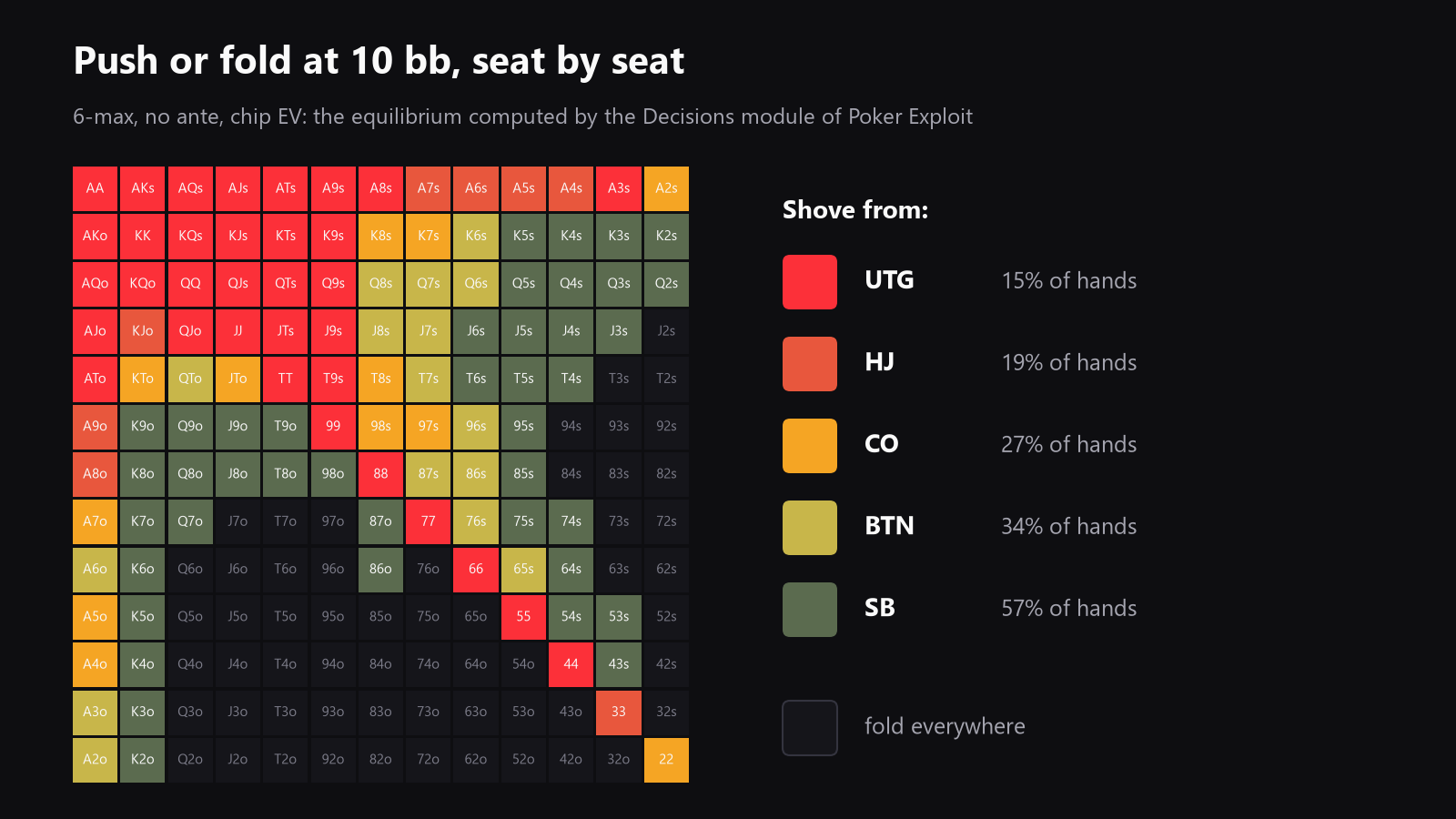
Use this kind of chart as a starting point, not as a law.
How to use it in practice
- Identify your effective stack Use the smaller stack between you and the player who can continue against you.
- Know the exact spot Are you first in? Facing a raise? Facing a shove? In the small blind? On the bubble?
- Check the chart for that position A hand that is a clear shove on the button may be a fold under the gun.
- Use the correct version A chart for cash chip EV is not the same as an ICM chart for a tournament bubble.
- Do not mix up stack depths A 10bb chart is not a 7bb chart. It is not a 15bb chart either.
The main mistake players make at 10bb
The biggest leak is not shoving too wide. It is usually playing a normal raising strategy when the stack is already short enough that the raise is awkward.
A few common leaks:
Calling too much
At 10bb, flat calling is often much worse than players think. You keep a difficult stack behind, and you give up the chance to win the pot immediately.
Raising and folding too often
This burns chips fast. If you open too wide and then fold to a reshove, your stack shrinks very quickly.
Ignoring position
A hand that is too weak from early position can be profitable from the button or small blind.
Using the wrong chart for the spot
Chip EV chart on a bubble spot? Bad idea. ICM chart in a low-pressure early stage? Also bad.
Forgetting antes
Antes make the pot bigger before the action starts, which increases the value of aggression and makes shoving better more often.
What changes by position
A 10bb push/fold chart is mostly about position.
Early position
From under the gun or early middle position, your shove range is usually tighter. You have more players left to act, which means more chances to run into a strong hand.
Middle position
You can start widening a little, but not dramatically. The players behind you still matter a lot.
Cutoff
Now the range opens up more. Fewer players remain, and fold equity improves.
Button
This is one of the most profitable spots in push/fold poker. You are close to the blinds, and your range can become much wider.
Small blind
When it folds to you in the small blind, shove ranges can become very wide at 10bb. You have one opponent left, and the dead money in the pot is meaningful.
Big blind
The big blind often plays differently because you already have chips in the pot. If someone shoves into you, you need to compare your calling range to the price you are getting.
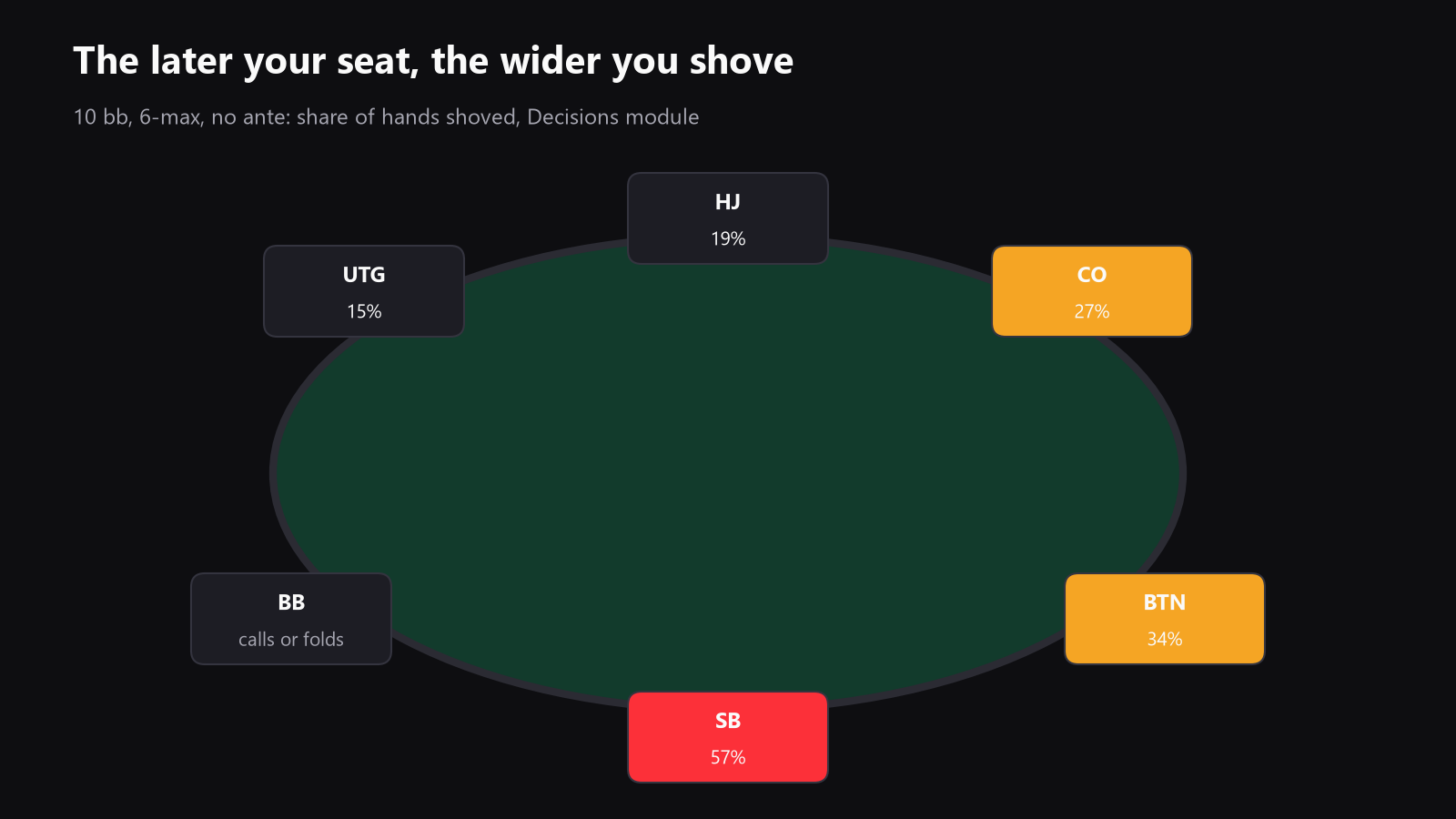
Position matters more and more as stacks get shorter.
Examples of hands that often move between shove and fold
A push/fold chart is precise, but the hand families below help you build intuition.
Hands that are often strong enough to shove
- Big pocket pairs
- Premium broadways like AK, AQ, sometimes KQ in late position
- Suited aces in many late-position spots
- Medium pairs in many late-position spots
- Some suited connectors and one-gappers from the button or small blind
Hands that are often close
- Weak offsuit broadways
- Marginal suited kings and queens
- Some small pairs, depending on position and ICM
- Hands that play well against calling ranges but poorly against strong ranges
Hands that are usually folds from early position
- Offsuit weak kings and queens
- Low suited trash
- Hands with poor blocker value and little showdown value
The exact answer depends on the spot. That is why charts matter.
Push/fold in MTT, Sit & Go, and Spins
The same idea exists in all tournament formats, but the details change.
In MTTs
You must care about stack distribution and payout pressure. Around the bubble or final table, chip EV and tournament EV are not the same thing.
In Sit & Go
Push/fold comes up very often because stacks get short quickly, and payout jumps matter a lot.
In Spins
Short-stack play is central. Your late-game decisions often revolve around exact shove and call ranges, especially with payout pressure and blind jumps.
If you only learn one chart, make sure you know what format it belongs to.
Chip EV versus ICM
This is where many players go wrong.
A hand that is a profitable shove in chip EV can become a fold under ICM pressure.
Chip EV
Chip EV is about winning chips. It is the right lens when payout pressure is low or when the tournament is far from the money structure that changes decisions.
ICM
ICM, or Independent Chip Model, changes the value of chips based on payout implications. It matters a lot on the bubble, at final tables, and in formats with steep prize jumps.
Here is the key idea:
- When ICM is low, you can often shove wider
- When ICM is high, you often need to tighten up
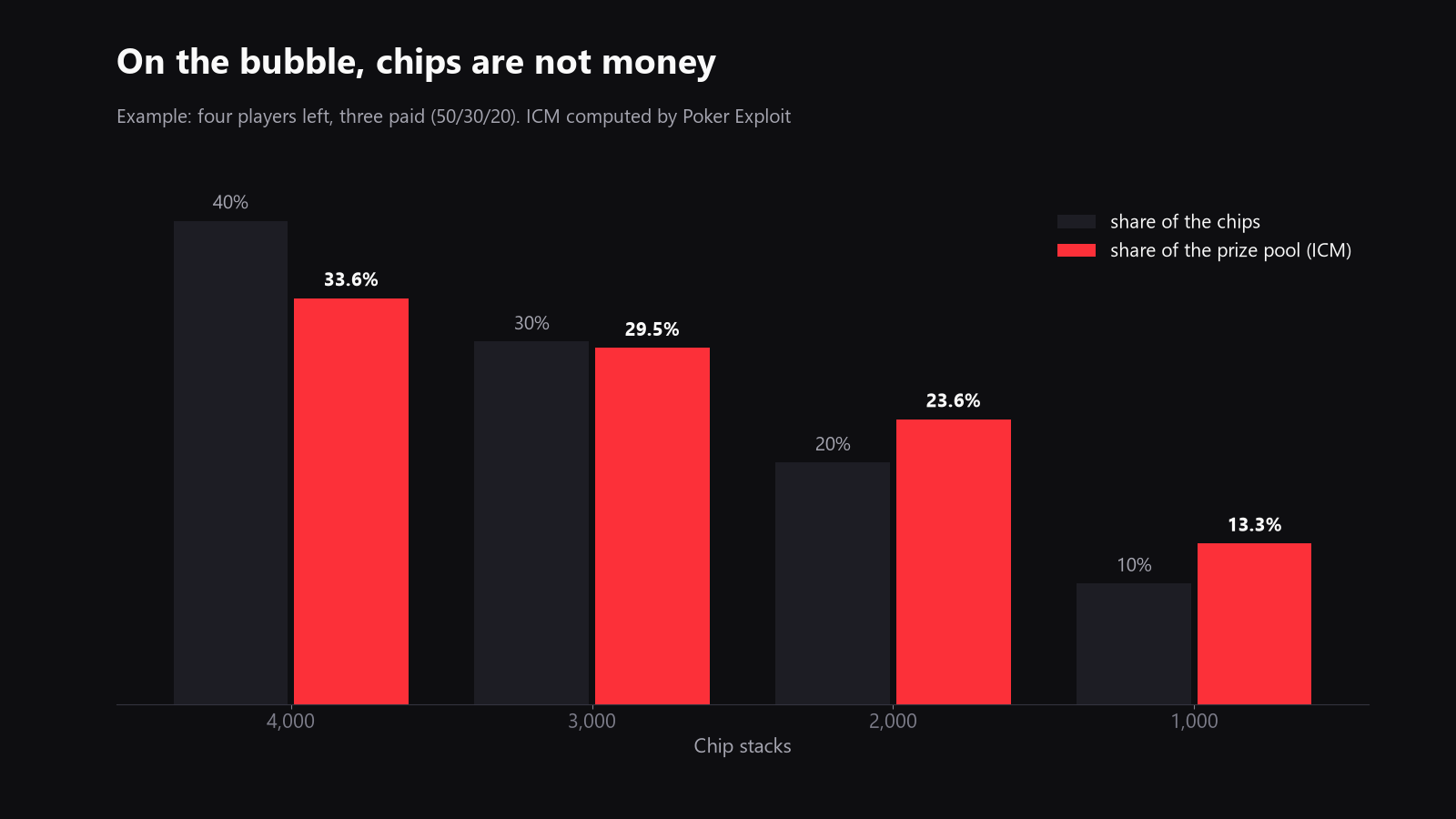
This is why a good push/fold chart needs to match the tournament stage, not just the stack size.
How to adjust beyond the chart
A chart gives you a baseline. Good players then adjust to the table.
Shove a little wider when:
- the blinds fold too much
- the players behind are tight
- you have good blockers
- antes are large
- the table is passive
Shove a little tighter when:
- one or more players are calling too wide
- you are near a pay jump
- there is a large ICM penalty
- a specific opponent is a sticky caller
- you are covered by a short stack and cannot leverage fold equity as much
The important point is that you should start with the chart, then adjust with real information. Do not replace the chart with guesswork.
A simple way to study push/fold well
If you want to improve fast, do this:
- Learn a baseline chart for 10bb Start with unopened pots and the most common positions.
- Separate chip EV from tournament EV Do not use the same logic everywhere.
- Review your own hands Look for places where you called too much, min-raised and folded too often, or shoved too tight from late position.
- Mark the recurring spots Button, small blind, big blind, and bubble spots are the highest-value places to study.
- Build rules, not memorized exceptions For example, “my shove range widens on the button and tightens under ICM pressure” is more useful than remembering one isolated combo.
If you want to study these spots on your own hands, the Poker Exploit Decisions module gives push, fold, or call answers with a short stack, and the Coach module can answer questions on spots from your database, offline.
Common questions players ask
Is push/fold only for 10bb?
No. It becomes more and more important as stacks get shorter. Around 10bb is just the classic teaching point because the strategy becomes very clean there.
Should I always shove at 10bb?
No. Some hands are still folds. Some spots are better as min-raises in specific structures. The right answer depends on position, ICM, and opponent tendencies.
Is a chart enough?
A chart is enough to start playing correctly in many common spots. To become stronger, you need to understand why the chart says what it says.
Can I use the same chart in every tournament?
No. The right chart depends on payout structure, blinds, antes, and the stage of the tournament.
The main lesson
At 10bb, you do not win by being fancy. You win by being accurate.
Push/fold poker rewards players who know:
- when fold equity is worth more than small-ball postflop play
- when a shove is better than a raise
- when ICM changes everything
- when a simple chart is the right tool
If you remember only one thing, remember this:
At 10bb, every preflop decision is a stack decision.
Learn the baseline chart, understand why it works, and then adjust it to the real game you are in. That is how you make your short-stack decisions more systematic and less guess-based.
Do it on your own hands.