
A squeeze is a 3-bet after an open raise and at least one call.
That extra call changes the hand.
If you only face the opener, you are making a normal 3-bet. If someone has already called, the pot is bigger, the ranges are different, and the players in the middle have a much harder decision. That is why squeezes are one of the most important preflop tools in No-Limit Hold’em.
At micro and small stakes, players often open too wide, call too much, and defend too passively against pressure. That creates a spot where a good squeeze can win dead money, value hands can build a pot more efficiently, and weak ranges are put under real strain.
Why a squeeze works
A squeeze works for three reasons.
1. There is dead money in the pot
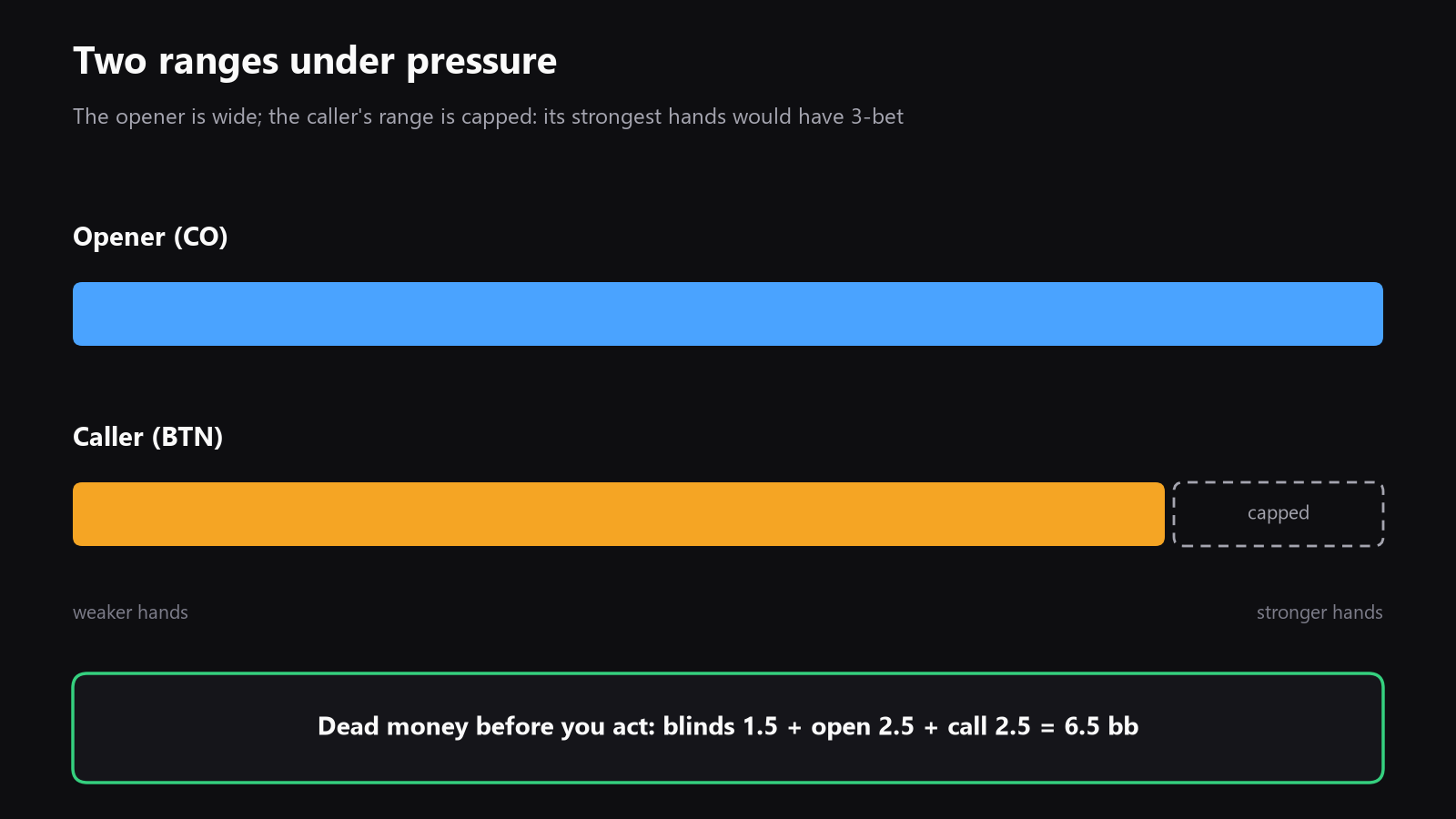
The open raise is already there, and the caller has added chips too. Sometimes the blinds have contributed as well. So before you act, there is already money worth fighting for.
When you 3-bet in this spot, you are not only attacking one player. You are attacking a pot that already contains value.
2. The caller is often capped
A flat call after an open usually means the caller has a range that is weaker or more limited than the opener’s. Many players do not slow-play their strongest hands enough, so the calling range often misses the top of range more often than the opening range does.
That does not mean the caller is always weak. It means their range is often easier to pressure.
3. The opener is trapped in the middle
The opener now has to think about both you and the caller. That makes continuing awkward.
If the opener has a hand that was happy to open but not happy to face a large pot, they often fold. If they continue, they do so with a stronger range than the one they opened with. That is exactly what you want when you squeeze.
The best squeeze spots
Not every open and call is a good squeeze spot.
The best spots usually have these features:
- the opener opens wide
- the caller flat-calls too much and does not continue aggressively enough
- you have position, or at least a strong seat to attack from
- stacks are deep enough for fold equity to matter
- the players behind you are not likely to wake up with a monster too often
The most common squeeze spots are from the blinds against late-position opens, especially when one player has already called.
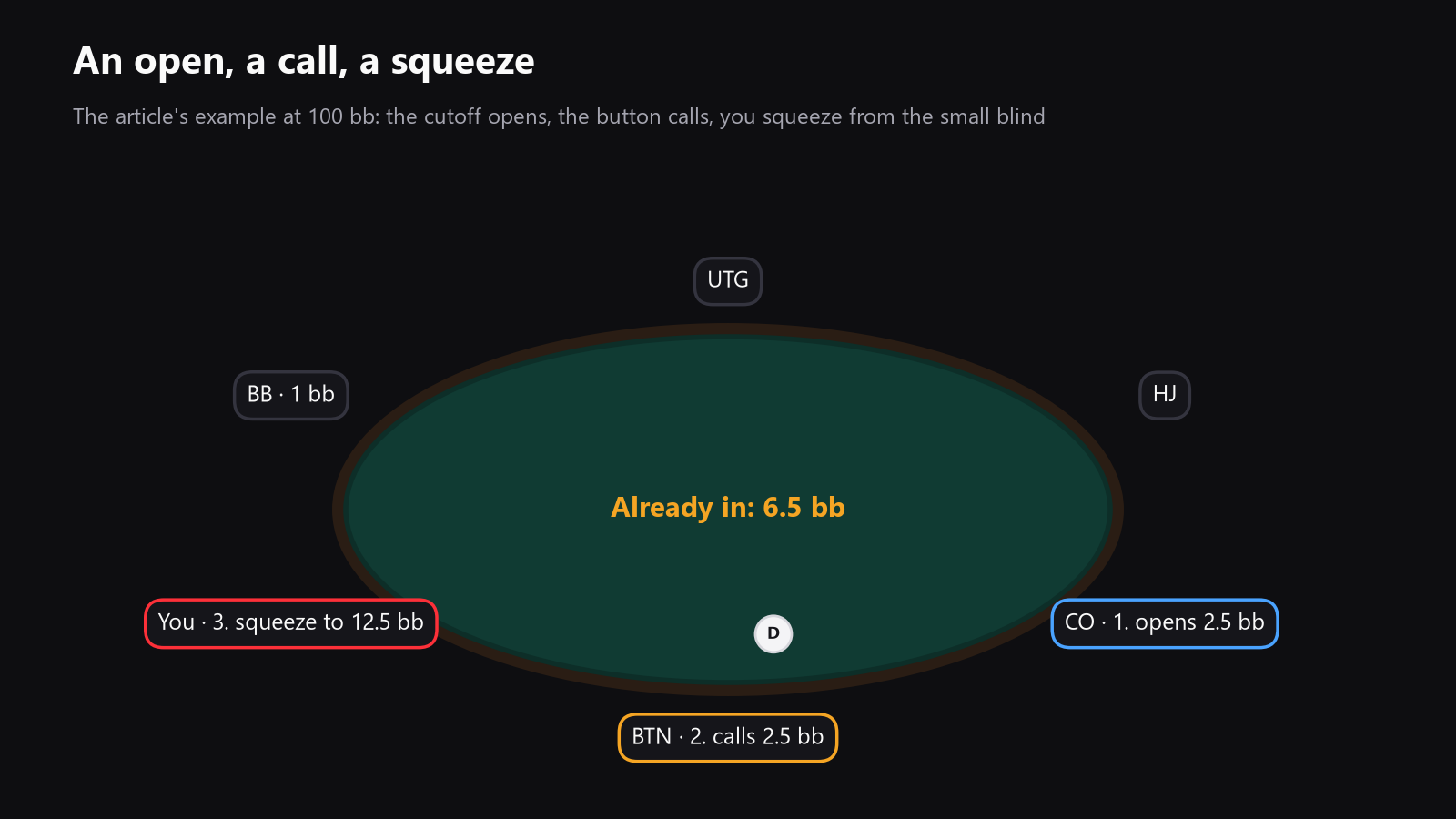
For example, a cutoff open, button call, and your action in the small blind is a classic squeeze setup.
Which hands to squeeze
You should not squeeze only with monsters, and you should not squeeze only with blockers. You want hands that can do well if called, and hands that benefit from fold equity.
Think in three groups.
Value hands
These are the easiest squeezes.
Examples:
- TT+
- AQ+
- AJs, KQs
- sometimes 99 and ATs, depending on the spot
Against loose openers and weak callers, more hands can move into value territory.
Semi-bluffs and blockers
These hands are useful because they block strong continuing ranges and still have playability when called.
Examples:
- A5s to A2s
- KTs, KJs
- QJs, JTs
- some suited connectors when stacks are deep enough
These are not magic hands. They work because the spot is good, not because they contain an ace.
Hands to avoid
Be careful with hands that:
- play poorly in big pots
- make dominated top pairs too often
- have little equity when called
- do not block the continuing range at all
For example, hands like KTo or A9o can look tempting, but they often become trouble hands after the squeeze gets called.
An example squeeze range
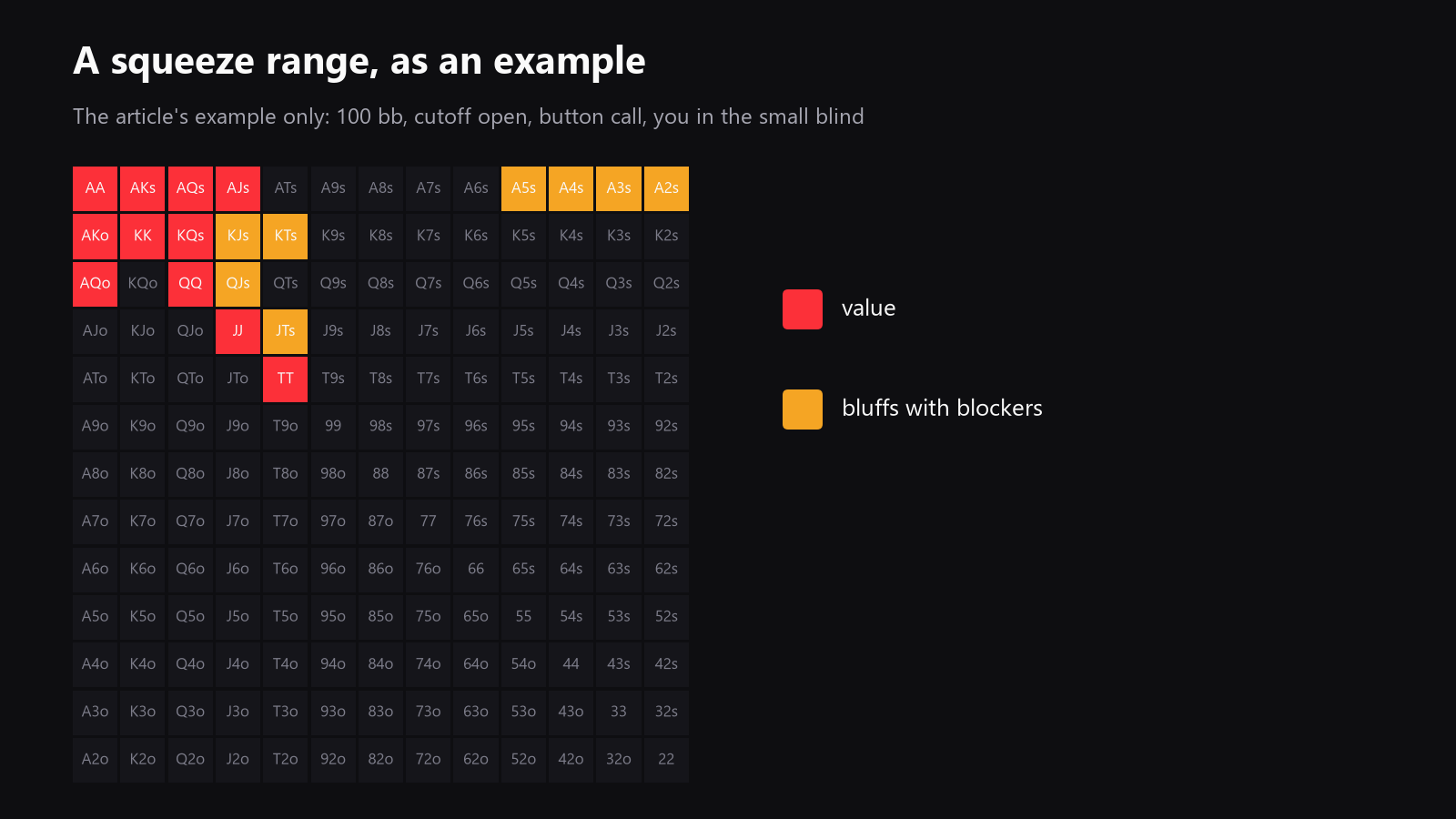
This is only an example, not a universal chart.
Imagine this spot:
- 100bb stacks
- a cutoff open
- a button call
- you are in the small blind
An example squeeze range could include:
- value: TT+, AQo+, AJs+, KQs
- some bluffs: A5s to A2s, KJs, KTs, QJs, JTs
That is not the correct range for every table. It is just an example of how a squeeze range can mix value and bluff hands.
If the opener is tighter, remove the light hands. If the caller is sticky, remove the weaker bluffs. If the table is softer and people overfold, you can often squeeze a little wider.
If you want the exact answer for a given stack depth and seat order, the Solver module can compute the spot directly.
How big should a squeeze be?
A squeeze should be bigger than a normal 3-bet.
A useful rule of thumb is:
take your normal 3-bet size, then add one open size for each caller
So if the open is 2.5bb and one player calls, your squeeze should usually be larger than your usual 3-bet size, often by a full open raise size.
Examples:
- open to 2bb, one caller, squeeze bigger than a standard 3-bet
- open to 2.5bb, one caller, squeeze around 10bb in position or around 12.5bb out of position, for example from the small blind, in many cash-game spots
- open to 2.5bb, two callers, go even larger
The more callers there are, the larger your size should be. You are charging more players, denying better direct odds, and increasing the price for dominated ranges to continue.
Why smaller is usually worse
A small squeeze gives the caller good odds and makes it easier for the opener to continue with speculative hands. It also fails to punish the range that has already shown weakness.
Why too large can also be bad
If you make it unnecessarily huge, you may force out the hands you wanted to target while keeping in only the strongest continues. Then your bluff part loses value and your value hands get less action.
So the goal is not “biggest possible.” The goal is “big enough to punish the spot.”
Who to squeeze against
The answer depends on how people at your table play.
Good targets
Squeeze more against players who:
- open wide
- call too much and then fold too much to pressure
- do not 4-bet enough
- give up too often after calling an open and facing a 3-bet
These are the players who make the squeeze profitable because their ranges are capped and they do not fight back enough.
Bad targets
Be more careful against players who:
- open tight
- flat only strong ranges
- 4-bet aggressively
- continue too much once they enter the pot
Against them, the squeeze works less often, and your bluffs need better playability.
Population reads matter
At many limits, people overcall preflop and under-defend against squeezes. At others, the pool is tighter and more aggressive. You should not assume the same response everywhere.
If you want to know what your pool actually does at your limits, the Reveal module shows real frequencies from your own hand histories. That is useful because a squeeze is only as good as the fold equity you actually get.
Common mistakes
1. Squeezing too wide
Do not turn every suited hand into a squeeze just because there is dead money. If the opener and caller both continue too often, your bluff range gets burned quickly.
2. Ignoring the caller
The caller is the key player in the spot. If the caller is strong, sticky, or under the gun, the squeeze loses a lot of value.
3. Using a normal 3-bet size
A squeeze is not a normal 3-bet. If you size it too small, you let too many hands continue cheaply.
4. Not planning for a 4-bet
Before you squeeze, know what you do versus a 4-bet. Some hands are good squeezes only if you are ready to continue. Others are good because they can fold cleanly.
5. Squeezing with hands that hate contact
Hands that do not play well in big pots often become expensive mistakes. Choose hands that can either win preflop or still function after a call.
A simple preflop checklist
Before you squeeze, ask yourself:
- Did someone open wide enough?
- Did one or more players call with a capped range?
- Is my hand good enough to continue if I get called?
- Is my size big enough to pressure both players?
- Do I know what I do against a 4-bet?
If the answer is yes to most of these, the squeeze is worth serious consideration.
The practical lesson
A squeeze is not just a fancy 3-bet.
It is a pressure spot created by an open raise and a call. The caller is often capped. The opener is stuck in the middle. There is dead money to win. And the right sizing matters as much as the right hand.
If you get these spots right, you stop treating them as random aggression and start using them as a clear preflop weapon.
If you want to study squeezes properly
The clean way to study this spot is to look at your own hands, not a generic answer.
That is where the program helps. The Solver module gives you the equilibrium strategy for a specific squeeze spot, and the Reveal module shows how the pool at your limits actually reacts to pressure. Used together, they help you compare theory with what your opponents really do.
For your own play, that is the difference between guessing and knowing.

Do it on your own hands.