
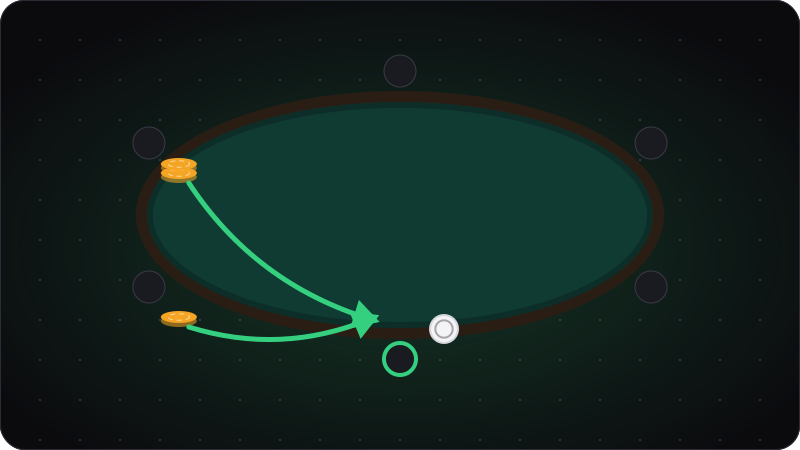
Blind stealing is one of the most profitable habits in poker, but only if you understand what you are actually attacking.
When you open from the cutoff, the button, or the small blind, you are trying to win the dead money in the blinds. Sometimes you get the pot right away. Sometimes you get called and play a pot in position or out of position. Sometimes you get 3-bet and have to continue with a tighter range.
The key idea is simple: you are not raising because every hand is good. You are raising because the pot is often already worth taking, and the players behind you do not defend enough.
What blind stealing means
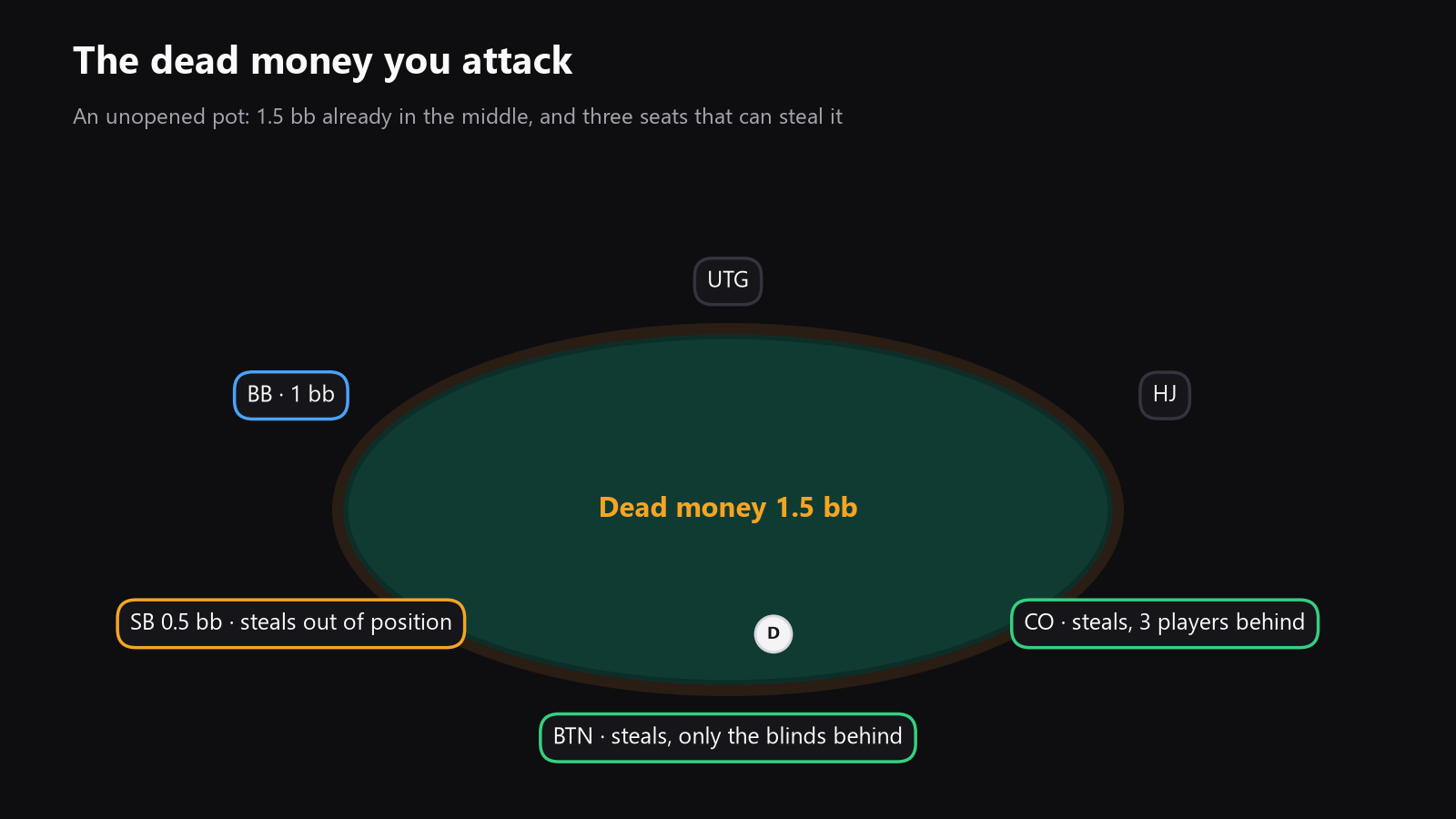
A blind steal is an open-raise made to attack the money sitting in the blinds.
That usually happens from:
- the cutoff
- the button
- the small blind
The term is not limited to spots where only the blinds remain. A cutoff open is also a blind steal, even though the button still acts behind you. What matters is the goal: you are trying to win the dead money from the blinds, or at least make them continue badly enough that your raise is profitable.
That distinction matters because a cutoff steal and a button steal are not identical. In the cutoff, you still have the button and both blinds behind you. On the button, only the blinds remain. In the small blind, you are facing the big blind and will be out of position after the flop.
Why blind stealing works
Blind stealing works for three main reasons.
1. There is dead money in the pot
The blinds already put chips in. If nobody defends, you win those chips without a fight.
2. The blinds must continue without perfect information
They do not know your exact hand, and they have to defend with imperfect ranges.
3. Most pools defend too loosely in some spots and too tightly in others
At micro and small stakes, many players overfold, especially in the blinds against late position opens. Others call too much but 3-bet too little. Both mistakes can be exploited.
The result is that even hands with modest raw strength can become profitable opens if the table gives up often enough.
The break-even math
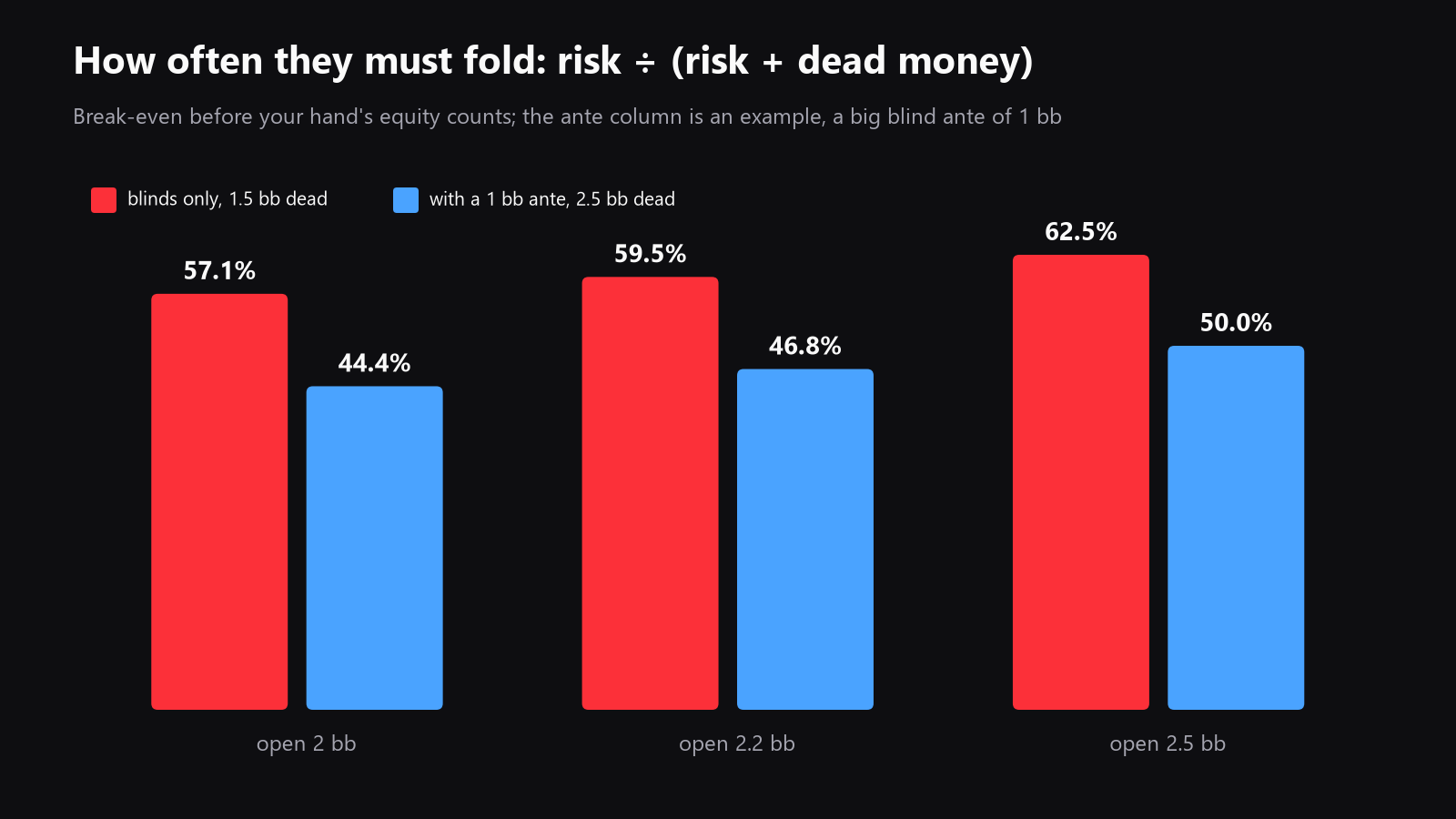
The cleanest way to think about a steal is to ask: how often do the players behind you need to fold for the open to break even before your hand's equity is even counted?
A simple formula is:
Break-even fold frequency = risk / (risk + dead money)
If you raise to 2.5bb and there are 1.5bb in the blinds, your immediate break-even fold frequency is:
2.5 / (2.5 + 1.5) = 62.5%
So if your hand had no equity after being called, you would need the table to fold 62.5% of the time just to break even.
With a smaller open size, the break-even point falls:
- 2.0bb open into 1.5bb dead money: 57.1%
- 2.2bb open into 1.5bb dead money: 59.5%
- 2.5bb open into 1.5bb dead money: 62.5%
If there are antes, the dead money is larger, so stealing becomes easier.
The important caveat
That math is only the floor.
In real poker, your hand has equity when called. In position, you also realize more of that equity than the player in the blinds usually does. So a hand can be profitable even if the raw fold frequency looks mediocre.
That is why hands like suited aces, suited broadways, pocket pairs, and connected hands often make good steals. They do not need the blinds to fold every time. They just need enough fold equity, plus enough playability when called.
Why the cutoff, button, and small blind differ
You should not treat every steal spot as the same.
Cutoff
The cutoff is a strong stealing seat because you are close to the button and still have good positional leverage, but there are more players left to act than on the button.
A cutoff steal gets better when:
- the players behind you do not 3-bet often
- the blinds fold too much
- the blinds do not punish you with frequent 3-bets
- the players behind you do not call too wide
The cutoff is often stealable with a fairly wide range, but usually not as wide as the button.
Button
The button is usually the best blind-stealing seat in cash games and many tournaments.
Why?
- you have position on both blinds
- you act last after the flop
- you realize equity well
- the pot is still small enough that dead money matters a lot
If both blinds overfold, the button becomes a very profitable place to attack. If one blind fights back with a lot of 3-bets, you still may steal profitably, but your range must be more robust.
Small blind
The small blind is different because you are attacking only the big blind, but you will be out of position postflop.
That changes the hand selection. A hand that is fine on the button may be worse in the small blind because it realizes equity more poorly when called.
In the small blind, you generally want:
- hands that play well out of position
- hands that can continue against 3-bets
- hands that do not hate being forced into bigger pots
If the big blind folds too much, you can steal wider. If the big blind calls too much, you should prefer hands with playability. If the big blind 3-bets often, you need hands that can continue or apply pressure back.
How fold-to-steal and 3-bet stats change your range
This is where many players go wrong.
They look at one number, such as fold-to-steal, and stop there. But a steal is shaped by both fold frequency and resistance.
If you open from the button, for example, you do not just care that the blinds fold a lot. You care about the combined behavior of both blinds, and about how often either one 3-bets.
Think in layers
A blind steal is not only about whether players fold. It is also about what happens when they do not fold.
You want to know:
- how often the blinds fold preflop
- how often they call
- how often they 3-bet
- how they play after the flop if they continue
A player who folds a lot but 3-bets aggressively can still make some steals awkward. A player who calls too much may give you postflop edges, but your pure steal profit drops. A player who does both badly is ideal.
Four useful patterns
1. High fold-to-steal, low 3-bet
This is the green light.
You can widen your opens because the blinds give up too much and do not punish you enough.
2. High fold-to-steal, high 3-bet
Still stealable, but your range must be tighter and better constructed.
Prefer hands that:
- realize equity well
- can continue against pressure
- have blockers
- do not suffer too much in bigger pots
3. Low fold-to-steal, low 3-bet
This is not a free money spot anymore.
You will see flops more often, so your postflop skill matters more. That can still be profitable if the players in the blinds are weak after the flop, but it is different from a pure preflop print.
4. Low fold-to-steal, high 3-bet
This is the toughest environment.
You should tighten your steal range unless you have a clear reason to attack, such as a player who overbluffs, overfolds to 4-bets, or plays badly postflop.
A practical rule of thumb
- High fold-to-steal and low 3-bet: widen a lot
- Moderate fold-to-steal and low 3-bet: widen some
- Low fold-to-steal and high 3-bet: steal selectively
- Unknown opponent: start tighter, then expand when the sample proves it
One stat can mislead you. A larger sample, or the field-level view of a pool, is much more reliable.
What hands steal well
A good steal range is not just a pile of garbage hands.
The best stealing hands usually have one or more of these features:
- decent raw equity when called
- good playability after the flop
- blockers to strong continuing ranges
- the ability to make top pair, strong draws, or hidden value hands
- good equity realization in position
That is why the following types of hands often work well in steal spots:
- pocket pairs
- suited aces
- suited broadways
- suited connectors and one-gappers
- some offsuit broadways
- some wheel hands
Pure offsuit trash tends to collapse when called. If the blinds defend honestly, those hands lose value very quickly.
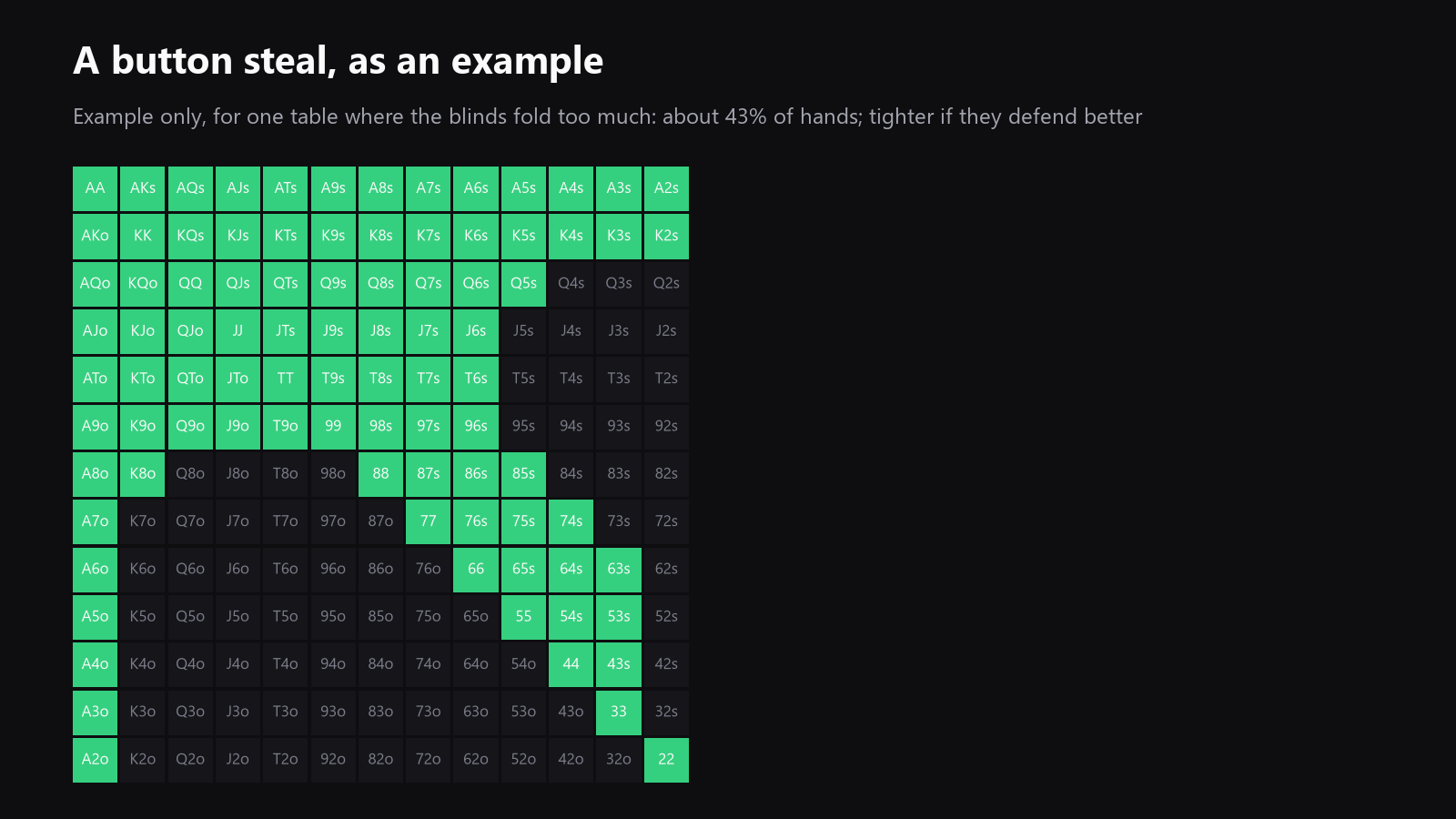
This grid is only an example, not a universal chart. It assumes a table where the blinds overfold enough that a wide button steal makes sense.
If the blinds defend better, the example range should shrink. If they overfold more, it can expand.
Cash games versus tournaments
Blind stealing matters in both formats, but for different reasons.
Cash games
In cash games, rake is a major factor.
That matters because many steals are thin. A spot that looks profitable before rake can become marginal once the pot gets taxed. At small stakes, that can change your opening decisions a lot.
So in cash games, do not widen automatically just because the blinds look weak. If the rake is heavy, your thin steals need real support from fold equity and postflop realization.
Tournaments
In tournaments, antes make blind stealing more profitable because the pot starts larger.
A well-chosen steal can build your stack without showdown. Late in a tournament, stack sizes also create pressure, which can make blinds fold more than they would in a cash game.
But ICM changes the value of chips. On the bubble or at a final table, a chip-EV steal can become a bad tournament-EV steal if the stacks behind you can punish you hard enough.
So the general rule is:
- more dead money makes stealing better
- more ICM pressure makes reckless stealing worse

Common mistakes when stealing blinds
1. Using one open range everywhere
A button steal against two tight blinds is not the same as a button steal against a sticky big blind and an aggressive small blind.
2. Looking only at fold-to-steal
You also need to know how often the blinds 3-bet and how they behave after they continue.
3. Ignoring position
A small blind steal is not the same as a button steal. Out of position changes the value of many hands.
4. Forgetting rake
Especially in cash games, small pots get taxed hard. Thin steals can disappear if you ignore the rake.
5. Stealing into bad stack depths
Short stacks behind you can reshove more often. Deep stacks can make postflop pressure much stronger. Your steal range should change with stack size.
6. Never adjusting to the pool
If your pool overfolds from the blinds, a static range leaves money on the table.
How to study blind stealing better
You do not have to guess.
You can study:
- how often the blinds fold to opens from late position
- how often they 3-bet
- how much rake your small pots are paying
- which seats give you the best steal opportunities
- how your open range should change when the blinds defend better
That is where the Reveal module and the Dashboard module help. Reveal shows what players at your limits actually do by street and spot, and the Dashboard shows your result next to the rake so you can see whether those small wins are really as good as they look.

The short version
Blind stealing is profitable because you are attacking dead money, imperfect defense, and often poor response frequencies.
To steal well, you need to know:
- how much dead money is in the pot
- how much your open risks
- how often the players behind you fold
- how often they 3-bet
- whether rake or ICM changes the spot
If the blinds overfold and do not fight back enough, widen your steals. If they defend aggressively, tighten up and choose hands that play well when called or 3-bet. And if you want to stop guessing, study the actual pool instead of inventing a range from memory.
Do it on your own hands.