
If you want to understand preflop 4-bets and 5-bets, start with the sequence.
One player opens.
Another player 3-bets.
The first player can then 4-bet.
If the 3-bettor raises again, that is a 5-bet.
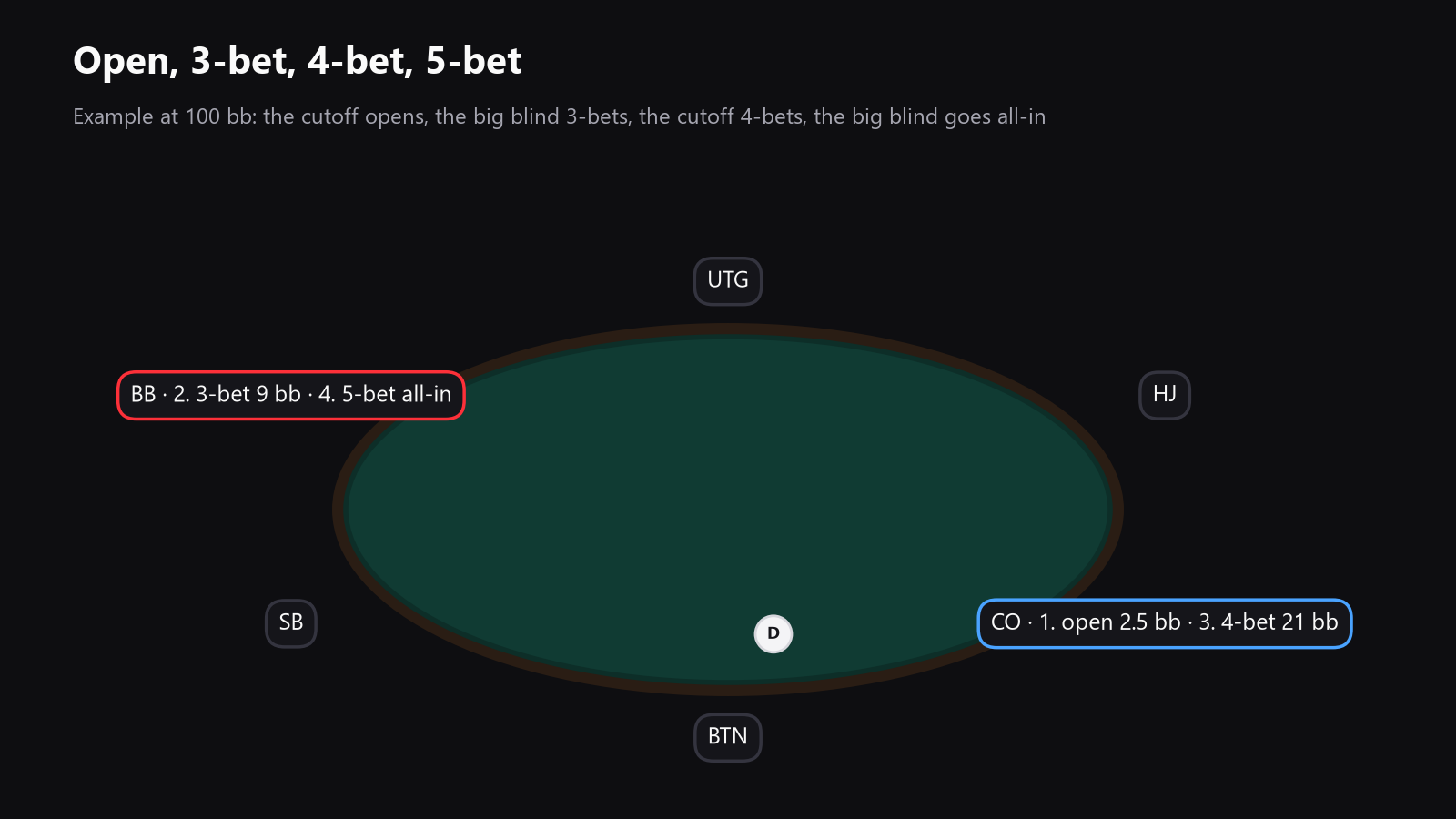
In practice, when players say 5-bet, they usually mean a 5-bet all-in. A small 5-bet can exist in deeper spots, but at 100 big blinds, the hand often ends in a shove or a fold.
That is the core idea of this article. Not the name of the raise, but what the raise is doing:
- building a pot with strong hands
- making worse hands pay
- denying equity
- using blockers to steal folds
- deciding when the stack is going in
What a 4-bet really is
A 4-bet is not automatically all-in.
It is simply the next re-raise in the sequence.
That matters, because many players mix up two different questions:
- Should I 4-bet?
- If I 4-bet, can I continue versus a shove?
Those are not the same question.
A hand can be good enough to 4-bet and still fold to a 5-bet jam in some spots. Other hands want to 4-bet and happily stack off. If you do not separate those two decisions, you will make your preflop game too rigid.
A good 4-bet usually does one of three jobs:
- it gets value from hands that call too wide
- it takes the pot down against a range that folds too much
- it sets up an easy stack-off with your strongest hands
Value 4-bets
A value 4-bet is a hand that wants action.
The exact range depends on position, stack depth, open size, 3-bet size, and the player pool, but the logic is stable:
- you 4-bet for value when your hand performs well against the hands that continue
- you want to make worse hands pay
- you do not mind getting the money in if villain continues aggressively
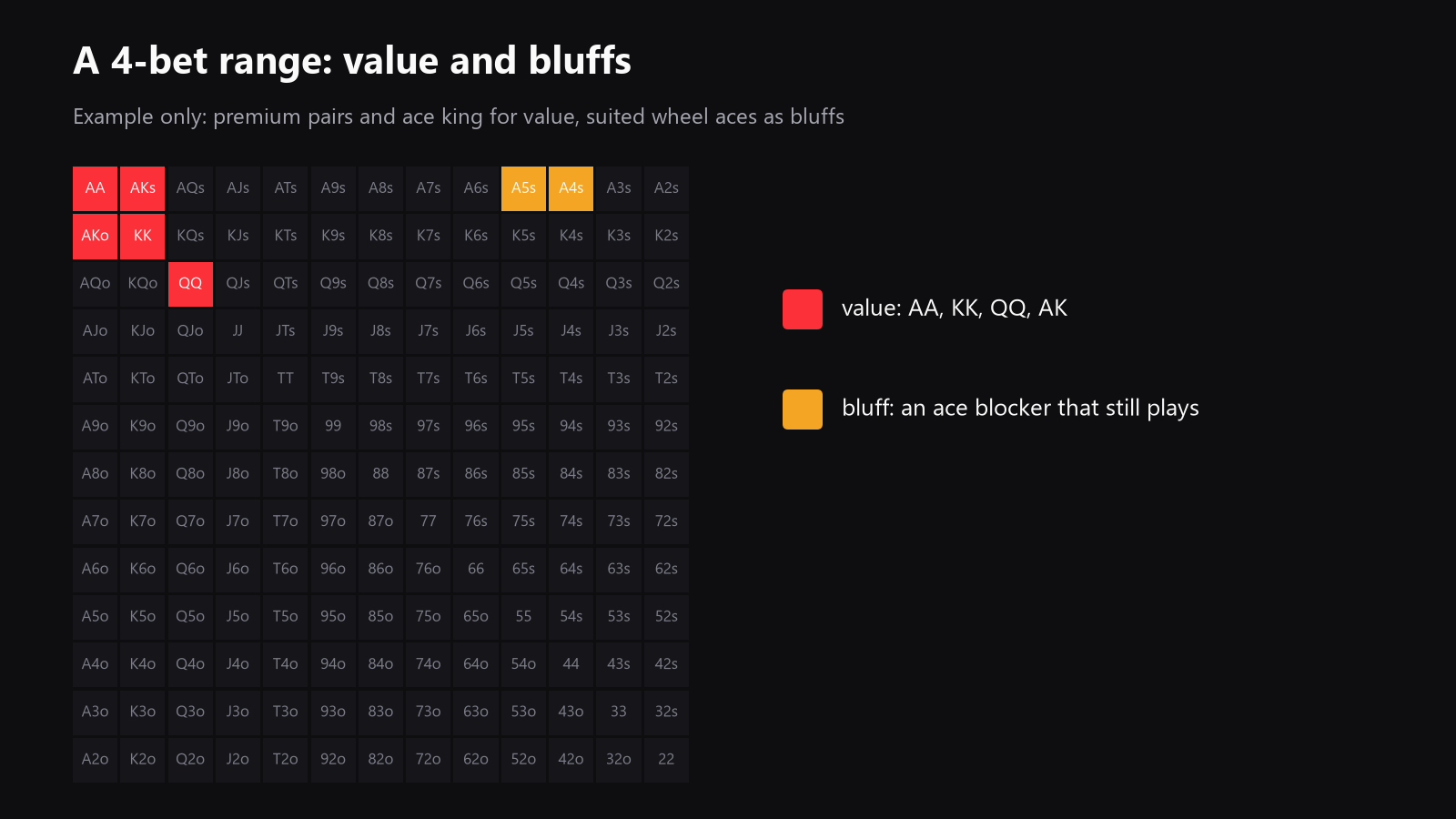
Typical value 4-bet hands include premium pairs and premium broadways, often something like AA, KK, QQ, AK. Depending on the spot, JJ or AQs can sometimes belong there too, but not always.
That last part matters. There is no single universal 4-bet chart that fits all pools. A tight 3-bettor in early position, a loose button 3-bettor, and a blind versus blind battle are three different games.
A useful rule is this:
- if villain 3-bets too tight, your value 4-bets get narrower
- if villain continues too wide, your value 4-bets can get thinner
- if villain is willing to stack off too light, your value hands should 4-bet more often
Sometimes calling the 3-bet is better than 4-betting with a medium-strength hand. Why? Because a call keeps worse hands in, controls the pot, and can realize equity more comfortably. That is why hands like QQ, JJ, or AQ are often mixed between call and 4-bet depending on the situation.
Bluff 4-bets with blockers
A bluff 4-bet is not a random raise.
It should usually have two things:
- blockers
- at least some playability if called
A blocker is a card that removes combinations from the opponent's strongest continuing range. The classic examples are an ace or a king.
Why does that matter?
Because if you hold an ace, you reduce the number of AA and AK combinations villain can have. If you hold a king, you reduce KK and AK combinations. That makes your bluff more attractive, because it is less likely that villain has the hands that want to continue.
This is why suited wheel aces, especially A5s and A4s, show up so often as bluff 4-bets. They block strong continuing hands, and they still have some equity and playability if called. They can make wheel straights, they can make nut flushes, and they are not dead when they see a flop.
By contrast, offsuit hands with a blocker are often much worse. An offsuit hand may block one strong combo class, but if it has poor postflop equity, it is a weak bluff candidate.
A simple way to think about it:
- best bluff 4-bets: blocker plus playability
- worse bluff 4-bets: blocker only
- bad bluff 4-bets: no blocker, poor playability, no clear fold equity
Usual 4-bet sizes
There is no magic number, but there are practical defaults.
A common working range is:
- in position: about 2.1x to 2.3x the 3-bet
- out of position: about 2.4x to 2.8x the 3-bet
If the 3-bet was very small, you often need to go a little larger in absolute terms. If stacks are deeper, the same relative size can still work, but the strategic meaning changes because there is more money behind. If stacks are shorter, the size naturally shrinks.
A few practical examples:
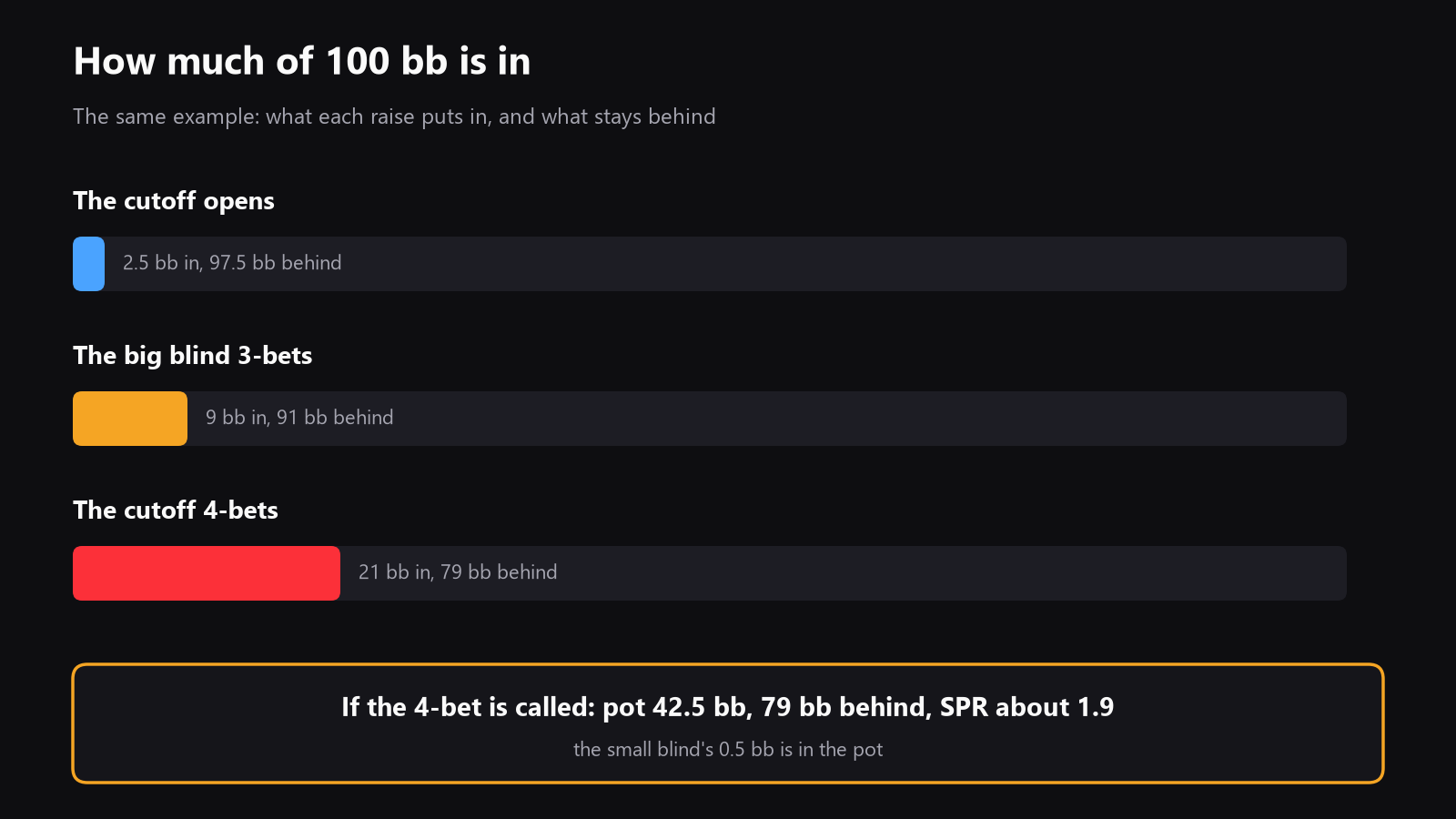
- open to 2.5bb, face a 9bb 3-bet, 4-bet to around 19bb to 21bb in position, and around 22bb to 25bb out of position
- open to 2.5bb, face a 10bb 3-bet, 4-bet to around 21bb to 23bb in position, and around 24bb to 28bb out of position
Do not obsess over one exact number. The goal is not to memorize a rigid size. The goal is to make a size that matches the hand class and the stack depth.
A good size should do three things:
- deny comfortable realization to the 3-bettor
- not risk more than necessary with bluffs
- leave the stack geometry sensible for value hands
That is why a min 4-bet is usually a leak. It gives villain great odds and creates a strange tree. At the other extreme, a very large 4-bet can burn too much value with bluffs and make your range too easy to read.
When a 4-bet commits the stack at 100bb
This is one of the most misunderstood parts of the spot.
A 4-bet does not automatically mean you are committed at 100bb.
But at 100bb, many 4-bets create a stack-to-pot ratio so low that folding to a 5-bet shove becomes very hard with the top of your range.
That means you should think in pot odds, not in feelings.
Ask yourself:
- how much money is left after I 4-bet?
- what does villain do with his continue range?
- if he jams, what price am I getting?
- how often does my hand beat his jamming range?
The answer is not the same in every spot.
For example, a 4-bet from the button against a blind 3-bet behaves differently from a 4-bet out of position against a tight early-position 3-bettor. The same hand can be a clear continue in one tree and a clear fold in another.
A useful mental shortcut is this:
- the stronger your hand, the more comfortable you should be with a 5-bet shove
- the weaker your hand, the more your 4-bet has to rely on fold equity
- the bigger your 4-bet, the less room you leave yourself to fold
That last point is the key.
If you size too big, you may turn a profitable bluff into an awkward half-commitment. If you size too small, you may give villain a cheap decision and let him continue too wide.
The exact stack-off point is not a slogan. It is a calculation.
If you want the raw math, the Equity module shows how much of the pot your hand owns against a chosen range. If you want the equilibrium strategy of a spot, the Solver module shows the strategy grid for that spot, with 169 starting hands coloured by action and the result figures beside them.
What a 5-bet all-in means
A 5-bet all-in is usually a very strong action at 100bb.
Most of the time, it is value-heavy. The player who 5-bet jams is saying, in effect, that the stack is ready to go in now.
Typical 5-bet jam value hands often include:
- AA
- KK
- sometimes QQ
- sometimes AK
The exact range again depends on the pool and the positions. A player who 4-bets too wide and then folds too much to jams can be punished more aggressively. A player who 4-bets only the top of range and never bluffs does not give you much room to fight back.
Can you bluff 5-bet jam?
Sometimes, but very carefully.
A bluff 5-bet all-in needs:
- strong blockers
- good evidence that villain 4-bets and folds enough
- a stack depth where fold equity is real
At micro and small stakes, many players do not need much bluffing in the 5-bet node. The pool often underbluffs there already. That means your main adjustment is usually to tighten your continues, not to invent fancy jams.
The biggest mistakes players make
1. They bluff 4-bet too often against callers
If a player 3-bets, then continues too much versus 4-bets, your bluff 4-bets lose value quickly.
You do not beat a calling station by having a pretty blocker.
You beat him by value 4-betting thinner and bluffing less.
2. They use bad blocker hands
Not every ace-x hand is a good bluff 4-bet.
Not every king-x hand is good either.
You want a hand that blocks strong continues and still has some postflop life if called. That is why suited wheel aces are so common and why random offsuit junk is usually bad.
3. They use one size for every spot
A blind versus blind 4-bet is not the same as a 4-bet against an early-position 3-bet.
If you use the same size everywhere, you ignore position, range strength, and stack depth.
4. They think 4-bet means all-in
Sometimes it does, but not always.
At 100bb, a 4-bet is often a setup for a future all-in, not the all-in itself. That distinction matters for range construction.
A practical way to study the spot
The fastest way to improve here is not to memorize a chart and stop thinking.
It is to ask better questions.
For every 4-bet spot, ask:
- who opened?
- who 3-bet?
- what does the 3-bettor continue with?
- which hands want value?
- which hands want to bluff with blockers?
- what happens if villain jams?
If you want to study the exact answer for a concrete spot, the Solver module shows the equilibrium strategy for that spot. If you want to see how the players at your limits actually react, the Reveal module tells you what they do in real hands from your own history. And if you are down to a short-stack decision where the choice is basically push or fold, the Decisions module handles that tree directly.
The point is not to find one sacred 4-bet chart.
The point is to understand why a hand wants to 4-bet, when it wants to continue, and when it should simply call or fold.
That is how 4-bets and 5-bets stop being scary labels and become a clear part of your preflop game.
Do it on your own hands.