
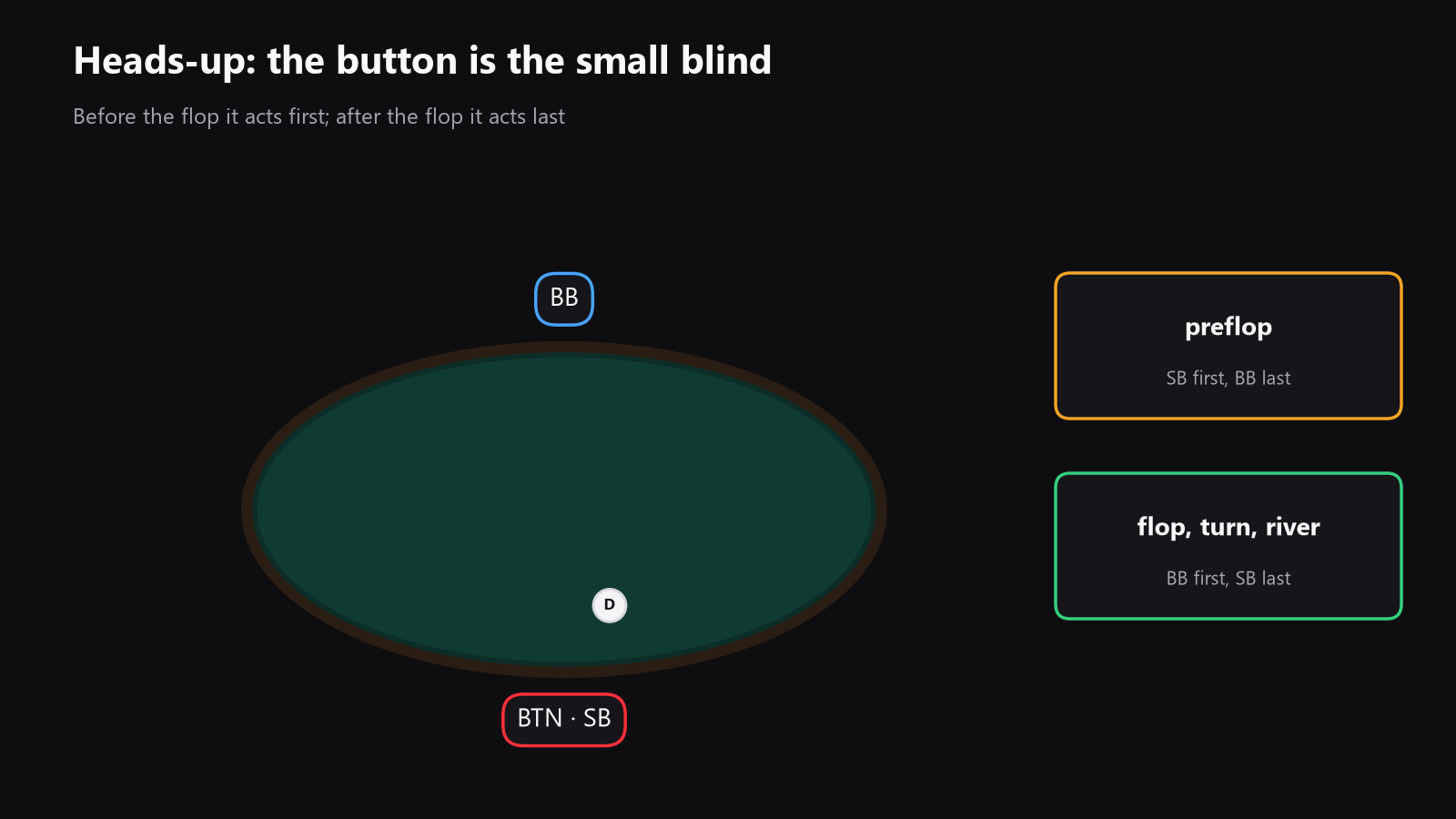
In Spin & Go heads-up, the game changes in a way that catches many players off guard. The small blind is the button, so you act first before the flop and last after it. That is a huge deal.
Preflop, you must choose your action without seeing what the big blind will do. Postflop, the same seat gets the final word on every street. So heads-up is not just "short-handed poker with two players left". It is a game where position flips in a strange way, and stack depth decides how much that matters.
Why heads-up Spin & Go feels different
If you come from six-max or full-ring, your instinct may be to think in terms of blind stealing and survival. In heads-up, that is too narrow.
You are opening from the button, but you are also the player with position after the flop. That means:
- you can open a wider range than you would from any other seat,
- you must still respect the possibility of a shove behind you,
- and once the flop comes, you get to control the hand more often than your opponent does.
The best heads-up players are comfortable living in both worlds at once. They know when the hand is really a preflop all-in decision, and when it is better to keep chips in play and use postflop position.
Stack depth changes the whole game
The deeper the stacks, the more postflop play matters. The shorter the stacks, the more the hand collapses into shove or fold decisions.
A useful baseline comes from push/fold heads-up in chips, computed with Poker Exploit in a pure all-in or fold model, without antes unless stated otherwise. This baseline does not tell you whether a smaller raise or a limp is better. It only tells you what the all-in game looks like.
| Effective stack | Small blind shove range | Big blind call range |
|---|---|---|
| 3 bb | 77.1% | 92.4% |
| 5 bb | 72.6% | 61.4% |
| 8 bb | 61.7% | 44.8% |
| 10 bb | 57.2% | 37.4% |
| 12 bb | 52.4% | 32.9% |
| 15 bb | 44.6% | 27.9% |
| 20 bb | 40.3% | 21.7% |
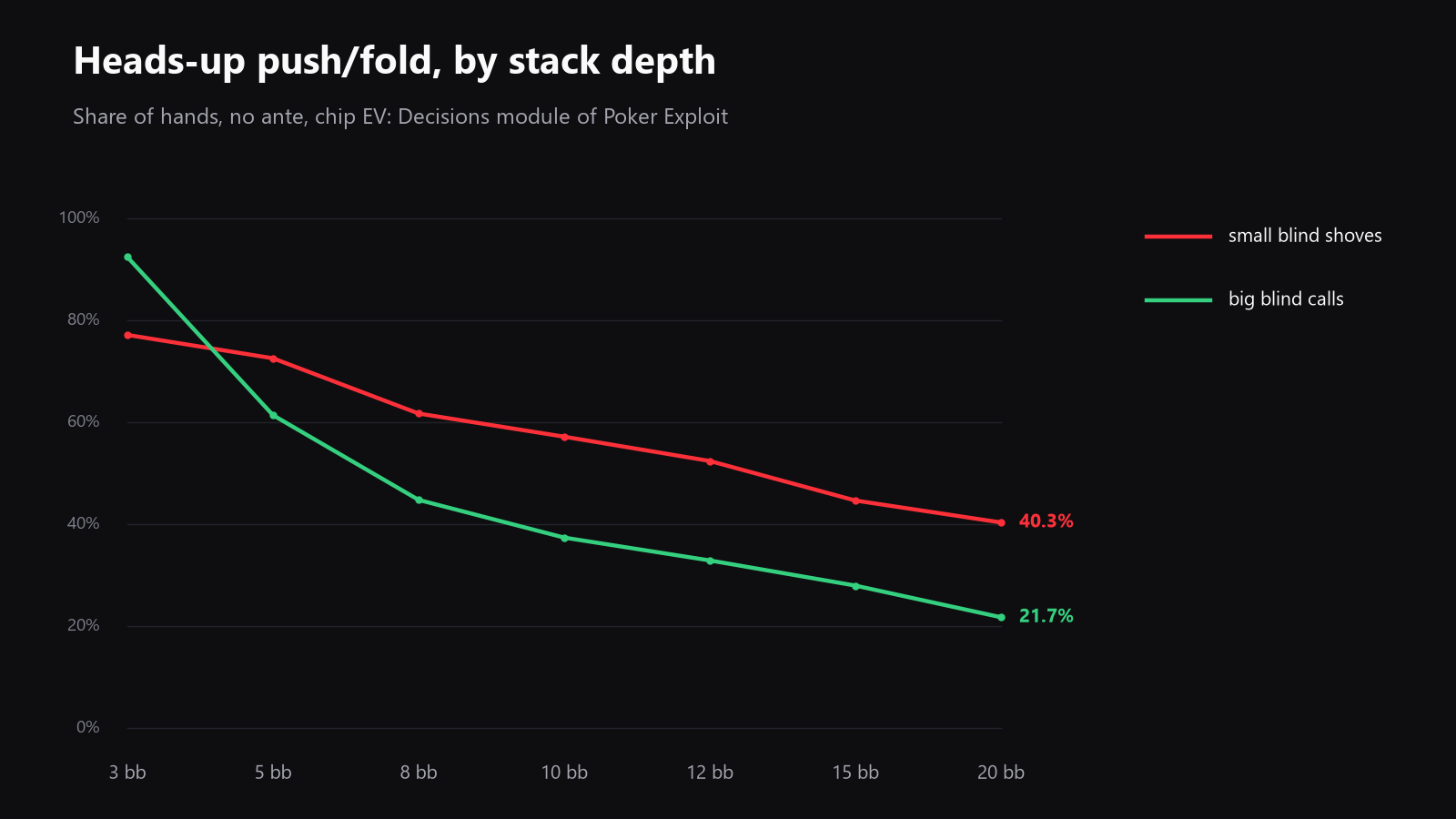
The lesson is not to memorize those numbers blindly. The lesson is to feel the shape of the game:
- at 20 bb, you still have room to raise and play poker after the flop,
- at 12 to 8 bb, shove pressure starts to matter a lot,
- at 5 bb and below, the game is close to pure push/fold.
If you are short, every chip matters more. If you are deeper, the ability to play later streets becomes worth more than raw preflop aggression.
Raising sizes against shoving
A lot of players ask the wrong question here. They ask, "What open size should I use?" The better question is, "What size gives me the best decision tree against the range that can shove on me?"
That is why there is no magic raise size.
If the big blind is shoving too much, you do not automatically need a bigger raise. In many cases, a larger open just creates a larger pot and gives the shove more chips to win when you fold. If your opponent is overjamming, the more useful exploit is often to keep your opening size compact and widen the hands you can continue with.
Use this rough logic:
- If the big blind overfolds, you can open wider and sometimes size up a little.
- If the big blind overjams, a smaller open often works better, because you risk less and keep your range flexible.
- If you are deep enough that postflop edges still matter, do not turn every spot into a preflop all-in test.
The important thing is that your open size and your continuing range belong together. A raise size is not good because it is "aggressive". It is good if it makes the opponent’s response worse for them.
How to call a shove
Calling a shove in heads-up Spin & Go is where many players lose money by thinking in feelings instead of ranges.
Do not ask, "Do I like this hand?" Ask, "Does this hand beat the shove range often enough for the price I am getting?"
That answer depends on:
- effective stack,
- how wide the shover really is,
- how much dead money is in the pot,
- and how much equity your hand has against that range.
A few practical ideas:
- Against a very wide shover, you can call wider with hands that dominate the extra junk in their range.
- Against a tighter shover, medium-strength hands lose value fast.
- When stacks are short, calling ranges can be very wide if the shove range is wide enough.
- When stacks are a little deeper, the cost of a bad call rises, because you are risking more chips for less immediate reward.
This is why push/fold charts are useful, but only as a floor. They are the baseline for the spot where the only choices are all in or fold. They do not tell you whether a smaller raise or a limp would be better.
What changes after the flop
Once the flop comes, you still have one huge advantage: you are the button.
That means you act last on the flop, turn and river. In heads-up play, that position is worth a lot. It lets you:
- realize equity more efficiently,
- control the size of the pot,
- use smaller continuation bets when the board favors your range,
- and check more often when the board favors the big blind.
A few practical adjustments matter a lot:
On dry boards
When the board is dry and disconnected, your range often has the better overcards and more top-pair candidates. You can often c-bet small and put pressure on hands that missed.
On connected boards
When the board is wet, the big blind’s defended range connects more often. You need more checking, more pot control, and more respect for raises and check-raises.
With shallow stacks
When stacks are short, one bet can commit the hand. That means your flop decision is often also your turn decision. Plan ahead. Do not bet flops without knowing what happens on many turn cards.
With deeper stacks
When stacks are deeper, postflop skill matters more. You can slow down, keep weaker hands in range, and use position to make the big blind guess more often.
The big idea is simple: heads-up is not only about preflop pressure. It is about using the button to keep the hand on your terms once the flop appears.
How to study heads-up spots away from the table
You will improve faster if you study heads-up spots by stack depth and street, not as one giant blur.
A clean study routine looks like this:
- Start with preflop. Use a push/fold baseline first. That gives you a reference point for shove and call decisions.
- Move to the flop. Pick common board types, such as dry high-card boards, low connected boards, and paired boards.
- Ask one question at a time. Should you bet small, bet big, check, call, or shove? Do not try to solve the whole hand at once.
- Write down the exploit. If your opponent overfolds, attack more. If they overcall, value-bet thinner. If they overjam, widen your continue range.
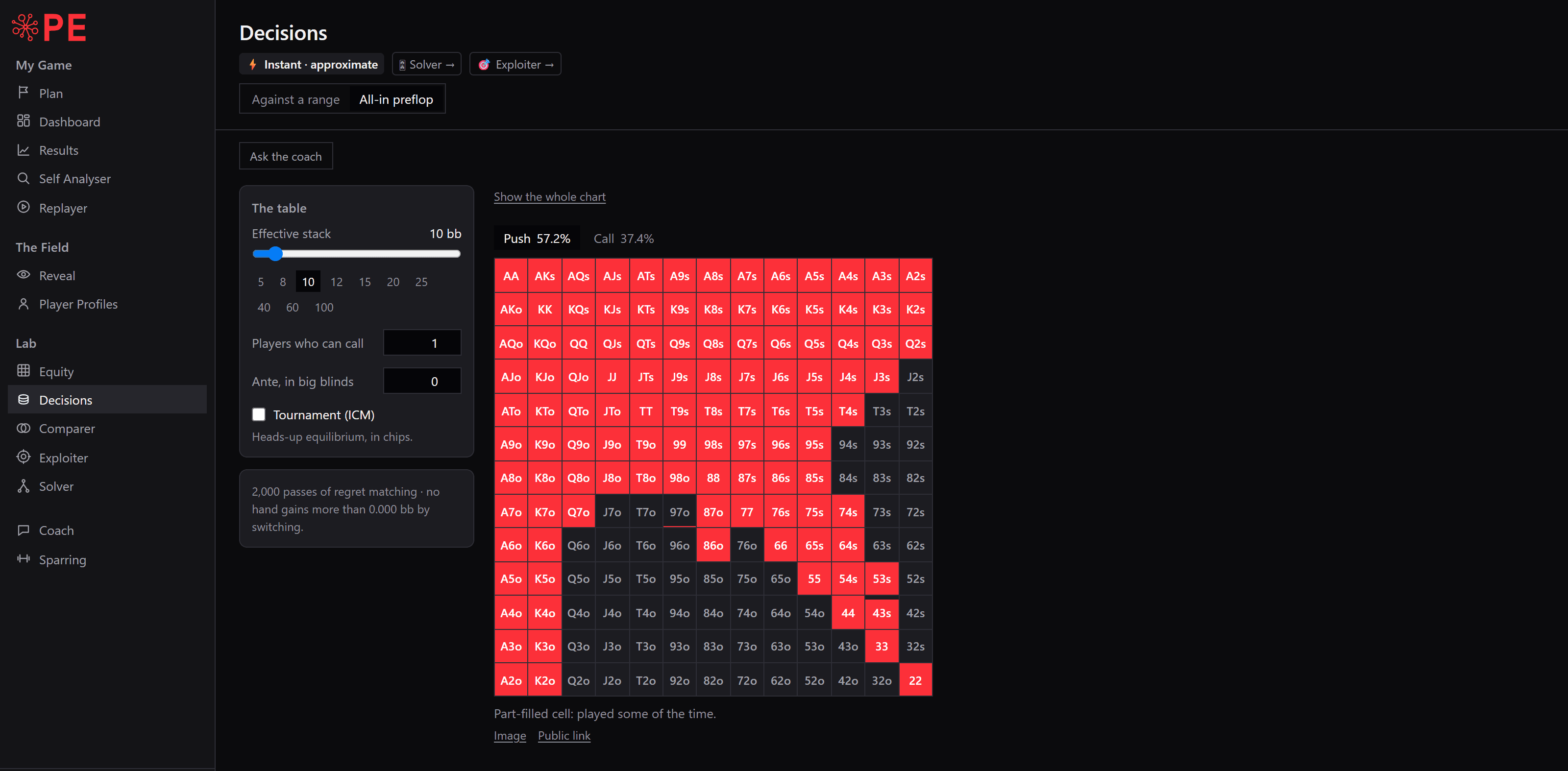
For preflop work, the Decisions module gives you push, fold or call with a short stack, plus push/fold charts.
For postflop work, the Solver module gives you the equilibrium strategy of a two-player spot, turn and river included, as a grid of the 169 starting hands with action and result figures. It computes away from the table and refuses hands from the session in progress.

That is the real study edge: not memorizing random charts, but training your eye on the exact heads-up spots you actually play.
The short version
If you want to play heads-up Spin & Go better, remember this:
- the small blind is the button,
- position flips after the flop,
- stack depth changes everything,
- push/fold is a baseline, not the whole strategy,
- and postflop edge comes from using the button well.
If you want a structured way to study those spots away from the table, Poker Exploit gives you the push/fold baseline in the Decisions module and deeper postflop work in the Solver module.
Do it on your own hands.