
Three-handed is where a Spin & Go stops feeling like a generic preflop game and starts feeling like a stack-depth puzzle.
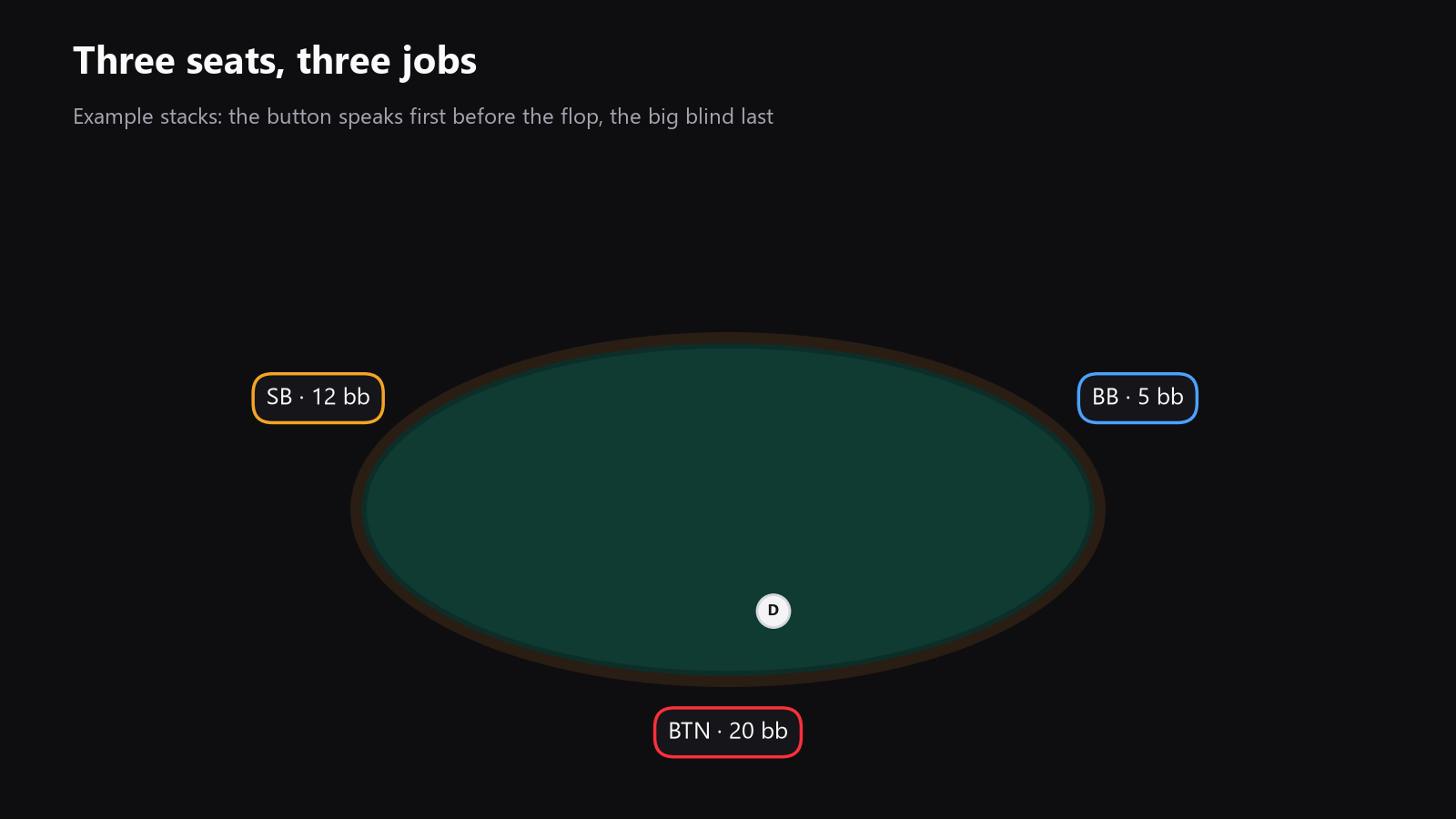
At this stage, you are no longer asking only, “What hand do I have?” You are asking, “What happens if I raise small, limp, or shove, and how do the two other stacks change that answer?”
That last part matters more than most players think.
Spin & Go payouts vary by multiplier. When the Spin pays the winner alone, which is most often the case, chip EV is the right first lens for this phase. That means the best starting point is not a vague feel for aggression, but a clear understanding of which hands belong in a shove range, which hands belong in a small open, and which hands belong in a limp range.
The main lesson: three-handed poker is not one fixed strategy. It is a moving set of thresholds, and stack depth decides which branch of the tree you should use.
1. Why stack depth changes everything
At three-handed, the same hand can play very differently at 5 bb, 10 bb, or 20 bb.
Short stacks push you toward binary decisions. Deep enough stacks give you room to choose between:
- a shove,
- a small raise,
- a limp,
- or a fold.
The deeper you are, the less often a pure shove is the whole answer. The shorter you are, the more often it is.
That is why a three-handed Spin & Go is really two games at once:
- a short-stack all-in game,
- and a deeper-stack opening game.
The first one is where push/fold charts matter most. The second one is where limps and small raises start to matter a lot more.
2. The button: two players still behind you
When you are on the button and both blinds are still to act, your shove has to survive two possible continuing ranges. That is why the button is not the freest jamming seat, even though it has position after the flop.
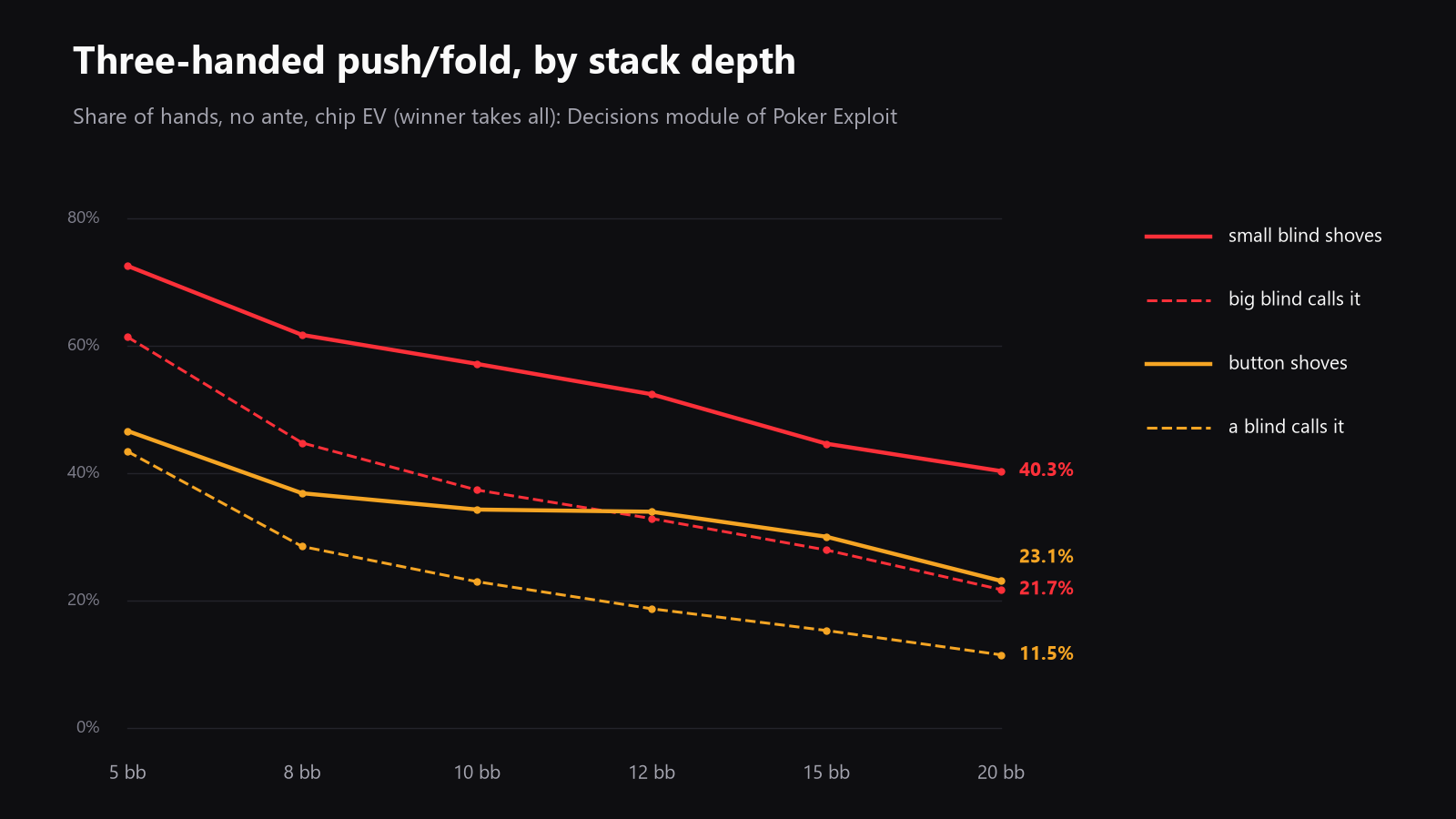
Computed with Poker Exploit, here is the equilibrium shove and blind-call picture for the button when the model allows only one caller, in chips and without antes:
| Stack depth | Button shove range | Blind call range (vs. the button's shove) |
|---|---|---|
| 5 bb | 46.6% | 43.4% |
| 8 bb | 36.9% | 28.5% |
| 10 bb | 34.3% | 23.0% |
| 12 bb | 34.0% | 18.7% |
| 15 bb | 30.0% | 15.3% |
| 20 bb | 23.1% | 11.5% |
With two players behind, that model understates how often the button gets called, so real three-handed shoving ranges are somewhat tighter.
Two things stand out immediately:
- from 5 bb to 20 bb, the button shove range drops from 46.6% to 23.1%, a fall of 23.5 points,
- the blind call range also tightens sharply, from 43.4% to 11.5%.
That is exactly what you should expect. The deeper you are, the more the shove range narrows, because each shove risks more chips to win the same blinds.
What this means in practice
At very short stacks, the button can jam a lot. At 5 bb, nearly half of all starting hands belong in the shove range in this model.
As stacks get deeper, the button should stop thinking only in all-in terms. Some hands that are not good shove candidates can still be better used in a smaller open or a limp when stacks are deeper. A shove wins the blinds now, but it also throws away postflop equity and folds out hands you might have earned value from.
So the rule is not “shove less because you are scared.” The rule is “shove less because the hand is deep enough to play a better tree.”
Method note: these numbers are push/fold equilibrium figures for a game where the only choices are all in or fold. They do not say whether a smaller raise or a limp is better with the rest of the stack.
3. The small blind: one player left, so the shove widens
Once the button folds and you are in the small blind against the big blind, the structure changes again.
Now you only need to get through one player, so your shove range widens a lot.
Computed with Poker Exploit, here are the small blind shove and call ranges in the same type of all-in model:
| Stack depth | Small blind shove range | Big blind call range |
|---|---|---|
| 5 bb | 72.6% | 61.4% |
| 8 bb | 61.7% | 44.8% |
| 10 bb | 57.2% | 37.4% |
| 12 bb | 52.4% | 32.9% |
| 15 bb | 44.6% | 27.9% |
| 20 bb | 40.3% | 21.7% |
This is the big contrast with the button.
At 5 bb, the small blind shoves 72.6% of hands, compared with 46.6% on the button. That is a difference of 26 points.
At 20 bb, the small blind still shoves 40.3%, while the button is down at 23.1%. The gap is still 17.2 points.
So the small blind is not just “one blind closer to the pot.” It is a real structural advantage in a shove-only game, because there is one fewer player left to wake up with a continue range.
What this means in practice
The small blind is where many players make two opposite mistakes:
- they limp too much and miss the pressure they could apply,
- or they shove too much and burn value with hands that would rather keep the pot smaller.
If you are around 5 to 8 bb, shoving is often a major part of the strategy. In a shove-or-fold model, the small blind shoves 72.6% of hands at 5 bb and 61.7% at 8 bb. These figures do not say whether a limp would do better.
If you are closer to 15 or 20 bb, a pure shove is only part of the story. Some hands want a limp, because they play well enough to see a flop and do not want to face a big continuing range after a jam.
4. How to call shoves without guessing
Calling a shove is a different skill from making one.
When you face an all-in, do not ask first, “Does this hand look strong?” Ask, “How wide is the shove range I am facing?”
That is the real question.
A hand can look pretty and still be a bad call if the shover is tight. A hand can look modest and still be a good call if the shover is wide.
This is why three-handed calling is not just about raw hand strength. It is about range versus range.
A practical way to think about it:
- if the shover is short and under pressure, their range is often wider,
- if the shover has depth and freedom, their range is often tighter,
- if you are calling a shove and there is still a player behind you, call tighter, because that player can still wake up with a hand and overcall.
In other words, your call should depend on the stack that can actually hurt you, not only on the chips in front of you.
5. How to use the stacks of the two others
This is the part most players underuse.
When you are three-handed, you should not look at the table and see “my stack and two opponents.” You should see:
- who can call me,
- how much pressure each stack can apply,
- and which stack is the effective one for this hand.
The shortest stack does not automatically matter the most.
Sometimes the short stack is the one you can attack relentlessly, because they cannot continue widely.
Sometimes the deeper stack matters more, because they are the one who can put you in the hardest spot.
So when you decide whether to shove, min-raise, limp, or fold, ask these questions in order:
- Who is left to act behind me?
- Which of them can call widest?
- Which stack changes my fold equity the most?
- If I get called, do I still like the hand?
- Would a smaller raise or a limp keep more value in the pot?
That checklist is more useful than memorizing one static chart.
6. A simple stack-depth guide
Here is the shortest useful summary for three-handed Spin & Go play:
- 5 bb to 8 bb: in a shove-or-fold model, the small blind shoves 72.6% of hands at 5 bb and 61.7% at 8 bb. These figures do not say whether a limp would do better.
- 10 bb to 12 bb: shoving is still very important, but small opens and some limps start to matter more.
- 15 bb to 20 bb: you are no longer in pure push/fold land. Limping and small raises become a real part of the strategy.
That does not mean every hand follows the same script. It means the deeper you are, the less you should think in binary terms.
7. The practical takeaway
If you want to play three-handed Spin & Go well, stop treating all preflop spots as the same.
Use stack depth to decide whether you are in:
- a shove-heavy spot,
- a mixed opening spot,
- or a spot where a limp is actually the best way to keep your range healthy.
And if you want the exact shove and call thresholds for the stack sizes you play most, the Decisions module gives you push/fold charts in seconds.
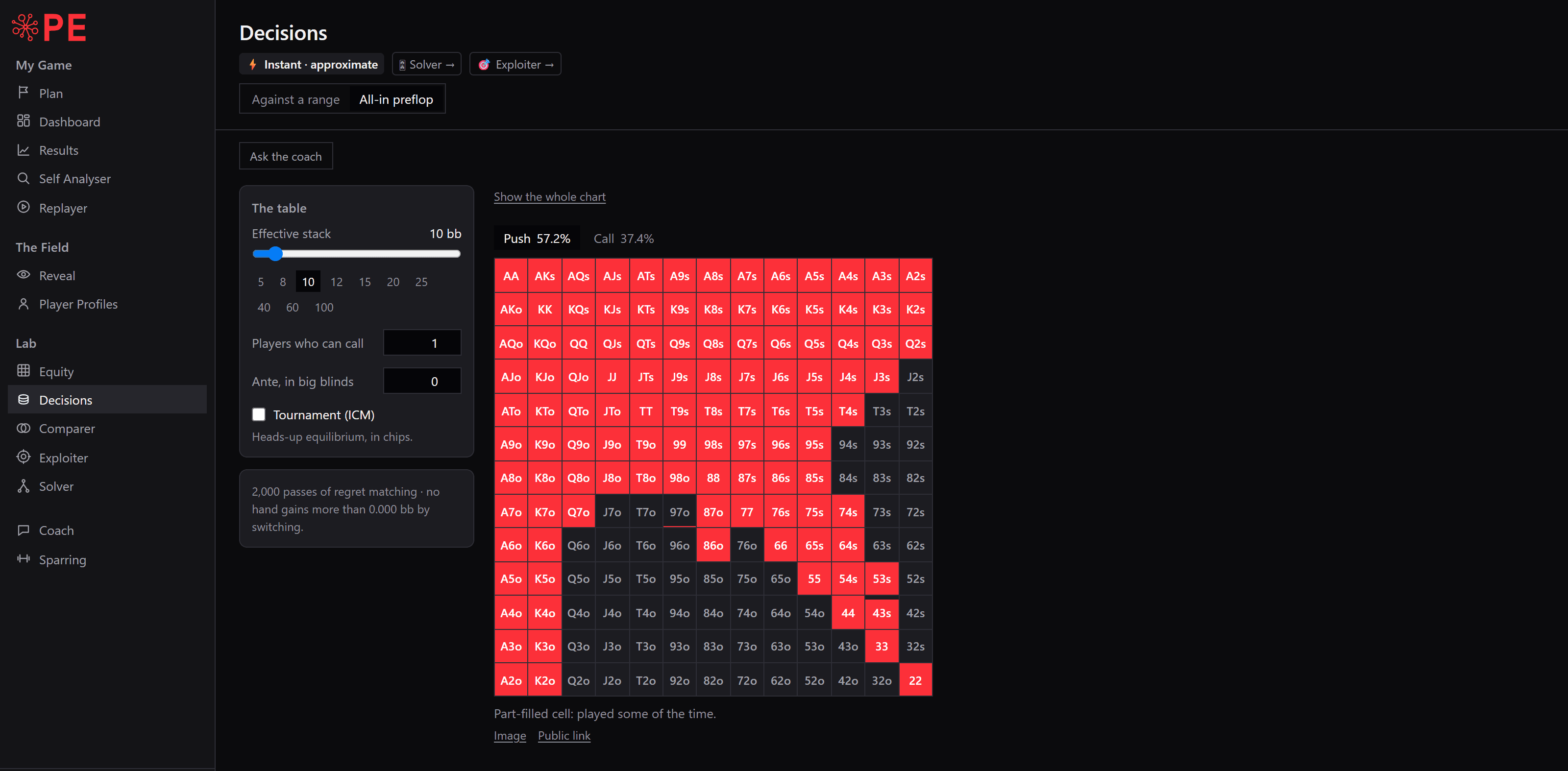
That is the fastest way to build the right instinct: study the baseline, then compare it with the spots you actually get. The goal is not to memorize one magic answer. The goal is to see why the answer changes when the stacks change.
Do it on your own hands.