
A Spin & Go is poker in its most concentrated form: three players, short stacks, and a prize multiplier drawn before the first hand. Most of the time, the winner takes the whole prize pool. The room's fee is taken from the buy-in and shows as a multiplier table whose average prize is less than the three buy-ins paid in. That changes everything.
In a normal cash game, you can wait for good spots and let edges build slowly. In a Spin & Go, the game is compressed. Every blind matters, stack sizes move fast, and the difference between a good shove and a bad call can decide the match. If you want to beat the format, you need to understand three things at the same time: the 3-handed phase, the heads-up phase, and the payout structure.
Spins seat players automatically against random opponents: there is no table to choose, only the room and the buy-in.
What makes Spin & Go strategy different
The format looks simple, but it is not shallow by accident. It is shallow by design.
You start with only three players, usually with short stacks relative to the blinds. That means:
- preflop decisions matter more than in deep-stack poker
- push-fold spots appear early and often
- postflop mistakes are costly because stacks are not deep enough to recover easily
- the prize structure can make survival more important than chip accumulation, if several places are paid
When the prize is winner-takes-all, the logic is pure chip EV. Chips you win and chips you lose are worth the same in prize terms. When the payout rewards several places, that symmetry breaks three-handed, and ICM appears there.
The two phases of the game
In practice, Spin & Go strategy has two phases.
1. Three-handed play
This is where most of the technical work happens.
Three-handed play is not just a smaller version of six-max poker. The ranges are wider, the blinds bite harder, and stack pressure changes the value of every decision. You are constantly asking:
- Is this a profitable shove?
- Is this a profitable call?
- Should I pressure the shorter stack?
- Am I risking too much equity for too little gain?
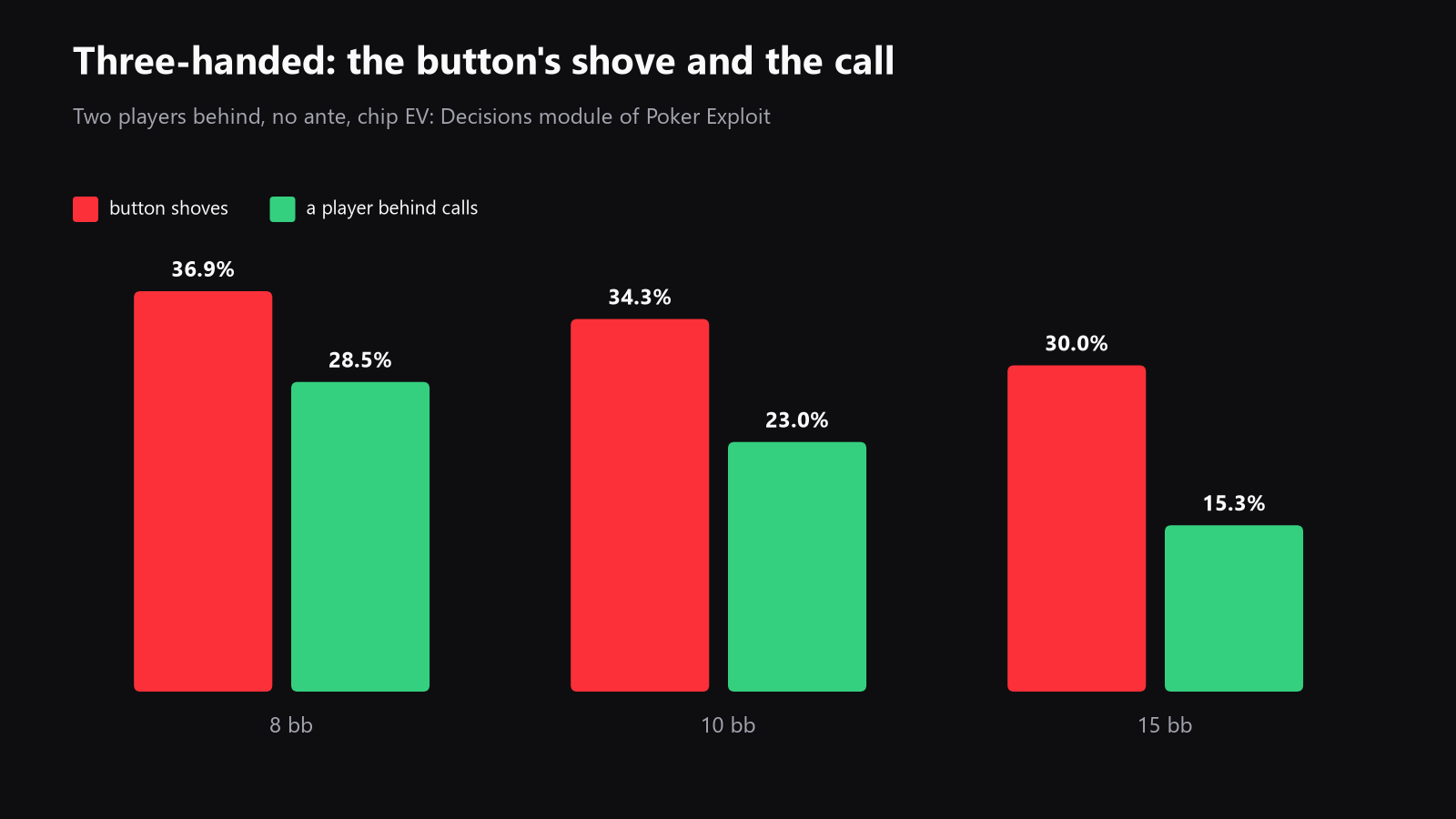
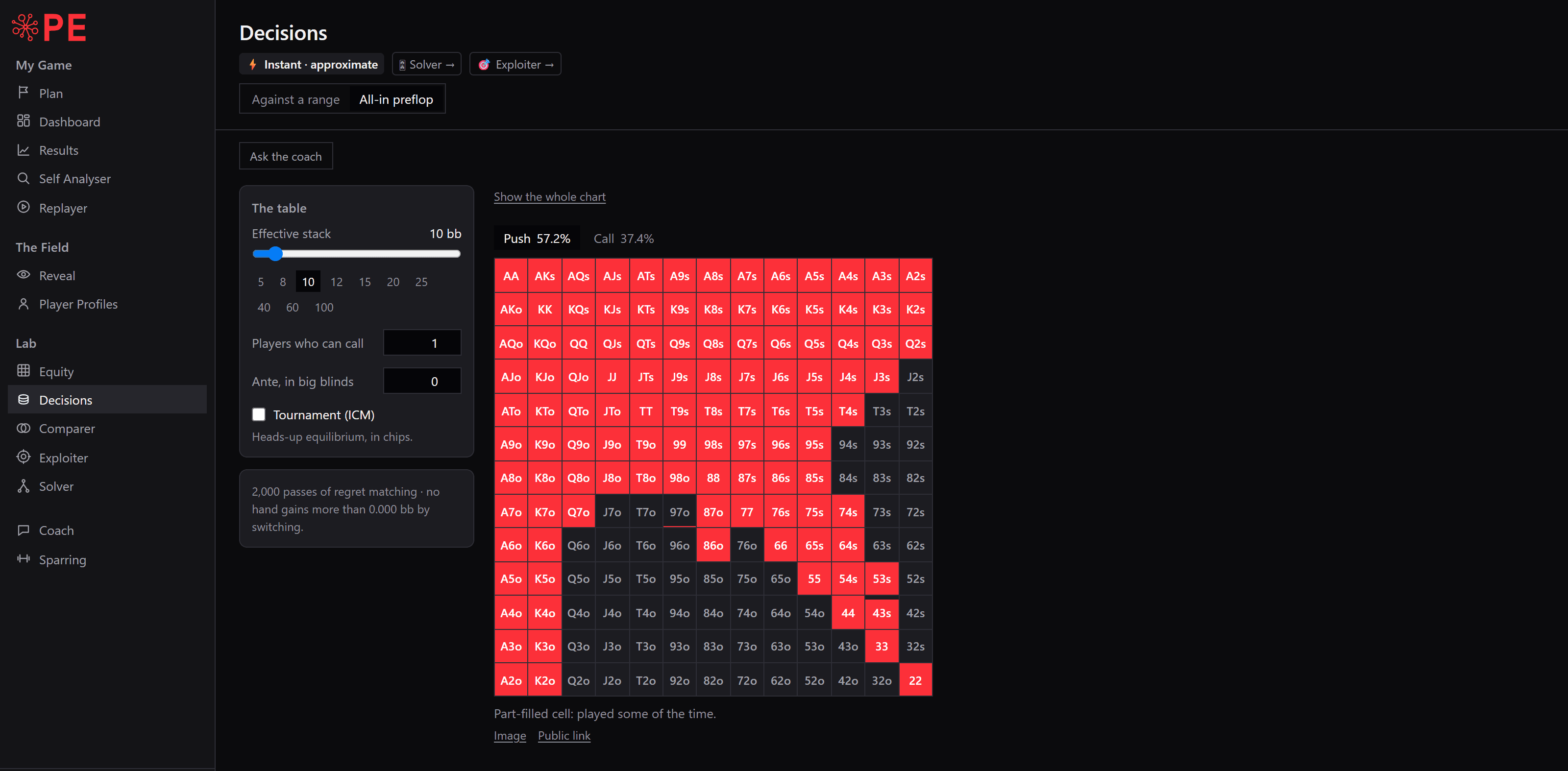
At very short stacks, the game simplifies into push or fold far more often than people expect. For example, on the button with two players behind, Poker Exploit computes the following equilibrium shove ranges and the calling range for a blind facing that shove, in chips, no ante, as a share of all hands, with the model letting only one of the two players call:
- 8 bb: the button shoves 36.9% of hands; a blind facing that shove calls 28.5%
- 10 bb: the button shoves 34.3% of hands; a blind facing that shove calls 23.0%
- 15 bb: the button shoves 30.0% of hands; a blind facing that shove calls 15.3%
That gives you an important lesson: as stacks get deeper, shove frequency goes down, and calling gets tighter much faster. In other words, the cost of a bad call rises quickly.
The practical takeaway is simple. In three-handed play, you want to:
- keep pressure on stacks that cannot comfortably defend
- avoid overcalling just because a hand looks playable
- value fold equity highly
- respect stack interactions, not just hand strength
If you are the stack that covers the others, you can apply more pressure. When several places are paid, ICM tightens calls, and the middle stack feels it most.
2. Heads-up play
Once one player is out, the game changes again.
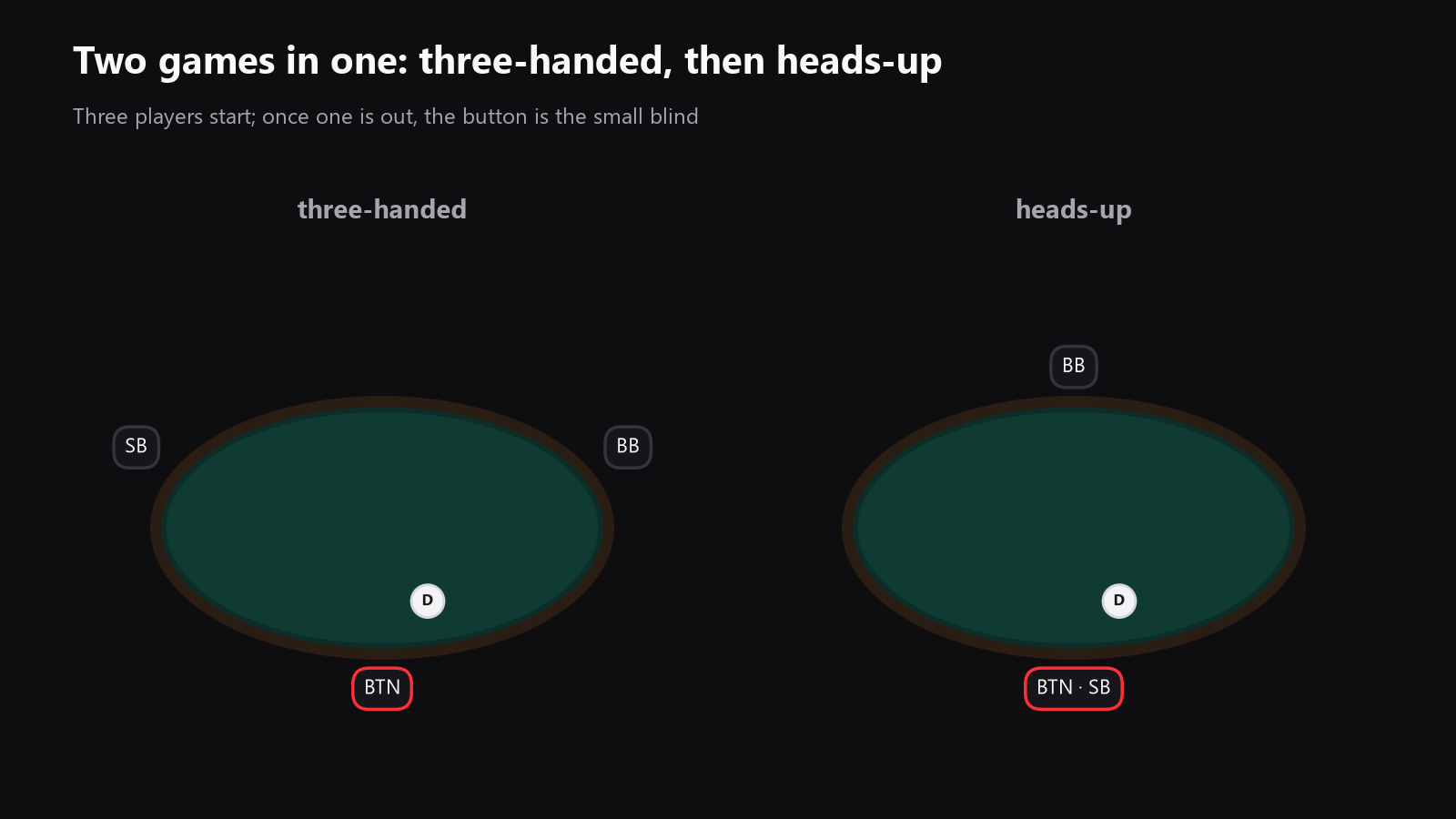
Heads-up poker is wider, looser, and more aggressive. Position becomes enormous. Heads-up, chips are money whatever the payout: the second prize is won and the rest is shared in proportion to chips. The button is also the small blind: it acts first before the flop and last on every later street; its edge is position.
That means:
- steal often
- defend enough, but not too much
- widen your value range
- bluff more often than in ring games
- punish opponents who play too passively
The mistake many players make is to carry over a survival mindset into heads-up play when no survival premium exists. That is why heads-up Spin & Go strategy often feels more aggressive than what casual players expect.
When ICM disappears, and when it matters
This is one of the most important ideas in the format.
ICM can matter only in the three-handed phase, when several places are paid. Once the game is heads-up, chips are money whatever the payout: the second prize is locked up, and the rest is shared in proportion to chips.
Winner-takes-all: no ICM premium
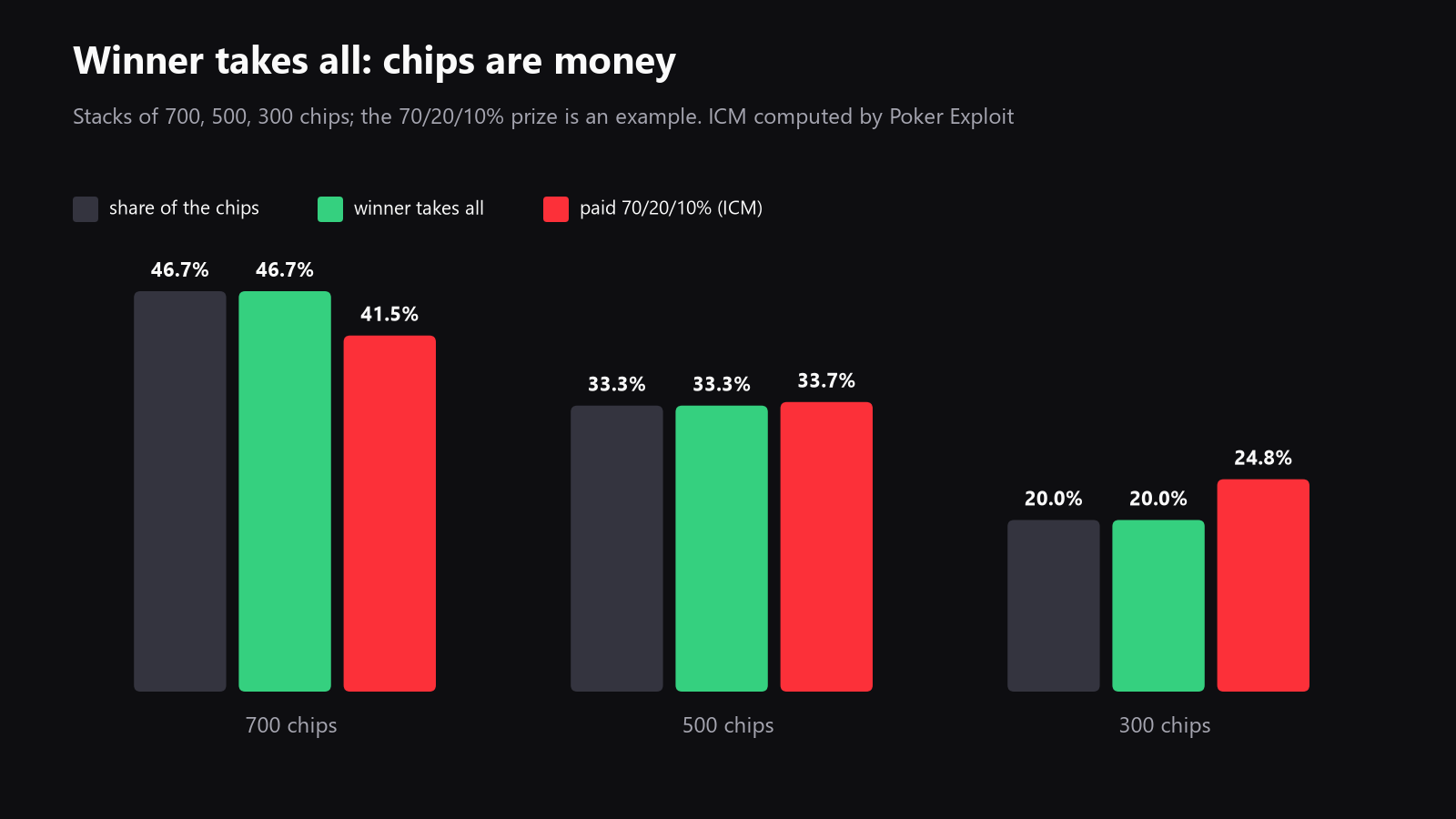
When the winner alone is paid, each player’s share of the prize is exactly their share of the chips. Using Poker Exploit for stacks of 700, 500, and 300 chips, the prize shares are:
- 700 chips: 46.7%
- 500 chips: 33.3%
- 300 chips: 20.0%
In that setting, a call needs the same equity it needs in chips. For an all-in, that is 50%, blinds aside.
So if the format pays only the winner, chip EV and prize EV line up. There is no ICM premium. You should not play scared just because someone is shorter than you. You should play the chips.
Multi-place payouts: ICM matters three-handed
Take this example, which is only an example, not a room’s payout table: 70% for first, 20% for second, 10% for third. With the same stacks, Poker Exploit gives:
- 700 chips: 41.5%
- 500 chips: 33.7%
- 300 chips: 24.8%
Now the calling thresholds are no longer symmetrical:
- the 500 calling the 700 needs 55.6% equity
- the 700 calling the 300 needs 51.1% equity
- the 300 calling the 700 needs 53.7% equity
This is the whole point of ICM. Chips are no longer worth the same in prize terms, because future elimination matters. The middle stack carries the largest survival premium.
So the rule is simple:
- winner-takes-all: think in chips
- several places paid, three-handed: think in ICM
And because Spin & Go payout tables and multipliers differ from room to room, and can change, you should never memorize a single payout chart as if it were universal.
How to think about stack depth in Spin & Go
If you want a practical mental model, use stack depth first, hand strength second.
At shallow stacks:
- broadways, strong aces, and pairs rise in value
- speculative hands lose value because there is not enough depth to realize their implied odds
- blockers matter more
- fold equity becomes a weapon
- calling off light gets punished quickly
At slightly deeper short stacks:
- reshove spots become a major part of your edge
- button pressure becomes more valuable
- your opponent’s calling tendencies matter a lot
- small leaks in preflop ranges show up fast in your results
This is why Spin & Go players who only think in terms of "good hand" and "bad hand" usually struggle. The format is range-driven. Your hand matters, but your stack, position, and payout structure matter just as much.
Why variance is brutal
Spin & Go variance is high by nature.
There are only three players, so one run of cards can decide a lot. The prize pool is also compressed into a very small number of outcomes. If the multiplier is big, the game can look glamorous, but the path to those big scores is extremely uneven.
That means two things:
- Short-term results are noisy.
- You need enough volume to know whether you are actually winning.
A player can run badly for a long stretch and still be a winning Spin & Go regular. Another player can run hot and still be a loser if the strategy is weak.
This is also why you should not judge your game by a few sessions. You need to separate:
- run good from skill
- run bad from mistakes
- normal variance from real leaks
Why rake matters so much
The room fee is a major part of Spin & Go strategy because it is taken from the buy-in before the first hand, and the average prize in the multiplier table is less than the three buy-ins paid in. It costs the same share of every game whatever happens at the table. If the fee is high relative to the buy-in, it can swallow a meaningful part of your edge before you even start.
That changes what you should care about:
- a marginal edge may not be enough
- room selection matters
- the choice of room and buy-in matters
- volume matters
- rakeback, if available, matters
- small strategic improvements can have a big impact over time
If you want to know how much the rake costs you, the Results module in Poker Exploit shows ROI and ITM for Sit & Go and Spin & Go, and it can be filtered by format. It also shows the rake next to the result.
What to study off the table
Spin & Go strategy improves fastest when you study the right things away from the tables.
A good study order is:
- push and call ranges for short stacks
- heads-up steal and defend ranges
- ICM spots when the payout is not winner-takes-all
- opponent pool tendencies
- your own mistakes, by stack depth and position
The Decisions module gives push, fold, or call with a short stack, and push/fold charts. That is a clean baseline for the late-game side of Spin & Go play.
The Reveal module is also built for tournaments, including Spins. It shows what players at your limits actually do, so you can compare theory with pool reality. That matters, because a strategy that is theoretically fine can still be wrong if your pool overfolds or overcalls in a very specific spot.
And if you want to go one step further, the Exploiter module includes ICM, which is exactly the kind of thing that matters when the payout structure stops being winner-takes-all.

The short version
If you want to beat Spin & Go games, remember this:
- three-handed play is about pressure, stack interaction, and disciplined calling
- heads-up play is about aggression and chip EV
- winner-takes-all means no ICM premium
- multi-place payouts matter three-handed, not heads-up
- variance is high, so volume matters
- the fee can quietly eat your ROI
Spin & Go is a small format, but it is not a simple one. The players who do well are the ones who understand the structure, not just the cards.
Do it on your own hands.