
Turbo and hyper-turbo Sit & Go strategy is mostly about compression.
The starting stacks are shorter, the blinds rise faster, and you have less room to navigate after the flop. That means the game reaches a point where many decisions are no longer about thin postflop edges, but about whether to move all in now or wait for a better spot.
If you play these formats well, you do not just learn which hands are strong. You learn when stack depth, position, and payout pressure turn a hand from a clear fold into a clear shove, or from a chip-EV call into a tournament fold.
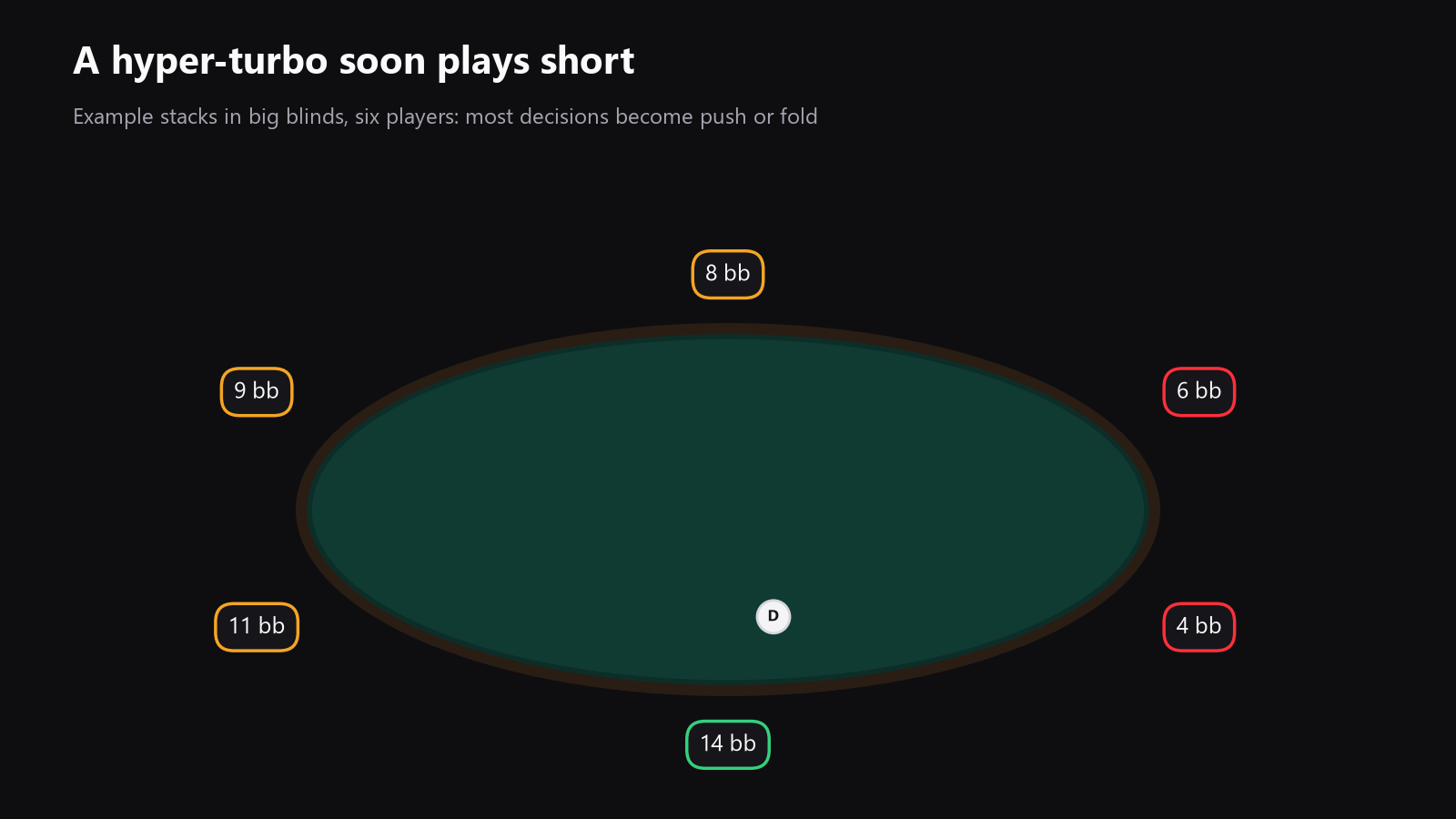
Why turbo and hyper-turbo games change so fast
In slower Sit & Go formats, you get more postflop decisions. In turbo and hyper-turbo games, that luxury disappears quickly.
A few things happen at once:
- stacks get shallow relative to the blinds,
- open raises lose some of their value because there is less room to play multiple streets,
- reshoves matter more,
- and ICM starts to distort chip-EV decisions as soon as the prizes become meaningful.
That is why a good turbo player studies preflop first. Not because postflop never matters, but because in these formats preflop decisions decide a huge share of your result.
A simple rule of thumb helps:
- with deeper stacks, you can still open, call, and continue on many boards,
- with medium stacks, you need to know when a raise is a trap,
- with short stacks, your first question is often, "Do I shove or fold?"
First-in shoves: stack depth and position
The best way to think about short-stack play is to separate two spots:
- You are first in and everyone before you has folded.
- You face a shove and must decide whether to call.
Those are different problems. The same hand can be a shove when first in and a fold facing a shove.
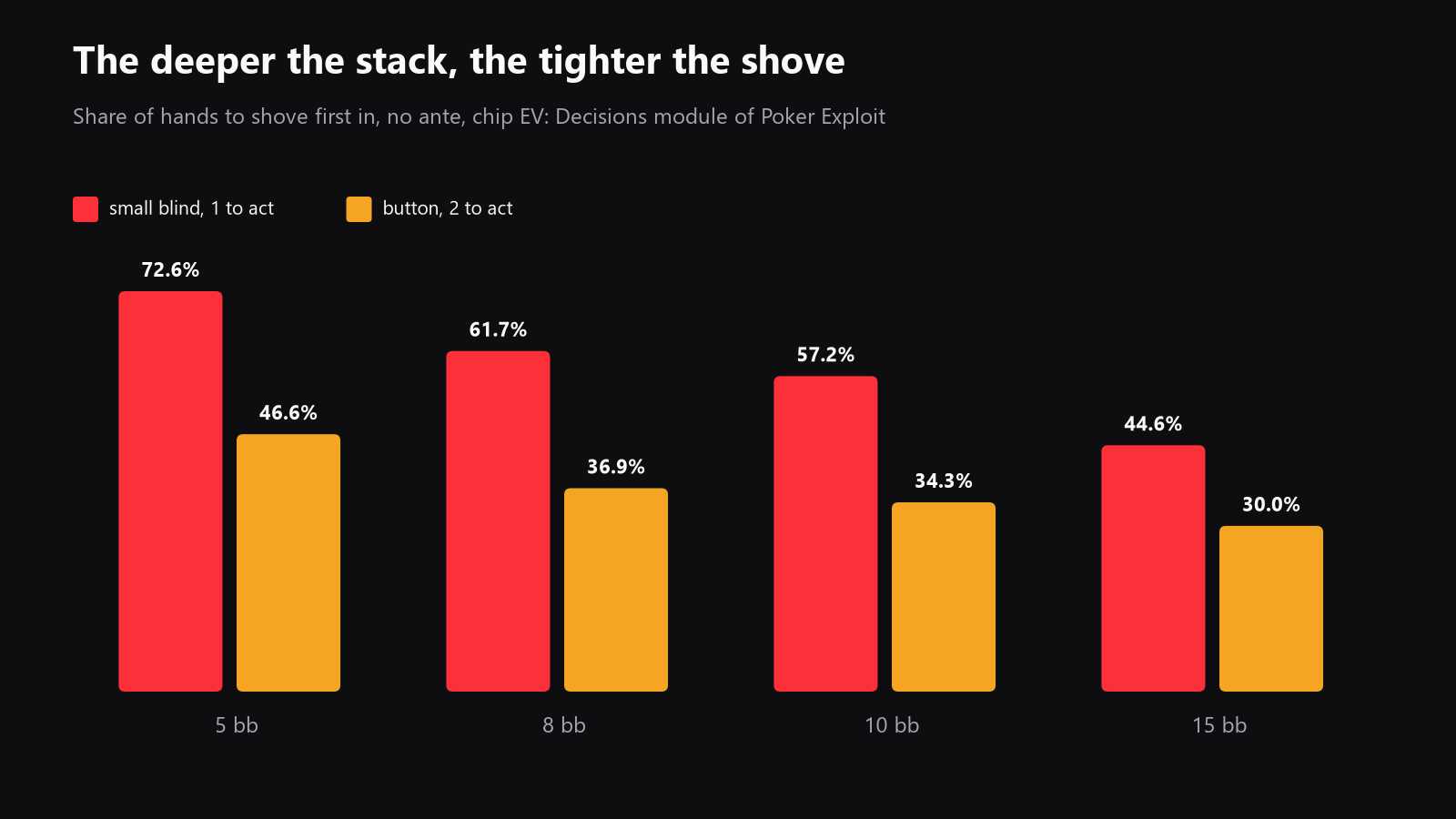
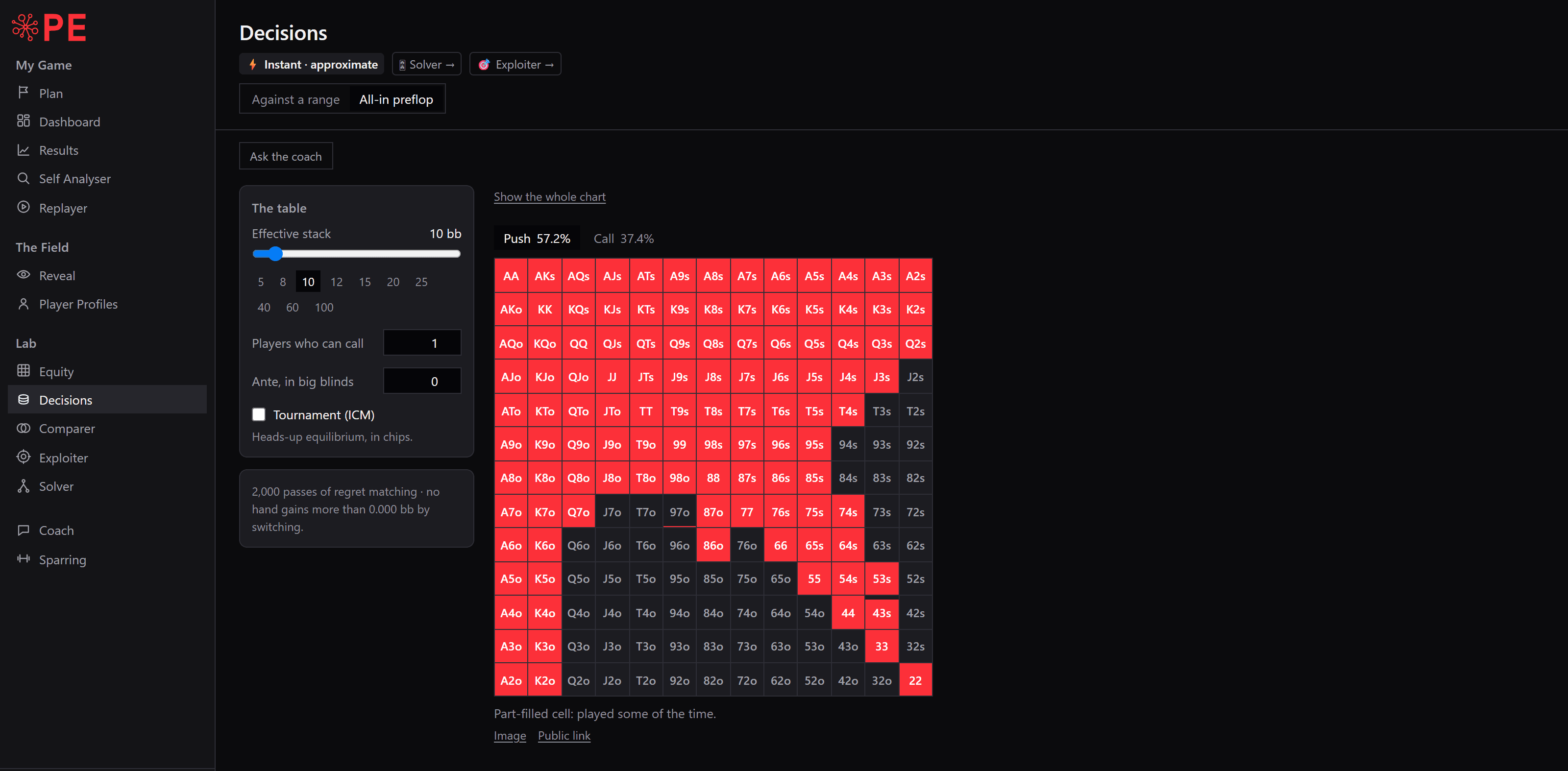
The figures below were computed with Poker Exploit as push/fold equilibrium ranges, in chips and without antes.
Small blind first in, heads up against the big blind
| Stack depth | Small blind shove range | Big blind call range |
|---|---|---|
| 5 bb | 72.6% | 61.4% |
| 8 bb | 61.7% | 44.8% |
| 10 bb | 57.2% | 37.4% |
| 12 bb | 52.4% | 32.9% |
| 15 bb | 44.6% | 27.9% |
| 20 bb | 40.3% | 21.7% |
These figures come from a model where the only choices are all in or fold, so they do not say whether a limp or a small raise from the small blind would do better.
What this means in practice:
- at 5 bb, the small blind can shove very wide because 1.5 bb is already in the pot, so the price is good even though fold equity is low,
- as stacks get deeper, the shove range shrinks because fewer hands want to risk a bigger stack for the same dead money,
- the big blind calls much tighter than the small blind shoves, because the shover has fold equity and the caller does not, so the caller needs enough equity against the shoving range.
The most important lesson is not the exact percentage. It is the shape of the curve. Once stacks shrink, ranges change fast. A move from 15 bb to 10 bb is not a small adjustment, it is a different game.
Button first in, with two players behind
The button is later position, but when two players remain behind you, your shove still has to get through two ranges.
| Stack depth | Button shove range | Range that calls, with one caller allowed by the model |
|---|---|---|
| 5 bb | 46.6% | 43.4% |
| 8 bb | 36.9% | 28.5% |
| 10 bb | 34.3% | 23.0% |
| 15 bb | 30.0% | 15.3% |
Two things stand out.
First, the button still has a viable shove range, but it tightens fast as stacks grow. At 10 bb, the button shoves 34.3%, much tighter than the small blind's 57.2% at the same depth.
Second, two players behind you is not the same as one player behind you. The model used here lets only one of them call, which understates how often a shove gets called in real play. That means the practical shove range in a real table can be tighter than the simple number suggests.
How to think about calling ranges
Many players focus on shove ranges and ignore call ranges. That is a mistake.
In turbo and hyper-turbo games, calling a shove is often the more delicate decision. The reason is simple: when you call, you are not just risking chips, you are risking future tournament equity.
A few practical ideas help:
- do not assume that hands that shove well also call well,
- your call range depends on stack depth, position, and who can still act,
- shorter stacks can call wider, not tighter, because the price improves,
- and once ICM matters, calling can become much tighter than chip EV suggests.
A useful mental model is this: shoving is about leverage, calling is about survival.
If you are first in, you can win the pot immediately and pick up dead money. If you call, you are often saying, "I am willing to risk my tournament life for this price." That is a much higher bar.
Why payout structure changes everything
In a cash game, chips are money. In a Sit & Go, chips are only a way to claim a share of the prize pool.
That is why ICM matters.
ICM, the classic model used in Poker Exploit, estimates each stack's share of the remaining prize pool from chips alone. It ignores skill, position, and blinds. The result is not perfect truth, but it is the standard way to understand tournament pressure.
The practical consequence is huge:
- chip-EV and tournament-EV are not the same,
- the bubble makes calling much tighter,
- short stacks can sometimes shove wider than chip EV alone would suggest,
- and big stacks can pressure medium stacks because the medium stacks care more about survival than chip accumulation.
Here is a concrete example.
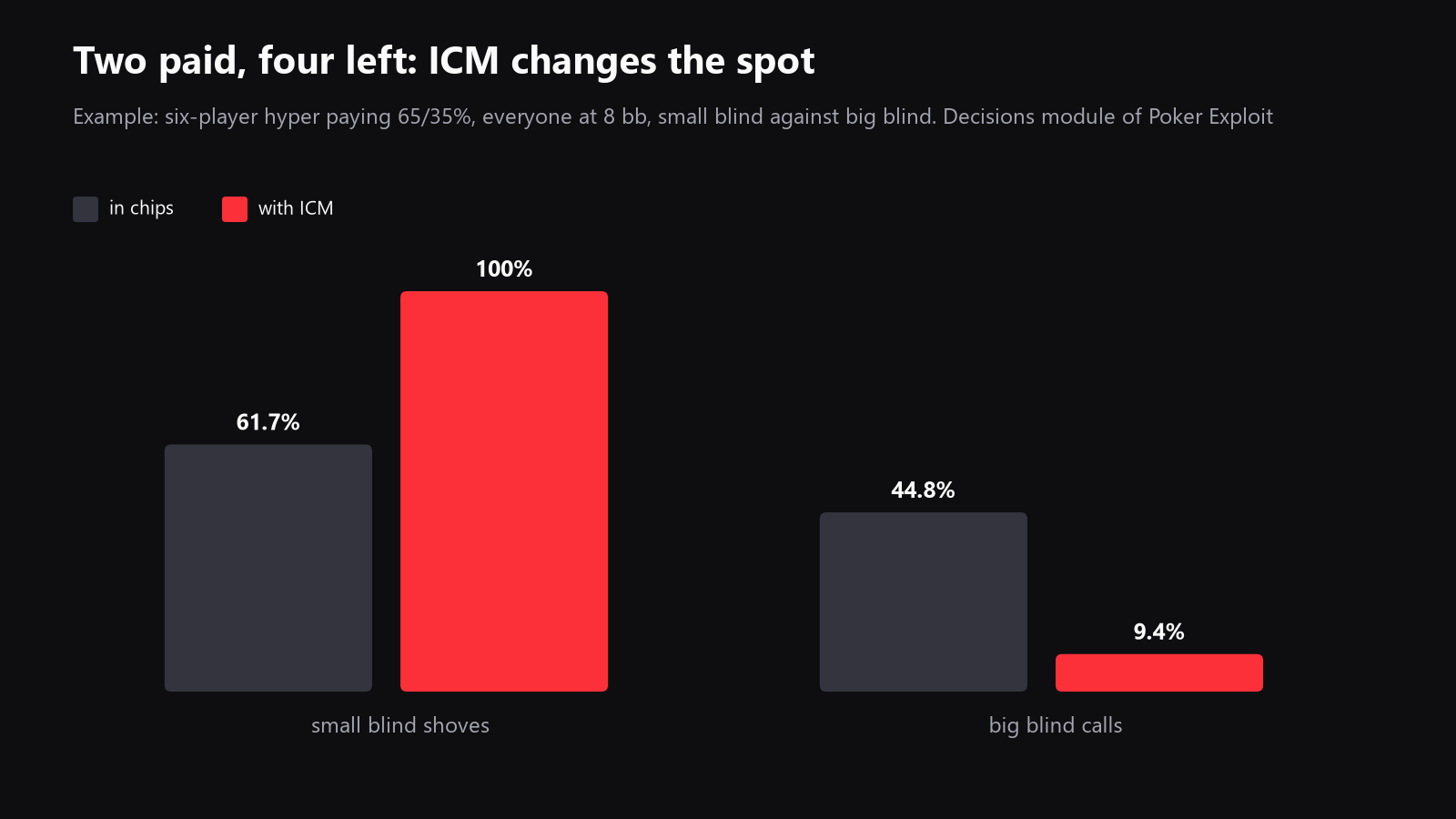
Suppose a six-player hyper Sit & Go pays 65% and 35%, and four players remain with 8 bb each. In a small blind versus big blind spot:
- in chips, the small blind shoves 61.7% and the big blind calls 44.8%,
- with ICM, the small blind shoves 100% and the big blind calls 9.4%.
That is a dramatic change.
It shows why you cannot use chip-EV ranges blindly in a payout-sensitive spot. The prize structure can turn a normal-looking shove into a slam-dunk, and a natural-looking call into a big mistake.
Variance is not a side effect, it is the format
Turbo and hyper-turbo Sit & Gos are high-variance formats.
That is not a bug. It is built into the structure.
Why the variance is so high:
- many pots are decided preflop,
- stacks go in earlier,
- all-ins happen more often,
- and the payout curve is top-heavy enough that one deep finish matters a lot more than several small pots.
This is why a strong player can have a rough-looking graph for a long time, and a weak player can run well for a while.
If you are serious about the format, you need to judge your results correctly:
- do not overreact to a short downswing,
- do not crown yourself after a hot streak,
- look at enough volume to see whether your edge is real,
- and always separate luck in all-ins from structural leaks.
ROI and ITM matter here. The Results module gives you ROI and ITM by format, with the rake beside the result.
- ROI tells you how much you gain or lose relative to everything paid to enter, fee included.
- ITM tells you how often you cash.
In a fast Sit & Go format, both are useful, but neither should be read in isolation. A player can have a solid strategy and still be down over a stretch because the format is high variance. Another player can spike a good ROI over a short sample and still have clear leaks.
That is also where rake matters. In a game with thin edges, the fee can eat a meaningful part of your ROI.

Bankroll: treat it like a swingy format, because it is one
You do not need a magic bankroll number to understand the principle.
You need more caution in turbo and hyper-turbo Sit & Gos than in slower formats, because each buy-in is exposed to a narrower set of high-impact decisions. One lost flip, one failed bluff, or one unlucky call can erase a lot of small gains.
So:
- keep a conservative bankroll,
- expect downswings,
- and measure your game over a meaningful sample, not over a week.
The real danger is not losing one tournament. The real danger is misreading variance as a strategy problem, or misreading a heater as proof that your ranges are right.
A practical way to study the format
If you want to improve fast in turbo and hyper-turbo Sit & Gos, study in this order:
- Learn your first-in shove ranges by stack depth and position.
- Learn your call ranges, not just your jams.
- Add ICM pressure near the bubble and at payout jumps.
- Review whether your results are real or just variance.
- Keep an eye on rake, because small edges get taxed hard.
That is the cleanest way to build a profitable game.
If you want equilibrium short-stack push, fold, and call ranges for a spot, the Decisions module computes them. If you want to know your ROI and ITM by format, with the rake beside the result, the Results module shows them.
Do it on your own hands.