
The small blind is the seat almost everyone hates.
You post money before seeing your cards, you act out of position for the rest of the hand, and you are forced into awkward spots against players who opened first. If you want a simple answer to the question “what is the best small blind strategy?”, it is this: be disciplined, steal enough, 3-bet aggressively against steals, and do not complete just because the option exists.
That is the whole topic in one sentence. The rest of this article is the explanation.
Why the small blind is the worst position
Position is power in poker.
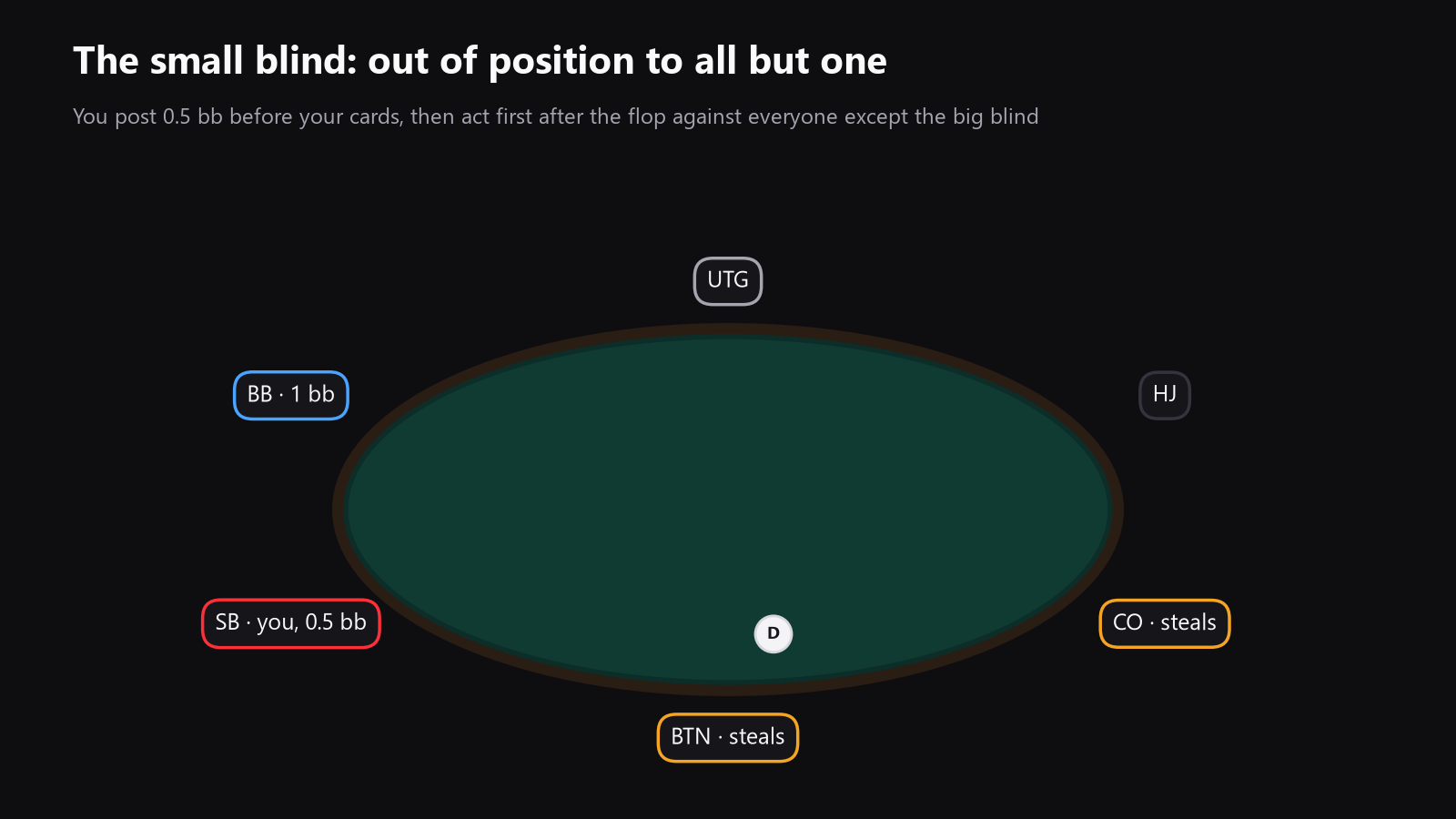
When you act last, you get to see what the other players do before you spend more chips. In the small blind, you rarely get that advantage. In fact, you usually have the opposite: you are out of position against everyone except the big blind, and even there you are still playing from a bad seat because the big blind has already posted more dead money and can defend cheaply.
Three things make the small blind especially painful:
- You post a forced investment
- You start the hand already losing half a blind.
- That dead money is not free equity. It is money you must win back.
- You play out of position
- Postflop, you often act first.
- Acting first means you guess more and control the pot less.
- Your ranges are squeezed
- If you open from the small blind, the big blind defends a lot because of the price.
- If the button or cutoff opens, you are often stuck between calling, 3-betting, or folding with imperfect information.
This is why the small blind is usually the worst position in the game. Not because every hand is impossible, but because the seat is structurally hostile. Your goal is not to “win the small blind back”. Your goal is to lose less than the table expects.
If you study your own results, this is a place where the loss is often real, not just variance. The Results module in Poker Exploit can show you whether the seat is actually costing you money over enough hands, instead of making you guess.

Small blind opening strategy: raise or fold
The first decision is the simplest one: when the action folds to you in the small blind, should you raise or complete?
For most players, the answer is: raise more, complete less.
That does not mean you should never complete. It means completing should be a deliberate choice, not a default reflex.
Why raising is usually better
When you raise from the small blind:
- you may pick up the pot immediately,
- you define the hand more clearly,
- you deny the big blind the easiest cheap defense,
- and you keep your own range more coherent.
When you complete:
- you invite the big blind to see a flop at a discount,
- you create more multi-street guesswork,
- and you often let better postflop players realize equity too easily.
A lot of players complete because they feel “pot committed” after posting the blind. That is a leak. The blind is already gone. The next chip you put in should be justified by hand value and strategy, not by the sunk-cost fallacy.
When completing can make sense
Completing is not dead. It can work when:
- the big blind is aggressive and will punish too much with raises,
- you have a hand that plays reasonably well in a raised pot but not well against a 3-bet,
- stacks are shallow and the postflop room for maneuver is limited,
- or the game is passive enough that you can realize equity cheaply.
But be careful: “can make sense” does not mean “should be your habit”.
A useful rule is this: if you cannot explain why completing is better than raising with that exact hand against that exact big blind, default to raising or folding.
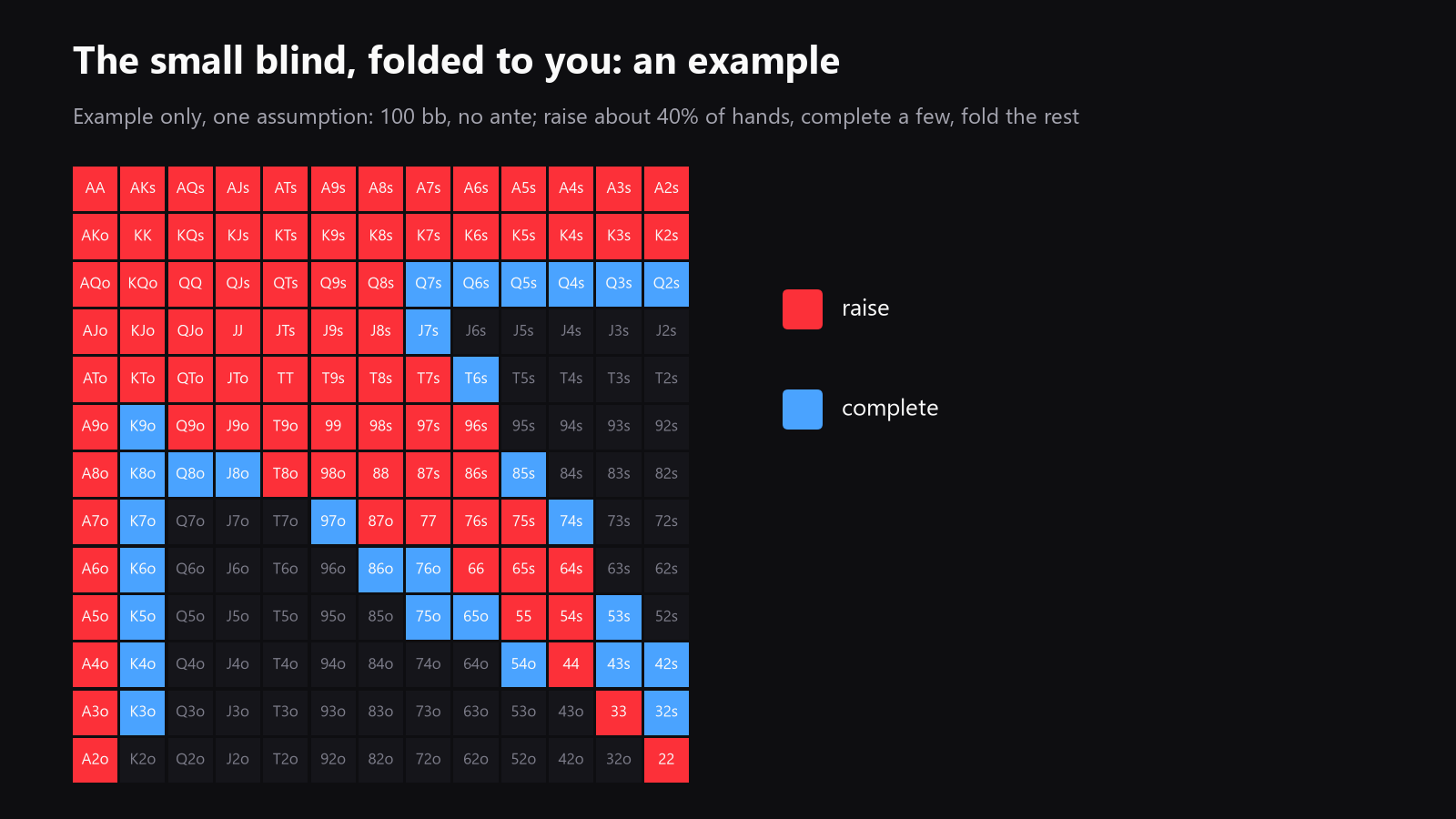
In Poker Exploit, the Solver module can show you the strategy grid for a spot like small blind unopened pot. That is useful not because you should copy a chart blindly, but because it teaches you what an internally consistent range looks like under a chosen assumption.
Raise or complete: what you should think about
If you want to choose correctly, think in terms of four variables:
1. The big blind’s defense
If the big blind defends too widely, your weaker opens perform worse. A raise that works against a tight blind can become a mistake against someone who calls and checks down too much or who attacks too much later.
2. Stack depth
The deeper the stacks, the more postflop skill matters. That usually makes raising attractive with hands that can continue on many boards. At very shallow stacks, completion can lose some of its worst postflop problems, but shallow stacks also make preflop aggression more valuable.
3. Your hand class
Not all playable hands want the same small blind treatment.
- Premium hands want value and isolation.
- Medium-strength hands want clarity and controlled SPR.
- Speculative hands need enough implied odds to justify entering.
- Weak offsuit hands usually should go away.
4. The rake environment
In raked cash games, marginal calls and small-pot lines get worse. The more rake matters, the more careful you should be about taking thin, low-initiative routes from the small blind.
That is one reason many micro and small-stakes players over-complete. They think they are being tricky, but they are actually donating too many low-value flops to the rake and to the player in position.
Small blind versus steal: 3-bet more, call less
Now move to the common live wire of small blind strategy: someone opens from the cutoff or button, and the action reaches you.
This is where many players make their biggest mistake.
They call too much.
Calling looks safe. It feels smaller. It seems to keep weaker hands in the pot. But from the small blind, calling a steal often creates the worst of both worlds:
- you do not take the initiative,
- you remain out of position,
- and you let the original raiser realize range advantage cheaply.
Why 3-betting is often better than calling
When you 3-bet from the small blind, you are doing at least one of three things:
- isolating a late-position opener with a stronger range,
- forcing folds from hands that would otherwise realize equity,
- or building a pot with a hand that wants value against a wide opening range.
Against steals, the small blind is often a 3-bet or fold position, especially against players who open widely and continue too loosely against aggression.
That does not mean every hand should be 3-bet. It means that when you have a hand too strong to fold but too awkward to flat profitably, 3-betting is often the cleanest answer.
When flat-calling is acceptable
Flat-calling can be fine when:
- the opener is tight,
- the big blind is unlikely to squeeze,
- your hand realizes equity well in position-less pots,
- or the stack sizes make 3-betting unattractive.
Still, treat flat-calling as a tool, not a default.
A good small blind player asks: “What happens if I call here?” If the answer is “I end up in a bloated pot, out of position, against a range that has me in trouble”, the hand probably belongs in the 3-bet or fold bucket.
In Poker Exploit, the Decisions module is useful for short-stack spots, and the Solver module can help you study steal-defense structures by stack depth. Even when the exact solution depends on assumptions, the shape of the strategy teaches you where the real pressure points are.
What hands belong in each bucket?
Without publishing a universal chart, because that would be misleading, you can still use a practical framework.
Clear value 3-bets
Hands that do well when called and that want to play a bigger pot should lean toward 3-betting. They gain from fold equity and value.
Mixed hands
Some hands can be mixed between call, 3-bet, and fold depending on stack depth, opener tendencies, and rake. These are the hands where players need the most discipline, because they are easy to overplay.
Trash
Weak offsuit holdings that do poorly against continuing ranges should usually go away. The small blind is not a place to defend “because I already posted”.
If you want a real example, use a solver on your own assumed spot rather than copying a random internet chart. A small blind strategy only makes sense when you know what opening size, stack depth, ante, rake, and opponent pool you are talking about.
Blind versus blind: the most important small blind battle
When everyone folds to the small blind, the big blind is the only player left to beat. This is blind versus blind, and it plays differently from everything else.
Why?
Because both players have already posted. There is dead money in the pot, the ranges are wider, and the action dynamics are more aggressive.
As the small blind in blind versus blind
Your job is to attack enough, but not wildly.
You want to:
- raise hands that do well heads-up,
- complete selectively when the hand and the villain justify it,
- and avoid giving the big blind free chances to realize equity.
Since the big blind is closing the action, they defend widely. That means your open-raising range can be broad, but it must still be coherent. If you open too many hands that cannot continue against pressure, you create leaks.
As the small blind after a limp
If you limp and face a raise from the big blind, the pot is now a different animal.
You need to ask:
- Is this hand good enough to continue?
- Does it prefer a limp-reraise?
- Or was the limp itself the mistake?
Against tough opponents, passive blind versus blind play often fails because it allows them to isolate you with the initiative.
As the small blind versus a limp-back
Sometimes both players limp, and the hand becomes a low-stack, high-realization fight. In those spots, hand reading matters more, but so does your discipline. Do not assume that “cheap flop” means “good flop”. Cheap flops can still be expensive mistakes.
Common small blind mistakes
Here are the leaks I see most often.
1. Completing too much
This is the classic leak. Players complete because the price looks small, not because the line is strong.
2. Calling too many steals
The small blind is not a place to show off postflop skill with marginal hands. You are out of position, which makes calling much less attractive than it looks.
3. Overvaluing suitedness
A hand being suited does not make it playable by itself. Suiting helps, but position and playability still matter more.
4. Defending emotionally
A lot of small blind mistakes are ego mistakes. Players feel attacked when someone opens into their blind, then overdefend to “protect” it. That is not strategy.
5. Ignoring stack depth
A line that works at 40 big blinds can be wrong at 100, and the reverse is also true.
A practical way to study the small blind
If you want to improve this seat, do not start with memorizing a giant chart. Start with three questions:
- What do I do unopened from the small blind?
- What do I do versus a steal?
- What do I do in blind versus blind pots?
Then separate your study by stack depth and game type.
For example:
- cash game, 100 big blinds, no ante,
- tournament, 25 big blinds, ante in play,
- tournament, final table, ICM pressure,
- heads-up blind battle with an aggressive big blind.
That is where the Solver module helps most: it gives you a baseline strategy for a spot, and then you can compare your own assumptions against it. If you want to know whether your results in the small blind are truly bad or just noisy, the Results screen can tell you whether the loss is large enough to matter.
A simple small blind blueprint
If you want a starting framework, use this:
- Unopened pot: raise a sensible range, complete only with a clear reason.
- Versus late-position opens: 3-bet more often than you flat.
- Versus strong early-position opens: tighten up.
- Blind versus blind: play actively, but not recklessly.
- At shallow stacks: simplify and value initiative more.
- In raked games: be even stricter with marginal calls.
That blueprint is not a chart. It is a map of priorities.
Final takeaway
The small blind is the worst position because you pay first, act early, and play too many pots from the wrong side of the table. Good small blind strategy is not about “defending your blind” at all costs. It is about choosing the lines that lose the least and win enough when the spot is favorable.
So remember the core ideas:
- raise or fold is often better than limp and hope,
- 3-bet more often than you call against steals,
- treat completing as a deliberate exception,
- and play blind versus blind with real aggression, not frustration.
If you want to study these spots on your own hands, use a tool that lets you compare your assumptions with computed strategy and with your actual results. That is exactly where Poker Exploit is useful: you can study the spot, measure the leak, and decide whether the problem is the seat, the pool, or your line.
Do it on your own hands.