
If you want to understand poker preflop, start with the big blind.
The big blind gets the best direct price to continue against an open, so it is the seat that defends widest. But that does not mean you should defend everything that looks playable. A solid big blind defense is built on three things:
- the price you are getting,
- the seat that opened the pot,
- the size of the open.
Get those three right, and your big blind defense becomes much cleaner.
Why the big blind defends wider than any other seat
The big blind has already posted one big blind, so when someone opens, you do not have to call a full raise. You only need to add the difference between the raise and your blind.
That is the key reason the big blind can continue much wider than other seats facing the same open.
A simple example:
- Open to 2 big blinds, you call 1 more big blind
- Open to 2.5 big blinds, you call 1.5 more
- Open to 3 big blinds, you call 2 more
As the open size grows, your price gets worse. As the open size shrinks, your price gets better.
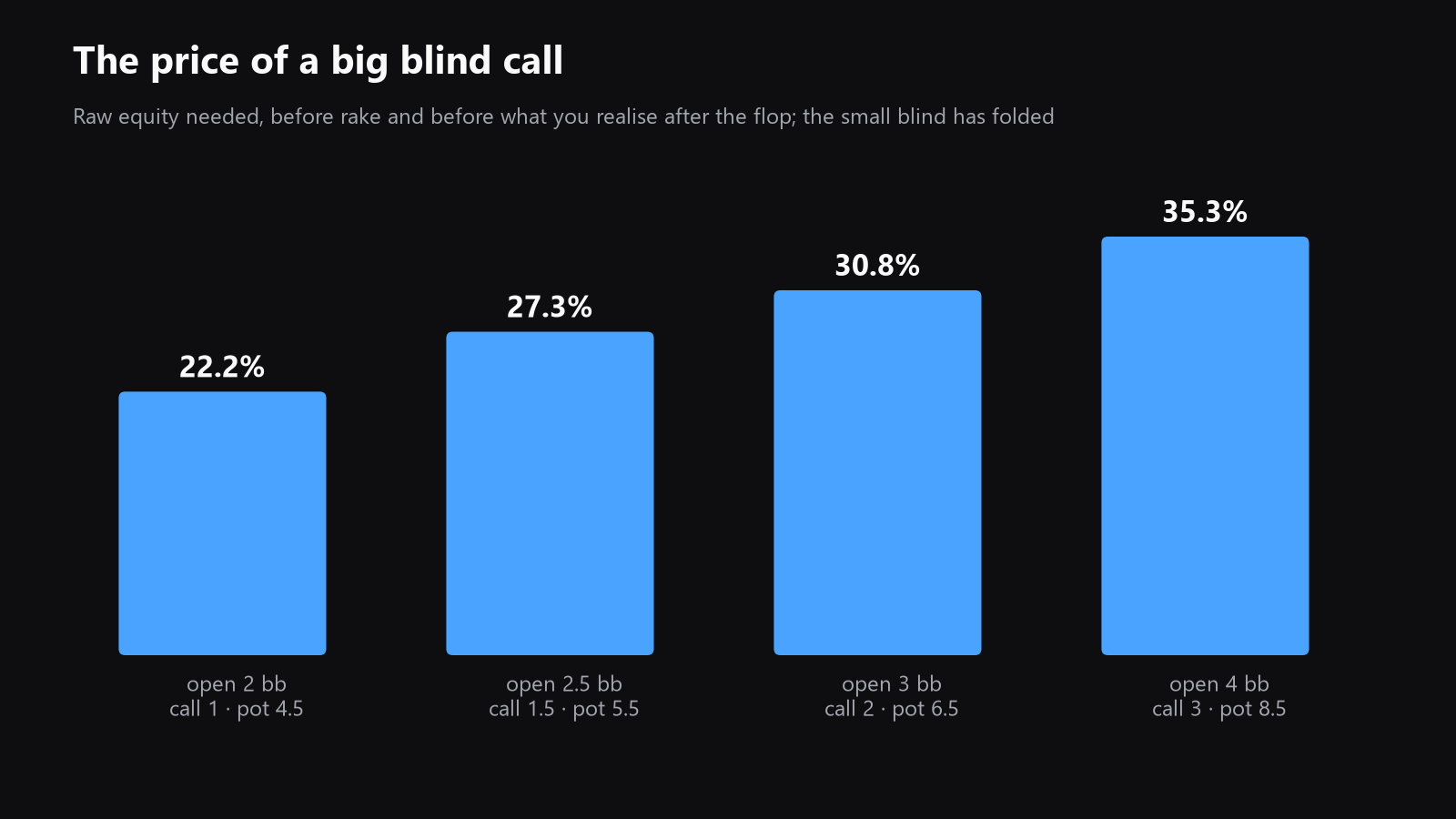
Here is the raw equity needed to call before rake and before postflop realization:
| Open size | Extra amount you call | Pot after you call | Raw equity needed |
|---|---|---|---|
| 2bb | 1bb | 4.5bb | 22.2% |
| 2.5bb | 1.5bb | 5.5bb | 27.3% |
| 3bb | 2bb | 6.5bb | 30.8% |
| 4bb | 3bb | 8.5bb | 35.3% |
That table is only the starting point. In real poker, you also need to consider rake, position, and how well your hand realizes equity after the flop.
Pot odds are not the whole story
Many players stop at raw equity. That is too simple.
A hand can have enough raw equity to call and still be a bad big blind defense if it realizes poorly. Another hand can look marginal on raw equity and still be a profitable continue because it plays well after the flop.
Three ideas matter here:
- Raw equity How often your hand would win if all five cards were dealt.
- Equity realization How much of that equity you actually turn into money in practice.
- Reverse implied odds How often you make a second-best hand and pay off too much.
This is why some suited hands defend better than ugly offsuit hands with similar top-card strength. It is also why some pocket pairs and suited connectors can continue surprisingly wide, while some hands with a decent-looking high card still belong in the muck.
A profitable big blind defense is not just “hands with enough equity”. It is “hands with enough equity, enough playability, and not too much domination”.
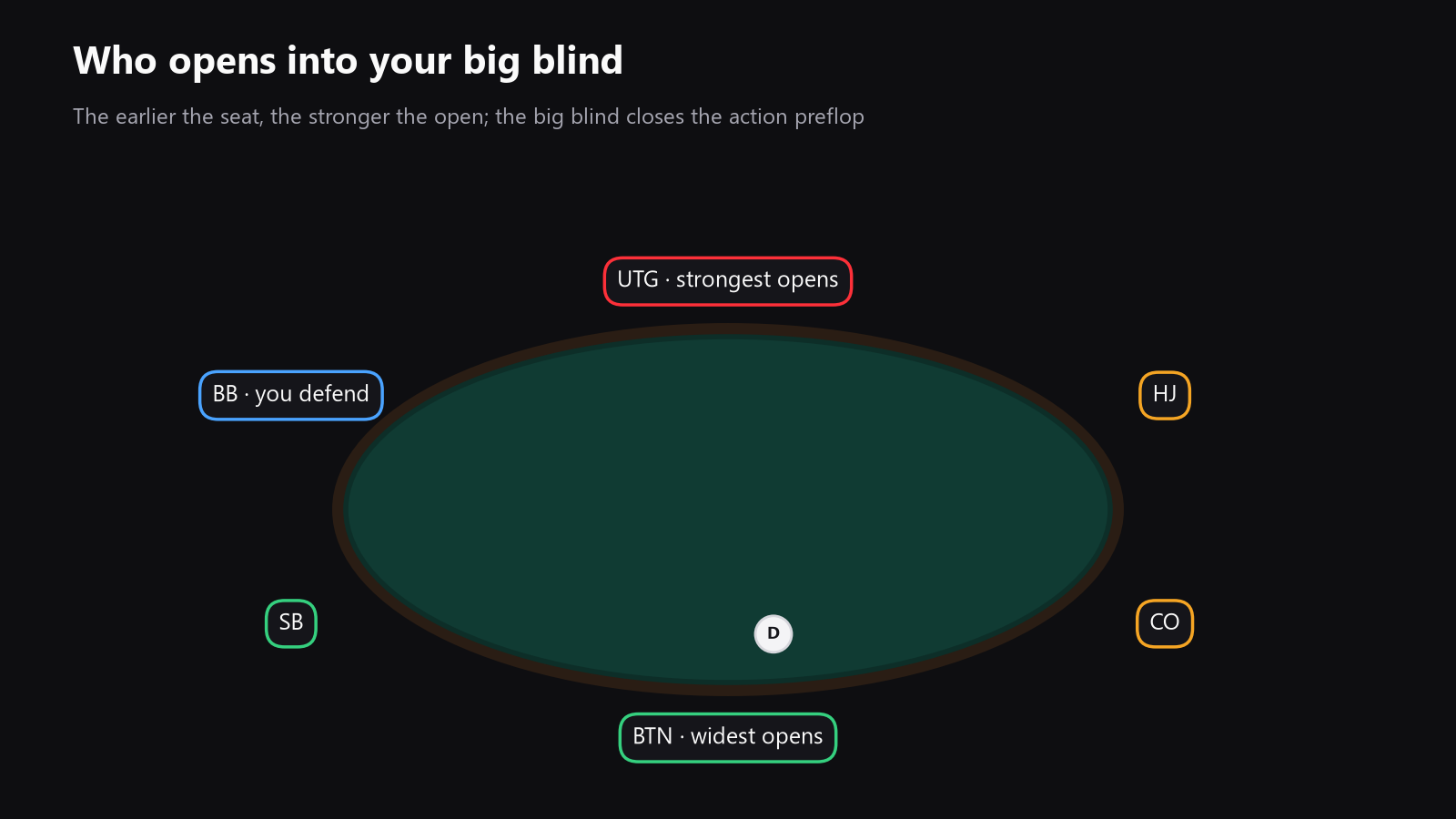
The opener’s seat changes everything
The first question is not “What is my hand?”
The first question is “Who opened?”
Against early-position opens
When the open comes from UTG or another early seat, the opening range is usually stronger. That means:
- you should defend less often,
- your 3-bets should lean more value-heavy,
- weak offsuit hands drop in value very fast.
Against a strong opener, many hands that look acceptable in the big blind are simply not good enough to continue. They do not perform well when called, and they do not generate enough fold equity to justify a bluff 3-bet.
So versus early position, your big blind defense is tighter and more selective. You still defend wider than other seats because of the price, but the bottom of the range gets trimmed hard.
Against cutoff opens
Cutoff opens are wider, so your big blind defense expands.
This is where some players make a different mistake: they see a wider opener and assume every suited or connected hand is now a call. Not true. The opener may be wider, but you are still out of position. You still need hands that can realize equity.
The cutoff is usually a good place to add some calls and some 3-bet bluffs, but the hands you add should be the ones that:
- have decent showdown value,
- make strong top pairs often enough,
- or work well as blockers for a 3-bet.
Against button opens
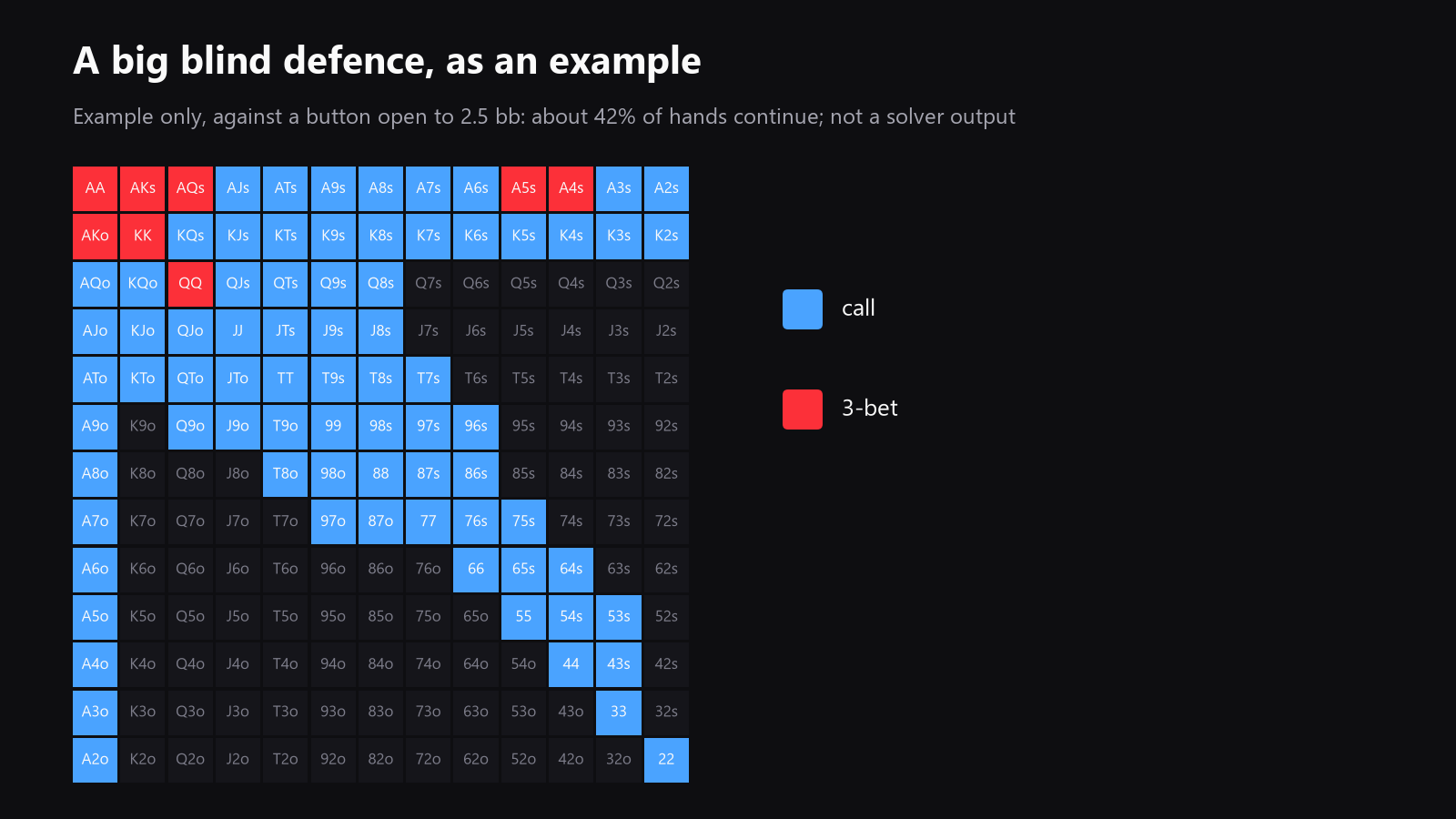
This is where the big blind usually defends widest in standard cash-game spots.
The button opens the widest, so your continuing range expands the most. The pot odds are still excellent, and the opener’s range is wide enough that many more hands have enough equity to continue.
But widest does not mean wild.
You are still out of position. You still pay rake. And your weakest hands still struggle to realize enough equity after the flop.
So yes, your defense versus the button is wide, but it should still be built around playable hands, not just hands that look decent in a vacuum.
Against small blind opens
If the small blind opens, the big blind still gets a very attractive price, and this is often one of the widest defend spots in the game.
It is also a special case, because blind-versus-blind creates a different dynamic. Ranges are often wider, and the opening size is often smaller. That combination pushes you to continue more often than against most other seats.
How open size changes your defense
The opener’s seat matters, but the size matters just as much.
A 2bb open and a 3bb open are not small variations of the same spot. They are different decisions.
A smaller open gives you:
- better price,
- more room to defend marginal hands with decent raw equity,
- more profitable calls with suited and connected hands.
A larger open gives you:
- worse price,
- less room to speculate,
- fewer profitable flats,
- more pressure to either fold or 3-bet.
This is one of the most common mistakes at micro stakes: defending the big blind as if the open size did not matter.
It matters a lot.
A hand that is a clear continue versus a min-raise can become a clear fold versus a 3bb or 4bb open, especially once rake is added. If you defend the same way against every size, you are leaking money.
Call, 3-bet, or fold?
This is the real decision tree.
You call when:
- your hand has enough raw equity for the price,
- it realizes equity well after the flop,
- it does not get dominated too often,
- and it can continue out of position without bleeding chips.
Typical call candidates are hands that:
- flop well,
- make strong made hands or draws often enough,
- and can continue on more than one street.
You 3-bet when:
- your hand has good value against the opener’s continuing range,
- or your hand is a strong bluff candidate with blockers and weak calling value,
- or flat-calling would make your life worse than turning the hand into a 3-bet.
A good big blind 3-bet usually has one of these jobs:
- Value extraction You are ahead of the opener’s continue range often enough to build the pot.
- Fold equity The opener folds enough that the 3-bet prints by itself.
- Range construction Your hand is too weak to call comfortably, but too useful as a bluff to just fold.
Against early opens, your 3-bets lean more value-heavy. Against later opens, your 3-bets can widen because the opener’s range is weaker and folds more often.
You fold when:
- your hand has too little equity,
- it realizes poorly,
- it suffers from domination,
- or the price is no longer good enough.
This is the part many players resist. They feel like the big blind is “supposed” to defend, so they convince themselves to continue with hands that are simply not good enough.
That is not discipline. That is a leak.
What makes a big blind defense profitable
A profitable big blind defense is not magic. It is a combination of several small edges.
1. You are getting a price
This is the foundation. Without a decent price, nothing else matters.
2. Your hand can realize equity
Some hands look fine in raw equity but play terribly out of position. They hit weak pairs, miss too often, or cannot continue when the pot gets bigger.
3. Your hand is not dominated too often
A hand can look playable on paper, but if it keeps running into better kickers and stronger top pairs, the defense leaks money.
4. The rake does not kill the spot
At micro and small stakes, rake matters a lot. Thin calls that look close in a vacuum can become losing calls once the house takes its cut.
5. You know the pool
If the opener overfolds to 3-bets, your bluff 3-bets improve. If the opener c-bets too much and gives up on turns, your calls improve. If the pool underbluffs, marginal bluff-catchers get worse.
This is why you should not think about big blind defense as one fixed range. It is a response to the opener, the size, the stack depth, and the pool.
What turns a call into a losing call
A lot of bad big blind defense comes from a few repeat mistakes.
Calling because you already put money in
The blind is gone. It is not a reason to continue.
Calling hands that do not realize equity well
A hand can be close on paper and still be bad if it gets crushed by domination or cannot navigate postflop spots.
Calling too wide against bigger opens
Once the open gets larger, your break-even point rises fast. Many hands that were fine versus 2bb are no longer fine versus 3bb.
Ignoring rake
This matters especially in small-stakes cash games. The thinner the edge, the more rake eats into it.
Treating every opener the same
An early-position open and a button steal are not the same spot. If you defend them the same way, your range is not adjusted to the game.
A practical way to think about big blind defense
When you face an open in the big blind, ask these questions in order:
- How much am I being asked to call?
- How strong is the opener’s range?
- Does my hand realize equity well enough out of position?
- Am I better off calling, 3-betting, or folding?
- How does rake or tournament pressure change the spot?
If you do that consistently, your big blind defense becomes much cleaner.
A short version to remember:
Defend wide in the big blind, but not blindly.
Tournaments add another layer
In tournaments, stack depth changes the picture.
At 100bb, you can defend more hands that rely on postflop playability. At 25bb, many of those same hands lose value because stack sizes reduce implied odds and change the value of speculative continues.
Then there is ICM.
Near the bubble or pay jumps, the big blind should often defend less than chip-EV logic alone would suggest, especially against opens from players who can pressure shorter stacks. In PKOs, bounty pressure can widen some continues again. In Spins, shallow stacks compress the whole tree.
The principle stays the same, but the ranges shift with the format.
A simple checklist for your BB defense
Use this quick check when someone opens into your big blind:
- Is the open small or large?
- Is the opener early or late?
- Does my hand realize equity well?
- Do I have a better 3-bet than call?
- Does rake or ICM make the spot tighter?
If one of those answers changes, your big blind defense should change too.
How to study this spot in your own game
This is a very good spot to study with Poker Exploit.
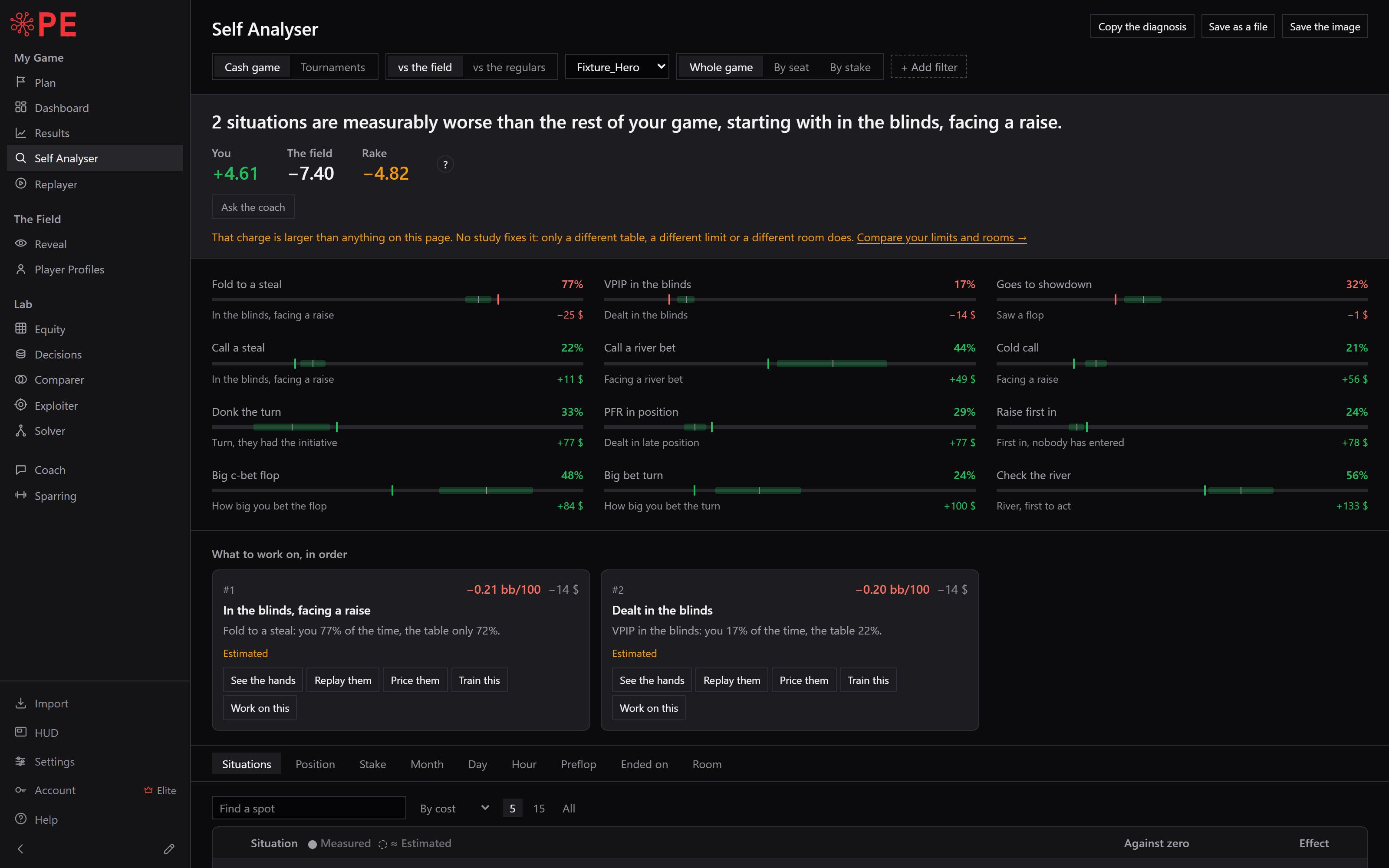
The Self Analyser module helps you see whether your big blind defense is leaking money, and whether the problem is calling too wide, 3-betting too little, or folding too much against specific situations. It measures each situation against the field and against the rest of your game.
The Results module lets you check whether the leak is real in your own sample, not just something you feel after one bad session.
The Solver module can show the computed strategy grid for a spot, so you can compare your intuition with an actual answer for the stack depth and open size you play.


Main takeaway
The big blind defends wider than any other seat because the price is better. But the best defense is not just the widest defense. It is the defense that fits the opener, the size, the stack depth, and the rake.
If the open is small, you can continue wider. If the open is large, you must tighten up. If the opener is early, respect the strength. If the opener is late, widen your defense, but still choose hands that realize equity well.
That is how you turn big blind defense from a leak into an edge.
Do it on your own hands.