
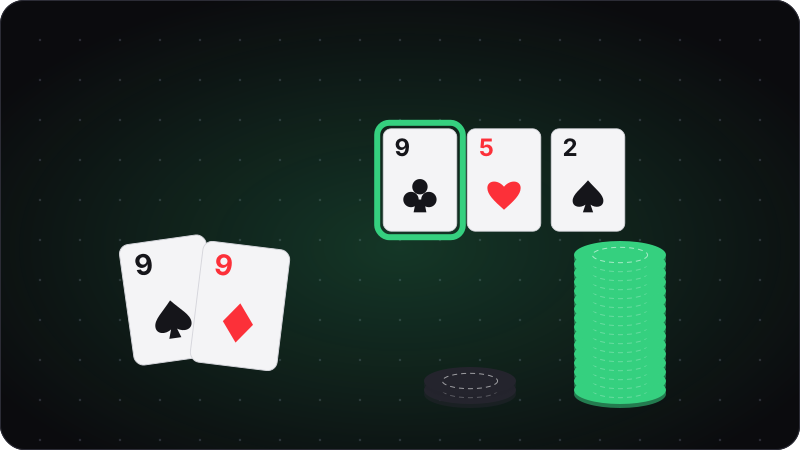
You usually want to bet your very strong hands after the flop.
That is the default because poker rewards value, not cleverness for its own sake. When you have a monster, you want worse hands to pay you, draws to make mistakes, and the pot to grow while you are ahead.
But slow play is not a gimmick. In the right spot, it can win more than a standard value bet. The problem is that many players slow play too often, on the wrong boards, against the wrong opponents, and at the wrong stack depth. Then they miss value, give free cards, and turn a winning hand into a small pot.
The real question is not "Should you slow play?" It is "When does checking or calling with a big hand make more money than betting now?"
What slow play actually means
Slow play means taking a passive line with a very strong hand to induce action later.
That usually means:
- checking back with a big hand in position,
- checking to the aggressor and calling,
- or flat-calling instead of raising when a raise would be available.
Slow play is not the same thing as a check-raise. A check-raise is an aggressive trap or value line, not a passive slow-play line. It can be very strong, but it works for a different reason: you are not trying to disguise strength by staying passive, you are trying to win more by letting the opponent continue first and then raising.
If you want to think clearly about the hand, keep that distinction clean:
- slow play = passivity with strength to induce later action,
- check-raise = aggression with strength to seize the betting lead and often build the pot faster.
That difference matters because many players call every trap a slow play, and then they end up using the wrong line on the wrong board.
Why betting strong hands is usually the default
When you bet a strong hand, you get several things at once.
1. You get called by worse hands
This is the cleanest form of value. One pair, second pair, top pair with a weak kicker, and draws can all put money in when you bet.
2. You charge drawing hands
On wet boards, the cards that can beat you are obvious. Betting makes those hands pay to continue.
3. You build the pot while you are ahead
A monster hand does you no good if the pot stays tiny and the board runs out harmlessly. You want the money in while your advantage is still large.
4. You deny equity
A free card can be expensive. Even if you are far ahead, a turn card can kill your action, counterfeit your hand, or complete a draw you could have taxed.
That is why slow play is usually a special move, not the default line.
When slow playing makes sense
Slow play works best when several conditions line up.
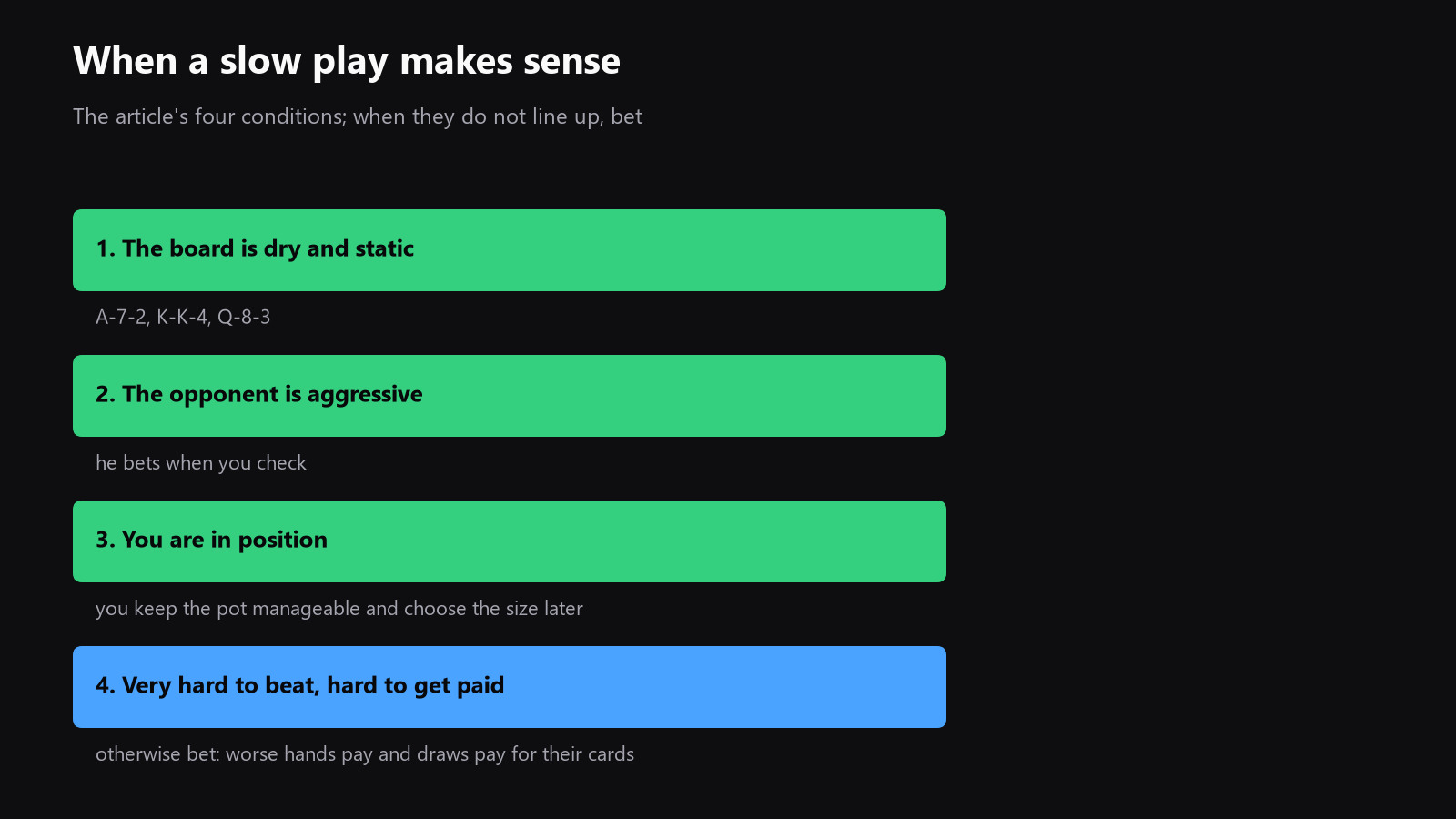
1. The board is dry and static
Dry boards are boards where the texture changes little on the next street.
Examples:
- A♣ 7♦ 2♠
- K♠ K♦ 4♣
- Q♣ 8♦ 3♠
On these boards, a strong hand is less vulnerable to bad turn cards. There are fewer obvious draws, fewer scare cards, and fewer ways for worse hands to suddenly improve.
That makes slow play much more attractive.
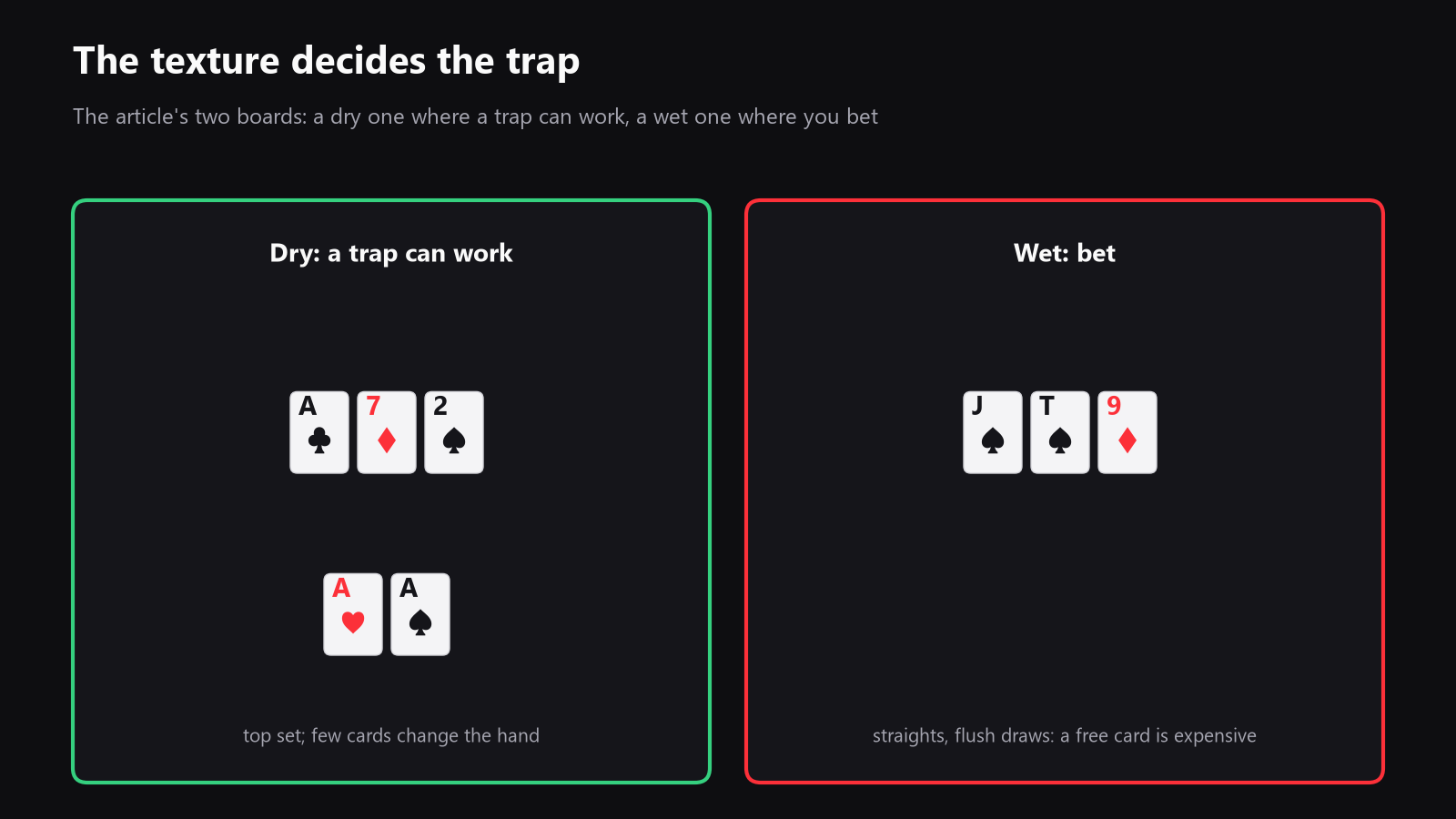
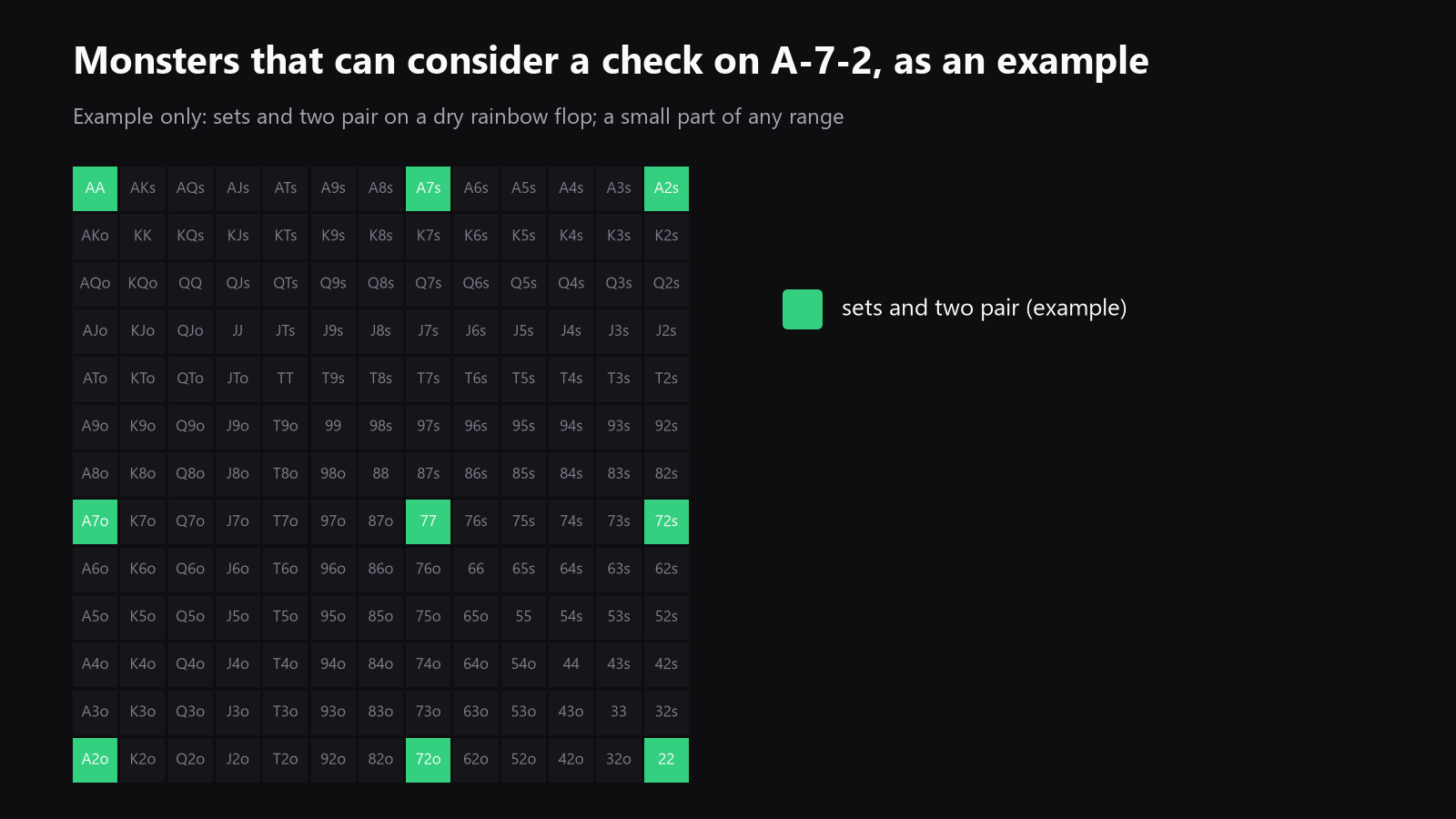
If you have top set on A♣ 7♦ 2♠, for example, checking can be excellent against the right opponent. Many worse hands will not fold later, and many bluffs will fire if you show weakness.
2. The opponent is aggressive
Slow play is most profitable when the other player likes to bluff.
If someone stabs too often when checked to, checks back too rarely, or likes to barrel turns, your strong hand can earn more by letting them hang themselves.
This is where the HUD module helps. If you see a player with high aggression or a tendency to bet when checked to, that is the kind of opponent against whom a trap becomes more attractive.
3. You are in position
In position, you have more control.
You can let the opponent act first on later streets, which means you can often:
- keep the pot manageable,
- induce a bluff,
- and decide how much more money you want to put in.
That said, position does not automatically mean slow play. If the board is wet or the value is obvious, betting is still often better.
4. Your hand is very hard to beat, but not easy to get action with
The best slow-play candidates are hands that are:
- strong enough to tolerate a turn check,
- but not so obvious that worse hands will happily call multiple streets.
For example, on a paired dry board, a full house or trips may be strong enough to trap. If worse hands are folding to one bet anyway, checking can keep bluffs in the pot without sacrificing much value.
5. There are not many players behind you
Slow play becomes riskier multiway.
The more players remain in the hand, the more likely someone has:
- a draw,
- a piece of the board,
- or a hand that will improve for free.
In multiway pots, your strong hand usually wants to bet more often. Too many bad things can happen when you give everyone a card.
When slow play is usually a mistake
1. The board is wet
On boards like J♠ T♠ 9♦ or 8♥ 7♥ 6♣, checking a monster often gives away too much.
Why? Because many turn cards change the hand dramatically. Straight draws, flush draws, two pair, and pair plus draw hands all gain equity quickly.
If you have a very strong hand on a wet board, you usually want to build the pot and charge the field.
2. The opponent is passive
If your opponent does not bluff much, checking loses value.
A passive player often checks back hands that you beat, and only bets when they have something. That means your trap does not catch much. You just miss a street of value.
3. Worse hands cannot continue enough
If you are unlikely to get called by worse, betting less is not a reason to check more. It is a reason to think about your size and your line.
A slow play that gets no action is just a missed bet.
4. The stack depth is short
The shorter the effective stack, the fewer streets you have to build the pot.
With shallow stacks, especially around 25 to 40 big blinds, strong hands often prefer to start growing the pot early. If you wait too long, there may not be enough room left to win a meaningful stack.
5. Free cards are expensive
Ask yourself what happens if you check and the turn is ugly.
A strong hand can still lose value when:
- a flush completes,
- a straight completes,
- the board pairs in a bad way,
- or the action dies.
If a free card can materially hurt your hand, slow play becomes much weaker.
A simple way to think about the decision
Before you check a monster, ask these five questions.
- What worse hands will bet or call? If the answer is "very few", betting is probably better.
- What bluffs will the opponent take this line with? If the answer is "many", slow play gains value.
- How dangerous are the next cards? The more dangerous the runout, the less you want to get cute.
- How many streets of value can I realistically win? If you need three streets, do not wait too long to start.
- Does this opponent attack weakness? If yes, checking can be a very good trap. If not, it may just be a gift.
This is the kind of spot where the exact answer depends on the board, the position, the stack depth, and the player type. If you want to review those spots away from the table, the Solver module can help you study the line. It refuses during a live session, which is exactly how it should be.
Practical examples
Example 1: top set on a dry board
You hold A♠ A♦ on A♣ 7♦ 2♠.
This is a classic spot where slow playing can work well against an aggressive opponent.
Why?
- Your hand is far ahead.
- The board is dry.
- Worse hands are likely to fold to one bet anyway.
- The opponent may stab if you check.
Against that kind of player, checking can create extra money later.
Example 2: a straight on a wet board
You hold Q♠ J♠ on T♠ 9♦ 8♣.
You have a very strong hand, but the board is full of danger.
Here, slow play is usually much worse. Too many turn cards change the board, too many draws exist, and too many worse hands can improve or go away.
You normally want to bet and start building the pot.
Example 3: a full house on a paired board
You hold K♣ K♦ on K♠ 9♠ 9♦.
This can be a great trap spot in some lineups.
The board is paired, your hand is very strong, and a lot of hands that continue are still interested in betting or calling later. If your opponent likes to bluff, checking can be very profitable.
But if the opponent is tight and shuts down often, a value bet is safer.
Bet sizing matters too
Slow play is not the only way to keep worse hands in.
Sometimes the right answer is not "check", but "bet smaller".
That lets you:
- charge draws,
- keep dominated made hands interested,
- and still avoid scaring off the part of the range you want action from.
Many players think the decision is only bet or check. In reality, the first question is often whether you should bet at all. If yes, the next question is how big.
The biggest slow-play mistakes
Here are the errors that cost the most:
- slow playing on wet boards,
- slow playing against passive players,
- slow playing multiway too often,
- waiting too long with short stacks,
- and checking because you are afraid of losing action, instead of because the line actually makes money.
If your hand is strong enough to bet for value, do not check just to look sophisticated.
Poker rewards money, not style.
The short rule
If the board is dry, the opponent is aggressive, and your hand is hard to beat but hard to extract value from, slow play can be excellent.
If the board is wet, the pot is multiway, or the opponent does not bluff enough, bet your strong hands.
When in doubt, lean toward value.
That is usually the safest and most profitable habit.

How to study these spots better
If you want to improve quickly, do not study slow play as a vague idea. Study it by spot.
Look at:
- board texture,
- position,
- stack depth,
- opponent type,
- and whether the hand needs protection or action.
The HUD module helps you spot the players who bluff too much or too little. The Plan module picks the situation that costs you the most against the field, and the Self Analyser module shows each situation against the field and against the rest of your game.
That is the real edge: not memorizing a cute trap, but learning when your strong hands should build the pot and when they should wait.
Do it on your own hands.