
Pot control means keeping the pot smaller than it could be when your hand is good enough to continue, but not strong enough to welcome a big fight.
That is the whole idea. You are not trying to win every pot immediately. You are trying to choose the size of the pot that fits the strength of your hand, the texture of the board, the stack depth, and the opponent in front of you.
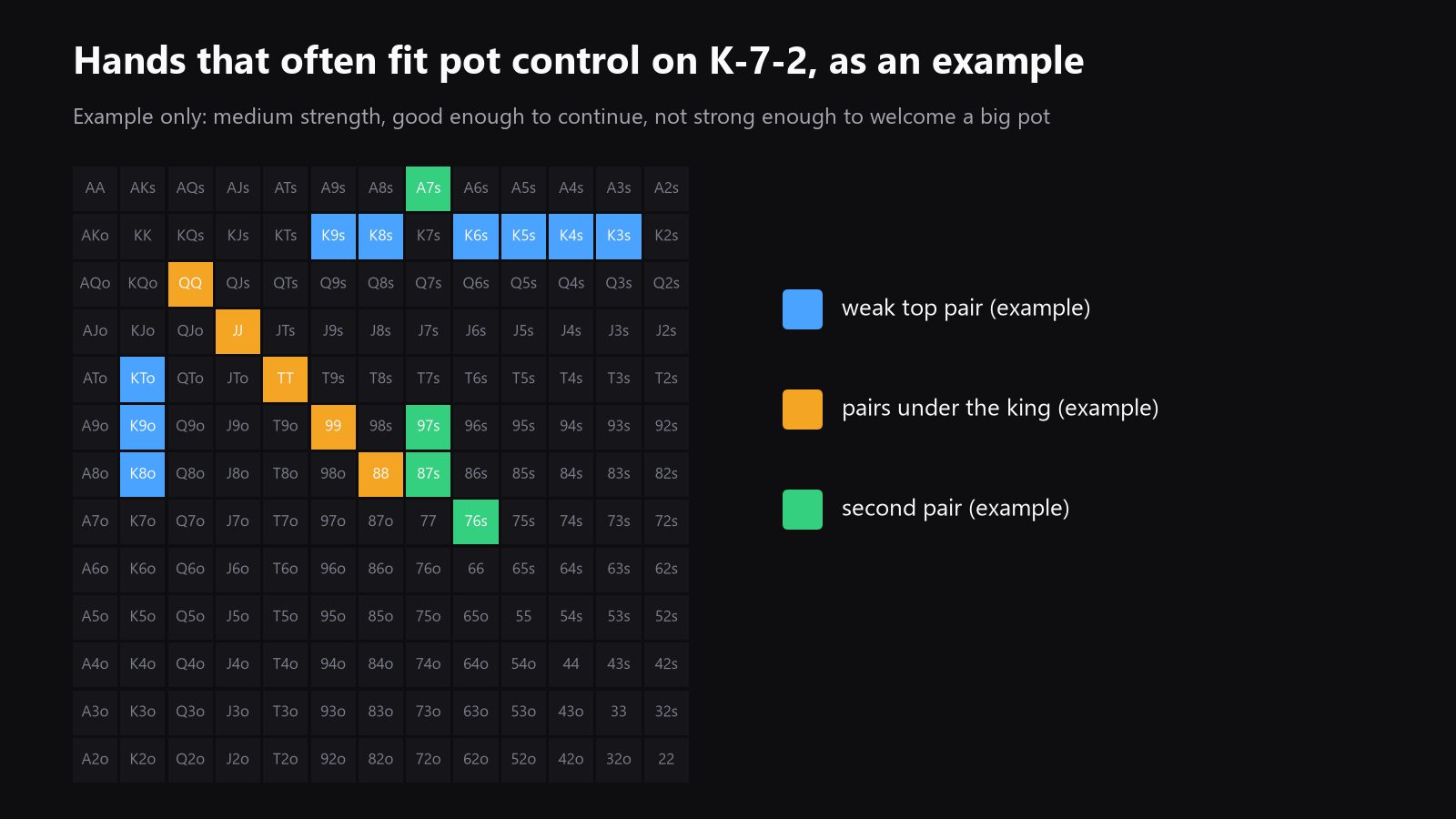
Most players understand the phrase, but not the job it does. Pot control is not a passive habit. It is a way to preserve your options when the hand is medium strength: one pair, weak top pair, second pair, some bluff-catchers, some hands with showdown value but limited appetite for a large pot.
What pot control actually does
When you check a street or choose a small line, you do several things at once:
- You keep the pot smaller.
- You keep more hands in both ranges.
- You delay the point where the hand becomes expensive to play.
That delay is the heart of pot control. A medium-strength hand often does not want to be the reason the pot explodes. If you build the pot too fast, you can turn a comfortable spot into a very hard one by the river.
A simple example shows why this matters.
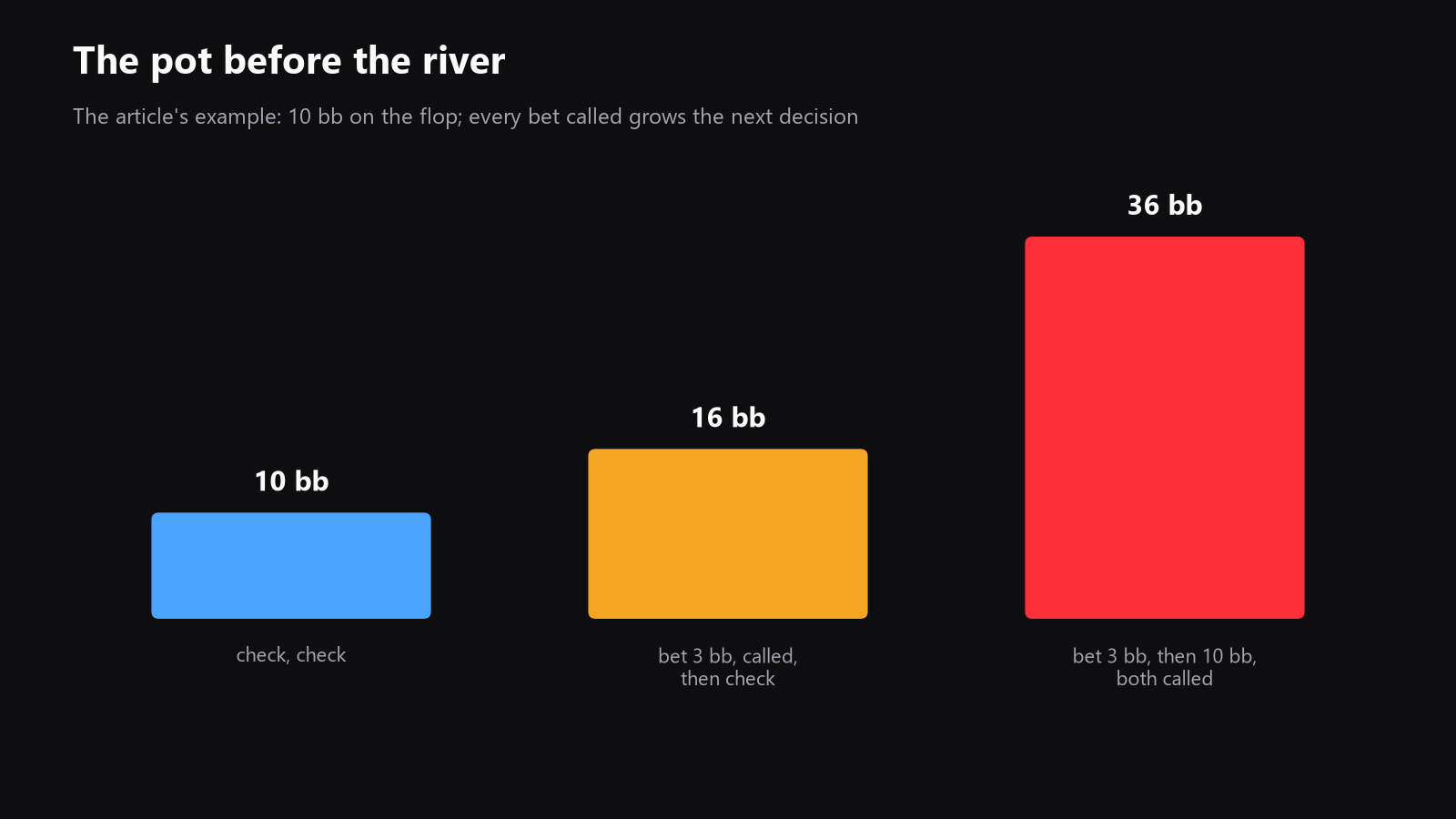
Say the pot is 10 bb on the flop. A bet of 3 bb gets called. The pot becomes 16 bb. If you bet again for 10 bb and get called, the pot is already 36 bb before the river. One line has committed you to a much bigger final decision.
That does not mean betting is wrong. It means every bet has a cost that grows on later streets. Pot control is about respecting that cost.
When checking back in position makes sense
In position, pot control is often easiest because you get to see what the other player does before you act again.
Checking back can be good when:
- your hand has showdown value, but not enough to want a big pot
- the board is dry or fairly static
- a bet would not get called by enough worse hands to justify the extra size
- a raise would create a spot you do not want
- you want to realise your equity cheaply
- you want to keep your checking range protected
That last point matters a lot. If your checks only contain air, your opponent can attack them freely. When you also check some medium-strength hands, your checking range becomes much harder to abuse.
A practical in-position example
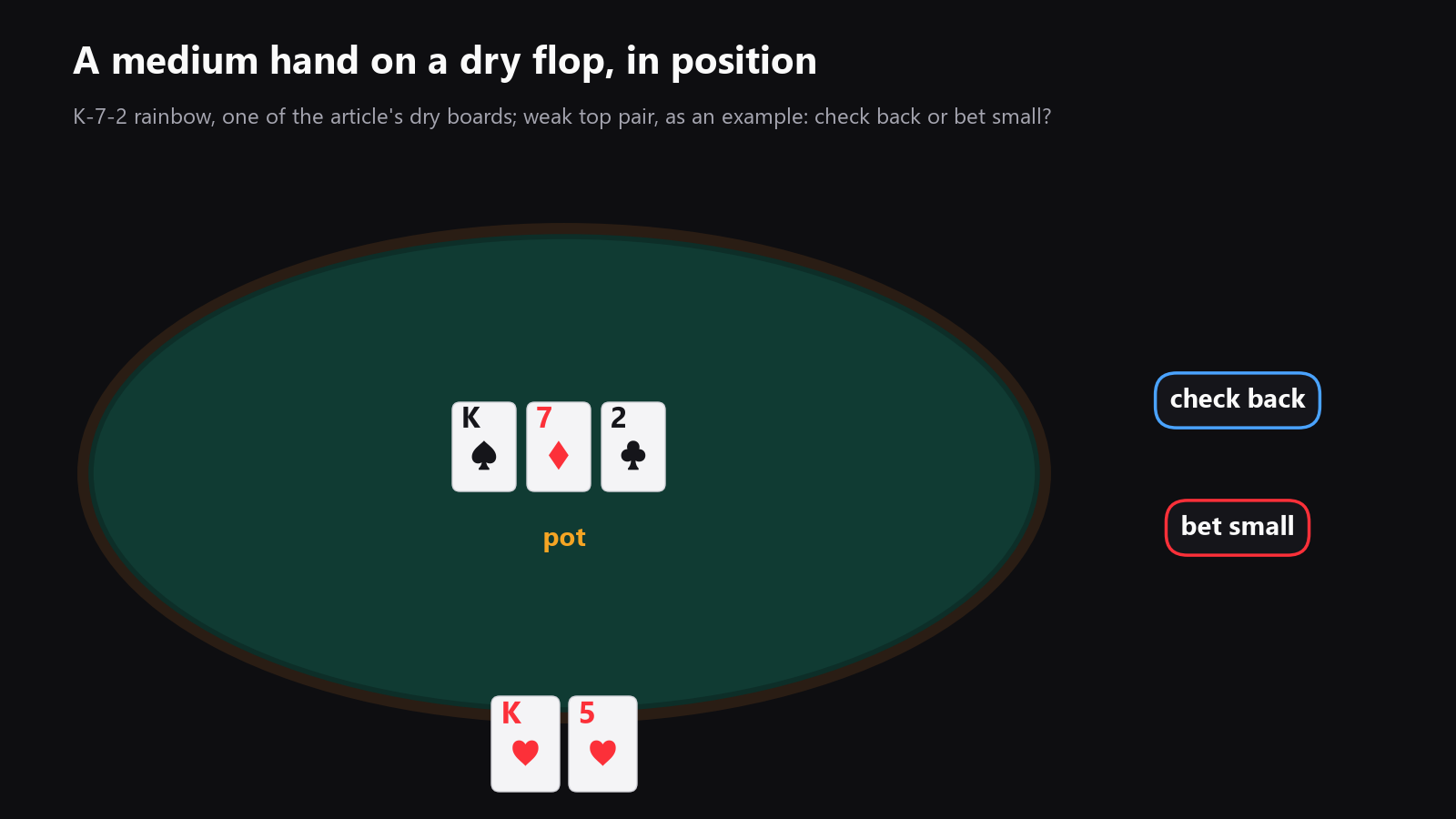
You raise preflop, get called, and see a dry flop where you have second pair or weak top pair. A small bet can be fine. But a check back can also be excellent if:
- the board does not need much protection
- worse hands do not call often enough
- being raised would be unpleasant
- you would rather keep the pot manageable and re-evaluate the turn
That is the real logic of pot control in position. It is not "do nothing because you are weak." It is "do not force growth when growth is not clearly profitable."
When checking out of position makes sense
Out of position, pot control is often more important, because you have less information and less flexibility.
If you bet, you may bloat the pot before you know whether your hand can stand up to resistance. If you check, you may keep the pot under control and let the hand develop more naturally.
Checking out of position is often reasonable when:
- your hand has enough showdown value to continue
- the board favours the caller or the preflop defender
- a free card is acceptable
- you expect a bet to face strong resistance
- you have a plan for later streets
That last part is critical. A check without a later plan is not good pot control. It is just indecision.
If you check and face a bet, you still need to know what your line is supposed to do. Call one street? Fold to pressure? Check-raise certain boards? Pot control only works when it belongs to a plan.
Out of position, the trade-off is sharper
Out of position, betting can feel safer because it looks proactive. But it can also force the pot to grow against a range that is not going away.
If you hold a medium-strength hand and the board is not ideal for building a large pot, a check-call line is often the cleaner way to keep the hand under control. You keep worse hands in, avoid inflating the pot unnecessarily, and preserve room for later decisions.
What pot control protects
Pot control protects several things at once.
1. Your stack
The most obvious one. If your hand is not a strong value hand, a large pot can become a trap. Smaller pots reduce the amount you can lose when villain shows up with value or a draw that improves.
2. Your equity realization
Some hands do not need to win now. They need to get to showdown cheaply enough. Pot control helps you reach the river with enough of your equity intact to profit from missed draws and weaker pairs.
3. Your checking range
If you never check strong enough hands, your checks become easy to attack. Pot control helps keep your range balanced enough that your opponent cannot just bet every time you show weakness.
4. Your variance
Big pots create big swings. Sometimes that is fine. Sometimes it is not what you want. If you are trying to reduce noise, protect a bankroll, or avoid turning marginal spots into giant ones, pot control is one of the cleanest tools you have.
What pot control costs you
Pot control is never free.
1. You may miss immediate value
If worse hands can call profitably and often enough, checking can leave money on the table. That is the first question you should ask: are you giving up a bet that gets paid?
2. You may allow a free card
On draw-heavy boards, a free card can be expensive. The more often the turn changes the relative strength of the hand, the more careful you must be about checking.
3. You may let villain realise equity
A weak pair, two overcards, a backdoor flush draw, or a straight draw may improve for free. If that happens often enough, your medium-strength hand may lose its edge.
4. You may give up initiative
Checking hands control less of the hand’s future than betting does. Against some players, that is acceptable. Against others, it can be a mistake.
The mistake of making pot control a rule
Pot control is a tool, not a slogan.
A common mistake is to think, "If worse hands may call, I should bet." That is too simple.
A bet can still be wrong even if worse hands call sometimes, because you also need to consider:
- what happens on future streets
- whether the board changes a lot
- how likely you are to get raised
- how deep the stacks are
- whether you are in position or out of position
- how well your hand realises equity after a call
- whether checking gives up too much or not enough
Sometimes the immediate call from worse hands is not enough compensation for what happens later. A hand can benefit from keeping the pot smaller even if it leaves some value on the table now.
That is why pot control is a judgment, not a rule.
The boards where pot control works best
Pot control is usually strongest on boards that are dry and stable.
It is often easier on boards like:
- K 7 2 rainbow
- Q 8 4 rainbow
- A 9 3 with few draws
It is often harder on boards like:
- T 9 8 with flush draws
- J T 7 two-tone
- boards with many straight and flush turns
On dry boards, checking a medium-strength hand is often appealing because the free card is less dangerous. On wet boards, you need to be much more alert to what you are giving away.
Stack depth changes everything
Pot control matters more when stacks are deep.
At 200 bb, one bet can create a very expensive river. At 100 bb, that danger still exists. At 25 bb, the hand is often already moving toward commitment, so the idea of "keeping it small" matters less than stack-to-pot ratio and raw hand strength.
The deeper the stacks, the more useful pot control becomes. Deep stacks punish careless pot building.
Common mistakes with pot control
1. Using it on every marginal hand
Not every medium-strength hand wants the same treatment. Some should bet for value and protection. Some should check. The right line depends on the board, the opponent, and the future streets.
2. Confusing a small bet with control
A small bet can still create a large river pot if the hand continues. Pot control is about the whole line, not the first bet size alone.
3. Checking without a plan
If you check and do not know what you do versus a bet, a check-back, or a raise later, you are not controlling the pot. You are surrendering the decision.
4. Forgetting to protect your checking range
If all your good hands bet and all your weak hands check, good opponents can attack your checks relentlessly. Some medium-strength hands need to live in the checking range.
5. Ignoring the opponent
Against calling stations, checking may leave value behind because they pay too much with worse. Against aggressive players, checking can be excellent because it lets them hang themselves or bluff into your range. The same hand can want very different lines against different people.
A simple decision checklist
Before you choose pot control, ask yourself:
- Does my hand have showdown value but limited appetite for a large pot?
- Does the board favour a smaller pot or a bigger one?
- Would I prefer to face one more card before committing more chips?
- Am I in position or out of position?
- How deep are the stacks?
- How likely is it that betting gets raised?
- What happens if I check and villain bets?
- What happens if I bet and get called?
If the answers push you toward caution, pot control is probably part of the right line.
Pot control and your own game
If you want to know whether you are controlling pots too much, or not enough, you need to look at your own hands.
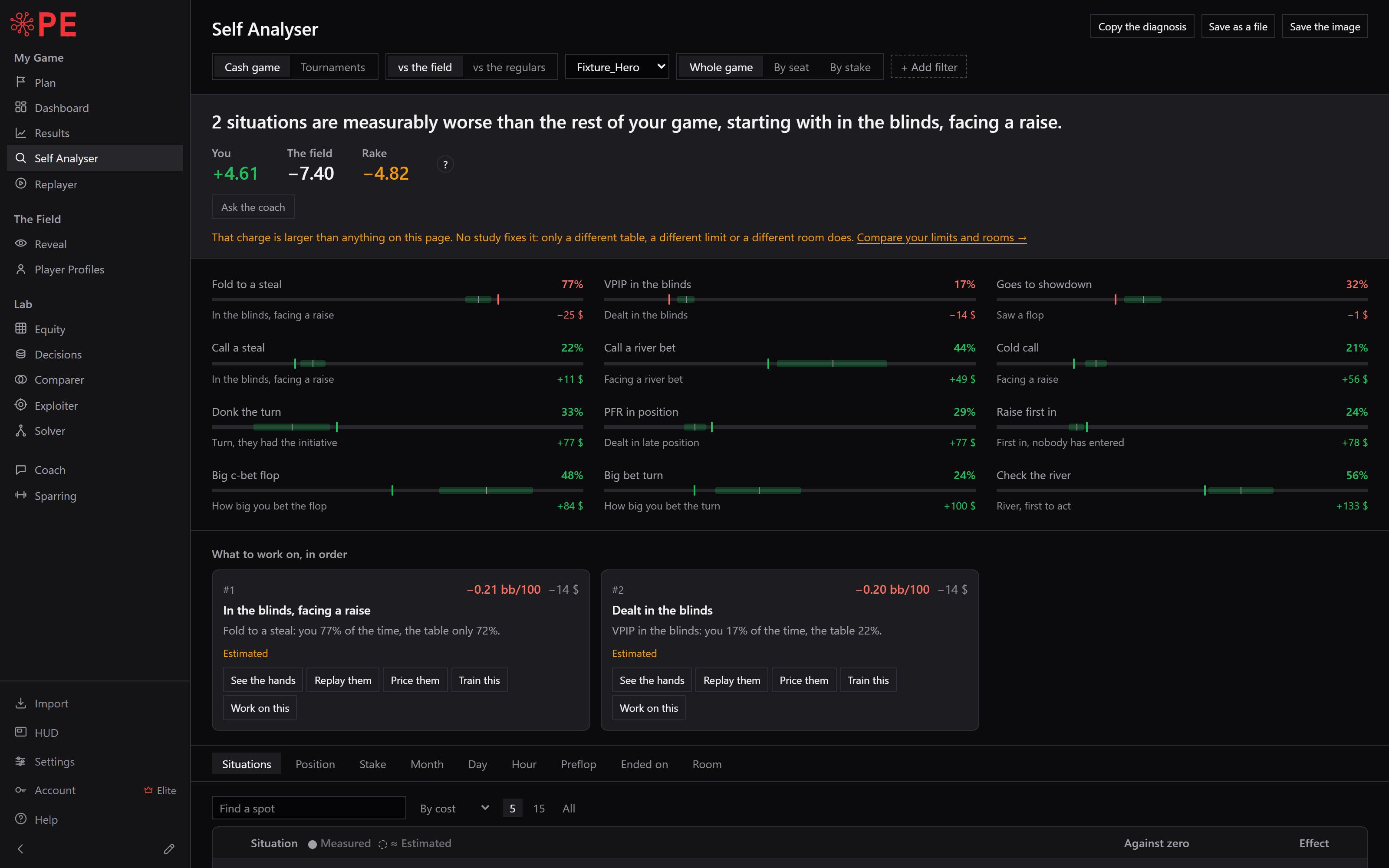
The Self Analyser module can help with that. It compares situations in your game against the field and against the rest of your game, with gauges that make leaks easier to spot. That is useful when you are trying to see whether certain medium-strength spots are costing you too much.
And if you want a precise answer to a tricky spot away from the table, the Solver module can calculate it after the session. That is where exact strategy work belongs. In the hand itself, the job is simpler: keep the pot small when the hand deserves it, and build it only when the hand can support the size.
The short version
Pot control is the art of refusing to grow the pot faster than your hand can comfortably support.
You use it with medium-strength hands when a smaller pot preserves value, reduces variance, and avoids ugly river spots. You pay for it by sometimes missing value and sometimes giving away a free card. The best players do not pot-control because they are afraid. They do it because they know when a hand wants a smaller future.
Do it on your own hands.