
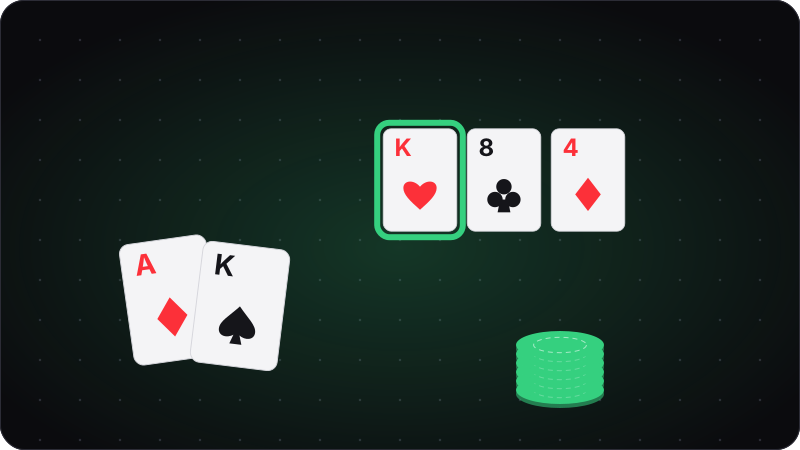
Top pair is one of the most common made hands in No-Limit Hold'em, and one of the most misplayed.
A lot of players see top pair and think, "I have a good hand, so I should bet." That is often right, but not always. Top pair can be a strong value hand, a thin value hand, or a bluff-catcher, depending on four things:
- your kicker
- the board texture
- your position
- your opponent
If you want to play top pair well, you need to stop asking, "Do I have a pair?" and start asking, "What worse hands call me, what better hands continue, and how many streets can I really get?"
What top pair really means
Top pair is simple in theory. You pair the highest card on the board.
Examples:
- On A 7 3, holding A K means top pair
- On Q 8 4, holding Q J means top pair
- On T 6 2, holding T 9 means top pair
But not all top pair hands are equal.
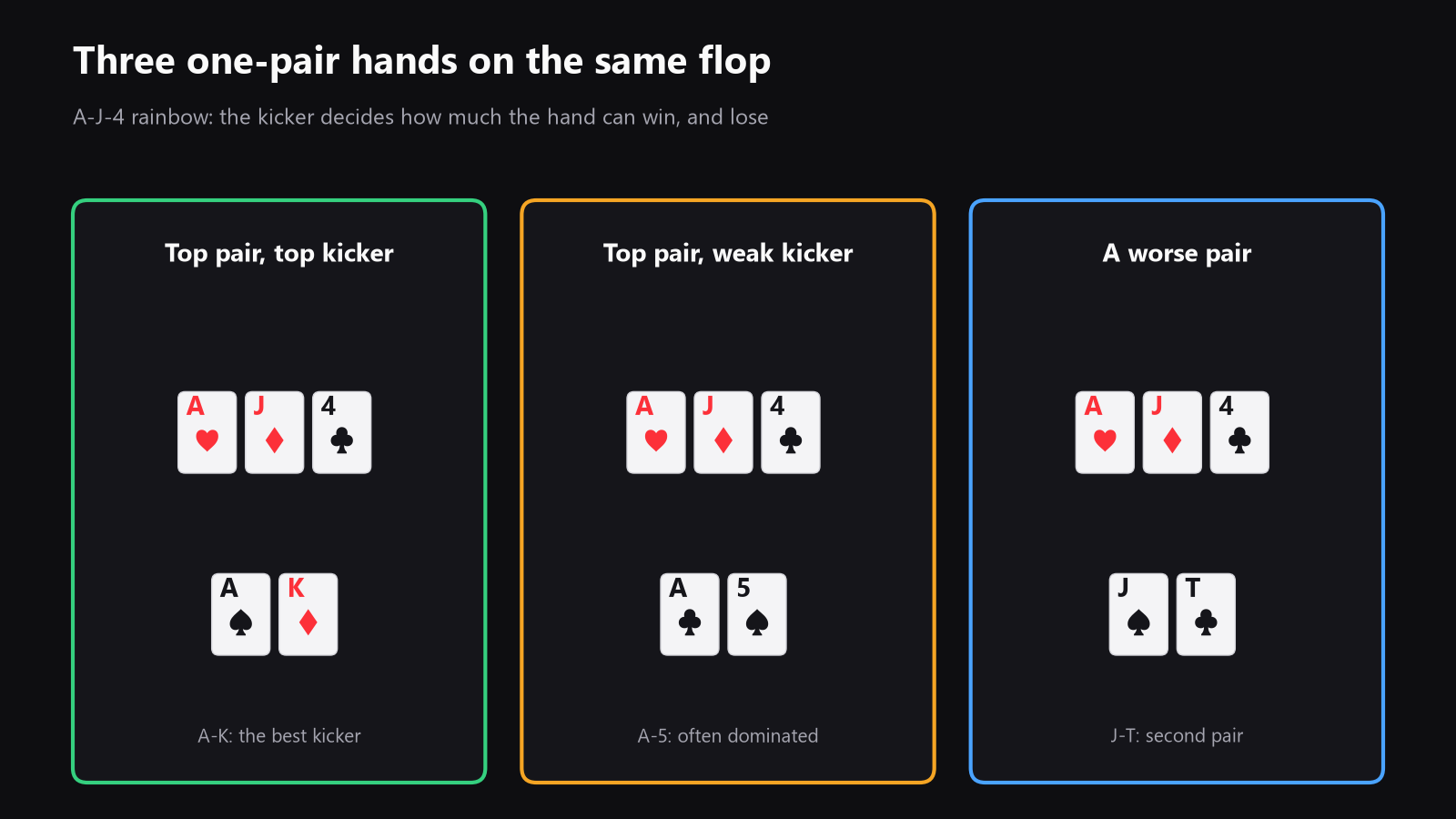
A K on A 7 3 is much stronger than A 5 on A 7 3, because kickers matter. On the same board, you can have the same pair and very different practical strength.
That is why top pair is not a hand class you can play on autopilot. It is a hand class you have to rank.
Kicker: the first thing that changes everything
Kicker decides how often your top pair is still good when money goes in.
Top pair top kicker
This is the version you usually want to value bet aggressively. If you have top pair top kicker, you often beat the part of your opponent's range that is calling with worse one-pair hands.
Examples:
- A K on A 7 3
- A K on A J 4
- A K on K 9 2
Top pair with a weaker kicker
This hand is still often ahead on the flop, but you should think more carefully about later streets.
Examples:
- A 5 on A 7 3
- K 7 on K J 4
- Q 4 on Q 8 2
Weak kicker hands get dominated more often. When stacks go in, the difference between strong and weak kicker shows up fast.
A simple rule: the weaker your kicker, the less eager you should be to build a big pot against a range that continues strongly.
Board texture: the board tells you how fragile top pair is
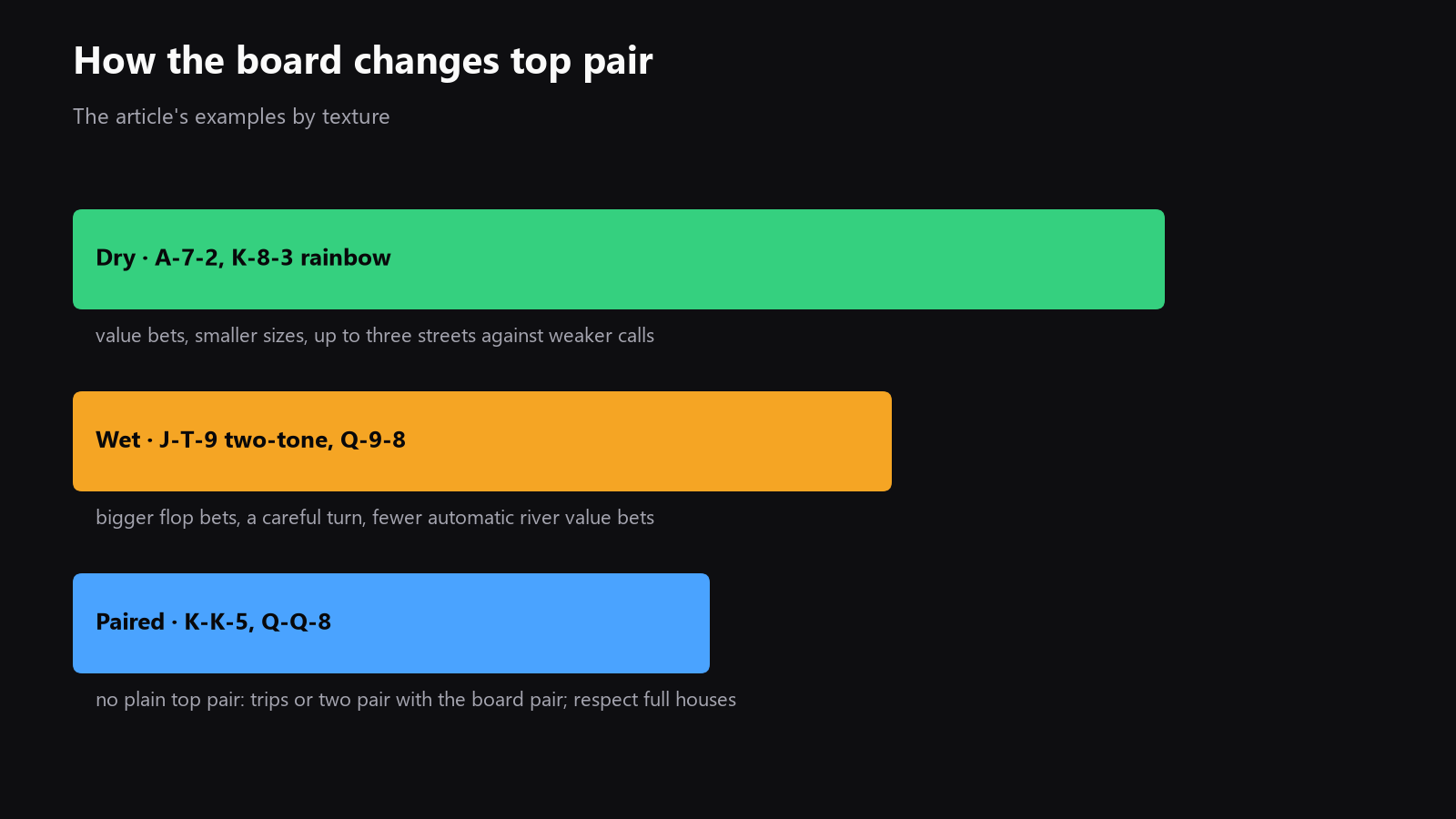
Not every top pair plays the same way. The board changes everything.
Dry boards
Examples: A 7 2 rainbow, K 8 3 rainbow
On dry boards, top pair is usually much safer. There are fewer straight and flush draws, fewer two-pair combinations, and fewer natural turn cards that completely change the hand.
On these boards, top pair often wants:
- value betting
- smaller sizing
- three streets against weaker calls, especially versus loose opponents
Wet boards
Examples: J T 9 two-tone, Q 9 8 with a flush draw, A J T connected
On wet boards, top pair is much more fragile.
Even if you are currently ahead, many turn cards are ugly, and many worse hands have real equity. Draws, two pair, sets, and made straights appear much more often.
On these boards, top pair often wants:
- bigger protection bets on the flop
- more cautious turn play
- fewer automatic river value bets
Paired boards
Examples: K K 5, Q Q 8
Paired boards are interesting because you usually do not have top pair in the usual sense. A king here makes trips, a 5 or a pocket pair makes two pair with the board pair, and an overpair is an overpair, not top pair.
Against many players, trips on a paired board can be a very good value hand, and two pair with the board pair is often strong too. But once action gets big, you should not ignore the possibility that your opponent has a full house or a very strong made hand.
Position changes the whole hand
Position is not a detail. It changes how many streets you can extract.
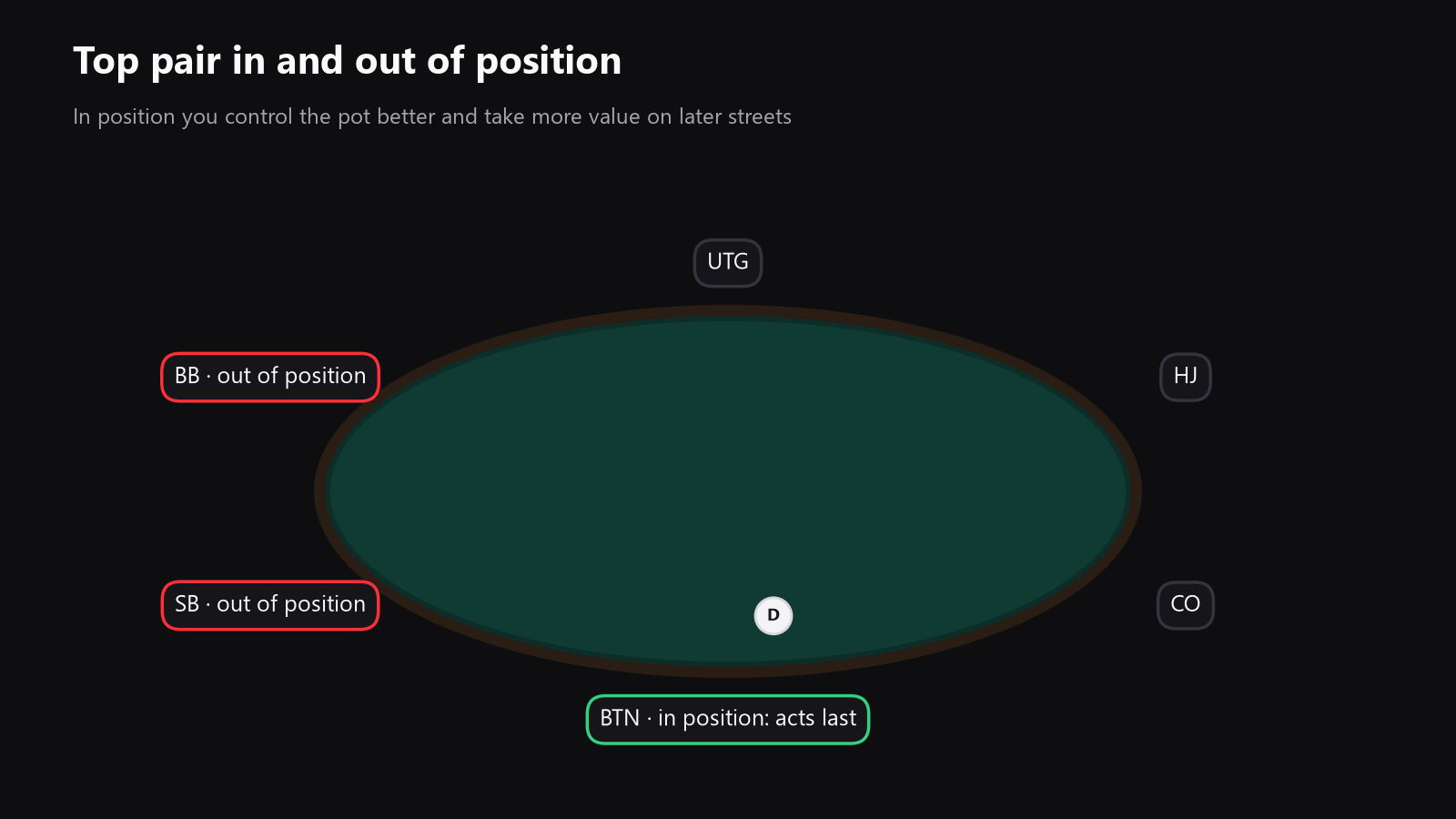
In position
When you are in position, you can:
- control the size of the pot better
- realize more value on later streets
- take a free card when the board gets worse for you
- bet thinner because you get more information
This means top pair in position can often go for three streets on good boards, especially versus a player who calls too much.
Out of position
When you are out of position, top pair gets harder to play.
You face more difficult decisions on the turn and river, and checking can invite pressure. In many spots, you should value bet the flop, then slow down more often on later streets if the board becomes dangerous or your opponent's line gets stronger.
Out of position, top pair is still usually a value hand, but not always a big-pot hand.
Opponent type matters more than people think
Top pair is not played against "the board." It is played against a range, and some opponents arrive at the river with very different ranges.
Against loose callers
This is where top pair prints.
If your opponent calls too much, top pair can often be value bet on multiple streets, even with a medium kicker. Worse one-pair hands, second pair, and missed draws may still pay you.
Against nits
Be more careful.
When a tight opponent continues, their range is stronger. That does not mean you should never bet top pair, but it does mean that thin value gets thinner quickly. Top pair with a weak kicker becomes much less comfortable.
Against aggressive players
Here, top pair often becomes a bluff-catcher on later streets.
Some players raise too much, especially on scary runouts. Against them, you want to think about whether they are representing value, or whether they are trying to apply pressure on a capped range.
If you want to check how often players at your limits continue, fold, or raise in spots like this, the Reveal module shows real frequencies from your own hands. That is much more useful than guessing.
How many streets of value should you aim for?
This is one of the most important questions with top pair.
The answer is not "always three." It depends on how many worse hands can call you on each street.
Usually three streets
You can often go for three streets when:
- the board is dry
- your kicker is strong
- you are against a calling station
- the runout does not change much
Example: you have A K on A 7 2 rainbow against a loose player. That is a classic three-street value candidate.
Usually two streets
Two streets is often better when:
- the board is semi-wet
- your kicker is decent but not great
- the opponent continues with many draws but folds later
- the river card often reduces value
Example: Q J on Q 8 5 two-tone against a competent regular. You can often get value on flop and turn, but the river is where you must be selective.
Often one street or check-call
One street, or a more cautious line, makes sense when:
- the board is very wet
- your kicker is weak
- stacks are deep and reverse implied odds matter
- your opponent's continuing range is strong
Example: T 4 on T 8 2 rainbow is not the kind of top pair you want to build a giant pot with.
When to slow down
You should slow down when the hand stops being a clear value hand and becomes a bluff-catcher.
Common slow-down spots:
- a turn card completes obvious draws
- your opponent shows strength after calling earlier streets
- a passive player suddenly raises
- the river bricks in a way that favors your opponent's strong calling range
- your kicker is weak and the pot is getting too big
Slow down does not always mean check-fold. It often means checking to control the pot, calling a reasonable bet, or betting smaller instead of forcing a big pot.
A useful question is this: "If I bet again, what worse hands call me?" If the answer is "almost none," you are probably no longer value betting, you are overplaying the hand.
When top pair is already beat
Top pair is beat more often than beginners think, but not always by the same hands.
The main hands that beat top pair are:
- two pair
- sets
- straights
- flushes
- better kickers of the same top pair
- occasional overpairs, depending on the board
You also have to think about draws that improve. A hand can be behind on the flop and still end up beating you by the river.
That is why top pair is not just a showdown hand. It is a hand that lives across three streets, and its value changes with every new card.
On the flop
You are usually ahead of many worse one-pair hands, overcards, and draws.
On the turn
The board often starts to define the hand. Some turns are great, some are terrible.
On the river
The river tells the truth. If the action has been heavy and the board is coordinated, top pair may be only a bluff-catcher.
Practical rules you can actually use
Here is a simple checklist:
- Top pair top kicker on a dry board
- usually bet
- often bet again
- often value bet river
- Top pair with a weak kicker on a wet board
- often bet flop
- be careful on turn
- do not auto-fire the river
- In position
- value bet thinner
- control the pot better
- punish weak ranges
- Out of position
- value bet when worse hands call
- slow down more often when action gets strong
- Against calling stations
- bet for value more often
- size up when the board is safe
- Against tight or aggressive opponents
- narrow your value range
- expect stronger continuing ranges
- be ready to check-call instead of forcing value
A quick example
You open the cutoff, the big blind calls, and the flop comes A 7 3 rainbow. You hold A J.
This is a classic value spot.
Why?
- you have top pair
- your kicker is strong enough
- the board is dry
- worse aces can continue
- many pocket pairs can call once
- many floats and random hands miss
On a board like this, you can often build a pot confidently.
Now compare that with A J on A T 9 two-tone.
You still have top pair, but now:
- many draws exist
- worse aces are less common
- two pair and straights are more realistic
- the turn can change everything
Same category of hand, very different plan.
The big mistake to avoid
The biggest mistake with top pair is thinking the hand is "made" in the same way every time.
It is not.
Top pair can be:
- a strong value hand
- a medium-strength hand
- a bluff-catcher
- a hand that should check back
- a hand that should bet for protection
- a hand that should stop on the turn
If you want to improve fast, review the spots where you lost the most money with one-pair hands. That is exactly the kind of work the Plan and Self Analyser modules are built for. And if you want to see how a spot behaves away from the table, the Solver module lets you study it later, not during a session.
Final takeaway
Top pair is good, but not automatically great.
Play it with the board, not against it. Play it with the kicker, not just the rank of the pair. Play it with position in mind. And above all, play it against the opponent in front of you.
If you do that, top pair stops being a hand that makes you guess, and becomes a hand you can value bet with confidence.
Do it on your own hands.