

If you want useful feedback on a poker hand, the way you post it matters almost as much as the hand itself.
A vague post gets vague answers.
A clear post gets better ranges, better sizing advice, better spot analysis, and often a much faster path to the real mistake.
This guide shows you how to share a poker hand so people can actually help you, whether you are posting in a forum, a Discord group, a study chat, or sending it to a coach.
Why some hand posts get bad advice
Most weak hand posts have the same problems.
1. They leave out key facts
If people do not know the game type, stack sizes, positions, or action sizes, they are forced to guess.
And once people guess, the quality of the advice drops fast.
2. They ask a vague question
Questions like:
- “What do you think?”
- “Was this okay?”
- “Should I have folded?”
are too broad. They invite opinions, not analysis.
3. They bury the important spot
Sometimes the real decision was preflop, but the post focuses on the river.
Sometimes the key issue was the flop sizing, but the post starts with the showdown.
If the structure is messy, the feedback will be messy too.
4. They bias the answer
If you reveal the result too early, people stop thinking about the line and start reacting to the showdown.
That is how people end up defending or criticizing a decision for the wrong reason.
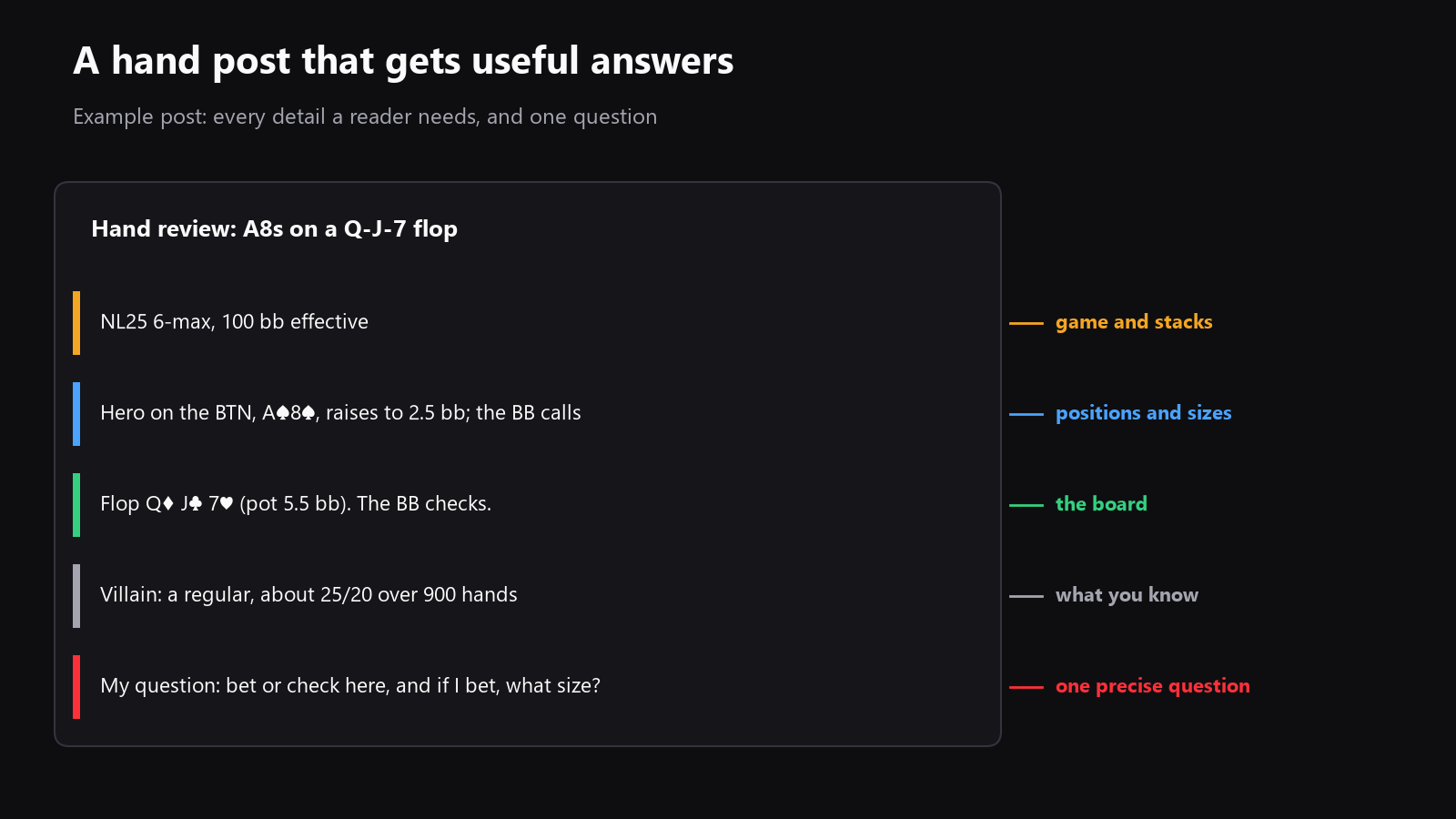
The minimum information to include
When you share a poker hand, include these details every time.
Game type
Say what format it is.
Examples:
- Cash game
- Tournament
- Sit & Go
- Spin & Go
- PKO or bounty tournament
Stakes and blinds
Be exact.
Examples:
- NL10 cash
- $5.50 tournament
- 100/200 with 25 ante
- 500/1,000 heads-up
Effective stack
This is one of the most important details in the hand.
If stacks are not equal, use the effective stack, meaning the smaller stack that can actually play for the pot.
Example:
- Hero: 78 bb
- Villain: 44 bb
- Effective stack: 44 bb
Positions
Always write positions clearly.
Examples:
- Hero on the button
- Villain in the big blind
- UTG opens, cutoff calls, hero 3-bets from the small blind
Full action and sizing
Do not say only “I bet” or “he raised.”
Write the exact sizes.
Examples:
- Open to 2.2 bb
- 3-bet to 9 bb
- Flop bet 33% pot
- Turn jam for 1.3x pot
The board
Write the board in order, street by street.
Example:
- Flop: K♥ 7♦ 2♣
- Turn: 9♠
- River: 2♦
Relevant reads
Only include reads that matter for the decision.
Useful reads:
- Villain is a reg
- Villain overfolds to 3-bets
- Villain defends too wide from the big blind
- Villain is passive and underbluffs rivers
- Villain is short and close to push or fold
Useless reads:
- “He felt weak”
- “He tanked a bit”
- “I had a bad feeling”
- “This guy is always a fish”
If a read does not change the decision, leave it out.
Your question
Ask one clear question.
Good questions:
- Is the flop bet mandatory here?
- Should I use a larger 3-bet size against this opener?
- Is this river value bet too thin?
- Is this a check back or a small c-bet?
Bad questions:
- What do you think?
- Was this a punt?
- What should I do here?
Specific questions produce specific answers.
A good template for posting a hand
Use a structure like this:
```text Game: NL25 cash Stacks: Hero 100 bb, Villain 94 bb effective Positions: Hero on the button, Villain in the big blind
Preflop: UTG folds, MP opens to 2.5 bb, Hero calls on the button, blinds fold.
Flop: Q♠ 8♦ 3♣ (6.2 bb) Villain checks, Hero bets 2 bb, Villain calls.
Turn: 2♥ (10.2 bb) Villain checks, Hero checks back.
River: J♣ (10.2 bb) Villain bets 7 bb.
Question: Is this a call, and if not, where did the hand go wrong? ```
That post is easy to read, easy to reconstruct, and easy to answer.
Now compare it with this:
``text Was this a bad fold? I had top pair and he shoved river. ``
Same hand, completely different quality of discussion.
Should you include the result?
Not at the beginning.
If you want honest feedback, show the line first and hide the showdown until people have already reasoned through the spot.
Why? Because results bias people.
If they see the hand ended badly, they may overcriticize a correct decision.
If they see the hand won, they may excuse a bad line.
The best hand reviews focus on the decision, not the outcome.
How to format your hand so people can read it fast
A good poker hand post should be simple to scan.
Use street-by-street lines
Separate preflop, flop, turn, and river.
Write exact bet sizes
Do not write “small bet” or “big bet” unless you also include the number.
Keep facts and thoughts separate
Put your own reasoning below the hand, not inside the action line.
Example:
``text I thought villain would continue with a lot of weak pairs and draws, but fold many river bluff catchers. ``
That is useful.
This is less useful:
``text I had a feeling he was weak so I clicked it back. ``
Avoid filler
People helping you need the hand, not the whole session diary.
You do not need to explain every bad beat that happened earlier.
What matters most in cash game hands
If you are posting a cash game hand, these details often matter the most:
- Stakes
- Effective stack
- Rake, if it affects the decision
- Position
- Preflop open size
- 3-bet and 4-bet sizes
- Flop SPR
- Villain type, if known
Cash game advice changes a lot with stack depth and rake.
A line that works at 200 bb may not work at 40 bb.
A size that is standard at one stake may be too small or too large at another.
If you want strong answers, make those details visible.
What matters most in tournament hands
Tournament hands need extra context.
Include:
- Blind level
- Ante
- Stack depth in big blinds
- Payout structure
- Bubble or not
- Final table or not
- ICM pressure
- Bounty structure if it is a PKO
In tournaments, chip EV and dollar EV are not always the same thing.
That means a line that is correct in a cash game can become wrong under ICM pressure.
If the hand is near the bubble, say so.
If it is a final table spot, say so.
If it is a bounty spot, include the bounty value if you know it.
Without that information, the advice may be incomplete or even misleading.
How to ask for more useful feedback
The best hand posts ask a question that points at the real decision.
Here are some strong examples:
- Is flop betting range or checking range better here?
- Do I want to use one-third pot or a bigger size on this texture?
- Is this a bluff catch or a fold against the population?
- Should I have 3-bet preflop instead of flatting?
- If villain’s turn raise range is value heavy, what is my best continue line?
These questions make people explain the reasoning.
That is where the learning happens.
Common mistakes when sharing a hand
1. Posting only the street where you got stuck
The river is often impossible to judge without the earlier streets.
2. Leaving out stack sizes
A shove for 25 bb and a shove for 100 bb are not the same spot.
3. Mixing facts and guesses
Do not write “he probably had a flush draw” unless you clearly say that it is a read, not a fact.
4. Asking too many things at once
One hand, one main question.
5. Focusing on the result
Good lines lose. Bad lines win.
6. Posting too many hands in one message
If you want a real review, post one spot in detail instead of ten spots with no context.
7. Ignoring pool tendencies
If the player pool overfolds to flop bets or underbluffs rivers, say so.
That kind of information can change the answer completely.
A checklist before you post
Before you share a poker hand, check this list:
- [ ] Game type is clear
- [ ] Stakes are clear
- [ ] Effective stack is clear
- [ ] Positions are clear
- [ ] Full action is written
- [ ] Bet sizes are exact
- [ ] Board cards are in order
- [ ] Relevant reads are included
- [ ] The question is specific
- [ ] The result is not steering the discussion
If you can tick all ten, your hand is probably ready to post.
When theory is not the same as exploit
Sometimes you are really asking two different questions:
- What is the best theoretical line?
- What is the best exploit against this pool or this player?
Those answers are not always the same.
If you want theory, solver-based analysis can help.
If you want exploit advice, you need opponent tendencies or population data.
That distinction is important when you post a hand, because it tells people what kind of answer you want.
If you review your own database regularly, you will also notice which spots come up often enough to deserve study. A hand replayer that shows the action street by street can make that review much easier, because you can see the spot clearly before you ask for outside feedback.
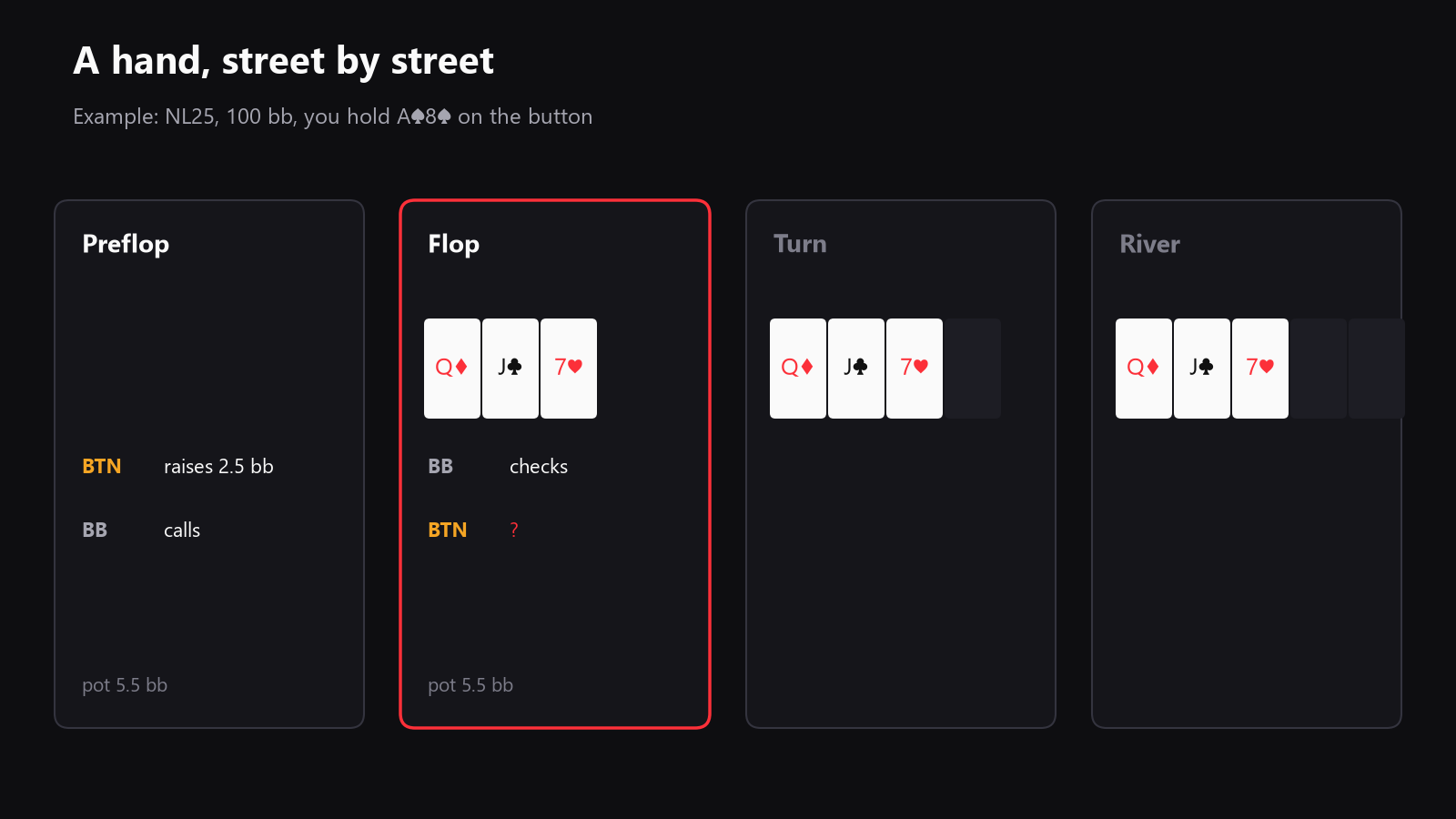
A strong example post
Here is what a good hand post can look like:
```text Game: $10 NL cash Hero: 120 bb Villain: 98 bb effective Hero is on the cutoff, Villain is on the big blind
Preflop: Hero opens to 2.2 bb. Villain calls.
Flop: J♠ 8♦ 4♣ (5.1 bb) Villain checks. Hero bets 1.7 bb. Villain calls.
Turn: 2♥ (8.5 bb) Villain checks. Hero checks back.
River: Q♣ (8.5 bb) Villain bets 6 bb.
Reads: Villain is a regular, folds a lot to flop c-bets, but seems to reach river with one-pair hands.
Question: Is this river a call, and would a different flop size make the hand easier to play? ```
That hand gives people enough information to think properly.
It is specific, structured, and focused on the decision that matters.
What to do before posting, if you want better answers
Before you share the hand, take a minute and ask yourself:
- What ranges arrive here?
- What is villain likely doing with missed draws, weak pairs, and value hands?
- What size gives me the best fold equity or the best price?
- Which street changed the hand the most?
- Where did my range become capped, if it did?
Even a short self-review will improve the quality of the post.
And if you already keep your hands in a tracker, it becomes easier to revisit the hand, replay it street by street, and extract the exact spot you want to ask about.
If you also use a study tool like the Coach or Sparring modules, you can turn that same hand into a more structured question about your own game, instead of guessing from memory.
FAQ
What is the best way to share a poker hand online?
Use a clear street-by-street format, include stack sizes, positions, action sizes, and ask one specific question.
Should I include my hole cards?
Yes, if they matter to the decision. But do not start with the showdown. Show the line first.
Can I post only the river?
Usually not. The earlier streets often define the river decision.
What if I do not know the villain?
Say so. Unknown opponent is still useful information.
What if the hand was live?
Reconstruct it as accurately as you can, with positions, sizes, and action order. If something is uncertain, say that clearly.
What if I want advice on a tournament hand?
Add blind level, ante, stack depths, payout structure, and ICM context if relevant.
Final takeaway
If you want useful poker advice, do not just share a hand.
Share it in a way that can be analyzed.
That means:
- full context
- clean formatting
- one precise question
- no result bias
- no missing stack sizes
- no vague reads
When you do that, the quality of the feedback changes immediately.
And over time, you will also get better at reviewing your own decisions, which is usually the biggest edge of all.
Do it on your own hands.