
If you want to improve at poker, reading theory is not enough. Theory helps you understand why a play works, but drills teach you to find the play when the clock is running and the pot is real. That is why the best off-table poker study is not passive reading. It is decision training.
The goal is simple: turn a spot into a reflex you can trust.
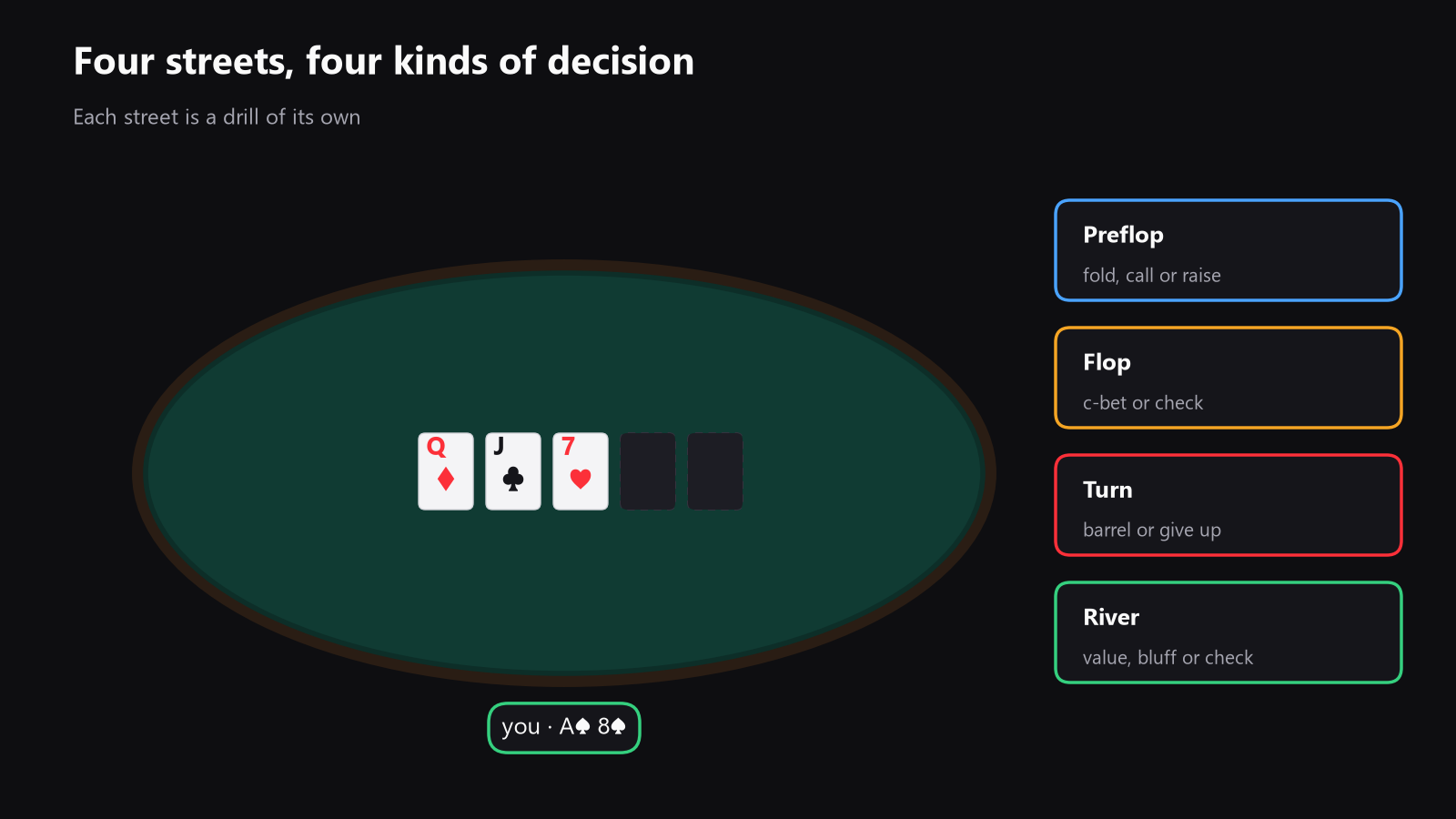
Why drilling beats reading
When you read poker theory, you often understand more than you can use. You recognize the concept, then the same spot appears in a hand and your mind is slower than you expected.
Drilling works better because it asks for a decision, not just recognition.
That matters for three reasons:
- You retrieve the answer instead of rereading it. Retrieval is harder than recognition, which is exactly why it sticks.
- You train the trigger, not just the idea. You do not want to remember that a spot is important. You want to know what to do before the action reaches you.
- You can measure improvement. A drill should become easier, faster, and more accurate. If it does not, it was probably too vague.
A good drill has a clear spot, a clear decision, and a clear reason for the answer. If the spot is fuzzy, the session becomes homework. If the answer is fuzzy, you are just entertaining yourself.
The drills that work best
Not every poker study format is equally useful. Some drills build habits you will actually use at the table.
1. Preflop ranges
Preflop is the easiest place to start because the decision tree is small enough to repeat often.
A useful preflop drill should look like this:
- one position,
- one stack depth,
- one open size,
- one response, such as fold, call, or 3-bet.
That is where a 13x13 starting hand grid helps. You are not trying to memorize a giant chart in one sitting. You are training pattern recognition.
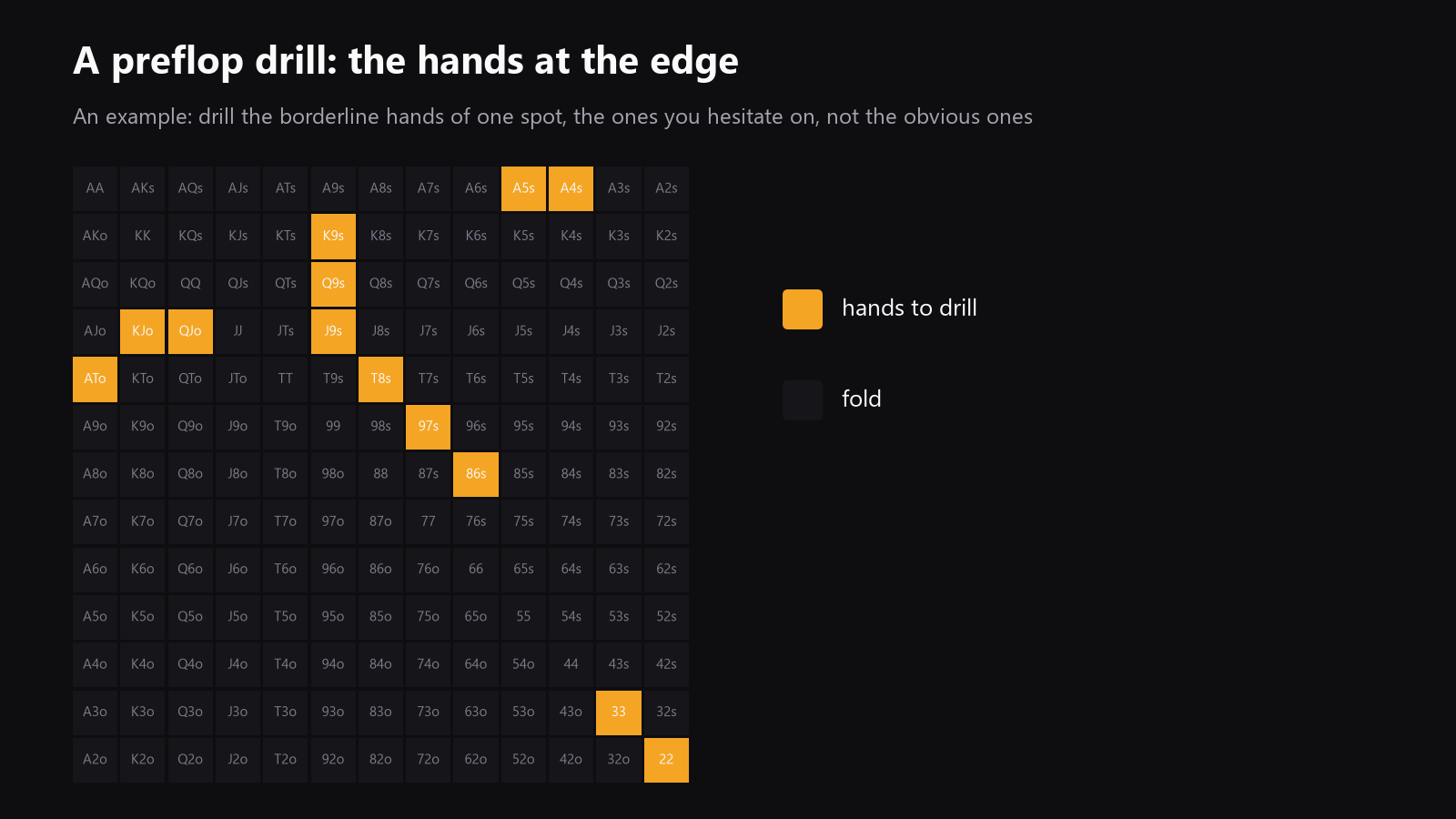
A strong preflop drill is not about reciting every combo. It is about seeing the shape of the range quickly:
- broadways play differently from suited connectors,
- blockers change your 3-bet choices,
- stack depth changes the value of speculative hands,
- position changes everything.
A simple way to practice is to cover the answer, name your action out loud, then reveal the solution. Repeat the same family of spots until you stop hesitating.
2. Push/fold
Push/fold is one of the best drills in poker because the decision is clean. You are short, the stack sizes are small, and the answer is often binary.
That makes it perfect for rapid repetition.
When you practice push/fold, do not just ask, “Is this a shove or a fold?” Ask:
- What are the stack sizes?
- What is the risk?
- What does the hand do when called?
- How wide should the range be against this opponent or this blind level?
If you use Poker Exploit, the Decisions module gives push, fold, or call instantly, which makes it useful for a quick warm-up or a fast check of your logic.
3. Facing a bet
This is one of the most valuable drills because many players guess here instead of calculating.
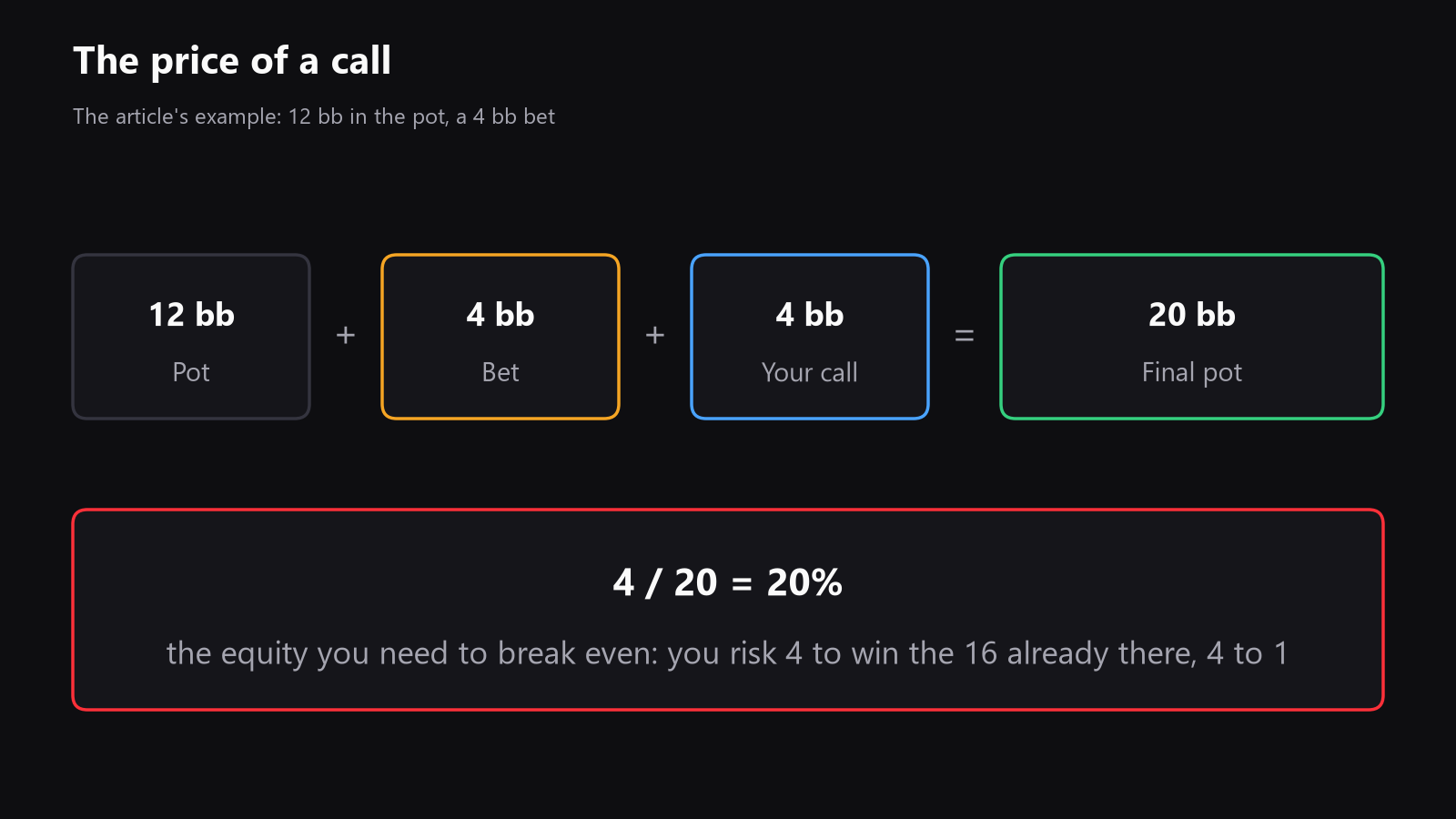
The first thing to train is the price. If the pot is 12 bb and your opponent bets 4 bb, you risk 4 bb to win 16 bb; after your call the pot is 20 bb, so your break-even equity is:
4 / 20 = 20%
That is the break-even point if the hand ended now; future streets (implied odds), position and how well you realise your equity move it up or down.
A good facing-a-bet drill should always include:
- the pot size,
- the bet size,
- the price to call,
- the equity needed,
- and, when relevant, whether your hand realizes equity well or poorly.
If you want this skill to become automatic, do not stop at the math. After you calculate the required equity, ask why the hand can actually win. Maybe your draw has strong blockers. Maybe your top pair is ahead of the opponent’s betting range. Maybe your hand is too weak to continue even if the price looks tempting.
That extra step is what turns arithmetic into poker judgment.
4. C-bet spots
Continuation-bet spots are ideal for structured drilling because they connect range, board texture, and position.
A useful c-bet drill should keep the setup fixed:
- same preflop action,
- same board,
- same stack depth,
- same position.
Then you decide:
- check or bet,
- if bet, what size,
- and why.
Good boards to study include:
- dry A-high boards,
- paired boards,
- connected low boards,
- monotone boards.
Each class behaves differently. On some boards, your range advantage is large and a small bet works well. On others, checking protects your range and keeps your weaker hands from overcommitting. The point of the drill is not to memorize a magic rule. The point is to learn what changes the strategy.

The Solver module is helpful here because it shows the equilibrium answer for one spot. But the drill itself should still be about your decision first. You want to be able to guess the line before you look.
Drill your own real spots, not generic ones
Generic spots are fine when you are learning the basics. Real spots are better when you want the training to transfer to your tables.
Why?
Because your leaks are not random. They tend to cluster:
- in certain positions,
- against certain stack depths,
- in some bet sizes,
- or in a few recurring board textures.
If you keep drilling generic examples, you may get better at poker in theory and still miss the exact spots that cost you money.
That is why it is better to drill your own hand histories whenever you can. The spot that cost you most is the spot worth studying first.
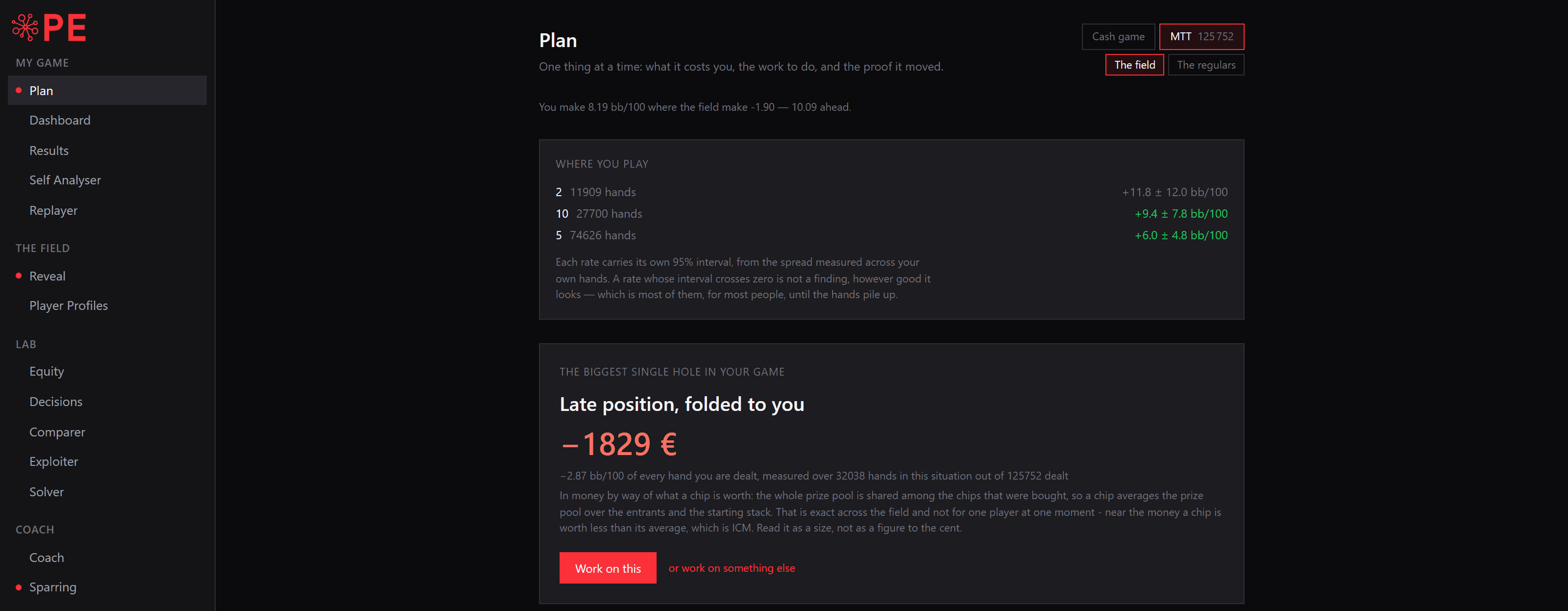
If you use Poker Exploit, the Sparring module is built for that. It can pull real spots from your own hands by family, including preflop, postflop, facing a bet, deep stacks, and push/fold. It can also start from the leak that costs you the most, which keeps the work focused instead of random.
Use spaced repetition, not one-and-done study
If you miss a spot once, that is not a reason to move on forever. It is a reason to bring it back later.
Spaced repetition works because weak memories fade quickly, then return stronger when you test them again. In poker terms, that means you should revisit the decisions that cost you most after a couple of days, then again later.
A simple repetition cycle looks like this:
- first exposure,
- short review soon after,
- second review a few days later,
- another review after more hands or more sessions.
That is much better than marathon study sessions that feel productive but disappear by the next weekend.
The best repetition target is not “everything I saw today.” It is the spot that actually leaked money. That is where repetition matters.
Keep your sessions short
A good drill session is short enough that your attention stays sharp.
For many players, 10 to 20 minutes is enough. Or 15 to 30 decisions in one family of spots. Once your speed drops, stop. When you are tired, you are no longer training recall, you are training fatigue.
Short sessions work because they are easier to repeat. One short session three or four times a week beats one huge session that you dread repeating.
A good rule is this: end before you start answering by habit instead of thought.
How to know the drill changed your play
The real test is not whether the session felt smart. The real test is whether your play changed at the tables.
Check for three things:
1. Your decision frequency moved
If you used to overfold a spot and now you continue more often, that is a sign the drill transferred.
2. Your decisions got faster
If the answer appears sooner, your pattern recognition is improving.
3. Your results or leak report changed over enough hands
A single session is not enough. You need enough hands for the trend to mean something.
This is where a tracker and review tools help. The Dashboard and Results screens show how your results evolve, and the Self Analyser helps you see whether a situation is still a leak or has started to normalize.

If you want to be strict about it, compare before and after in the same spot, not just your overall win rate. Your overall win rate is slow to move. A specific frequency in a specific spot can move much sooner.
A simple off-table routine you can actually keep
If you want a study routine that lasts, keep it simple:
- Pick one spot family.
- Review a short set of decisions.
- Say your answer before you reveal the solution.
- Write down why the answer works.
- Bring the same leak back a few days later.
- Check the spot at the tables after enough new hands.
That is enough to get started.
If you want generic study, you can read theory all day. If you want to change what you do in real pots, you need drills that force you to decide. The smaller the spot, the more repeatable it becomes. The more repeatable it becomes, the more it turns into a habit.
And if you want those drills built from your own hands instead of from a random example, that is exactly what the Sparring module is for.
Do it on your own hands.